
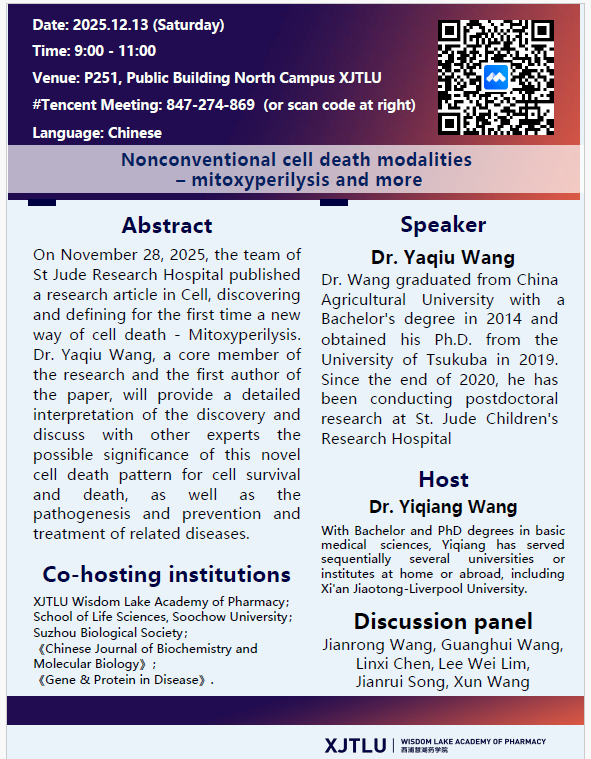
On November 28, 2025, the prestigious journal Cell published a landmark study from St. Jude Children’s Research Hospital that introduced -----Mitoxyperilysis, a novel lytic form of regulated cell death driven by mitochondrial oxidative stress and innate immune activation. The discovery has rapidly captured global attention, resonating not only across academic circles but also among younger scientific communities on social platforms such as Xiaohongshu (Little Red Book).
In response to this emerging paradigm shift in cell biology, Xi’an Jiaotong-Liverpool University (XJTLU) School of Pharmaceutical Sciences, in collaboration with Soochow University School of Medicine, Suzhou Society for Biological Sciences, Chinese Journal of Biochemistry and Molecular Biology, and Gene & Protein in Disease (GPD), convened a dedicated symposium titled “Mitoxyperilysis: A New Mode of Cell Death” on December 13, 2025. The event drew over 540 participants online from diverse disciplines including molecular biology, immunology, pharmacology, oncology, and systems medicine.
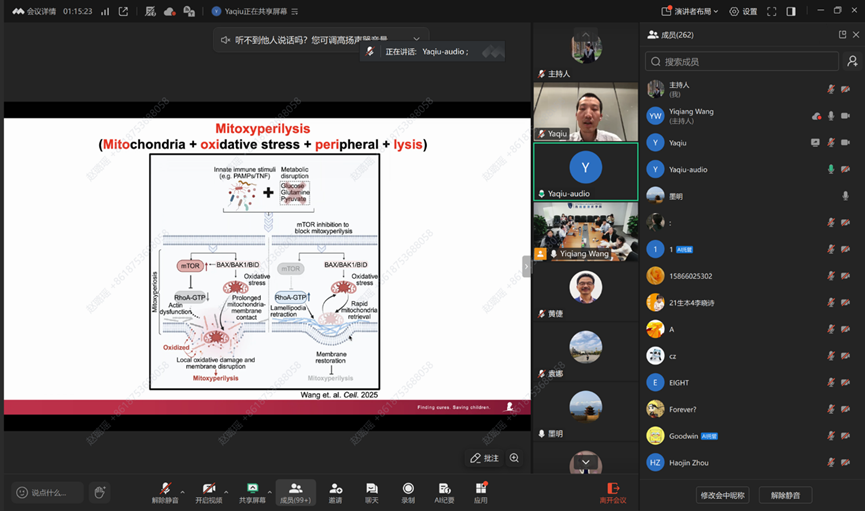
The symposium featured a keynote lecture by Dr. Yaqiu WANG, first author of the Cell paper, who presented “Nonconventional Cell Death Modalities – Mitoxyperilysis and Beyond.” Dr. Wang elucidated the experimental framework and mechanistic underpinnings of mitoxyperilysis, demonstrating how innate immune signaling combined with carbon-source deprivation triggers glutathione depletion and mitochondrial oxidative stress. Under conditions dependent on BAX, BAK1, and BID, damaged mitochondria establish aberrant, persistent contacts with the plasma membrane via mTORC2-mediated regulation. Due to the short half-life and localized production of reactive oxygen species (ROS), this spatial proximity results in focal, intense oxidative damage to the plasma membrane, culminating in membrane rupture, cytoplasmic leakage, and lytic cell death.
This mechanism distinguishes mitoxyperilysis from established pathways—including apoptosis, pyroptosis, necroptosis, ferroptosis, and PANoptosis—while offering a new conceptual framework for understanding cell fate under conditions of metabolic-immune crosstalk.
A vibrant panel discussion followed, featuring distinguished experts:
Prof. Jianrong Wang (Tang Zhongying Medical Research Institute, Soochow University), an authority on autophagy; Prof. Guanghui Wang (School of Pharmacy, Soochow University), specializing in neuropharmacology; Prof. Linxi Chen (School of Pharmacy, University of South China), known for Golgi-phagy research; Dr. Xun Wang (Suzhou Institute of Systems Medicine, CAMS), a mitochondrial biologist; Prof. Xinliang Mao (Guangzhou Medical University), an expert in tumor pathophysiology; and XJTLU faculty members Dr. Lee Wei Lim, Dr. Weiwei Dai, Dr. Jianrui Song, Dr. Yuanjun Sun, and Dr. Jinxin Gu.
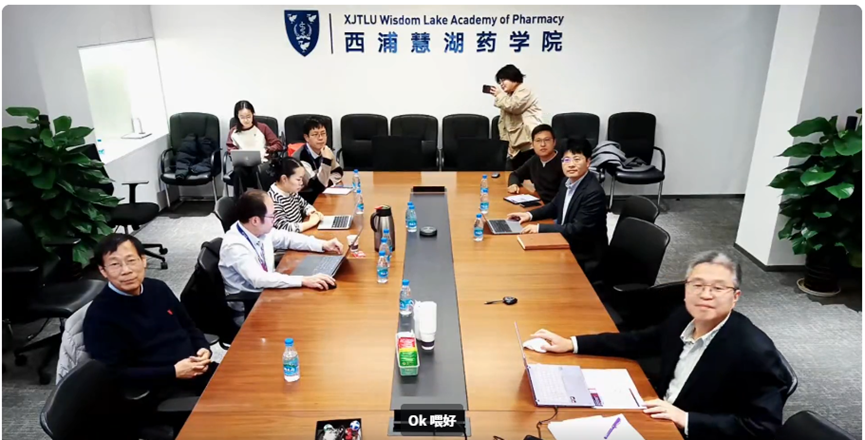
The panel explored critical questions regarding: Cross-talk between mitoxyperilysis and other cell death pathways; Potential involvement of non-mitochondrial organelles; Induction by stressors beyond inflammation or nutrient deprivation; Relevance in non-immune cell types and non-oncological diseases (e.g., neurodegeneration, metabolic disorders).
Dr. Wang responded comprehensively to numerous audience inquiries, including technical aspects of the experimental models.
In closing remarks, Prof. Yiqiang Wang, GPD Editorial Board Member and symposium organizer, emphasized the event’s dual significance: it not only facilitated international scholarly exchange but also provided early-career researchers and students with direct access to frontier science. “Such dialogues are essential for nurturing the next generation of interdisciplinary scientists,” he noted.
This symposium exemplifies GPD’s ongoing commitment to promoting timely discourse on transformative discoveries at the interface of genomics, proteostasis, and disease mechanisms. As a platform dedicated to high-impact, cross-disciplinary research, GPD continues to support the global scientific community through knowledge dissemination, editorial excellence, and active engagement with emerging research frontiers.