

Designing artificial intelligence-driven knowledge governance frameworks for public sector digital transformation

The rapid adoption of artificial intelligence (AI) in the public sector is reshaping how governments design policies, deliver services, and manage institutional knowledge. However, AI integration in digital governance often remains fragmented, with limited design-oriented frameworks that connect technological capabilities, knowledge management, and governance processes. This study addresses this gap by proposing an AI-driven knowledge governance framework for public sector digital transformation, explicitly aligned with system design principles and socio-technical architecture. Drawing on interdisciplinary perspectives from digital governance, knowledge management, information systems, and design research, the paper develops a structured framework incorporating data ecosystems, organizational memory, intelligent decision-support systems, and governance feedback loops. The study further presents design methods for integrating AI into public administration, including system architecture, workflow alignment, and visualized governance outputs that enhance transparency, accountability, and decision intelligence. Special attention is given to emerging economies, where institutional constraints, limited data infrastructure, and governance capacity gaps create unique implementation challenges. Ethical AI use, explainability, trust, and responsible automation are also examined as essential design requirements. By bridging AI innovation with governance design, the paper contributes a practical and scalable model for building inclusive, knowledge-driven, and resilient digital public sector systems.
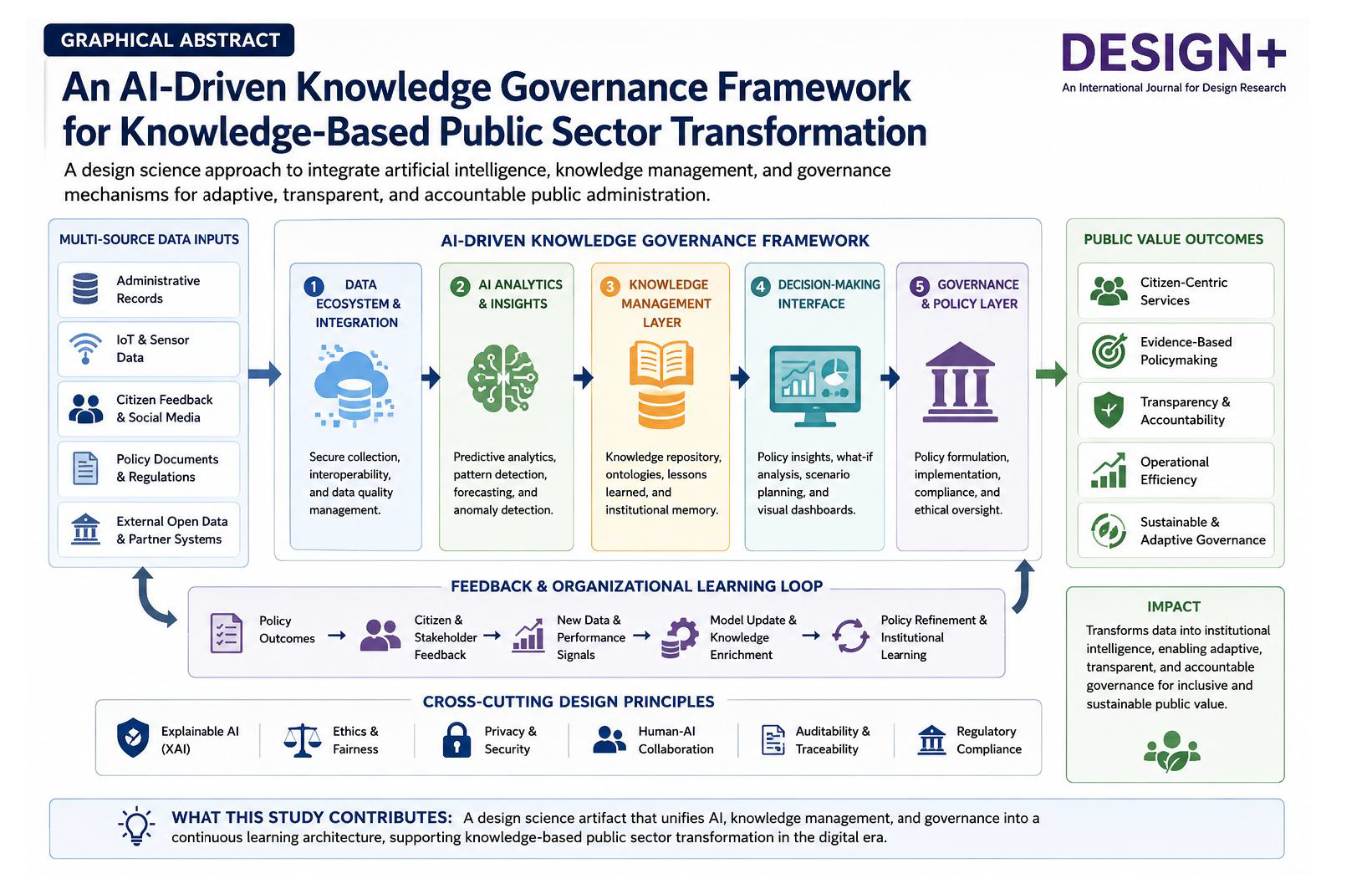
- Mergel I, Edelmann N, Haug N. Defining digital transformation: Results from expert interviews. Gov Inf Q. 2019;36(4):101385. doi: 10.1016/j.giq.2019.06.002
- United Nations Publications. United Nations E-Government Survey 2022. Department of Economic and Social Affairs (UN DESA); 2022. Accessed July 15, 2026. https://publicadministration.un.org/egovkb/en-us/reports/un-e-government-survey-2022
- Wirtz BW, Weyerer JC, Geyer C. Artificial Intelligence and the Public Sector—Applications and Challenges. Int J Public Adm. 2019;42(7):596-615. doi: 10.1080/01900692.2018.1498103
- Kuziemski M, Misuraca G. AI governance in the public sector: Three tales from the frontiers of automated decision-making in democratic settings. Telecommun Policy. 2020;44(6):101976. doi: 10.1016/j.telpol.2020.101976
- Sun TQ, Medaglia R. Mapping the Challenges of Artificial Intelligence in the Public sector: Evidence from Public Healthcare. Gov Inf Q. 2019;36(2):368-383. doi: 10.1016/j.giq.2018.09.008
- Dalkir k. Knowledge Management in Theory and Practice. 3rd ed. Cambridge, MA, USA: MIT Press; 2017.
- Alavi M, Leidner DE. Review: Knowledge Management and Knowledge Management Systems: Conceptual Foundations and Research Issues. MIS Q. 2001;25(1):107-136. doi: 10.2307/3250961
- Janssen M, van der Voort H, Wahyudi A. Factors influencing big data decision-making quality. J Bus Res. 2017;70:338-345. doi: 10.1016/j.jbusres.2016.08.007
- Zuiderwijk A, Chen YC, Salem F. Implications of the Use of Artificial Intelligence in Public governance: a Systematic Literature Review and a Research Agenda. Gov Inf Q. 2021;38(3):101577. doi: 10.1016/j.giq.2021.101577
- Choi H, Min Jae Park. To govern or be governed: an integrated framework for AI governance in the public sector. Sci Public Policy. 2023;50(6):1059-1072. doi: 10.1093/scipol/scad045
- Tan E. Designing an AI compatible open government data ecosystem for public governance. Inf Polity 2023;28(4):541-557. doi: 10.3233/ip-220020
- Gil-Garcia JR, Zhang J, Puron-Cid G. Conceptualizing smartness in government: An integrative and multi-dimensional view. Gov Inf Q. 2016;33(3):524-534. doi: 10.1016/j.giq.2016.03.002
- Radu R. Steering the governance of artificial intelligence: national strategies in perspective. Policy Soc. 2021;40(2):178-193. doi: 10.1080/14494035.2021.1929728
- Wirtz BW, Weyerer JC, Kehl I. Governance of artificial intelligence: A risk and guideline-based integrative framework. Gov Inf Q. 2022;39(4):101685. doi: 10.1016/j.giq.2022.101685
- Mehr H. Artificial Intelligence for Citizen Services and Government. Ash Center for Democratic Governance and Innovation, Harvard Kennedy School, Harvard University; 2017. Accessed July 15, 2026. https://ash.harvard.edu/wp-content/uploads/2024/02/artificial_intelligence_for_citizen_services.pdf
- Russell S, Norvig P. Artificial Intelligence: A Modern Approach. 4th ed. Hoboken, NJ, USA: Pearson; 2020.
- Hevner A, March S, Park J, Ram S. Design Science in Information Systems Research. MIS Q. 2004;28(1):75-106. doi: 10.2307/25148625
- Peffers K, Tuunanen T, Rothenberger MA, Chatterjee S. A Design Science Research Methodology for Information Systems Research. J Manag Inf Syst. 2007;24(3):45-77. doi: 10.2753/mis0742-1222240302
- Grant RM. Toward a Knowledge-Based Theory of the Firm. Strateg Manag J. 1996;17(S2):109-122. doi: 10.1002/smj.4250171110
- Bostrom RP, Heinen JS. MIS Problems and Failures: A Socio-Technical Perspective. Part I: The Causes. MIS Q. 1977;1(3):17-32. doi: 10.2307/248710
- Jasanoff S, Kim SH, eds. Dreamscapes of Modernity: Sociotechnical Imaginaries and the Fabrication of Power. Chicago, IL, USA: The University of Chicago Press; 2015.
- Kitchin R. The Data Revolution: Big Data, Open Data, Data Infrastructures & Their Consequences. London, UK: SAGE; 2014. doi: 10.4135/9781473909472
- Adadi A, Berrada M. Peeking Inside the Black-Box: A Survey on Explainable Artificial Intelligence (XAI). IEEE Access. 2018;6:52138-52160. doi: 10.1109/access.2018.2870052
- Arrieta AB, Díaz-Rodríguez N, Del Ser J, et al. Explainable Artificial Intelligence (XAI): Concepts, taxonomies, Opportunities and Challenges toward Responsible AI. Inf Fusion. 2020;58(1):82-115. doi: 10.1016/j.inffus.2019.12.012
- Doshi-Velez F, Kim B. Towards a rigorous science of interpretable machine learning. arXiv. Preprint posted online 2017. doi: 10.48550/arXiv.1702.08608
- Wiener N. Cybernetics: Or Control and Communication in the Animal and the Machine. Cambridge, MA, USA: MIT Press; 1948.
- Argyris C, Schön DA. Organizational Learning: A Theory of Action Perspective. Reading, MA, USA: Addison-Wesley; 1978.
- Folke C, Hahn T, Olsson P, Norberg J. Adaptive governance of social-ecological systems. Annu Rev Environ Resour. 2005;30(1):441-473. doi: 10.1146/annurev.energy.30.050504.144511