

Participatory temporal urbanism: Reimagining participatory design, place evolution, and sustainable cities

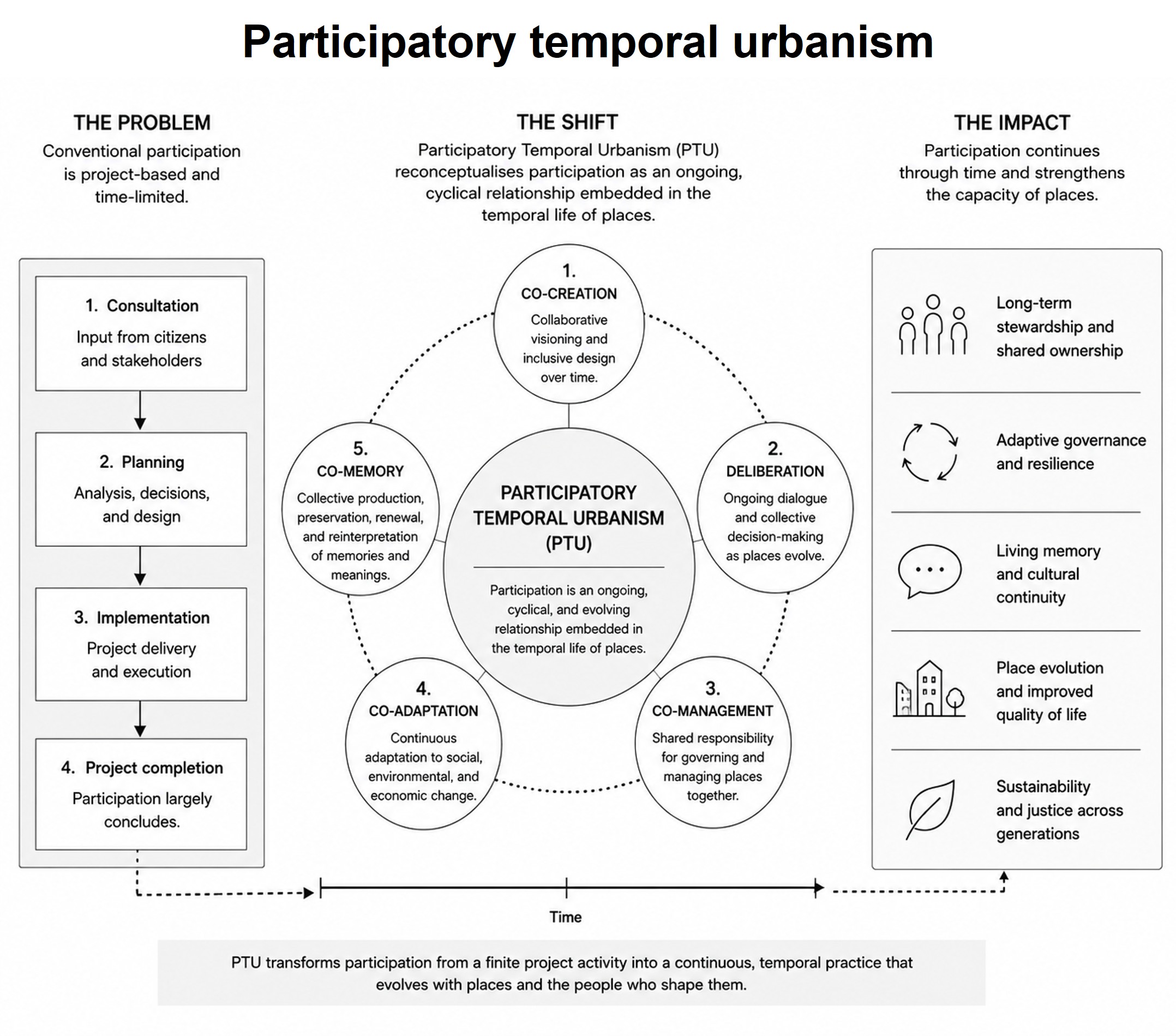
Public participation has long occupied a central position within planning and design theory. From Arnstein’s seminal work on citizen participation to collaborative planning, co-production, and contemporary participatory design approaches, scholars and practitioners have increasingly recognized the importance of involving citizens and users in shaping urban environments. Despite these advances, participation continues to be understood predominantly as an episodic and project-based activity associated with specific interventions, workshops, or consultation processes. Relatively limited attention has been devoted to the temporal dimensions of participation and to how users, places, meanings, and needs evolve over time. This study argues that time remains one of the least-explored dimensions of participatory planning and design. Building on literature from planning theory, participatory design, commons scholarship, care studies, and emerging work on temporality, the study proposes participatory temporal urbanism as a conceptual framework for understanding participation as an ongoing and evolving relationship rather than as a discrete event. The framework introduces five interrelated dimensions: co-creation, deliberation, co-management, co-adaptation, and co-memory. Drawing on concepts such as stewardship, commoning, maintenance, and care, the study further argues that sustainable urban development requires forms of participation that extend beyond implementation and continue throughout the life cycle of places. Particular attention is given to deliberative approaches, including the jury principle associated with New Urbanism, and to the role of participatory design in accommodating changing social, cultural, and intergenerational needs. By introducing time as a central analytical category, the study contributes to ongoing debates on participatory planning and participatory design and offers a new framework for understanding the collective processes through which sustainable cities can be collectively shaped, maintained, and continuously reinterpreted over time.
- Arnstein SR. A ladder of citizen participation. J Am Inst Plan. 1969;35(4):216-224. doi: 10.1080/01944366908977225
- Healey P. Collaborative Planning: Shaping Places in Fragmented Societies. London, UK: Macmillan Education; 1997. doi: 10.1007/978-1-349-25538-2
- Innes JE, Booher DE. Reframing public participation: Strategies for the 21st century. Plan Theory Pract. 2004;5(4):419-436. doi: 10.1080/1464935042000293170
- Sanoff H. Community Participation Methods in Design and Planning. Hoboken, New Jersey, USA: John Wiley & Sons; 2000.
- Jacobs J. The Death and Life of Great American Cities. New York, NY, USA: Random House; 1961.
- Sennett R. Building and Dwelling: Ethics for the City. New York, NY, USA: Farrar, Straus and Giroux; 2018.
- Mattern S. A City Is Not a Computer: Other Urban Intelligences. Princeton, New Jersey, USA: Princeton University Press; 2021. doi: 10.2307/j.ctv1h9dgtj.6
- de la Bellacasa MP. Matters of Care: Speculative Ethics in More Than Human Worlds. Minneapolis, Minnesota, USA: University of Minnesota Press; 2017.
- Rosa H. Social Acceleration: A New Theory of Modernity. New York, NY, USA: Columbia University Press; 2013.
- Sharma S. In the Meantime: Temporality and Cultural Politics. Durham, North Carolina, USA: Duke University Press; 2014.
- Lindblom CE. The science of “muddling through.” Public Adm Rev. 1959;19(2):79-88. doi: 10.2307/973677
- Davidoff P. Advocacy and pluralism in planning. J Am Inst Plan. 1965;31(4):331-338. doi: 10.1080/01944366508978187
- Friedmann J. Planning in the Public Domain: From Knowledge to Action. Princeton, New Jersey, USA: Princeton University Press; 1987. doi: 10.2307/j.ctv10crf8d
- Lukes S. Power: A Radical View. In: Power. London, UK: Macmillan Education; 2005:14-59. doi: 10.1007/978-0-230-80257-5_2
- Flyvbjerg B. Rationality and Power: Democracy in Practice. Chicago, Illinois, USA: University of Chicago Press; 1998.
- Tritter JQ, McCallum A. The snakes and ladders of user involvement: Moving beyond Arnstein. Health Policy. 2006;76(2):156-168. doi: 10.1016/j.healthpol.2005.05.008
- Yiftachel O. Planning and social control: Exploring the dark side. J Plan Lit. 1998;12(4):395-406. doi: 10.1177/088541229801200401
- Forester J. Planning in the Face of Power. Berkeley, California, USA: University of California Press; 1988.
- Cars G. Förhandlingar mellan privata och offentliga aktörer i samhällsbyggandet [Negotiations Between Private and Public Actors in Urban Development]. Doctoral dissertation. KTH Royal Institute of Technology; 1992.
- Hillier J. ‘Agon’izing over consensus: Why Habermasian ideals cannot be ‘real’. Plan Theory. 2003;2(1):37-59. doi: 10.1177/1473095203002001005
- Ehn P. Work-Oriented Design of Computer Artifacts. Stockholm, Sweden: Arbetslivscentrum; 1988.
- Sanders EBN, Stappers PJ. Co-creation and the new landscapes of design. CoDesign. 2008;4(1):5-18. doi: 10.1080/15710880701875068
- Manzini E. Design, When Everybody Designs: An Introduction to Design for Social Innovation. Cambridge, Massachusetts, USA: MIT Press; 2015.
- Björgvinsson E, Ehn P, Hillgren PA. Design things and design thinking: Contemporary participatory design challenges. Des Issues. 2012;28(3):101-116. doi: 10.1162/desi_a_00165
- Lennertz B, Lutzenhiser A. The Charrette Handbook: The Essential Guide for Accelerated, Collaborative Community Planning. Chicago, Illinois, USA: American Planning Association; 2006.
- Lennertz B, Lutzenhiser A. The Charrette Handbook. 2nd ed. Routledge; 2014.
- Duany A, Plater-Zyberk E, Speck J. Suburban Nation: The Rise of Sprawl and the Decline of the American Dream. New York, NY, USA: North Point Press; 2000.
- Ostrom E. Governing the Commons: The Evolution of Institutions for Collective Action. Cambridge, UK: Cambridge University Press; 1990.
- Bollier D. Think Like a Commoner: A Short Introduction to the Life of the Commons. Gabriola Island, Canada: New Society Publishers; 2014.
- Folke C, Hahn T, Olsson P, Norberg J. Adaptive governance of social-ecological systems. Annu Rev Environ Resour. 2005;30(1):441-473. doi: 10.1146/annurev.energy.30.050504.144511
- Armitage DR, Plummer R, Berkes F, et al. Adaptive co-management for social-ecological complexity. Front Ecol Environ. 2008;7(2):95-102. doi: 10.1890/070089
- Dempsey N, Burton M. Defining place-keeping: The long-term management of public spaces. Urban For Urban Green. 2012;11(1):11-20. doi: 10.1016/j.ufug.2011.09.005
- Gabauer A, Knierbein S, Cohen N, et al. Care and the City. New York, USA: Routledge; 2021. doi: 10.4324/9781003031536
- Davis J. The Caring City: Ethics of Urban Design. Bristol, UK: Bristol University Press; 2022. doi: 10.2307/j.ctv2jtxrfc
- Lefebvre H. Rhythmanalysis: Space, Time and Everyday Life. London, UK: Continuum; 2004.
- Adam B. Timescapes of Modernity: The Environment and Invisible Hazards. New York, USA: Routledge; 1998.
- Sheller M. Mobility Justice: The Politics of Movement in an Age of Extremes. Verso; 2018.
- Amin A. Land of Strangers. Identities. 2013;20(1):1-8. doi: 10.1080/1070289x.2012.732544
- Lydon M, Garcia A. Tactical Urbanism: Short-Term Action for Long-Term Change. Washington, DC, USA: Island Press/Center for Resource Economics; 2015. doi: 10.5822/978-1-61091-567-0
- Bishop P, Williams L. The Temporary City. New York, USA: Routledge; 2012.
- Preiser WFE, Rabinowitz HZ, White ET. Post-Occupancy Evaluation. New York, USA: Van Nostrand Reinhold; 1988.
- Haas T. Designing the dialectic: A rejoinder to “Ideology, science and the New Urban Design—Critique and evolution.” J Urban Des. 2025;30(6):715-723. doi: 10.1080/13574809.2025.2593165
- Halbur T. Andrés Duany wants to reform the public process. Planetizen. 2010. Accessed July 9, 2026. https://www.planetizen.com/node/43935
- Lind D. Control the masses: Andrés Duany. Architect Magazine. 2011. Accessed July 9, 2026. https://www.architectmagazine.com/design/urbanism-planning/control-the-masses-andres-duany_o
- Foster SR, Iaione C. The city as a commons. Yale Law Policy Rev. 2016;34(2):281-349.
- Watson V. Seeing from the South: Refocusing urban planning on the globe’s central urban issues. Urban Studies. 2009;46(11):2259-2275. doi: 10.1177/0042098009342598
- Miraftab F. Insurgent planning: Situating radical planning in the Global South. Plan Theory 2009;8(1):32-50. doi: 10.1177/1473095208099297