

Uncertainty estimation of breast cancer classification using deep learning methods with explainable artificial intelligence

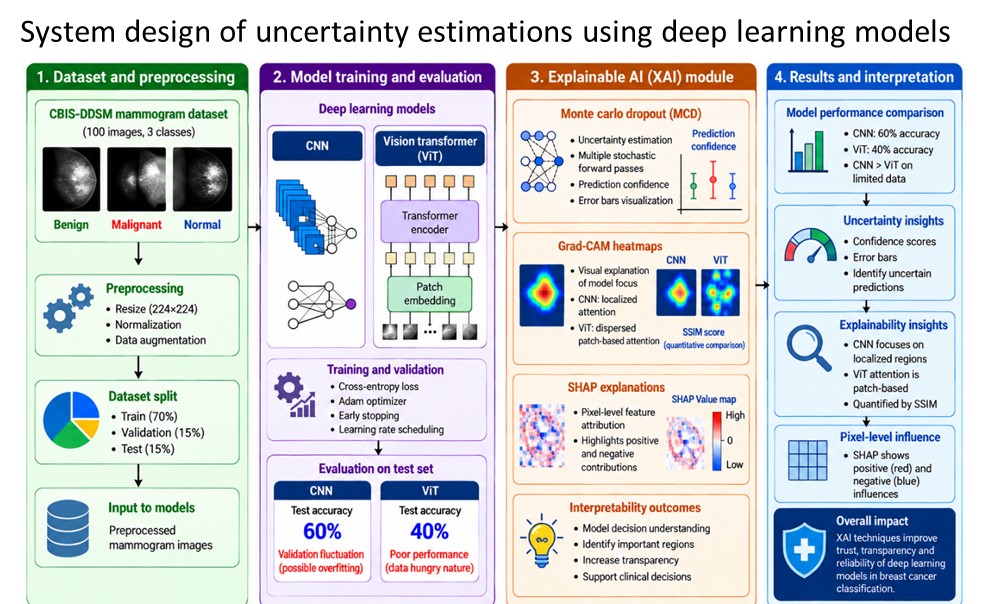
Globally, breast cancer-related mortality among women requires early and precise diagnostic support to improve patient outcomes. The existing research work discusses using Machine learning and deep learning models for precise diagnosis with a combination of classified outcomes using various datasets. The proposed work focuses on uncertainty estimation of breast cancer using a deep learning framework with Explainable Artificial Intelligence (XAI) with the Curated Breast Imaging Subset of Digital Database for Screening Mammography Dataset. The novelty of the work is that it classifies breast cancer as benign, benign-without-callback, and malignant using a convolutional neural network (CNN) and a vision transformer (ViT), uncertainty estimation using Monte Carlo dropout, and gradient-weighted class activation mapping for visual localization of discriminative regions and SHapley Additive exPlanations for pixel-level feature importance to increase transparency as well as reliability. The consistency of the XAI maps produced by CNN and ViT has been examined quantitatively using the structural similarity index measure. The results show that ViT has more dispersed attention patterns, while CNN focuses more on isolated lesion sites. As a result, the proposed work supports clinical decision-making for precise breast cancer diagnosis, improves model interpretability, and supports uncertainty forecasting.
- Saharan S, Wani NA, Chatterji S, Kumar N, Almuhaideb AM. A deep learning and explainable artificial intelligence based scheme for breast cancer detection. Sci Rep. 2025;15(1):32125. doi: 10.1038/s41598-024-80535-7
- Karthiga R, Narasimhan K, Thanikaiselvan V, Hemalatha M, Amirtharajan R. Review of AI and XAI-based breast cancer diagnosis methods using various imaging modalities. Multimed Tools Appl. 2025;84(5):2209-2260. doi: 10.1007/s11042-024-20271-2
- Fatima M, Zia R, Usmani IA. A hybrid framework integrating deep learning and XAI for breast cancer detection with stratified cross-validation. Syst Soft Comput. 2025;7:200412. doi: 10.1016/j.sasc.2025.200412
- Arravalli T, Chadaga K, Muralikrishna H, et al. Detection of breast cancer using machine learning and explainable artificial intelligence. Sci Rep. 2025;15(1):26931. doi: 10.1038/s41598-025-12644-w
- Talukder MA. An improved XAI-based DenseNet model for breast cancer detection using reconstruction and fine-tuning. Results Eng. 2025;26:104802. doi: 10.1016/j.rineng.2025.104802
- Ahmmed J, Ahmed F, Kabir MA, et al. LBNet: an optimized lightweight CNN for mammographic breast cancer classification with XAI-based interpretability. Sci Rep. 2025;16(1):2013. doi: 10.1038/s41598-025-31642-6
- Manojee KS, Kannan AR. Patho-Net: enhancing breast cancer classification using deep learning and explainable artificial intelligence. Am J Cancer Res. 2025;15(2):754-768. doi: 10.62347/XKFN1793
- Singh SK, Patnaik KS. MammXAI: an XAI integrated adaptive multi-model deep learning approach for breast cancer detection using multi-modality images. Biomed Signal Process Control. 2026;113:109173. doi: 10.1016/j.bspc.2025.109173
- Tchokponhoue GAD, Idri A. On the value of uncertainty quantification in deep learning-based breast cancer molecular subtype classification. Appl Soft Comput. 2026;186:114249. doi: 10.1016/j.asoc.2025.114249
- Sabry M, Balaha HM, Ali KM, et al. AI-driven breast cancer diagnosis: a systematic review of imaging modalities, deep learning, and explainability. Cancers. 2026;18(8):1305. doi: 10.3390/cancers18081305
- Barseghyan S, Babajanyan A, Balyan Z, Asatryan A, Kumar S. Explainable AI for breast cancer risk prediction: evaluating the accuracy-explainability trade-off. Mach Learn Comput Sci Eng. 2025;1(2):25. doi: 10.1007/s44379-025-00028-w
- Bouallegue B, Abd El-Latif YM, El-Sofany H, Taj-Eddin IA, Vocaturo E. An enhanced approach for predicting breast cancer using different deep learning algorithms and explainable AI techniques in an IoT environment. Int J Intell Syst. 2025;2025(1):8884481. doi: 10.1155/int/8884481
- Ergün U, Çoban T, Kayadibi İ. BCECNN: an explainable deep ensemble architecture for accurate diagnosis of breast cancer. BMC Med Inform Decis Mak. 2025;25(1):374. doi: 10.1186/s12911-025-03186-2
- Ghasemi A, Hashtarkhani S, Schwartz DL, Shaban-Nejad A. Explainable artificial intelligence in breast cancer detection and risk prediction: a systematic scoping review. Cancer Innov. 2024;3(5):e136. doi: 10.1002/cai2.136
- Chai H, Lin S, Lin J, et al. An uncertainty-based interpretable deep learning framework for predicting breast cancer outcome. BMC Bioinformatics. 2024;25(1):88. doi: 10.1186/s12859-024-05716-7
- Hamedani-KarAzmoudehFar F, Tavakkoli-Moghaddam R, Tajally AR, Aria SS. Breast cancer classification by a new approach to assessing deep neural network-based uncertainty quantification methods. Biomed Signal Process Control. 2023;79:104057. doi: 10.1016/j.bspc.2022.104057
- Chegini M, Mahloojifar A. Uncertainty-aware deep learning-based CAD system for breast cancer classification using ultrasound and mammography images. Comput Methods Biomech Biomed Eng Imaging Vis. 2024;12(1):2297983. doi: 10.1080/21681163.2023.2297983
- Di Giammarco M, Vitulli C, Cirnelli S, et al. Explainable deep learning for breast cancer classification and localization. ACM Trans Comput Healthc. 2025;6(1):1-18. doi: 10.1145/3702237
- Alom MR, Farid FA, Rahaman MA, et al. An explainable AI-driven deep neural network for accurate breast cancer detection from histopathological and ultrasound images. Sci Rep. 2025;15(1):17531. doi: 10.1038/s41598-025-97718-5
- Murugan TK, Karthikeyan P, Sekar P. Efficient breast cancer detection using neural networks and explainable artificial intelligence. Neural Comput Appl. 2025;37(5):3759-3776. doi: 10.1007/s00521-024-10790-2
- Thiagarajan P, Khairnar P, Ghosh S. Explanation and use of uncertainty quantified by Bayesian neural network classifiers for breast histopathology images. IEEE Trans Med Imaging. 2021;41(4):815-825. doi: 10.1109/TMI.2021.3123300
- Fuentes-Fino R, Calderón-Ramírez S, Domínguez E, López-Rubio E, Elizondo D, Molina-Cabello MA. An uncertainty estimator method based on the application of feature density to classify mammograms for breast cancer detection. Neural Comput Appl. 2023;35(30):22151-22161. doi: 10.1007/s00521-023-08904-3
- López-Pérez M, Morales-Álvarez P, Cooper LA, Molina R, Katsaggelos AK. Deep Gaussian processes for classification with multiple noisy annotators: application to breast cancer tissue classification. IEEE Access. 2023;11:6922-6934. doi: 10.1109/ACCESS.2023.3237990
- Li J, Arefan D, Wu S. Uncertainty quantification for deep learning-based medical imaging classification model evaluation and individualized risk estimation. In: 2025 IEEE 7th International Conference on Trust, Privacy and Security in Intelligent Systems, and Applications (TPS-ISA). 2025:717-723. doi: 10.1109/TPS-ISA67132.2025.00088
- Kurz A, Hauser K, Mehrtens HA, et al. Uncertainty estimation in medical image classification: systematic review. JMIR Med Inform. 2022;10(8):e36427. doi: 10.2196/36427
- Tajally A, Zarean J, Bozorgi-Amiri A, Tavakkoli-Moghaddam R. Deep uncertainty quantification algorithms for confidence-aware hope classification of breast cancer patients based on their cognitive features. Appl Soft Comput. 2025;172:112860. doi: 10.1016/j.asoc.2025.112860
- Ayer T, Alagoz O, Chhatwal J, Shavlik JW, Kahn CE Jr, Burnside ES. Breast cancer risk estimation with artificial neural networks revisited: discrimination and calibration. Cancer. 2010;116(14):3310-3321. doi: 10.1002/cncr.25081
- Musah T, Kalaiwo C, Akram M, et al. Towards trustworthy breast tumor segmentation in ultrasound using Monte Carlo dropout and deep ensembles for epistemic uncertainty estimation. In: Lecture Notes in Computer Science. Springer Nature Switzerland; 2026:41-51. doi: 10.1007/978-3-032-13654-1_5
- Ali ZA, Sallow AB, Hassan MM. Bayesian deep learning with selective inference for uncertainty-aware breast ultrasound classification. J Radiat Res Appl Sci. 2026;19(2):102308. doi: 10.1016/j.jrras.2026.102308
- Zaheer Sajid M, Fareed Hamid M, Qureshi I. Explainable and uncertainty-aware ensemble framework with causal analysis for breast cancer detection. Front Oncol. 2025;15:1751090. doi: 10.3389/fonc.2025.1751090
- Joshi P, Dhar R. EpICC: a Bayesian neural network model with uncertainty correction for a more accurate classification of cancer. Sci Rep. 2022;12(1):14628. doi: 10.1038/s41598-022-18874-6
- Ünal S, Gürfidan R. Uncertainty-aware machine learning for predicting axillary lymph node metastasis using breast MRI. BCTT. 2026;18:1-19. doi: 10.2147/bctt.s599211
- Fooladgar F, Jamzad A, Connolly L, et al. Uncertainty estimation for margin detection in cancer surgery using mass spectrometry. Int J Comput Assist Radiol Surg. 2022;17(12):2305-2313. doi: 10.1007/s11548-022-02764-3
- Pflieger LT, Mason CC, Facelli JC. Uncertainty quantification in breast cancer risk prediction models using self-reported family health history. J Clin Transl Sci. 2017;1(1):53-59. doi: 10.1017/cts.2016.9
- Yao N, Hu H, Chen K, et al. A robust deep learning method with uncertainty estimation for the pathological classification of renal cell carcinoma based on CT images. J Imaging Inform Med. 2025;38(3):1323-1333. doi: 10.1007/s10278-024-01276-7
- Fordellone M, Chiodini P. Unsupervised hierarchical classification approach for imprecise data in breast cancer detection. Entropy. 2022;24(7):926. doi: 10.3390/e24070926
- Borquez S, Pezoa R, Salinas L, Torres CE. Uncertainty estimation in the classification of histopathological images with HER2 overexpression using Monte Carlo dropout. Biomed Signal Process Control. 2023;85:104864. doi: 10.1016/j.bspc.2023.104864
- Prabakaran I, Wu Z, Lee C, et al. Gaussian mixture models for probabilistic classification of breast cancer. Cancer Res. 2019;79(13):3492-3502. doi: 10.1158/0008-5472.CAN-19-0573
- Verboom SD, Kroes J, Broeders MJ, Sechopoulos I. Estimating deep learning model uncertainty of breast lesion classification to guide reading strategy in breast cancer screening. In: Medical Imaging 2024: Computer-Aided Diagnosis. Proceedings of SPIE; 2024;12927:467-472. doi: 10.1117/12.3006713
- Pocevičiūtė M, Eilertsen G, Jarkman S, Lundström C. Generalisation effects of predictive uncertainty estimation in deep learning for digital pathology. Sci Rep. 2022;12(1):8329. doi: 10.1038/s41598-022-11826-0