

Age-invariant functional retinal biomarkers for Alzheimer’s disease using adversarial deep learning

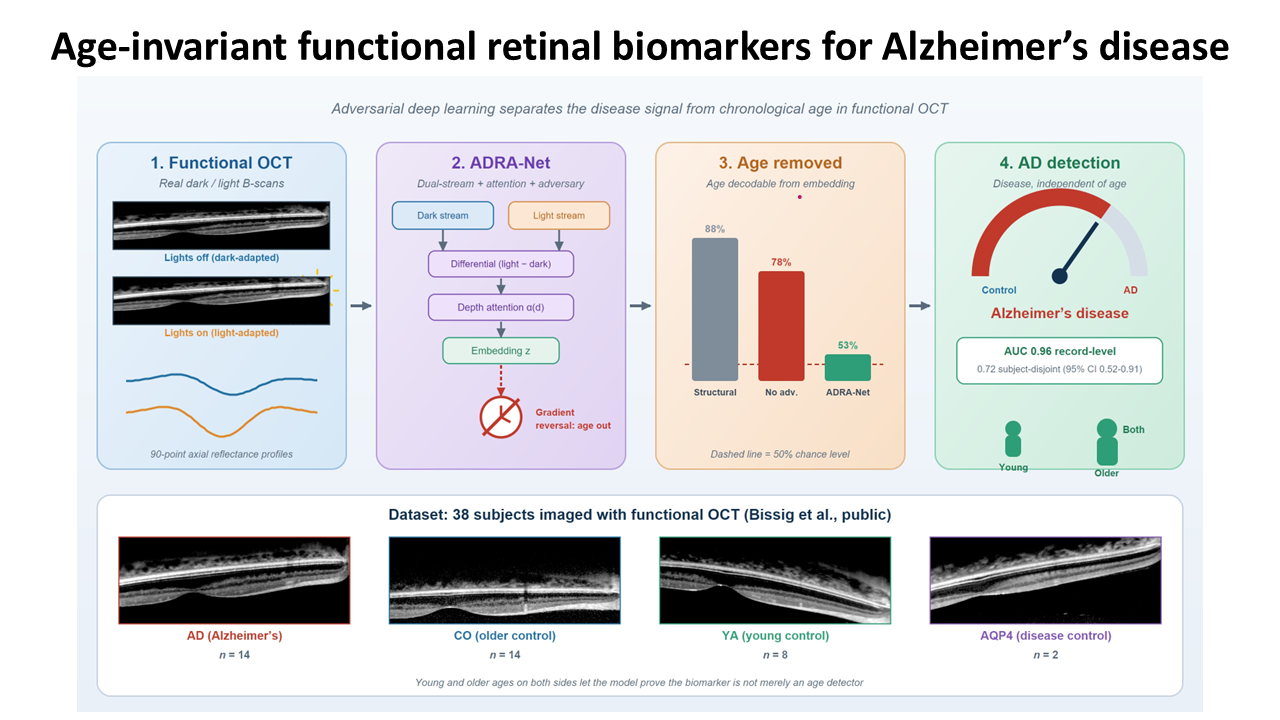
Structural retinal optical coherence tomography (OCT) markers of Alzheimer’s disease overlap with those of normal aging, which limits their diagnostic specificity. We investigate whether the light-dependent functional response of the retina can serve as a biomarker of Alzheimer’s disease that is largely independent of chronological age and propose a deep learning architecture that distinguishes the disease-related signal from the ageing-related signal. Using the publicly available Bissig functional OCT dataset of dark-adapted and light-adapted reflectance profiles from 38 subjects, we develop the Age-Debiased Retinal-response Attention Network (ADRA-Net), which encodes paired dark and light profiles through a shared fully-connected encoder, models the light response through a differential stream, applies depth attention, and enforces reduced age dependence through a gradient-reversal adversary. We primarily evaluate the model using strict subject-disjoint five-fold cross-validation, report 95% confidence intervals (CIs) across folds, and present the record-level protocol only as an optimistic reference for comparison with the literature. Under subject-disjoint validation ADRA-Net achieved a mean area under the curve of 0.72 (95% CI: 0.52–0.91), an accuracy of 73.2% (95% CI: 63.7%–82.7%) and a balanced accuracy of 67.9% (95% CI: 58.4%–77.3%); the record-level protocol, which allows scans of the same subject to appear in training and testing, gave an inflated area under the curve of 0.96 and accuracy of 94.1%, illustrating the effect of subject leakage. The gradient-reversal adversary reduced chronological-age decodability from the functional embedding to 52.7% under subject-disjoint testing, close to the 50% chance level, whereas structural features remained strongly age-predictive (87.9%). These proof-of-concept results provide evidence that the functional retinal response carries Alzheimer-related information with substantially reduced age dependence; however, validation in larger, multi-site cohorts is required before any clinical use.
- Ibrahim Y, Xie J, Macerollo A, et al. A systematic review on retinal biomarkers to diagnose dementia from OCT/OCTA images. J Alzheimers Dis Rep. 2023;7(1):1201-1235. doi: 10.3233/ADR-230042
- García-Bermúdez MY, Vohra R, Freude K, et al. Potential retinal biomarkers in Alzheimer’s disease. Int J Mol Sci. 2023;24(21):15834. doi: 10.3390/ijms242115834
- Alber J, Bouwman F, den Haan J, et al. Retina pathology as a target for biomarkers for Alzheimer’s disease: current status, ophthalmopathological background, challenges, and future directions. Alzheimers Dement. 2024;20(1):728-740. doi: 10.1002/alz.13529
- Bahr T, Vu TA, Tuttle JJ, Iezzi R. Deep learning and machine learning algorithms for retinal image analysis in neurodegenerative disease: systematic review of datasets and models. Transl Vis Sci Technol. 2024;13(2):16. doi: 10.1167/tvst.13.2.16
- Varrassi G, Tran YV, Farì G, et al. The eye as a window to neurodegeneration: oxidative stress, optic nerve vulnerability, and retinal biomarkers—a scoping review. Antioxidants. 2026;15(8):948. doi: 10.3390/antiox15080948
- Ma X, Xie Z, Wang H, et al. A cross-sectional study of retinal vessel changes based on optical coherence tomography angiography in Alzheimer’s disease and mild cognitive impairment. Front Aging Neurosci. 2023;15:1101950. doi: 10.3389/fnagi.2023.1101950
- Ibrahim Y, Macerollo A, Sardone R, Shen Y, Romano V, Zheng Y. Retinal microvascular density and inner thickness in Alzheimer’s disease and mild cognitive impairment. Front Aging Neurosci. 2025;17:1477008. doi: 10.3389/fnagi.2025.1477008
- Bissig D, Zhou CG, Le V, Bernard JT. Optical coherence tomography reveals light-dependent retinal responses in Alzheimer’s disease. Neuroimage. 2020;219:117022. doi: 10.1016/j.neuroimage.2020.117022
- Zhou Y, Chia MA, Wagner SK, et al. A foundation model for generalizable disease detection from retinal images. Nature. 2023;622(7981):156-163. doi: 10.1038/s41586-023-06555-x
- Laouarem A, Kara-Mohamed C, Bourennane EB, Hamdi-Cherif A. HTC-retina: a hybrid retinal diseases classification model using transformer-convolutional neural network from optical coherence tomography images. Comput Biol Med. 2024;178:108726. doi: 10.1016/j.compbiomed.2024.108726
- Shen J, Hu Y, Zhang X, Gong Y, Kawasaki R, Liu J. Structure-oriented transformer for retinal diseases grading from OCT images. Comput Biol Med. 2023;152:106445. doi: 10.1016/j.compbiomed.2022.106445
- Cheung CY, Ran AR, Wang S. A deep learning model for detection of Alzheimer’s disease based on retinal photographs: a retrospective, multicentre case-control study. Lancet Digit Health. 2022;4(11):e806-e815. doi: 10.1016/S2589-7500(22)00169-8
- Wisely CE, Wang D, Henao R, et al. Convolutional neural network to identify symptomatic Alzheimer’s disease using multimodal retinal imaging. Br J Ophthalmol. 2022;106(3):388-395. doi: 10.1136/bjophthalmol-2020-317659
- Wisely CE, Richardson A, Henao R, et al. A convolutional neural network using multimodal retinal imaging for differentiation of mild cognitive impairment from normal cognition. Ophthalmol Sci. 2024;4(1):100355. doi: 10.1016/j.xops.2023.100355
- Chua J, Li C, Antochi F. Utilizing deep learning to predict Alzheimer’s disease and mild cognitive impairment with optical coherence tomography. Alzheimers Dement. 2025;17(1):e70041. doi: 10.1002/dad2.70041
- Liu S, Zhang Z, Gu Y, et al. Beyond the eye: a relational model for early dementia detection using retinal OCTA images. Med Image Anal. 2025;102:103513. doi: 10.1016/j.media.2025.103513
- Hao J, Kwapong WR, Shen T, et al. Early detection of dementia through retinal imaging and trustworthy AI. npj Digit Med. 2024;7(1):294. doi: 10.1038/s41746-024-01292-5
- Xie J, Yi Q, Wu Y, et al. Deep segmentation of OCTA for evaluation and association of changes of retinal microvasculature with Alzheimer’s disease and mild cognitive impairment. Br J Ophthalmol. 2024;108(3):432-439. doi: 10.1136/bjo-2022-321399
- Lee T, Rivera A, Brune M, et al. Convolutional neural network-based automated quality assessment of OCT and OCT angiography image maps in individuals with neurodegenerative disease. Transl Vis Sci Technol. 2023;12(6):30. doi: 10.1167/tvst.12.6.30
- Dinsdale NK, Jenkinson M, Namburete AIL. Deep learning-based unlearning of dataset bias for MRI harmonisation and confound removal. Neuroimage. 2021;228:117689. doi: 10.1016/j.neuroimage.2020.117689
- Laxmikantha K, Ashokkumar PS. The explainable attention-guided multimodal ensemble framework for alzheimer’s disease prediction and severity estimation. Eng Technol Appl Sci Res. 2026;16(3):36345-36351. doi: 10.48084/etasr.18269
- Zhu Z, Shi D, Guankai P, et al. Retinal age gap as a predictive biomarker for mortality risk. Br J Ophthalmol. 2023;107(4):547-554. doi: 10.1136/bjophthalmol-2021-319807
- Sim MA, Tham YC, Nusinovici S. A deep-learning retinal aging biomarker for cognitive decline and incident dementia. Alzheimers Dement. 2025;21(3):e14601. doi: 10.1002/alz.14601
- Yu Z, Chen R, Gui P. A cross population study of retinal aging biomarkers with longitudinal pre-training and label distribution learning. npj Digit Med. 2025;8(1):344. doi: 10.1038/s41746-025-01751-7
- Khan F, Yu X, Yuan Z, Ur Rehman A. ECG classification using 1-D convolutional deep residual neural network. PLoS ONE. 2023;18(4):e0284791. doi: 10.1371/journal.pone.0284791
- Yoo J, Yoo I, Youn I, et al. Residual one-dimensional convolutional neural network for neuromuscular disorder classification from needle electromyography signals with explainability. Comput Methods Programs Biomed. 2022;226:107079. doi: 10.1016/j.cmpb.2022.107079
- Ait Hammou B, Antaki F, Boucher MC, Duval R. MBT: model-based transformer for retinal optical coherence tomography image and video multi-classification. Int J Med Inform. 2023;178:105178. doi: 10.1016/j.ijmedinf.2023.105178
- Şevik U, Mutlu O. Automated multi-class classification of retinal pathologies: a deep learning approach to unified ophthalmic screening. Diagnostics. 2025;15(21):2745. doi: 10.3390/diagnostics15212745
- Islam MR, Qaraqe M, Qaraqe K, Serpedin E. CAT-Net: convolution, attention, and transformer based network for single-lead ECG arrhythmia classification. Biomed Signal Process Control. 2024;93:106211. doi: 10.1016/j.bspc.2024.106211
- van der Velden BHM, Kuijf HJ, Gilhuijs KGA, Viergever MA. Explainable artificial intelligence (XAI) in deep learning-based medical image analysis. Med Image Anal. 2022;79:102470. doi: 10.1016/j.media.2022.102470
- Kapoor S, Narayanan A. Leakage and the reproducibility crisis in machine-learning-based science. Patterns. 2023;4(9):100804. doi: 10.1016/j.patter.2023.100804
- Rosenblatt M, Tejavibulya L, Jiang R, Noble S, Scheinost D. Data leakage inflates prediction performance in connectome-based machine learning models. Nat Commun. 2024;15(1):1829. doi: 10.1038/s41467-024-46150-w
- Varoquaux G, Cheplygina V. Machine learning for medical imaging: methodological failures and recommendations for the future. npj Digit Med. 2022;5(1):48. doi: 10.1038/s41746-022-00592-y
- Deshpande G, Lu B, Huynh N, Rangaprakash D. VAE deep learning model with domain adaptation, transfer learning and harmonization for diagnostic classification from multi-site neuroimaging data. Front Neuroinform. 2025;19:1553035. doi: 10.3389/fninf.2025.1553035
- Chen RJ, Wang JJ, Williamson DFK, et al. Algorithmic fairness in artificial intelligence for medicine and healthcare. Nat Biomed Eng. 2023;7(6):719-742. doi: 10.1038/s41551-023-01056-8
- Hamdan S, Love BC, von Polier GG, et al. Confound-leakage: confound removal in machine learning leads to leakage. Gigascience. 2023;12:giad071. doi: 10.1093/gigascience/giad071
- De Bonis MLN, Fasano G, Lombardi A, et al. Explainable brain age prediction: a comparative evaluation of morphometric and deep learning pipelines. Brain Inform. 2024;11(1):33. doi: 10.1186/s40708-024-00244-9
- Xu J, Costen F. Machine Learning-Based Multiclass Classification of Cognitive Stages Using Plasma Biomarkers, Clinical Assessments, and Genetic Features: A Repeated, Nested Cross-Validation Study in ADNI with External Evaluation in CNTN. Diagnostics. 2026;16(12):1755. doi: 10.3390/diagnostics16121755
- Tian J, Smith G, Guo H, et al. Modular machine learning for Alzheimer’s disease classification from retinal vasculature. Sci Rep. 2021;11(1):238. doi: 10.1038/s41598-020-80312-2
- Dumitrascu OM, Li X, Zhu W. Color fundus photography and deep learning applications in Alzheimer disease. Mayo Clin Proc Digit Health. 2024;2(4):548-558. doi: 10.1016/j.mcpdig.2024.08.005