Introduction
AccScience Publishing (ASP) operates a rigorous peer review process handled by researchers and scholars, that aims to maximize quality. Submitted manuscripts are handled according to the flow chart below.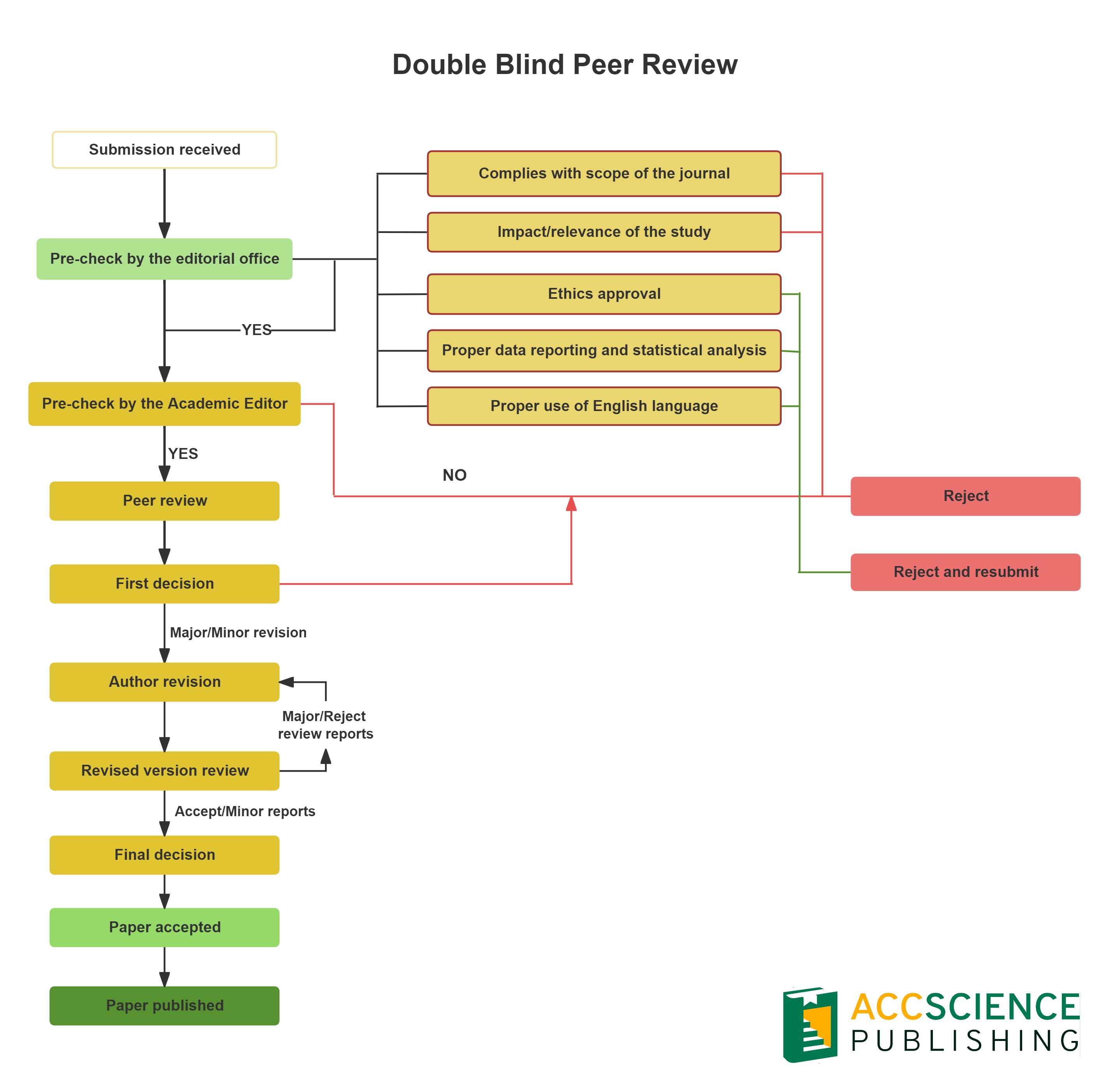
For most ASP journals, peer review is a double-blind assessment involving two or more reviewers, followed by a final acceptance/rejection decision by the Academic Editor. For every submission, an Academic Editor will be selected to oversee the peer-review process, including editorial decision-making. An Academic Editor is generally selected from the editorial board (Editor-in-Chief, or other Editorial Board Members); for Special Issues, a dedicated Guest Editor will be selected as the handling Academic Editor. The selection of the Academic Editor is based on the following principles:
(i) the submission to be screened or assessed is not contributed by the Academic Editor, or their involvement will not lead to a conflict of interest (including, but not limited to, assessing a submission contributed by a colleague, past/present collaborator, student, individual from the same institution, etc.); and
(ii) the Academic Editor demonstrates expertise in the subject matter of the assigned submission.
Pre-check
The pre-check stage consists of two main steps: a technical pre-check performed by a dedicated in-house journal editor (of the Editorial Office), and an editorial pre-check performed by an Academic Editor.
The technical pre-check is designed to assess:
(i) the overall suitability of the manuscript to the journal and the assigned Special Issue;
(ii) manuscript adherence to high-quality research and ethical standards; and
(iii) standards of rigor to qualify for further review.
The editorial pre-check primarily entails an in-depth assessment by the handling Academic Editor regarding a submission’s match with the journal’s scope, as well as the overall scientific soundness of the manuscript, including the relevance of the references and the correctness of the applied methodology. Submissions that do not meet the desired standards during the technical and/or editorial pre-checks will be desk-rejected.
Only submissions that have passed both the technical and editorial pre-checks will be subjected to peer review.
Peer Review
For most ASP journals, peer review is a double-blind assessment involving two or more reviewers, which the reviewer's name and information is withheld from the author.
Recommending Reviewers: For manuscripts that have passed the pre-check, the Academic Editor recommends two or more external reviewers who are subject-matter experts and who are not Editorial Board members. Candidate reviewers are selected through web searches for related articles or from the publisher’s database of qualified reviewers, with appropriate conflict of interest management applied during the selection process. Preferred or potential reviewers recommended by authors might be considered, but there is no guarantee that all or some of them will be eventually invited to review. Scholars whom the authors wish to exclude from the peer-review process of their manuscripts will be taken into consideration, as long as their reasons for exclusion are well-justified.
Selecting Reviewers: Only scholars and/or researchers that fulfill the requirements in the following will be invited to be reviewers:
- Having the primary expertise to evaluate the manuscript’s quality (based on a proven publication record in the field of the submitted paper, as verified through Scopus or ORCID);
- Hold a PhD or be an MD (applicable for medical journals);
- Holding no conflicts of interest with any of the authors (including not in active research collaboration with the authors for the past three years);
- Not coming from the same institution as the authors;
- Affiliated to an official and recognized academic institution.
If agreed to review an assigned manuscript, reviewers are advised to submit quality review reports within the stipulated period upon invitation (typically within 7–10 days). When reviewing a revised manuscript, reviewers are required to provide review reports within 3 days. Extensions can also be granted on request. Submission of review reports can be done via our online platform, OSS.
Reviewers are expected to remain responsive throughout peer review, and maintain standards of professionalism and ethics.
During the peer-review process, the in-house journal editor will play an assistive role in handling all communications with reviewers, authors, and the Academic Editor. The Academic Editor can check the status of manuscripts and the identity of reviewers at any time; any issues can be raised to the handling in-house journal editor for a discussion.
At least two review reports will be collected for each manuscript. For primary research articles (e.g., original research, clinical trials, observational studies, case studies), two or more external reviewers experts who are not members of the journal's Editorial Board will be invited to ensure independent evaluation. Under rare circumstances, other Editorial Board Members may be consulted for additional, comprehensive evaluations, only if needed, to complement the review comments contributed by external reviewers, provided that they have relevant expertise and no conflicts of interest.
After each round of peer review, the Academic Editor will make an appropriate editorial decision (i.e., reject, minor revision, major revision, accept) based on review reports.
Editorial Decision-Making
When a sufficient number of review reports (typically a minimum of two review reports) are received after the first round of peer review, the manuscript will be subjected to editorial decision-making by the handling Academic Editor. The options for decisions generally include reject, minor revision, major revision, and accept. A decision is made based on the overall manuscript quality, as well as feedback and recommendations by reviewers. In the event of conflicting reviewers’ recommendations, the handling Academic Editor will step in to adjudicate and provide an objective editorial decision. If necessary, more reviewers will be invited to review the same manuscript to aid with decision-making. Academic Editors reserve the right to disagree with the views and recommendations of the invited reviewers, and they should justify their decision for the benefit of the authors and reviewers. This may include circumstances where the handling Academic Editor recommends to accept a manuscript despite a reviewer’s recommendation to reject it. For such instance, in-house journal editor will seek a second independent opinion from another Editorial Board member or the Editor-in-Chief before communicating a final decision to the authors.
Revision
In cases where only minor or major revisions are recommended, authors are requested to revise the paper in accordance with the comments and feedback laid within the decision letter.
Revised versions of manuscripts may or may not be sent to reviewers, depending on whether the reviewer has made a selection to see the revised version. By default, however, revised manuscript will be sent to reviewers who request major revisions or recommend rejection. All reviewers can access the most recent revised version of the manuscript via OSS.
If the revision time requested by the authors is estimated to be longer than 2 months, we recommend that authors withdraw their manuscript so as to avoid unnecessary time pressure and to ensure comprehensive revisions before making a resubmission.
Revised manuscripts undergoing subsequent rounds of peer review will again be subject to editorial decision-making by the handling Academic Editor, as described above.
Special Issue
All Special Issue submissions are subject to rigorous and impartial peer-review like other regular submissions. Guest Editors will serve as the handling Academic Editors for their own Special Issues, supervising the editorial process of all Special Issue submissions and making an editorial decision (e.g., reject, minor revision, major revision, accept) based on review reports. The same principles of Academic Editor selection, as outlined in the introductory segment, apply for Special Issue submissions. For fair and unbiased assessments, Guest Editors are required to refrain from handling submissions from authors with whom they have potential competing interests. It is important to note that the entire editorial oversight conducted by the Guest Editors will be supervised by the Editor-in-Chief to ensure academic quality.
Papers submitted to a special issue by the guest editor(s) must be handled under an independent review process and make up no more than 25% of the issue’s total. Guest Editors are not allowed to handle their own submissions; therefore, an Academic Editor with no competing interests will be recruited for an independent peer review.
Author Appeals
Authors may appeal a rejection by sending an email to the Editorial Office of the journal. The appeal must provide a detailed justification, including point-by-point responses to the reviewers' and/or Editor's comments. Appeals can only be submitted following a “reject and decline resubmission” decision and must be lodged within three months from the decision date. Failure to meet these criteria will result in the appeal not being considered further.
Upon receipt of an appeal, the original handling Academic Editor will review the manuscript, the authors’ grounds for appeal, and relevant supporting materials (including the confidential identities of the reviewers, accessible only internally). The handling Academic Editor will provide an advisory recommendation based on the materials available and may recommend acceptance, further peer review, or uphold the original rejection decision. This decision will then be validated by the Editor-in-Chief. A reject decision at this stage is final and cannot be reversed.
Production & Publication
Following acceptance, the manuscript will be subjected to a series of production processes, including copy-editing, layout/galley proof preparation, and proofreading. In cases where extensive editing or formatting is required, authors will be notified and requested to address all the issues identified themselves before further production steps can commence. Alternatively, authors are recommended to employ a professional English editing and formatting service. Upon completion, the first galley proof will be shared with the authors for at least a round of proofreading. Finalized articles that have been confirmed by the authors will be released online.
Editorial Independence and Authority
Manuscripts are accepted by selected Academic Editor based on the overall quality of the manuscript, as well as feedback and recommendations by reviewers—particularly external reviewers for primary research articles—after a rigorous peer-review process. In-house journal editors (i.e., employed by AccScience Publishing) are not involved in editorial decision-making.
Our editors can reject any papers at any time before publication, including after acceptance, if concerns arise about the integrity of the submitted works.
Confidentiality
Submitted works and accessory materials will only be processed and evaluated by the in-house journal editors, Academic Editors, reviewers, and production editors.
Supplementary materials containing additional information to aid the understanding of work described in the manuscript is also subjected to peer review. Accessory documents such as research ethics approval proof, study participant consent form, copyright clearance proof and documents that might contain author-identifiable information and/or do not directly aid in understanding the work to be reviewed are not subjected to peer review.
