

Artificial intelligence in radiation dose optimization research: A bibliometric mapping

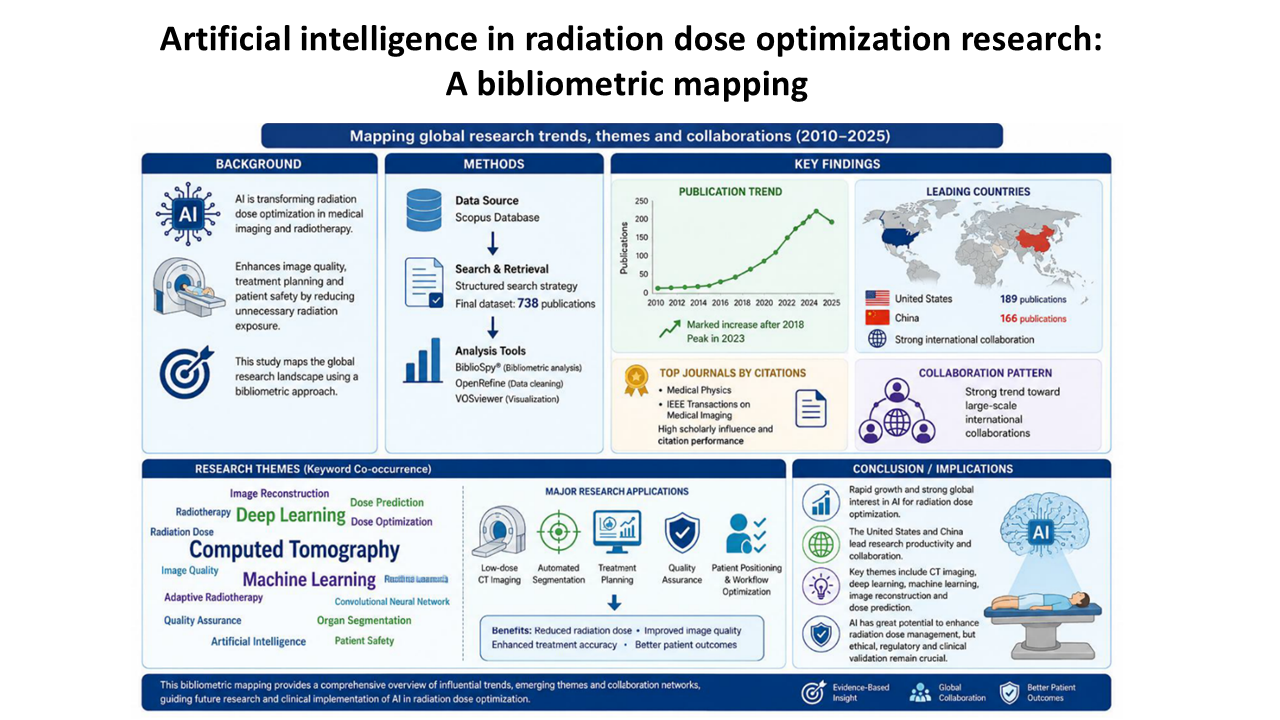
In radiation dose optimization, artificial intelligence (AI) plays a crucial role in improving image quality, treatment planning, and patient safety in medical imaging and radiotherapy. Although research in this field is growing rapidly, publication patterns, intellectual structure, themes, and co-authorship remain poorly understood. This study therefore aimed to systematically visualize the global AI research landscape in radiation dose optimization through a bibliometric approach. Data were retrieved from the Scopus database, obtained through a structured search strategy, yielding a final dataset of 738 publications. We performed bibliometric analysis with BiblioSpy®, data cleaning with OpenRefine, and network visualization and keyword co-occurrence analysis with VOSviewer. The results showed a substantial increase in publication output since 2018, reaching its highest annual output in 2025 with 187 publications; data for 2026 reflect an incomplete year, reflecting growing scholarly attention to AI-driven radiation dose optimization in medical imaging and radiotherapy. The United States and China led in research productivity and international collaboration. Medical Physics and IEEE Transactions on Medical Imaging showed high citation performance and were the two publications with the strongest scholarly influence. The keyword analysis revealed the main research topics: computed tomography, deep learning, machine learning, image reconstruction, and dose prediction. Co-authorship analysis also showed a strong trend toward large-scale, international collaboration. In conclusion, this research provides a thorough bibliometric analysis of AI research in radiation dose optimization, highlighting key trends, emerging areas, and international research collaborations to guide future studies and clinical practice.
- Resühr D, Garnett C. The Good, the Bad, and the Ugly of AI in Medical Imaging. EMJ Radiol. 2025;6(1):53-55. doi: 10.33590/emjradiol/jtpo7801
- Buaka ESD, Moid MZI. AI and medical imaging technology: evolution, impacts, and economic insights. J Technol Transf. 2024;49(6):2260–2272. doi: 10.1007/s10961-024-10100-x
- Pinto-Coelho L. How Artificial Intelligence Is Shaping Medical Imaging Technology: A Survey of Innovations and Applications. Bioengineering. 2023;10(12):1435. doi: 10.3390/bioengineering10121435
- Damilakis J, Stratakis J. Descriptive overview of AI applications in X-ray imaging and radiotherapy. J Radiol Prot. 2024;44(4):041001. doi: 10.1088/1361-6498/ad9f71
- Currie GM, Rohren EM. Radiation Dosimetry, Artificial Intelligence and Digital Twins: Old Dog, New Tricks. Semin Nucl Med. 2023;53(3):457-466. doi: 10.1053/j.semnuclmed.2022.10.007
- Ng CKC. Artificial Intelligence for Radiation Dose Optimization in Pediatric Radiology: A Systematic Review. Children. 2022;9(7):1044. doi: 10.3390/children9071044
- Melazzini L, Bortolotto C, Brizzi L, et al. AI for image quality and patient safety in CT and MRI. Eur Radiol Exp. 2025;9(1):28. doi: 10.1186/s41747-025-00562-5
- Bani-Ahmad M, England A, McLaughlin L, Hadi YH, McEntee M. Potential of artificial intelligence for radiation dose reduction in computed tomography—A scoping review. Radiography. 2025;31(4):102968. doi: 10.1016/j.radi.2025.102968
- McCollough CH, Leng S. Use of artificial intelligence in computed tomography dose optimisation. Ann ICRP. 2020;49(1_suppl):113-125. doi: 10.1177/0146645320940827
- Zafar F, Vilsan J, Mani S, et al. AI in Radiation Oncology: A Comprehensive Review of Current Applications and Future Directions. Cureus. 17(9):e92964. doi: 10.7759/cureus.92964
- Huynh E, Hosny A, Guthier C, et al. Artificial intelligence in radiation oncology.Nat Rev Clin Oncol. 2020;17(12):771–781. doi: 10.1038/s41571-020-0417-8
- Claessens M, Oria CS, Brouwer CL, et al. Quality Assurance for AI-Based Applications in Radiation Therapy. Semin Radiat Oncol. 2022;32(4):421-431.. doi: 10.1016/j.semradonc.2022.06.011
- Erdur AC, Rusche D, Scholz D, et al. Deep learning for autosegmentation for radiotherapy treatment planning: State-of-the-art and novel perspectives. Strahlentherapie Onkol. 2025;201(3):236-254. doi: 10.1007/s00066-024-02262-2
- Jiang C, Ji T, Qiao Q. Application and progress of artificial intelligence in radiation therapy dose prediction. Clin Transl Radiat Oncol. 2024:47:100792. doi: 10.1016/j.ctro.2024.100792
- Park J, Hwang D, Kim KY, Kang SK, Kim YK, Lee JS. Computed tomography super-resolution using deep convolutional neural network. Phys Med Biol. 2018;63(14):145011. doi: 10.1088/1361-6560/aacdd4
- Chow JCL. Hybrid Artificial Intelligence–Monte Carlo Methods for Radiotherapy Dose Calculation. Encyclopedia. 2026;6(3):55. doi: 10.3390/encyclopedia6030055
- Clement David-Olawade A, Olawade DB, Vanderbloemen L, et al. AI-Driven Advances in Low-Dose Imaging and Enhancement—A Review. Diagnostics. 2025;15(6):689. doi: 10.3390/diagnostics15060689
- Sheng Y, Zhang J, Ge Y, et al. Artificial intelligence applications in intensity modulated radiation treatment planning: An overview. Quant Imaging Med Surg. 2021;11(12):4859-4880. doi: 10.21037/qims-21-208
- Zadnorouzi M, Abtahi SMM. Artificial intelligence (AI) applications in improvement of IMRT and VMAT radiotherapy treatment planning processes: A systematic review. Radiography. 2024;30(6):1530-1535. doi: 10.1016/j.radi.2024.09.049
- Isik IH. Artificial intelligence for radiation dose reduction in computed tomography: a narrative synthesis of clinical evidence from 2020 to 2025. J Radiol Prot. 2026;46(1). doi: 10.1088/1361-6498/ae475a
- Antony M, Gulhane M, Dhawane P, Rakesh N, Sarda P, Sable NP. AI-Based Solutions for Improving Radiation Dose Distribution in Oncology. In: 2025 2nd International Conference on Integration of Computational Intelligent System, ICICIS 2025. Institute of Electrical and Electronics Engineers Inc.; 2025. doi: 10.1109/ICICIS65613.2025.11371140
- Kawamura M, Kamomae T, Yanagawa M, et al. Revolutionizing radiation therapy: the role of AI in clinical practice. J Radiat Res. 2024;65(1):1-9. doi: 10.1093/jrr/rrad090
- Kumar S, Kumar B, Ashique S, Bhui U. Advances in Radiotherapy Using Artificial Intelligence. In: From Radiobiology to Radiation Oncology. Springer Science+Business Media; 2025:321-340. doi: 10.1007/978-3-031-95724-6_17
- Garajová L, Garbe S, Sprinkart AM. Artificial intelligence in diagnostic radiology for dose management: Advances and perspectives using the example of computed tomography. Radiologie. 2024;64(10):787-792. doi: 10.1007/s00117-024-01330-z
- Ahervo H, Korhonen J, Lim Wei Ming S, et al. Artificial intelligence-supported applications in head and neck cancer radiotherapy treatment planning and dose optimisation. Radiography. 2023;29(3):496-502. doi: 10.1016/j.radi.2023.02.018
- Deig CR, Kanwar A, Thompson RF. Artificial Intelligence in Radiation Oncology. Hematol Oncol Clin North Am. 2019;33(6):1095-1104. doi: 10.1016/j.hoc.2019.08.003
- Marr C, Tsang Y. Radiation therapists’ perspectives on artificial intelligence: Insights from a single institution on improving effectiveness and educational supports. Tech Innov Patient Support Radiat Oncol. 2025;33(6):100300. doi: 10.1016/j.tipsro.2025.100300
- Woo OH, Song SE, Choe SJ, Kim M, Cho KR, Seo BK. Invasive Breast Cancers Missed by AI Screening of Mammograms. Radiology. 2025;315(3):e242408. doi: 10.1148/radiol.242408
- Chow JCL. Artificial Intelligence in Radiotherapy and Patient Care. In: Artificial Intelligence in Medicine. Springer International Publishing; 2022:1275-1286. doi: 10.1007/978-3-030-64573-1_143
- Dehbaghi HA, Khoshgard K. The role of artificial intelligence in optimizing radiation dose in diagnostic imaging. Health Technol. 2026;16(2):243-253. doi: 10.1007/s12553-025-01049-4
- Abolaban FA. Review of recent impacts of artificial intelligence for radiation therapy procedures. Radiat Phys Chem. 2023;202:110469. doi: 10.1016/j.radphyschem.2022.110469
- Sumini M, Teodori F, Isolan L. Digital twins in dosimetry and radiotherapy, a survey and some applications. Radiat Phys Chem. 2024;218:111649. doi: 10.1016/j.radphyschem.2024.111649
- Mian TS, Saeed HF, Alatawi EM. Machine Learning in Radiation Oncology. In: AI and Machine Learning for Cancer Care: Precision Medicine and Beyond. IGI Global; 2026:259-281. doi: 10.4018/979-8-3373-4312-9.ch008
- Xue Y, Peng Y, Bi L, Feng D, Kim J. CG-3DSRGAN: A classification guided 3D generative adversarial network for image quality recovery from low-dose PET images. In: Proceedings of the Annual International Conference of the IEEE Engineering in Medicine and Biology Society, EMBS. Institute of Electrical and Electronics Engineers Inc.; 2023. doi: 10.1109/EMBC40787.2023.10341112
- Lepri G, Oddi F, Gulino RA, Giansanti D. Reimagining Radiology: A Comprehensive Overview of Reviews at the Intersection of Mobile and Domiciliary Radiology over the Last Five Years. Bioengineering. 2024;11(3):216. doi: 10.3390/bioengineering11030216
- Tsui B, Calabrese E, Zaharchuk G, Rauschecker AM. Reducing Gadolinium Contrast With Artificial Intelligence. J Magn Reson Imaging. 2024;60(3):848-859. doi: 10.1002/jmri.29095
- Alves JL, Borges IB, De Nadae J. Sustainability in complex projects of civil construction: Bibliometric and bibliographic review. Gest e Prod. 2021;28(4). doi: 10.1590/1806-9649-2020v28e5389
- Assyakur DS, Rosa EM. Spiritual Leadership in Healthcare: A Bibliometric Analysis. J Aisyah J Ilmu Kesehat. 2022;7(2). doi: 10.30604/jika.v7i2.914
- Wu YCJ, Wu T. A decade of entrepreneurship education in the Asia Pacific for future directions in theory and practice. Manag Decis. 2017;55(7):1333-1350. doi: 10.1108/MD-05-2017-0518
- Sangadji SS. Foundations of Bibliometric Writing: A Comprehensive Guide for Novice Researchers. SCIENTIA: J Multi Discip Sci. 2023;2(2):95–107. doi: 10.62394/scientia.v2i2.79
- Boyi L, Ishak NAB. Bibliometric Research on Academic Writing Performance. J Ecohumanism. 2025;4(1):1552-1569. doi: 10.62754/joe.v4i1.6013
- Fahimnia B, Sarkis J, Davarzani H. Green supply chain management: A review and bibliometric analysis. Int J Prod Econ. 2015;162:101-114. doi: 10.1016/j.ijpe.2015.01.003
- Al-Khoury A, Hussein SA, Abdulwhab M, et al. Intellectual Capital History and Trends: A Bibliometric Analysis Using Scopus Database. Sustainbility. 2022;14(18);11615. doi: 10.3390/su141811615
- Di Stefano G, Peteraf M, Verona G. Dynamic capabilities deconstructed: A bibliographic investigation into the origins, development, and future directions of the research domain. Ind Corp Chang. 2010;19(4):1187-1204. doi: 10.1093/icc/dtq027
- Khiste GP, Paithankar RR. Analysis of Bibliometric term in Scopus. Int J Libr Sci Inf Manag. 2017;3(3):18-88.
- Gu D, Li T, Wang X, Yang X, Yu Z. Visualizing the intellectual structure and evolution of electronic health and telemedicine research. Int J Med Inform. 2019;130:103947. doi: 10.1016/j.ijmedinf.2019.08.007
- Ahmi A. OpenRefine: An approachable tool for cleaning and harmonizing bibliographical data. AIP Conf Proceedings. 2023. doi: 10.1063/5.0164724
- Bortruex D. Review of OpenRefine Software. TCB: Tech Serv Relig Theol. 2022;30(2):7. doi: 10.31046/tcb.v30i2.3132
- Miller M, Vielfaure N. OpenRefine: An Approachable Open Tool to Clean Research Data. Assoc Can Map Libr Arch Bull. 2022;170. doi: 10.15353/ACMLA.N170.4873
- Aidi Ahmi. BiblioSpy—Professional Bibliometric Analytics Tool. BiblioSpy. Published 2026. Accessed XXX. https://bibliospy.me/
- Van Eck NJ, Waltman L. Software survey: VOSviewer, a computer program for bibliometric mapping. Scientometrics. 2010;84(2):523-538. doi: 10.1007/s11192-009-0146-3
- Van Eck NJ, Waltman L. Citation-based clustering of publications using CitNetExplorer and VOSviewer. Scientometrics. 2017;111(2):1053-1070. doi: 10.1007/s11192-017-2300-7
- McAllister JT, Lennertz L, Atencio Mojica Z. Mapping A Discipline: A Guide to Using VOSviewer for Bibliometric and Visual Analysis. Sci Technol Libr. 2022;41(3):319-348. doi: 10.1080/0194262X.2021.1991547
- Appio FP, Cesaroni F, Di Minin A. Visualizing the structure and bridges of the intellectual property management and strategy literature: a document co-citation analysis. Scientometrics. 2014;101(1):623-661. doi: 10.1007/s11192-014-1329-0
- Van Eck NJ, Waltman L. Bibliometric mapping of the computational intelligence field. Int J Uncertain Fuzziness Knowl.-Based Syst. 2007;15(05):625-645. doi: 10.1142/S0218488507004911
- Appio FP, Martini A, Massa S, Testa S. Unveiling the intellectual origins of Social Media-based innovation: insights from a bibliometric approach. Scientometrics. 2016;108(1):355-388. doi: 10.1007/s11192-016-1955-9
- Zhao X. A scientometric review of global BIM research: Analysis and visualization. Autom Constr. 2017;80:37-47. doi: 10.1016/j.autcon.2017.04.002
- Li H, An H, Wang Y, Huang J, Gao X. Evolutionary features of academic articles co-keyword network and keywords co-occurrence network: Based on two-mode affiliation network. Phys A Stat Mech its Appl. 2016;450:657-669. doi: 10.1016/j.physa.2016.01.017
- Allahverdiyev M, Yucesoy Y. Development stages and types of glass art from past to present. Il Ponte. 2017;73(4). doi: 10.21506/j.ponte.2017.4.53
- Liu Z, Yin Y, Liu W, Dunford M. Visualizing the intellectual structure and evolution of innovation systems research: a bibliometric analysis. Scientometrics. 2015;103(1):135-158. doi: 10.1007/s11192-014-1517-y
- Wolterink JM, Leiner T, Viergever MA, Išgum I. Generative adversarial networks for noise reduction in low-dose CT. IEEE Trans Med Imaging. 2017;36(12):2536-2545. doi: 10.1109/TMI.2017.2708987
- Wang Y, Yu B, Wang L, et al. 3D conditional generative adversarial networks for high-quality PET image estimation at low dose. Neuroimage. 2018;174:550-562. doi: 10.1016/j.neuroimage.2018.03.045
- Shan H, Vimieiro RB, Borges LR, Vieira MAC, Wang G. Impact of loss functions on the performance of a deep neural network designed to restore low-dose digital mammography. Artif Intell Med. 2023;142:102555. doi: 10.1016/j.artmed.2023.102555
- Fan J, Wang J, Chen Z, Hu C, Zhang Z, Hu W. Automatic treatment planning based on three-dimensional dose distribution predicted from deep learning technique. Med Phys. 2019;46(1):370-381. doi: 10.1002/mp.13271
- Nguyen D, Long T, Jia X, et al. A feasibility study for predicting optimal radiation therapy dose distributions of prostate cancer patients from patient anatomy using deep learning. Sci Rep. 2019;9(1). doi: 10.1038/s41598-018-37741-x
- Greffier J, Hamard A, Pereira F, et al. Image quality and dose reduction opportunity of deep learning image reconstruction algorithm for CT: a phantom study. Eur Radiol. 2020;30(7):3951-3959. doi: 10.1007/s00330-020-06724-w
- Bohoudi O, Bruynzeel AME, Senan S, et al. Fast and robust online adaptive planning in stereotactic MR-guided adaptive radiation therapy (SMART) for pancreatic cancer. Radiother Oncol. 2017;125(3):439-444. doi: 10.1016/j.radonc.2017.07.028
- Ravishankar S, Ye JC, Fessler JA. Image Reconstruction: From Sparsity to Data-Adaptive Methods and Machine Learning. Proc IEEE. 2020;108(1):86-109. doi: 10.1109/JPROC.2019.2936204
- You C, Yang Q, Shan H, et al. Structurally-sensitive multi-scale deep neural network for low-dose CT denoising. IEEE Access. 2018;6:41839-41855. doi: 10.1109/ACCESS.2018.2858196
- Wu D, Kim K, El Fakhri G, Li Q. Iterative low-dose CT reconstruction with priors trained by artificial neural network. IEEE Trans Med Imaging. 2017;36(12):2479-2486. doi: 10.1109/TMI.2017.2753138