

Multimodal data-driven intelligent diagnosis in traditional Chinese medicine: Current status and future perspectives

With advances in artificial intelligence, traditional Chinese medicine diagnosis is gradually becoming more intelligent. This review departs from the conventional framework that categorizes the four diagnostic methods in isolation. Instead, it starts from five heterogeneous data modalities, namely vision, audition, olfaction, textual, and tactile, and systematically reconstructs the digital mapping relationships of traditional Chinese medicine diagnostic information, thereby directly aligning traditional Chinese medicine diagnostic problems with the input paradigms of artificial intelligence. This study comprehensively examines the current state of research on multimodal acquisition technologies, fusion methods, and clinical applications, and analyzes the core challenges and future directions in this field. This study aims to provide a theoretical foundation for achieving truly intelligent integration of the four diagnostic methods.
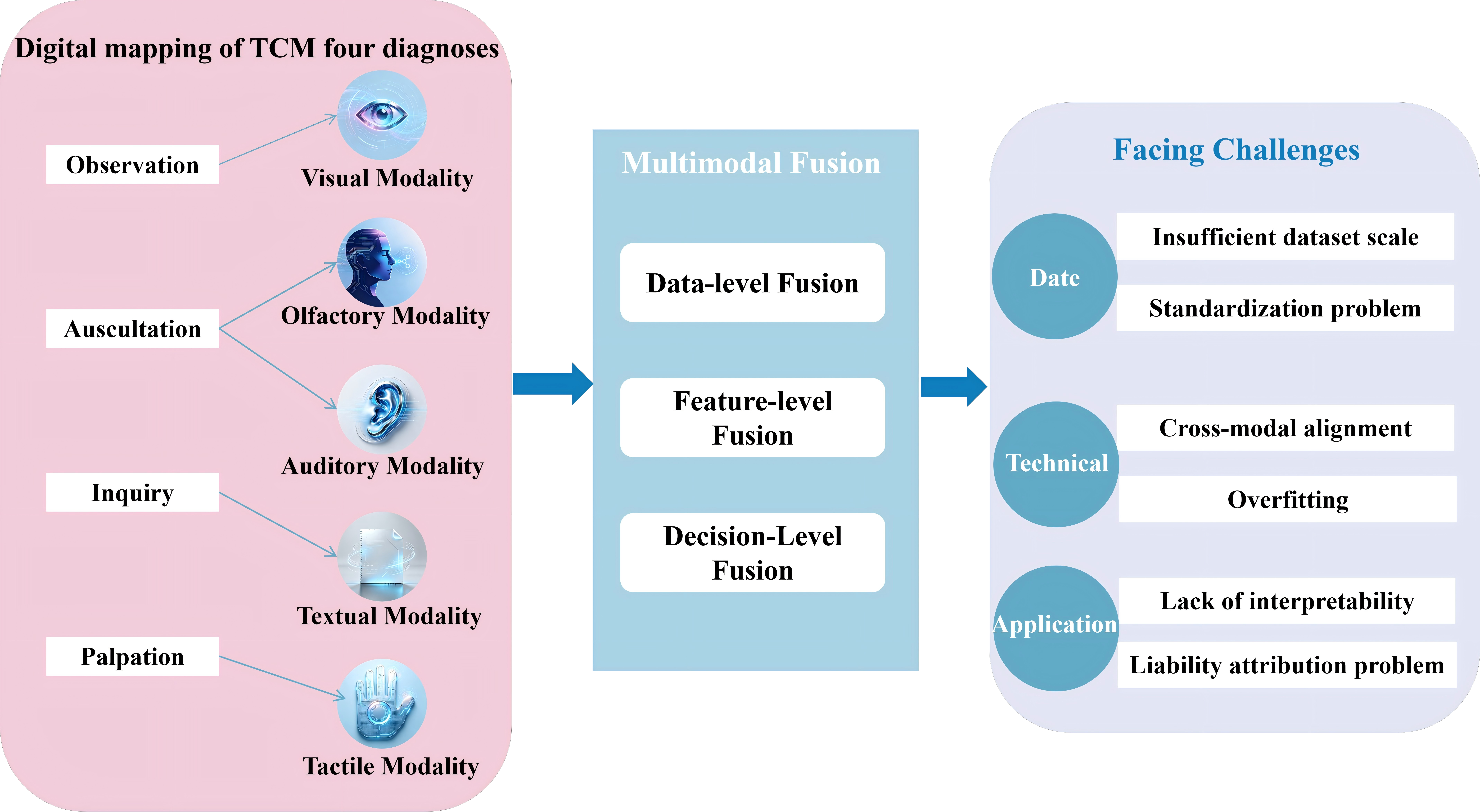
- Tang JL, Liu BY, Ma KW. Traditional Chinese medicine. Lancet. 2008;372(9654):1938-1940. doi: 10.1016/S0140-6736(08)61354-9
- Tian Z, Wang D, Sun X, et al. Current status and trends of artificial intelligence research on the four traditional Chinese medicine diagnostic methods: a scientometric study. Ann Transl Med. 2023;11(3):145. doi: 10.21037/atm-22-6431
- Abdullahi M, Oyelade ON, Kana AFD, et al. A systematic literature review of visual feature learning: deep learning techniques, applications, challenges and future directions. Multimed Tools Appl. 2024;84(19):20439-20496. doi: 10.1007/s11042-024-19823-3
- Wang J, Liu YM, Li J, et al. Artificial Intelligence in Traditional Chinese Medicine: Multimodal Fusion and Machine Learning for Enhanced Diagnosis and Treatment Efficacy. Curr Med Sci. 2025;45(5):1013-1022. doi: 10.1007/s11596-025-00103-6
- Ren Y, Luo X, Wang Y, et al. Large Language Models in Traditional Chinese Medicine: A Scoping Review. J Evid Based Med. 2025;18(1):e12658. doi: 10.1111/jebm.12658
- Bhatnagar V, Bansod PP. Challenges and Solutions in Automated Tongue Diagnosis Techniques: A Review. Crit Rev Biomed Eng. 2022;50(1):47-63. doi: 10.1615/CritRevBiomedEng.2022044392
- Guo C, Jiang Z, He H, Liao Y, Zhang D. Wrist pulse signal acquisition and analysis for disease diagnosis: A review. Comput Biol Med. 2022;143:105312. doi: 10.1016/j.compbiomed.2022.105312
- Sui Dong, Zhang L, Yang F. Data-driven based four examinations in TCM: a survey. Digital Chinese Med. 2022;5(4):377-385. doi: 10.1016/j.dcmed.2022.12.004
- Tian D, Chen W, Xu D, et al. A review of traditional Chinese medicine diagnosis using machine learning: Inspection, auscultation-olfaction, inquiry, and palpation. Comput Biol Med. 2024;170:108074. doi: 10.1016/j.compbiomed.2024.108074
- Zhang S, Wang W, Pi X, He Z, Liu H. Advances in the Application of Traditional Chinese Medicine Using Artificial Intelligence: A Review. Am J Chin Med. 2023;51(5):1067-1083. doi: 10.1142/S0192415X23500490
- Baltrusaitis T, Ahuja C, Morency LP. Multimodal Machine Learning: A Survey and Taxonomy. IEEE Trans Pattern Anal Mach Intell. 2019;41(2):423-443. doi: 10.1109/tpami.2018.2798607
- Huang Z, Miao J, Song H, et al. A novel tongue segmentation method based on improved U-Net. Neurocomputing. 2022;500:73-89. doi: 10.1016/j.neucom.2022.05.023
- Wu J, Li Z, Cai Y, et al. A Novel Tongue Coating Segmentation Method Based on Improved TransUNet. Sensors. 2024;24(14):4455. doi: 10.3390/s24144455
- Tiryaki B, Torenek-Agirman K, Miloglu O, Korkmaz B, Ozbek İ Y, Oral EA. Artificial intelligence in tongue diagnosis: classification of tongue lesions and normal tongue images using deep convolutional neural network. BMC Med Imaging. 2024;24(1):59. doi: 10.1186/s12880-024-01234-3
- Ang L, Yim MH, Do JH, Lee S. A Novel Method in Predicting Hypertension Using Facial Images. Appl Sci. 2021;11(5):2414. doi: 10.3390/app11052414
- Kadiri SR, Alku P. Analysis and Detection of Pathological Voice Using Glottal Source Features. IEEE J Sel Top Signal Processing. 2020;14(2):367-379. doi: 10.1109/JSTSP.2019.2957988
- Khan R, Khan SU, Saeed U, Koo IS. Auscultation-Based Pulmonary Disease Detection through Parallel Transformation and Deep Learning. Bioengineering. 2024;11(6):586. doi: 10.3390/bioengineering11060586
- Agbavor F, Liang H. Predicting dementia from spontaneous speech using large language models. PLoS Digit Health. 2022;1(12):e0000168. doi: 10.1371/journal.pdig.0000168
- Heers H, Gut JM, Hofmann R, et al. Pilot study for bladder cancer detection with volatile organic compounds using ion mobility spectrometry: a novel urine-based approach. World J Urol. 2024;42(1):353. doi: 10.1007/s00345-024-05047-5
- Chandran D, Ooi EH, Watson DI, Kholmurodova F, Jaenisch S, Yazbeck R. The Use of Selected Ion Flow Tube-Mass Spectrometry Technology to Identify Breath Volatile Organic Compounds for the Detection of Head and Neck Squamous Cell Carcinoma: A Pilot Study. Medicina. 2019;55(6):306. doi: 10.3390/medicina55060306
- Ding X, Zhang Y, Zhang Y, et al. Modular Assembly of MXene Frameworks for Noninvasive Disease Diagnosis via Urinary Volatiles. ACS Nano. 2022;16(10):17376-17388. doi: 10.1021/acsnano.2c08266
- Kistenev YV, Borisov AV, Zasedatel VS, Spirina LV. Diabetes noninvasive diagnostics and monitoring through volatile biomarkers analysis in the exhaled breath using optical absorption spectroscopy. J Biophotonics. 2023;16(12):e202300198. doi: 10.1002/jbio.202300198
- Bi W, Xiong Q, Chen X, Du Q, Wu J, Zhuang Z. Intelligent visual question answering in TCM education: An innovative application of IoT and multimodal fusion. Alex Eng J. 2025;118(000):325-336. doi: 10.1016/j.aej.2024.12.052
- Zhang H, Chen J, Jiang F, et al. HuatuoGPT, Towards Taming Language Model to Be a Doctor. In: Proceedings of the Association for Computational Linguistics: EMNLP 2023. Singapore: Association for Computational Linguistics; 2023:10859-10885. doi: 10.18653/v1/2023.findings-emnlp.725
- Chen Q, Huang Y, Zhu X, et al. Palpation localization of radial artery based on 3-dimensional convolutional neural networks. EURASIP J Image Video Processing. 2022;2022(1):1-13. doi: 10.1186/s13640-022-00587-5
- Zhu X, Ji Z, Wang FY, Zhou P, Luo J. A Robotic Platform for Digitalized Pulse Information Collection. In: Proceedings of the 2022 12th International Conference on CYBER Technology in Automation, Control, and Intelligent Systems (CYBER). Baishan, China; 2022:1055-1060. doi: 10.1109/CYBER55403.2022.9907105
- Cui YH. Ji yu shen du xue xi de zhong yi mai xiang shi bie fang fa yan jiu [Deep learning-based TCM pulse pattern recognition]. Master’s thesis. Nanchang Hangkong University; 2023. [In Chinese] doi: 10.27233/d.cnki.gnchc.2023.000912
- Wang XZ, Zhang D. A New Tongue Colorchecker Design by Space Representation for Precise Correction. IEEE J Biomed Health Inform. 2013;17(2):381-391. doi: 10.1109/titb.2012.2226736
- Niu JL, Zhao CB, Li GZ. A comprehensive study on color correction for medical facial images. Int J Mach Learn Cybern. 2019;10(5):1-13. doi: 10.1007/s13042-017-0773-6
- Zhao C, Niu JL, Li GZ, Wang HH, He C. Facial Color Management for Mobile Health in the Wild. IEEE Trans NanoBioscience. 2016;15(4):316-327. doi: 10.1109/TNB.2016.2553122
- Huang HF, Tai SC. Robust Facial Expression Recognition Using Near Infrared Cameras. J Adv Comput Intell Intell Inform. 2012;11(1):41-54. doi: 10.5565/rev/elcvia.451
- Yan J, Cai J, Xu Z, et al. Tongue crack recognition using segmentation based deep learning. Sci Rep. 2023;13(1):511. doi: 10.1038/s41598-022-27210-x
- Zhang Z, Zheng J, Zhao R, Liu S, Liu Z, Wang J. Cracked Tongue Extraction Model Based on Improved U-Net Method. IEEE Access. 2023;11:126352-126364. doi: 10.1109/access.2023.3329975
- Mukai N, Mori K, Takei Y. Tongue model construction based on ultrasound images with image processing and deep learning method. J Med Ultrason. 2022;49(2):153-161. doi: 10.1007/s10396-022-01193-8
- Yizhuo Z, Yu R, Hongxing C, et al. A Novel Method for Rapid Measurement of Facial Blood Oxygen Saturation Using a Snapshot Multispectral Imager. J Biophotonics. 2025;18(6):e70001. doi: 10.1002/jbio.70001
- Hallgrímsson B, Aponte JD, Katz DC, et al. Automated syndrome diagnosis by three-dimensional facial imaging. Genet Med. 2020;22(10):1682-1693. doi: 10.1038/s41436-020-0845-y
- Meng T, Guo X, Lian W, et al. Identifying Facial Features and Predicting Patients of Acromegaly Using Three-Dimensional Imaging Techniques and Machine Learning. Front Endocrinol. 2020;11:492. doi: 10.3389/fendo.2020.00492
- Jiang C, Wu J, Zhong W, et al. Automatic Facial Paralysis Assessment via Computational Image Analysis. J Healthc Eng. 2020;2020:1-10. doi: 10.1155/2020/2398542
- Liao JF, Jiang XM, Xie Z, et al. Exploring the efficacy of laser speckle contrast imaging in the stratified diagnosis of rosacea: a quantitative analysis of facial blood flow dynamics across varied regions. Front Immunol. 2024;15:1419005. doi: 10.3389/fimmu.2024.1419005
- Lu E. Colorful Diagnosis: AI-powered tongue analysis borrows from traditional Chinese medicine. Sci Am. 2025;333(4):13. doi: 10.1038/scientificamerican112025-5vE238wlBiRsMfL9Vmkm9k
- Yang Z, Zhao Y, Yu J, Mao X, Xu H, Huang L. An Intelligent Tongue Diagnosis System via Deep Learning on the Android Platform. Diagnostics. 2022;12(10):2451.doi: 10.3390/diagnostics12102451
- Ridha AM, Shehieb W, Yacoub P, Al-Balawneh K, Arshad K. Smart Prediction System for Facial Paralysis. In: Proceedings of the 2020 7th International Conference on Electrical and Electronics Engineering (ICEEE). Antalya, Turkey: IEEE; 2020:321-327.doi: 10.1109/ICEEE49618.2020.9102600
- Hsu JY, Stone RA, Logan-Sinclair RB, Worsdell M, Busst CM, Chung KF. Coughing frequency in patients with persistent cough: assessment using a 24 hours ambulatory recorder. Eur Respir J. 1994;7(7):1246-1253. doi: 10.1183/09031936.94.07071246
- Drugman T, Urbain J, Bauwens N, et al. Objective study of sensor relevance for automatic cough detection. IEEE J Biomed Health Inform. 2013;17(3):699-707. doi: 10.1109/jbhi.2013.2239303
- Rece CA, Cherry AC, Jr., Reece AT, Hatcher TB, Diehl AM. Tape recorder for evaluation of coughs in children. Am J Dis Child. 1966;112(2):124-128. doi: 10.1001/archpedi.1966.02090110068005
- Eyben F, Scherer KR, Schuller BW, et al. The Geneva Minimalistic Acoustic Parameter Set (GeMAPS) for Voice Research and Affective Computing. IEEE Trans Affect Comput. 2016;7(2):190-202.doi: 10.1109/taffc.2015.2457417
- Song XY, Xu ZX, Wang SJ, Ding XD, Feng L, Wang YQ. 121 li fei jie jie huan zhe de yu yin gong zhen feng chu tan [A preliminary study of voice formants in 121 pulmonary nodule patients]. World Sci Technol Mod Tradit Chin Med. 2019;21(12):2904-2908. [In Chinese] doi: 10.11842/wst.20180130001
- de la Fuente Garcia S, Ritchie CW, Luz S. Artificial Intelligence, Speech, and Language Processing Approaches to Monitoring Alzheimer’s Disease: A Systematic Review. J Alzheimers Dis. 2020;78(4):1547-1574. doi: 10.3233/jad-200888
- Sung SH, Hong S, Kim JM, Kang DY, Park H, Kim S. Cognitive Impairment Classification Prediction Model Using Voice Signal Analysis. Electronics. 2024;13(18):3644. doi: 10.3390/electronics13183644
- Tabatabaei SAH, Fischer P, Schneider H, Koehler U, Gross V, Sohrabi K. Methods for Adventitious Respiratory Sound Analyzing Applications Based on Smartphones: A Survey. IEEE Rev Biomed Eng. 2021;14:98-115. doi: 10.1109/rbme.2020.3002970
- Barata F, Cleres D, Tinschert P, et al. Nighttime Continuous Contactless Smartphone-Based Cough Monitoring for the Ward: Validation Study. JMIR Form Res. 2023;7:e38439. doi: 10.2196/38439
- Moschovis PP, Sampayo EM, Cook A, et al. The diagnosis of respiratory disease in children using a phone-based cough and symptom analysis algorithm: The smartphone recordings of cough sounds 2 (SMARTCOUGH-C 2) trial design. Contemp Clin Trials. 2021;101:106278. doi: 10.1016/j.cct.2021.106278
- Lu JW, Chen SY, Yuan LF, Chen FM, Xie CY, Li CT. Ji yu Matlab shen du xue xi de zhi neng ting zhen xi tong ying yong cheng xu kai fa [Development of intelligent stethoscope system based on Matlab deep learning]. Chin J Med Phys. 2023;40(5):602-608. [In Chinese] doi: 10.3969/j.issn.1005-202X.2023.05.013
- Zhang X, Frankevich V, Ding J, Ma Y, Chingin K, Chen H. Direct mass spectrometry analysis of exhaled human breath in real-time. Mass Spectrom Rev. 2025;44(1):43-61. doi: 10.1002/mas.21855
- Schmidt K, Podmore I. Current Challenges in Volatile Organic Compounds Analysis as Potential Biomarkers of Cancer. J Biomark. 2015;2015:1-16. doi: 10.1155/2015/981458
- Buszewski B, Grzywinski D, Ligor T, Stacewicz T, Bielecki Z, Wojtas J. Detection of volatile organic compounds as biomarkers in breath analysis by different analytical techniques. Bioanalysis. 2013;5(18):2287-306. doi: 10.4155/bio.13.183
- Chen H, Huo D, Zhang J. Gas Recognition in E-Nose System: A Review. IEEE Trans Biomed Circuits Syst. 2022;16(2):169-184. doi: 10.1109/tbcas.2022.3166530
- Turner AP, Magan N. Electronic noses and disease diagnostics. Nat Rev Microbiol. 2004;2(2):161-166. doi: 10.1038/nrmicro823
- Pajot E. Medical diagnosis by breath analysis: odor sensors. m¨¦decine/sciences. 2019;35(2):123-131. doi: 10.1051/medsci/2019001
- Vadala R, Pattnaik B, Bangaru S, et al. A review on electronic nose for diagnosis and monitoring treatment response in lung cancer. J Breath Res. 2023;17(2):024002. doi: 10.1088/1752-7163/acb791
- Su Y, Chen G, Chen C, et al. Self-Powered Respiration Monitoring Enabled By a Triboelectric Nanogenerator. Adv Mater. 2021;33(35):e2101262. doi: 10.1002/adma.202101262
- Sabilla IA, Purbawa DP, Sarno R, Fauzi AA, Gunawan R. Men and Women Classification at Night Through the Armpit Sweat Odor using Electronic Nose. In: Proceedings of the 2021 IEEE Asia Pacific Conference on Wireless and Mobile (APWiMob). Bandung, Indonesia: IEEE; 2021:121-127. doi: 10.1109/APWiMob51111.2021.9435273
- Hakim M, Broza YY, Barash O, et al. Volatile organic compounds of lung cancer and possible biochemical pathways. Chem Rev. 2012;112(11):5949-5966. doi: 10.1021/cr300174a
- Rieder F, Kurada S, Grove D, et al. A Distinct Colon-Derived Breath Metabolome is Associated with Inflammatory Bowel Disease, but not its Complications. Clin Transl Gastroenterol. 2016;7(11):e201. doi: 10.1038/ctg.2016.57
- Arasaradnam RP, McFarlane M, Daulton E, et al. Non-invasive exhaled volatile organic biomarker analysis to detect inflammatory bowel disease (IBD). Dig Liver Dis. 2016;48(2):148-153. doi: 10.1016/j.dld.2015.10.013
- Mani-Varnosfaderani A, Gao A, Poch KR, Caceres SM, Nick JA, Hill JE. Breath biomarkers associated withnontuberculosis mycobacteriadisease status in persons with cystic fibrosis: a pilot study. J Breath Res. 2022;16(3):031001. doi: 10.1088/1752-7163/ac6bb6
- Ferrandino G, De Palo G, Murgia A, et al. Breath Biopsy(®) to Identify Exhaled Volatile Organic Compounds Biomarkers for Liver Cirrhosis Detection. J Clin Transl Hepatol. 2023;11(3):638-648. doi: 10.14218/jcth.2022.00309
- Jia Z, Jiang Y, Shang T, et al. Advanced strategy for cancer detection based on volatile organic compounds in breath. J Nanobiotechnol. 2025;23(1):468. doi: 10.1186/s12951-025-03526-4
- Zhou M, Wang Q, Lu X, et al. Exhaled breath and urinary volatile organic compounds (VOCs) for cancer diagnoses, and microbial-related VOC metabolic pathway analysis: a systematic review and meta-analysis. Int J Surg. 2024;110(3):1755-1769. doi: 10.1097/js9.0000000000000999
- Orduña-Medina FM, Díaz de León-Martinez L, Alarcón-Rivera GDD, Prieto-Gómez NA, Mizaikoff B, Alcántara-Quintana LE. Utility of Volatile Organic Compounds and Electronic Nose Technology for Breast Cancer Detection: A Systematic Review. Breast Cancer. 2025;17:805-817. doi: 10.2147/bctt.S525265
- Li X, Shi L, Long Y, et al. Volatile organic compounds in exhaled breath: a promising approach for accurate differentiation of lung adenocarcinoma and squamous cell carcinoma. J Breath Res. 2024;18(4):046007. doi: 10.1088/1752-7163/ad6474
- van Liere E, van Dijk LJ, Bosch S, et al. Urinary volatile organic compounds for colorectal cancer screening: A systematic review and meta-analysis. Eur J Cancer. 2023;186:69-82. doi: 10.1016/j.ejca.2023.03.002
- Rydosz A. Sensors for Enhanced Detection of Acetone as a Potential Tool for Noninvasive Diabetes Monitoring. Sensors. 2018;18(7):2298. doi: 10.3390/s18072298
- Belluomo I, Tarazi M, Lao-Kaim NP, Tai YF, Spanel P, Hanna GB. Detection of Volatile Organic Compounds as an emerging strategy for Parkinson’s disease diagnosis and monitoring. npj Parkinsons Dis. 2025;11(1):161. doi: 10.1038/s41531-025-00993-2
- Yang S, Zhao H, Zhu S, et al. Zhongjing: Enhancing the Chinese Medical Capabilities of Large Language Model through Expert Feedback and Real-world Multi-turn Dialogue. In: Proceedings of the AAAI Conference on Artificial Intelligence. Washington, DC: AAAI Press; 2023;38(17):19368-19376. doi: 10.1609/aaai.v38i17.29907
- Soman K, Rose PW, Morris JH, et al. Biomedical knowledge graph-optimized prompt generation for large language models. Bioinformatics. 2024;40(9):btae560. doi: 10.1093/bioinformatics/btae560
- Jia Y, Ji X, Wang X, et al. Qibo: A Large Language Model for traditional Chinese medicine. Expert Syst Appl. 2025;284:127672. doi: 10.1016/j.eswa.2025.127672
- Wei S, Peng X, Wang Y, et al. BianCang: A Traditional Chinese Medicine Large Language Model. IEEE J Biomed Health Inform. 2025:1-12. doi: 10.1109/jbhi.2025.3612415
- Liu Z, Yang T, Wang J, et al. Tianyi: A traditional Chinese medicine all-rounder language model and its real-world clinical practice. Inform Fusion. 2026;126:103663. doi: 10.1016/j.inffus.2025.103663
- Kong KW, Lau WM, Wong KS, et al. A pulse-sensing robotic hand for tactile arterial palpation. In: Proceedings of the 2016 IEEE International Conference on Cyber Technology in Automation, Control, and Intelligent Systems (CYBER). Chengdu, China; 2016:141-145. doi: 10.1109/CYBER.2016.7574811
- Quanyu E. Pulse Signal Analysis Based on Deep Learning Network. Biomed Res Int. 2022;2022:6256126. doi: 10.1155/2022/6256126
- Xu Z, Wang Z, Wang J, et al. A multi-indicator pulse monitoring system based on an ultra-sensitive and stable self-powered wearable triboelectric sensor with assistance of personalized deep learning. Nano Energy. 2025;140:111039. doi: 10.1016/j.nanoen.2025.111039
- Kang X, Zhang J, Shao Z, et al. A Wearable and Real-Time Pulse Wave Monitoring System Based on a Flexible Compound Sensor. Biosensors. 2022;12(2):133. doi: 10.3390/bios12020133
- Kang X, Huang L, Zhang Y, et al. Wearable Multi-Channel Pulse Signal Acquisition System Based on Flexible MEMS Sensor Arrays with TSV Structure. Biomimetics. 2023;8(2):207. doi: 10.3390/biomimetics8020207
- Zhang Y, Xia K, Jiang Y, et al. Multi-Modality Fusion & Inductive Knowledge Transfer Underlying Non-Sparse Multi-Kernel Learning and Distribution Adaption. IEEE/ACM Trans Comput Biol Bioinform. 2023;20(4):2387-2397. doi: 10.1109/tcbb.2022.3142748
- Teoh JR, Dong J, Zuo X, Lai KW, Hasikin K, Wu X. Advancing healthcare through multimodal data fusion: a comprehensive review of techniques and applications. PeerJ Comput Sci. 2024;10:e2298. doi: 10.7717/peerj-cs.2298
- Huang B, Yang F, Yin M, Mo X, Zhong C. A Review of Multimodal Medical Image Fusion Techniques. Comput Math Methods Med. 2020;2020:1-16. doi: 10.1155/2020/8279342
- Buvaneswari P, Gayathri R. Detection and Classification of Alzheimer’s disease from cognitive impairment with resting-state fMRI. Neural Comput Appl. 2023;35(31):22797–22812. doi: 10.1007/s00521-021-06436-2
- Gu TY, Yan ZZ, Jiang JH. Classifying Chinese Medicine Constitution Using Multimodal Deep-Learning Model. Chin J Integr Med. 2024;30(2):163-170. doi: 10.1007/s11655-022-3541-8
- Ding Y, Li Y, Wang Y, et al. Ji yu ke guan hua duo mo tai shu ju rong he de ya jian kang gan yu pi xu zheng zhen duan mo xing gou jian [Construction of a diagnostic model for sub-health liver-stagnation and spleen-deficiency pattern based on objective multimodal data fusion]. China J Tradit Chin Med Pharm. 2025;40(1):71-76. [In Chinese]
- Yang L, Wang TS, Yang T, Hu KF. Ji yu zhong yi she tu de duo ceng ci te zheng rong he zhong yi ti zhi bian shi yan jiu [Multilevel feature fusion for TCM constitution identification based on tongue images]. J Nanjing Univ Tradit Chin Med. 2026;(4):627-636. [In Chinese] doi: 10.14148/j.issn.1672-0482.2026.0627
- Gan Q, Wang C, Zhong Z, et al. Cross-modal attention model integrating tongue images and descriptions: a novel intelligent TCM approach for pathological organ diagnosis. Front Physiol. 2025;16:1580985. doi: 10.3389/fphys.2025.1580985
- Qian X, Pei J, Zheng H, et al. Prospective assessment of breast cancer risk from multimodal multiview ultrasound images via clinically applicable deep learning. Nat Biomed Eng. 2021;5(6):522-532. doi: 10.1038/s41551-021-00711-2
- Khosravi P, Lysandrou M, Eljalby M, et al. A Deep Learning Approach to Diagnostic Classification of Prostate Cancer Using Pathology-Radiology Fusion. J Magn Reson Imaging. 2021;54(2):462-471. doi: 10.1002/jmri.27599
- Chen RJ, Lu MY, Wang J, et al. Pathomic Fusion: An Integrated Framework for Fusing Histopathology and Genomic Features for Cancer Diagnosis and Prognosis. IEEE Trans Med Imaging. 2022;41(4):757-770. doi: 10.1109/tmi.2020.3021387
- Sammut SJ, Crispin-Ortuzar M, Chin SF, et al. Multi-omic machine learning predictor of breast cancer therapy response. Nature. 2022;601(7894):623-629. doi: 10.1038/s41586-021-04278-5
- Feng L, Liu Z, Li C, et al. Development and validation of a radiopathomics model to predict pathological complete response to neoadjuvant chemoradiotherapy in locally advanced rectal cancer: a multicentre observational study. Lancet Digit Health. 2022;4(1):e8-e17. doi: 10.1016/s2589-7500(21)00215-6
- Yap J, Yolland W, Tschandl P. Multimodal skin lesion classification using deep learning. Exp Dermatol. 2018;27(11):1261-1267. doi: 10.1111/exd.13777
- Li C, Wang P, Zheng M, Li W, Zhou J, Fu L. One-stop multi-sensor fusion and multimodal precise quantified traditional Chinese medicine imaging health examination technology. J Radiat Res Appl Sci. 2024;17(4):101038.doi: 10.1016/j.jrras.2024.101038
- Zhang R, Wang K, Wang S, et al. Multimodal deep learning model for prediction of breast cancer recurrence risk and correlation with oncotype DX. Breast Cancer Res. 2025;27(1):178. doi: 10.1186/s13058-025-02129-z
- Yuan L, Yang L, Zhang S, et al. Development of a tongue image-based machine learning tool for the diagnosis of gastric cancer: a prospective multicentre clinical cohort study. eClinicalMedicine. 2023;57:101834. doi: 10.1016/j.eclinm.2023.101834
- Yang L, Dong Q, Lin D, Lü X. TongueNet: a multi-modal fusion and multi-label classification model for traditional Chinese Medicine tongue diagnosis. Front Physiol. 2025;16:1527751. doi: 10.3389/fphys.2025.1527751
- Dai Y, Wang G, Dai J, Geman O. A multimodal deep architecture for traditional Chinese medicine diagnosis. Concurr Comput Pract Exp. 2020;32(19):e5781. doi: 10.1002/cpe.5781
- Shi Y, Yao X, Xu J, et al. A New Approach of Fatigue Classification Based on Data of Tongue and Pulse With Machine Learning. Front Physiol. 2022;12:708742. doi: 10.3389/fphys.2021.708742
- Shi YL, Jiang T, Hu XJ, et al. A Study of Logistic Regression for Fatigue Classification Based on Data of Tongue and Pulse. Evid Based Complement Alternat Med. 2022;2022:1-11. doi: 10.1155/2022/2454678
- Huang CJ, Lin HJ, Liao WL, Ceurvels W, Su SY. Diagnosis of traditional Chinese medicine constitution by integrating indices of the tongue, the acoustic sound, and the pulse. Eur J Integr Med. 2019;27:114-120. doi: 10.1016/j.eujim.2019.04.001
- Zhuang Y, Yu L, Jiang N, Ge Y. TCM-KLLaMA: Intelligent generation model for Traditional Chinese Medicine Prescriptions based on knowledge graph and large language model. Comput Biol Med. 2025;189:109887. doi: 10.1016/j.compbiomed.2025.109887
- Chen RJ, Lu MY, Williamson DFK, et al. Pan-cancer integrative histology-genomic analysis via multimodal deep learning. Cancer Cell. 2022;40(8):865-878.e6. doi: 10.1016/j.ccell.2022.07.004
- Reda I, Khalil A, Elmogy M, et al. Deep Learning Role in Early Diagnosis of Prostate Cancer. Technol Cancer Res Treat. 2018;17:1533034618775530. doi: 10.1177/1533034618775530
- Wu H, Dai W, Li S, Tu L, Xu J, Zhang Z. Evaluation of reducing the south and reinforcing the north method on postmenopausal atherosclerosis disease based on 4 diagnostic objectifications: A prospective observational study. Medicine. 2024;103(14):e37615. doi: 10.1097/md.0000000000037615
- Marra A, Morganti S, Pareja F, et al. Artificial intelligence entering the pathology arena in oncology: current applications and future perspectives. Ann Oncol. 2025;36(7):712-725. doi: 10.1016/j.annonc.2025.03.006
- Zhang P, Zhang D, Zhou W, et al. Network pharmacology: towards the artificial intelligence-based precision traditional Chinese medicine. Brief Bioinform. 2023;25(1):bbad518.doi: 10.1093/bib/bbad518
- Bonkhoff AK, Grefkes C. Precision medicine in stroke: towards personalized outcome predictions using artificial intelligence. Brain. 2022;145(2):457-475. doi: 10.1093/brain/awab439
- Song Z, Chen G, Chen CY. AI empowering traditional Chinese medicine? Chem Sci. 2024;15(41):16844-16886. doi: 10.1039/d4sc04107k
- Aravazhi PS, Gunasekaran P, Benjamin NZY, et al. The integration of artificial intelligence into clinical medicine: Trends, challenges, and future directions. Dis Mon. 2025;71(6):101882. doi: 10.1016/j.disamonth.2025.101882
- Marques M, Almeida A, Pereira H. The Medicine Revolution Through Artificial Intelligence: Ethical Challenges of Machine Learning Algorithms in Decision-Making. Cureus. 2024;16(9):e69405. doi: 10.7759/cureus.69405
- Carini C, Seyhan AA. Tribulations and future opportunities for artificial intelligence in precision medicine. J Transl Med. 2024;22(1):411. doi: 10.1186/s12967-024-05067-0
- Lu L, Lu T, Tian C, Zhang X. AI: Bridging Ancient Wisdom and Modern Innovation in Traditional Chinese Medicine. JMIR Med Inform. 2024;12:e58491. doi: 10.2196/58491
- Chen J, Cai Z, Liu Z, et al. ShizhenGPT: towards multimodal LLMs for traditional Chinese medicine. arXiv. 2025. doi: 10.48550/arXiv.2508.14706
- Zhu Y, Yao KY, Peng SY, Yang XL. Traditional Chinese Medicine (TCM) Domain Ontology: Current Status and Rethinking for the Future Development. Chin Med Sci J. 2022;37(3):228-233. doi: 10.24920/004151
- Liang W, Tadesse GA, Ho D, et al. Author Correction: Advances, challenges and opportunities in creating data for trustworthy AI. Nat Mach Intell. 2022;4(10):904. doi: 10.1038/s42256-022-00548-7
- Tang Z, Tang Z, Wu J. Anomaly detection in medical via multimodal foundation models. Front Bioeng Biotechnol. 2025;13:1644697. doi: 10.3389/fbioe.2025.1644697
- Long H, Zhu Y, Jia L, et al. An ontological framework for the formalization, organization and usage of TCM-Knowledge. BMC Med Inform Decis Mak. 2019;19(Suppl 2):53. doi: 10.1186/s12911-019-0760-9
- Klauschen F, Dippel J, Keyl P, et al. Toward Explainable Artificial Intelligence for Precision Pathology. Annu Rev Pathol. 2024;19(1):541-570. doi: 10.1146/annurev-pathmechdis-051222-113147
- Terranova C, Cestonaro C, Fava L, Cinquetti A. AI and professional liability assessment in healthcare. A revolution in legal medicine? Front Med. 2024;10:1337335. doi: 10.3389/fmed.2023.1337335
- Hallowell N, Badger S, Sauerbrei A, Nellåker C, Kerasidou A. “I don’t think people are ready to trust these algorithms at face value”: trust and the use of machine learning algorithms in the diagnosis of rare disease. BMC Med Ethics. 2022;23(1):112. doi: 10.1186/s12910-022-00842-4
- Li W, Ge X, Liu S, Xu L, Zhai X, Yu L. Opportunities and challenges of traditional Chinese medicine doctors in the era of artificial intelligence. Front Med. 2024;10:1336175. doi: 10.3389/fmed.2023.1336175
- Ouyang T, Yang J, Gu Z, et al. Research on privacy protection in the context of healthcare data based on knowledge map. Medicine. 2024;103(33):e39370. doi: 10.1097/md.0000000000039370
- Alum EU, Ugwu PC. Artificial intelligence in personalized medicine: transforming diagnosis and treatment. Discov Appl Sci. 2025;7(3):1-5. doi: 10.1007/s42452-025-06625-x