

Perceived barriers to artificial intelligence integration among Moroccan public health care professionals: A cross-sectional study

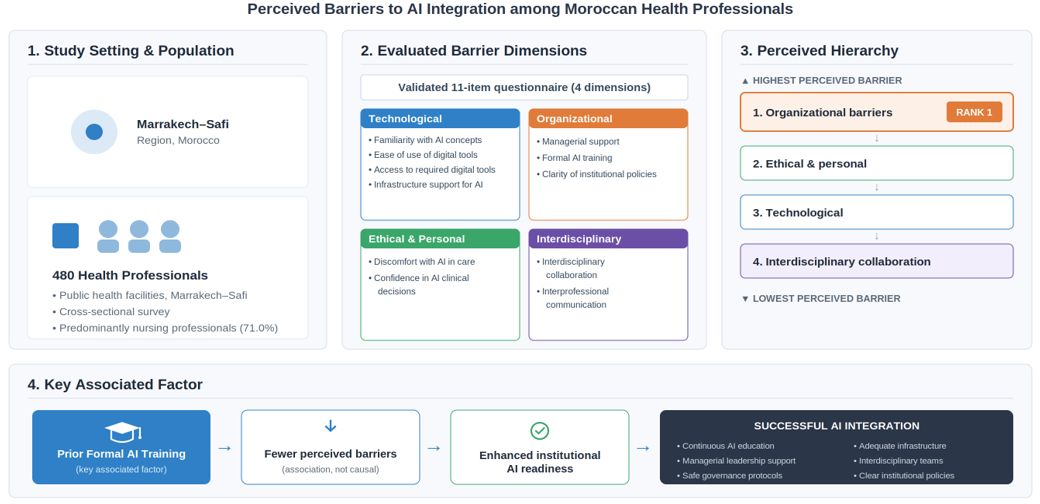
Artificial intelligence (AI) is increasingly promoted as a tool for improving health care delivery, yet successful implementation depends on workforce and organizational readiness. This cross-sectional analytical study assessed perceived barriers to AI integration and associated factors among 480 health care professionals working in public facilities in the Marrakech-Safi region of Morocco. Participants were recruited through professional and institutional networks and completed an anonymous electronic questionnaire. The final 11-item instrument measured technological, organizational, ethical and personal, and interdisciplinary collaboration barriers on a five-point scale, with higher scores indicating greater barriers. Organizational barriers had the highest mean score (3.36 ± 0.84), followed by ethical and personal barriers (2.69 ± 0.99), technological barriers (2.61 ± 0.76), and interdisciplinary collaboration barriers (2.25 ± 0.90). The overall score was 2.76 ± 0.64, and 80.2% of participants reported no prior formal AI training. In multivariable general linear models, prior formal AI training was the only factor significantly associated with all four dimensions and the overall score, with the largest effect sizes for organizational barriers (ηp2 = 0.326) and overall barriers (ηp2 = 0.148); these two estimates were attenuated (ηp2 = 0.088 and 0.078) in a sensitivity analysis excluding one scale item that overlapped conceptually with the training variable. Because of the cross-sectional, self-reported design, this association cannot be interpreted causally. Age, professional category, educational qualification, and department showed dimension-specific associations, whereas gender and professional experience were not independently associated after adjustment. These findings indicate that AI integration in Moroccan public health care is constrained primarily by organizational preparedness and limited training. Role-specific education, clear institutional policies, supportive leadership, and adequate digital infrastructure are therefore needed. Given the cross-sectional design and convenience sampling, causal inference and broad generalization should be approached with caution.
- Varnosfaderani SM, Forouzanfar M. The Role of AI in Hospitals and Clinics: Transforming Healthcare in the 21st Century. Bioengineering. 2024;11(4):337. doi:10.3390/bioengineering11040337
- Olawade DB, David-Olawade AC, Wada OZ, Asaolu AJ, Adereni T, Ling J. Artificial Intelligence in Healthcare Delivery: Prospects and Pitfalls. J Med Surg Public Health. 2024;3:100108. doi:10.1016/j.glmedi.2024.100108
- Pavuluri S, Sangal R, Sather J, and Taylor RA. Balancing act: the complex role of artificial intelligence in addressing burnout and healthcare workforce dynamics. BMJ Health Care Inform. 2024;31(1):e101120. doi:10.1136/bmjhci-2024-101120
- Rony MKK, Parvin MR, and Ferdousi S. Advancing nursing practice with artificial intelligence: Enhancing preparedness for the future. Nurs Open. 2023;11(1). doi:10.1002/nop2.2070
- Khan MS, Umer H, Faruqe F. Artificial intelligence for low income countries. Hum Soc Sciences Commun. 2024;11(1):1422. doi:10.1057/s41599-024-03947-w
- Wolniak R, Stecuła K. Artificial Intelligence in Smart Cities—Applications, Barriers, and Future Directions: A Review. Smart Cities. 2024;7(3):1346-1389. doi:10.3390/smartcities7030057
- WHO. Artificial Intelligence for Health. Published online May 27, 2024. Accessed August 7, 2026. https://www.who.int/publications/m/item/artificial-intelligence-for-health?
- OECD. Scaling Artificial Intelligence in Health. OECD Publishing; 2026. doi:10.1787/a436e12d-en
- Hassan M, Kushniruk A, Borycki E. Barriers to and Facilitators of Artificial Intelligence Adoption in Health Care: Scoping Review. JMIR Hum Factors. 2024;11:e48633. doi:10.2196/48633
- Khanijahani A, Iezadi S, Dudley S, Goettler M, Kroetsch P, Wise J. Organizational, professional, and patient characteristics associated with artificial intelligence adoption in healthcare: A systematic review. Health Policy Technol. 2022;11(1):100602. doi:10.1016/j.hlpt.2022.100602
- Ahmed MI, Spooner B, Isherwood J, et al. A Systematic Review of the Barriers to the Implementation of Artificial Intelligence in Healthcare. Cureus. 2023;15(10):e46454. doi:10.7759/cureus.46454
- Iqbal JD, Biller-Andorno N. The regulatory gap in digital health and alternative pathways to bridge it. Health Policy Technol. 2022;11(3):100663. doi:10.1016/j.hlpt.2022.100663
- Ayorinde A, Mensah DO, Walsh J, Ghosh I, Ibrahim SA, Hogg J, Peek N, Griffiths F. Health Care Professionals’ Experience of Using AI: Systematic Review With Narrative Synthesis. J Med Internet Res. 2024;26:e55766. doi:10.2196/55766
- Wang M, Huang K, Li X, Zhao X, Downey L, Hassounah S, Liu X, Jin Y, Ren M. Health workers’ adoption of digital health technology in low- and middle-income countries: a systematic review and meta-analysis. Bull World Health Organ. 2025;103(2):126-135F. doi:10.2471/BLT.24.292157
- Alotaibi N, Wilson CB, Traynor M. Enhancing digital readiness and capability in healthcare: a systematic review of interventions, barriers, and facilitators. BMC Health Serv Res. 2025;25:500. doi:10.1186/s12913-025-12663-3
- Badawy W, Zinhom H, Shaban M. Navigating ethical considerations in the use of artificial intelligence for patient care: A systematic review. Int Nurs Rev. 2025;72(3):e13059. doi:10.1111/inr.13059
- Mennella C, Maniscalco U, De Pietro G, Esposito M. Ethical and regulatory challenges of AI technologies in healthcare: A narrative review. Heliyon. 2024;10(4):e26297. doi:10.1016/j.heliyon.2024.e26297
- Agarwal R, Bjarnadottir M, Rhue L, Dugas M, Crowley K, Clark J, Gao G. Addressing algorithmic bias and the perpetuation of health inequities: An AI bias aware framework. Health Policy Technol. 2023;12(1):100702. doi:10.1016/j.hlpt.2022.100702
- Mohanasundari SK, Kalpana M, Madhusudhan U, et al. Can Artificial Intelligence Replace the Unique Nursing Role? Cureus. 2023. doi:10.7759/cureus.51150
- Rony MKK, Kayesh I, Bala SD, Akter F, Parvin MstR. Artificial intelligence in future nursing care: Exploring perspectives of nursing professionals - A descriptive qualitative study. Heliyon. 2024;10(4):e25718. doi:10.1016/j.heliyon.2024.e25718
- Bendowska A, Baum E. The Significance of Cooperation in Interdisciplinary Health Care Teams as Perceived by Polish Medical Students. Int J Environ Res Public Health. 2023;20(2):954. doi:10.3390/ijerph20020954
- Allam RM, Abdelfatah D, Khalil MIM, Elsaieed MM, El Desouky ED. Medical students and house officers’ perception, attitude and potential barriers towards artificial intelligence in Egypt, cross sectional survey. BMC Med Educ. 2024;24:1244. doi:10.1186/s12909-024-06201-8
- Azzam S, El-Morsy EMA, Said ASA, Eissa N, Khalil DM. Perception and awareness of healthcare professionals toward the applications of artificial intelligence in Egyptian healthcare settings. Front Artif Intell. 2026;8:1700493. doi:10.3389/frai.2025.1700493
- Itoe O, Tatsinkou Bomba FD, Kibu OD, et al. Healthcare providers’ perception and knowledge of the use of artificial intelligence in healthcare service delivery in the Limbe and Buea Health Districts: a cross-sectional study. Front Digit Health. 2025;7:1575633. doi:10.3389/fdgth.2025.1575633
- Mahdaoui M, Kissani N. Morocco’s Healthcare System: Achievements, Challenges, and Perspectives. Cureus. 2023;15(6):e41143. doi:10.7759/cureus.41143
- Yousif M, Asghar S, Akbar J, et al. Exploring the perspectives of healthcare professionals regarding artificial intelligence; acceptance and challenges. BMC Health Serv Res. 2024;24:1200. doi:10.1186/s12913-024-11667-9
- Benfatah M. Exploring the Barriers to Artificial Intelligence Integration in Nursing Practice: A Survey of Nurses. J Radiol Nurs. 2025;44(2):190-194. doi:10.1016/j.jradnu.2024.12.010
- Belharar O, Amrani S, Chakor A. Facilitators and barriers to the adoption of artificial intelligence by Moroccan nurses: An exploratory qualitative study. Policies Adm Mark J. 2025;1(1-2):83-103. doi:10.34874/PRSM.pamj-vol1iss1-2.5427
- MTNRA. stratégie “Digital Morocco 2030”. Ministère de la Transition Numérique et de la Réforme de l’Administration. Published online September 25, 2024. Accessed May 31, 2026. https://www.mmsp.gov.ma/fr/actualites/cliquez-ici-pour-d%C3%A9couvrir-la-strat%C3%A9gie-digital-morocco-2030
- Lambert SI, Madi M, Sopka S, Lenes A, Stange H, Buszello CP, Stephan A. An integrative review on the acceptance of artificial intelligence among healthcare professionals in hospitals. NPJ Digit Med. 2023;6:111. doi:10.1038/s41746-023-00852-5
- Nair M, Svedberg P, Larsson I, Nygren JM. A comprehensive overview of barriers and strategies for AI implementation in healthcare: Mixed-method design. PLoS ONE. 2024;19(8):e0305949. doi:10.1371/journal.pone.0305949
- Scipion CEA, Manchester MA, Federman A, Wang Y, Arias JJ. Barriers to and facilitators of clinician acceptance and use of artificial intelligence in healthcare settings: a scoping review. BMJ Open. 2025;15(4):e092624. doi:10.1136/bmjopen-2024-092624
- Henzler D, Schmidt S, Koçar A, Herdegen S, Lindinger GL, Maris MT, Bak MAR, Willems DL, Tan HL, Lauerer M, Nagel E, Hindricks G, Dagres N, Konopka MJ. Healthcare professionals’ perspectives on artificial intelligence in patient care: a systematic review of hindering and facilitating factors on different levels. BMC Health Serv Res. 2025;25:633. doi:10.1186/s12913-025-12664-2
- Arvai N, Katonai G, Mesko B. Health Care Professionals’ Concerns About Medical AI and Psychological Barriers and Strategies for Successful Implementation: Scoping Review. J Med Internet Res. 2025;27:e66986. doi:10.2196/66986
- Kimiafar K, Sarbaz M, Tabatabaei SM, Ghaddaripouri K, Mousavi AS, Raei Mehneh M, Mousavi Baigi SF. Artificial Intelligence Literacy Among Healthcare Professionals and Students: A Systematic Review. Front Health Inform. 2023;12:168. doi:10.30699/fhi.v12i0.524
- Hoffman J, Hattingh L, Shinners L, Angus RL, Richards B, Hughes I, Wenke R. Allied Health Professionals’ Perceptions of Artificial Intelligence in the Clinical Setting: Cross-Sectional Survey. JMIR Form Res. 2024;8:e57204. doi:10.2196/57204
- Kaushik A, Barcellona C, Mandyam NK, Tan SY, Tromp J. Challenges and Opportunities for Data Sharing Related to Artificial Intelligence Tools in Health Care in Low- and Middle-Income Countries: Systematic Review and Case Study From Thailand. J Med Internet Res. 2025;27:e58338. doi:10.2196/58338
- Sanchez-Gonzalez MA, Ascio NM, Shah O, Matejka A, Terrell M, Muddassir S. Feasibility of artificial intelligence-driven personalized learning for internal medicine residents: Integrating adaptive artificial intelligence in flipped classrooms. Artif Intell Health. 2025;2(4):139-145. doi:10.36922/AIH025130023
- Bolarinde SO, Akinsete FH, Okorocha L, Alli AR, Subulade AT. Knowledge and perceptions of Nigerian healthcare professionals on the adoption of artificial intelligence and machine learning in healthcare. Afr J Health Sci Technol. 2025;7(1):1-10. doi:10.5897/AJHST2024.0032
- Ong QC, Ang CS, Lai NM, Atun R, Car J. Differences in Expert Perspectives on AI Training in Medical Education: Secondary Analysis of a Multinational Delphi Study. J Med Internet Res. 2025;27:e72186. doi:10.2196/72186
- Alexander CA, Wang L. Effective metrics to detect and prioritize cyber incidents in healthcare. Artif Intell Health. 2026;3(3):025170035. doi:10.36922/AIH025170035