

Artificial intelligence in skin cancer diagnosis and prognosis: A comprehensive narrative review of current applications and future perspectives

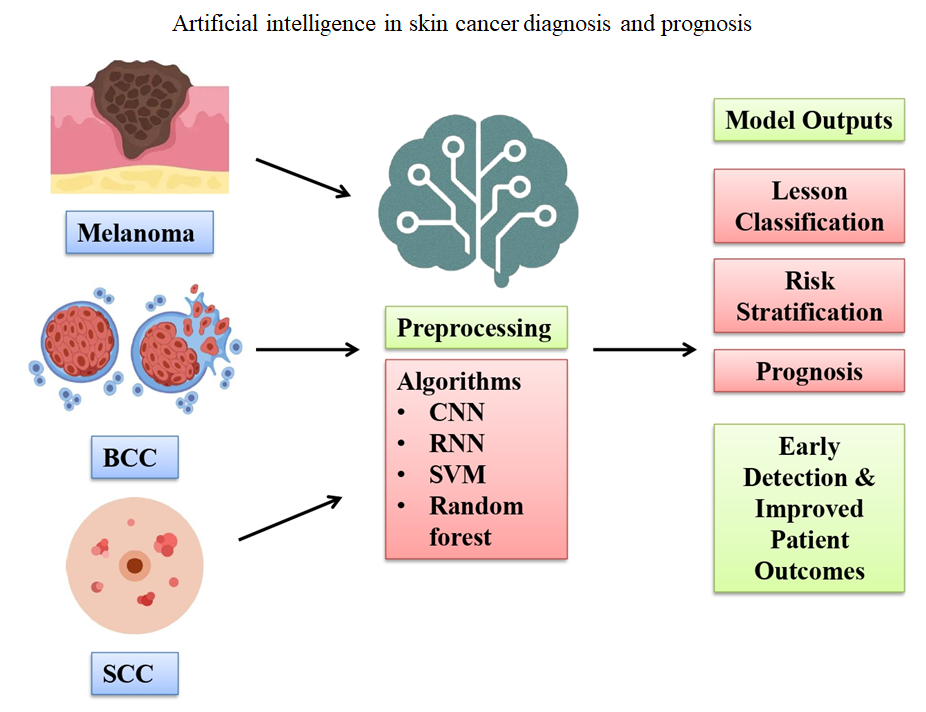
Skin cancer is among the most prevalent malignancies worldwide, and early, accurate diagnosis is crucial for improving patient outcomes. Recent advances in artificial intelligence (AI), particularly machine learning and deep learning, have shown substantial potential to enhance skin cancer detection, classification, and prognostic assessment. This review provides a comprehensive synthesis of current AI-based approaches for melanoma and non-melanoma skin cancers, highlighting methodological innovations and clinical applications. Literature from 2015 to 2025 was screened from PubMed/MEDLINE, Scopus, IEEE Xplore, and ScienceDirect, focusing on peer-reviewed studies reporting AI-driven diagnostic, classification, or prognostic outcomes. Deep learning models, especially convolutional neural networks, demonstrated high diagnostic performance in image-based skin cancer detection, often comparable to experienced dermatologists. AI has also shown promise in lesion segmentation, risk stratification, and prognostic modeling. However, challenges remain, including class imbalance, underrepresentation of darker skin tones, limited external validation, algorithmic opacity, and integration into clinical workflows. To enable broader clinical adoption, future research should prioritize diverse multicenter datasets, explainable AI systems, multimodal data integration, and prospective clinical validation studies. Overall, AI technologies offer significant potential to improve the accuracy and efficiency of skin cancer diagnosis and prognosis, but their translation into routine dermatological practice requires careful attention to reliability, equity, and interpretability.
- Kristensen I, Iversen IB, Fenger-Grøn M, et al. Occupational solar ultraviolet radiation and incidence of non-melanoma skin cancer in a nationwide cohort. Environ Pollut. 2025;386:127275. Volume X Issue X (2026) 18 doi: 10.36922/AIH025470106 doi: 10.1016/J.ENVPOL.2025.127275
- Roky AH, Islam MM, Ahasan AMF, et al. Overview of skin cancer types and prevalence rates across continents. Cancer Pathog Ther. 2025;3:89–100. doi: 10.1016/J.CPT.2024.08.002
- Savage DJ, Switzer B, Parikh R, et al. Patterns in progression from early-stage melanoma to late-stage melanoma: implications for survivorship follow-up. Melanoma Manag. 2024;11:2424708. doi: 10.1080/20450885.2024.2424708
- Kakish, D.R.K., Alsamhori, J.F., Qaqish, L.N, et al. Gender Disparities in Melanoma: Advances in Diagnosis, Treatment, and the Role of Artificial Intelligence. Dermatol Rev. 2025;6:e70022. doi: 10.1002/DER2.7002
- Zhao J, Zhang X, Tang Q, et al. The correlation between dermoscopy and clinical and pathological tests in the evaluation of skin photoaging. Ski Res Technol. 2024;30:e13578. doi: 10.1111/SRT.13578
- Skin cancer – IARC n.d. Available from: https://www.iarc.who.int/cancer-type/skin-cancer/ [Last accessed on April 1, 2026].
- Non-melanoma skin cancer statistics|Cancer Research UK n.d. Available from: https://www.cancerresearchuk.org/ health-professional/cancer-statistics/statistics-by-cancer-type/non-melanoma-skin-cancer [Last accessed on April 1, 2026].
- Melarkode N, Srinivasan K, Qaisar SM, Plawiak P. AI-Powered Diagnosis of Skin Cancer: A Contemporary Review, Open Challenges and Future Research Directions. Cancers. 2023;15:1183. doi: 10.3390/CANCERS15041183
- Garrison ZR, Hall CM, Fey RM, Clister T, Khan N, Nichols R, et al. Advances in Early Detection of Melanoma and the Future of At-Home Testing. Life. 2023;13:974. doi: 10.3390/LIFE13040974
- Fahim YA, Hasani IW, Kabba S, Ragab WM. Artificial intelligence in healthcare and medicine: clinical applications, therapeutic advances, and future perspectives. Eur J Med Res. 2025;30:848. doi: 10.1186/S40001-025-03196-W
- Akram N, Mattoo S, Qaddoura B, Karimaghaei D, Hamarsheh I, Radha S. Computer Vision in Lower Limb Orthopaedics: A Scoping Review of Imaging-Based Artificial Intelligence Applications. Cureus. 2025;17:e98648. doi: 10.7759/cureus.98648
- Górecki S, Tatka A, Brusey J. Artificial Intelligence and New Technologies in Melanoma Diagnosis: A Narrative Review. Cancers. 2025;17:3896. doi: 10.3390/cancers17243896
- Sengupta D. Artificial Intelligence in Diagnostic Dermatology: Challenges and the Way Forward. Indian Dermatol Online J. 2023;14:782. doi: 10.4103/IDOJ.IDOJ_462_23
- França RP, Borges Monteiro AC, Arthur R, Iano Y. An overview of deep learning in big data, image, and signal processing in the modern digital age. Trends in Deep Learning Methodologies: Algorithms, Applications, and Systems. 2020:63–87. doi: 10.1016/B978-0-12-822226-3.00003-9
- Yu Z, Liu JK, Jia S, et al. Toward the Next Generation of Retinal Neuroprosthesis: Visual Computation with Spikes. Engineering 2020;6:449–61. doi: 10.1016/j.eng.2020.02.004
- Bajwa J, Munir U, Nori A, Williams B. Artificial intelligence in healthcare: transforming the practice of medicine. Future Healthc J. 2021;8:e188. doi: 10.7861/FHJ.2021-0095
- Rashidi HH, Pantanowitz J, Hanna MG, et al. Introduction to Artificial Intelligence and Machine Learning in Pathology and Medicine: Generative and Nongenerative Artificial Intelligence Basics. Mod Pathol. 2025;38:100688. doi: 10.1016/J.MODPAT.2024.100688
- Mienye ID, Swart TG. A Comprehensive Review of Deep Learning: Architectures, Recent Advances, and Applications. Information. 2024;15:755. doi: 10.3390/INFO15120755
- Hermosilla P, Soto R, Vega E, Suazo C, Ponce J. Skin Cancer Detection and Classification Using Neural Network Algorithms: A Systematic Review. Diagnostics. 2024;14:454. doi: 10.3390/DIAGNOSTICS14040454
- Sadr H, Nazari M, Khodaverdian Z, et al. Unveiling the potential of artificial intelligence in revolutionizing disease diagnosis and prediction: a comprehensive review of machine learning and deep learning approaches. Eur J Med Res. 2025;30:418. doi: 10.1186/S40001-025-02680-7
- Davis LE, Shalin SC, Tackett AJ. Current state of melanoma diagnosis and treatment. Cancer Biol Ther. 2019;20:1366. doi: 10.1080/15384047.2019.1640032
- Das S, Dey MK, Devireddy R, Gartia MR. Biomarkers in Cancer Detection, Diagnosis, and Prognosis. Sensors. 2023;24:37. doi: 10.3390/S24010037
- Marrapodi R, Bellei B. The Keratinocyte in the Picture Cutaneous Melanoma Microenvironment. Cancers. 2024;16:913. doi: 10.3390/CANCERS16050913
- Lin T-L, Lee K-H, Karmakar R, et al. Artificial Intelligence- Assisted Dermatologic Screening: Epidemiology and Clinical Features of Basal Cell Carcinoma, Squamous Cell Carcinoma, Seborrheic Keratosis and Actinic Keratosis. Bioengineering. 2025;12:1258. doi: 10.3390/BIOENGINEERING12111258
- Najar Najafi N, Hajihassani H, Azimzadeh Irani M. The Impact of Artificial Intelligence on Cancer Diagnosis and Treatment: A Review. Cancer Inform 2025;24:11769351251371272. doi: 10.1177/11769351251371273
- Zhang B, Shi H, Wang H. Machine Learning and AI in Cancer Prognosis, Prediction, and Treatment Selection: A Critical Approach. J Multidiscip Healthc. 2023;16:1779. doi: 10.2147/JMDH.S410301
- Mao WB, Lyu JY, Vaishnani DK, et al. Application of artificial neural networks in detection and diagnosis of gastrointestinal and liver tumors. World J Clin Cases. 2020;8:3971. doi: 10.12998/wjcc.v8.i18.3971
- Güler F, Ağraz M. Investigation of Binary and Multiclass Classification Performance of Skin Cancer Images Using Transfer Learning Methods. J Clin Pract Res. 2025;47:235. doi: 10.14744/cpr.2025.27623
- Geradts Z, Filius N, Ruifrok A. Interpol review of imaging and video 2016–2019. Forensic Sci Int. 2020;2:540–62. doi: 10.1016/j.fsisyn.2020.01.017
- Hussein AA, Abdulazeez AM. A Review on Utilizing Machine Learning Classification Algorithms for Skin Cancer. J Appl Sci Technol Trends. 2024;5:60–71. doi: 10.38094/jastt52191
- Pennisi F, Borlini S, Harrison H, et al. Cancer Risk Prediction Using Machine Learning for Supporting Early Cancer Diagnosis in Symptomatic Patients: A Systematic Review of Model Types. Cancer Med. 2025;14:e71463. doi: 10.1002/cam4.71463
- Ahmed SF, Alam MS Bin, Hassan M, et al. Deep learning modelling techniques: current progress, applications, advantages, and challenges. Artif Intell Rev. 2023;56:13521–617. doi: 10.1007/s10462-023-10466-8
- Ali M, Dewan A, Sahu AK, Taye MM. Understanding of Machine Learning with Deep Learning: Architectures, Workflow, Applications and Future Directions. Computers. 2023;12:91. doi: 10.3390/COMPUTERS12050091
- Ahmad I, Alqurashi F. Early cancer detection using deep learning and medical imaging: A survey. Crit Rev Oncol Hematol. 2024;204:104528. doi: 10.1016/J.CRITREVONC.2024.104528
- Hussein AA, Montaser AM, Elsayed HA. Skin cancer image classification using hybrid quantum deep learning model with BiLSTM and MobileNetV2. Quantum Mach Intell. 2025;7:66. doi: 10.1007/s42484-025-00288-y
- Syafiandini AF, Wasito I, Yazid S, Fitriawan A, Amien M. Multimodal Deep Boltzmann Machines for feature selection on gene expression data. In: Proceedings of the 2016 International Conference on Advanced Computer Science and Information Systems, ICACSIS 2016 2017:407–12. doi: 10.1109/ICACSIS.2016.7872733
- Vinay S. Nalawade. Developing Improved Melanoma Detection Strategies Using Hybrid CNN and Autoencoder Models and Detailed Data Analysis. J Inf Syst Eng Manag. 2025;10:383–99. doi: 10.52783/jisem.v10i9s.1238
- Kiser AC, Shi J, Bucher BT. An Explainable Long Short-Term Memory Network for Surgical Site Infection Identification. Surgery. 2024;176:24. doi: 10.1016/j.surg.2024.03.006
- Han SS, Moon IJ, Kim SH, et al. Assessment of deep neural networks for the diagnosis of benign and malignant skin neoplasms in comparison with dermatologists: A retrospective validation study. PLoS Med. 2020;17:e1003381. doi: 10.1371/JOURNAL.PMED.1003381.
- Puri P, Comfere N, Drage LA, et al. Deep Learning for Dermatologists: Part II. Current Applications. J Am Acad Dermatol. 2020;87:1352. doi: 10.1016/j.jaad.2020.05.053.
- Farhi L, Kazmi SM, Imam H, Alqahtani M, Rehman FU. Dermoscopic Image Classification Using Deep Belief Learning Network Architecture. Wirel Commun Mob Comput. 2022;2022. doi: 10.1155/2022/2415726.
- Qureshi AS, Roos T. Transfer Learning with Ensembles of Deep Neural Networks for Skin Cancer Detection in Imbalanced Data Sets. Neural Process Lett. 2023;55:4461–79. doi: 10.1007/s11063-022-11049-4.
- Barata C, Rotemberg V, Codella NCF, et al. A reinforcement learning model for AI-based decision support in skin cancer. Nat Med. 2023;29:1941. doi: 10.1038/s41591-023-02475-5.
- Afza F, Sharif M, Khan MA, Tariq U, Yong HS, Cha J. Multiclass Skin Lesion Classification Using Hybrid Deep Features Selection and Extreme Learning Machine. Sensors. 2022;22:799. doi: 10.3390/s22030799.
- Patel RH, Foltz EA, Witkowski A, Ludzik J. Analysis of Artificial Intelligence-Based Approaches Applied to Non- Invasive Imaging for Early Detection of Melanoma: A Systematic Review. Cancers. 2023;15:4694. doi: 10.3390/CANCERS15194694
- Bhatt H, Shah V, Shah K, Shah R, Shah M. State-of-the-art machine learning techniques for melanoma skin cancer detection and classification: a comprehensive review. Intell Med. 2023;3:180–90. doi: 10.1016/j.imed.2022.08.004
- Brinker TJ, Hekler A, Enk AH, Berking C, Haferkamp S, Hauschild A, et al. Deep neural networks are superior to dermatologists in melanoma image classification. Eur J Cancer. 2019;119:11–7. doi: 10.1016/j.ejca.2019.05.023
- Esteva A, Kuprel B, Novoa RA, Ko J, Swetter SM, Blau HM, et al. Dermatologist-level classification of skin cancer with deep neural networks. Nature. 2017;542:115–8. doi: 10.1038/nature21056
- Usama M, Naeem MA, Mirza F. Multi-Class Skin Lesions Classification Using Deep Features. Sensors. 2022;22:8311. doi: 10.3390/s22218311
- Musthafa MM, T R M, V VK, Guluwadi S. Enhanced skin cancer diagnosis using optimized CNN architecture and checkpoints for automated dermatological lesion classification. BMC Med Imaging. 2024 24:1 2024;24:201. doi: 10.1186/s12880-024-01356-8
- Gouda W, Sama NU, Al-Waakid G, Humayun M, Jhanjhi NZ. Detection of Skin Cancer Based on Skin Lesion Images Using Deep Learning. Healthcare. 2022;10. doi: 10.3390/HEALTHCARE10071183
- Melbin K, Raj YJV. Integration of modified ABCD features and support vector machine for skin lesion types classification. Multimed Tools Appl. 2020;80:6 2020;80:8909–29. doi: 10.1007/s11042-020-10056-8
- Divya D, Ganeshbabu TR. Fitness adaptive deer hunting-based region growing and recurrent neural network for melanoma skin cancer detection. Int J Imaging Syst Technol. 2020;30:731–52. doi: 10.1002/ima.22414
- Nawaz M, Mehmood Z, Nazir T, et al. Skin cancer detection from dermoscopic images using deep learning and fuzzy k-means clustering. Microsc Res Tech. 2022;85:339–51. doi: 10.1002/jemt.23908
- Rezk E, Haggag M, Eltorki M, El-Dakhakhni W. A comprehensive review of artificial intelligence methods and applications in skin cancer diagnosis and treatment: Emerging trends and challenges. Healthcare Anal. 2023;4:100259. doi: 10.1016/J.HEALTH.2023.100259
- Brancaccio G, Balato A, Malvehy J, Puig S, Argenziano G, Kittler H. Artificial Intelligence in Skin Cancer Diagnosis: A Reality Check. J Investig Dermatol. 2024;144:492–9. doi: 10.1016/J.JID.2023.10.004
- Li Z, Koban KC, Schenck TL, Giunta RE, Li Q, Sun Y. Artificial Intelligence in Dermatology Image Analysis: Current Developments and Future Trends. J Clin Med. 2022;11:6826. doi: 10.3390/JCM11226826
- Chan B. Black-box assisted medical decisions: AI power vs. ethical physician care. Med Health Care Philos. 2023;26:285. doi: 10.1007/S11019-023-10153-Z
- Combalia M, Codella N, Rotemberg V, et al. Validation of artificial intelligence prediction models for skin cancer diagnosis using dermoscopy images: the 2019 International Skin Imaging Collaboration Grand Challenge. Lancet Digit Health. 2022;4:e330. doi: 10.1016/S2589-7500(22)00021-8
- Yadav N, Pandey S, Gupta A, Dudani P, Gupta S, Rangarajan K. Data Privacy in Healthcare: In the Era of Artificial Intelligence. Indian Dermatol Online J. 2023;14:788. doi: 10.4103/IDOJ.IDOJ_543_23
- Wei ML, Tada M, So A, Torres R. Artificial intelligence and skin cancer. Front Med. 2024;11:1331895. doi: 10.3389/FMED.2024.1331895/FULL
- Ahmed F, Naz NS, Khan S, Rehman AU, Ismael WM, Khan MA. Explainable artificial intelligence (XAI) in medical imaging: a systematic review of techniques, applications, and challenges. BMC Med Imaging. 2026;26:37. doi: 10.1186/S12880-025-02118-W
- Al-Waisy AS, Al-Fahdawi S, Khalaf MI, Mohammed MA, Al-Attar B, Al-Andoli MN. A deep learning framework for automated early diagnosis and classification of skin cancer lesions in dermoscopy images. Sci Rep. 2025 15:1 2025;15:31234-. doi: 10.1038/s41598-025-15655-9
- Parvin N, Joo SW, Jung JH, Mandal TK. Multimodal AI in Biomedicine: Pioneering the Future of Biomaterials, Diagnostics, and Personalized Healthcare. Nanomaterials. 2025;15:895. doi: 10.3390/nano15120895
- Okita AL, de Sousa RM, Rivero-Zavala EJ, et al. Development of an AI-Based Skin Cancer Recognition Model and Its Application in Enabling Patients to Self-Triage Their Lesions with Smartphone Pictures. Dermato. 2024;4:97–111. doi: 10.3390/dermato4030011
- Zhou J, Li H, Chen S, Chen Z, Han Z, Gao X. Large language models in biomedicine and healthcare. Npj Artif Intell. 2025;1:44. doi: 10.1038/s44387-025-00047-1
- Ribeiro Silva Fernandes T, Teles AS, Renan Neves Fernandes J, Daniel Batista Lima L, Lima Sousa D, de Castro Soares R, et al. External Validation of AI Models for Skin Diseases: A Systematic Review. IEEE Access. 2025;13:114411–27. doi: 10.1109/ACCESS.2025.3584904
- Yu Z, Xin C, Yu Y, Xia J, Han L. AI dermatology: Reviewing the frontiers of skin cancer detection technologies. Intell Oncol. 2025;1:89–104. doi: 10.1016/J.INTONC.2025.03.002
- Kurtansky NR, D’Alessandro BM, Gillis MC, et al. The SLICE-3D dataset: 400,000 skin lesion image crops extracted from 3D TBP for skin cancer detection. Sci Data. 2024;11. doi: 10.1038/S41597-024-03743-W
- Yu J, Cheong IH, Kozlakidis Z, Wang H. Advancements and challenges of artificial intelligence in dermatology: a review of applications and perspectives in China. Front Digit Health. 2025;7:1544520. doi: 10.3389/FDGTH.2025.1544520
- Ricci Lara MA, Rodríguez Kowalczuk MV, et al. A dataset of skin lesion images collected in Argentina for the evaluation of AI tools in this population. Sci Data. 2023;10. doi: 10.1038/S41597-023-02630-0
- Tschandl P, Rosendahl C, Kittler H. The HAM10000 dataset, a large collection of multi-source dermatoscopic images of common pigmented skin lesions. Sci Data. 2018;5:180161. doi: 10.1038/SDATA.2018.161
- Accurate and Scalable System for Automatic Detection of Malignant Melanoma. Dermoscopy Image Anal. 2015:309– 60. doi: 10.1201/B19107-14
- Somfai E, Baffy B, Fenech K, et al. Handling dataset dependence with model ensembles for skin lesion classification from dermoscopic and clinical images. Int J Imaging Syst Technol. 2023;33:556–71. doi: 10.1002/IMA.22827
- Cahyanto KA, Adi K, Widodo CE. The L2-EffCANet: A Novel Overfitting-Resistant EfficientNetV2S with Attention Mechanism and L2 Regularization for Skin Disease Classification. Int J Online Biomed Eng. 2025;21:113–129. doi: 10.3991/IJOE.V21I13.57417
- Pollastri F, Parreño M, Maroñas J, Bolelli F, Paredes R, Ramos D, et al. A deep analysis on high-resolution dermoscopic image classification. IET Computer Vision. 2021;15:514–526. doi: 10.1049/CVI2.12048;PAGE:STRING:ARTICLE/ CHAPTER
- Jeong HK, Park C, Henao R, Kheterpal M. Deep Learning in Dermatology: A Systematic Review of Current Approaches, Outcomes, and Limitations. JID Innov. 2022;3:100150. doi: 10.1016/J.XJIDI.2022.100150
- Li Y, Taylor M, Chmielinski KS, Halpern AC, Daneshjou R, Lester JC, et al. Improving dataset transparency in dermatologic Artificial Intelligence using a dataset nutrition label. NPJ Digit Med. 2025;8:641. doi: 10.1038/S41746-025-02125-9
- Wang M, Chang W, Zhang Y. Artificial Intelligence for the Diagnosis and Management of Cancers: Potentials and Challenges. MedComm. 2025;6:e70460. doi: 10.1002/MCO2.70460
- Abd-Alrazaq A, Solaiman B, Mekki YM, Al-Thani D, Farooq F, Alkubeyyer M, et al. Hype vs Reality in the Integration of Artificial Intelligence in Clinical Workflows. JMIR Form Res. 2025;9:e70921. doi: 10.2196/70921
- Das A, Agarwal V, Shetty NP. Comparative analysis of multimodal architectures for effective skin lesion detection using clinical and image data. Front Artif Intell. 2025;8:1608837. doi: 10.3389/FRAI.2025.1608837/BIBTEX
- Behara K, Bhero E, Agee JT. AI in dermatology: a comprehensive review into skin cancer detection. PeerJ Comput Sci. 2024;10:1–42. doi: 10.7717/PEERJ-CS.2530/SUPP-1
- Alipour N, Burke T, Courtney J. Skin Type Diversity in Skin Lesion Datasets: A Review. Curr Dermatol Rep. 2024;13:198. doi: 10.1007/S13671-024-00440-0
- Fehr J, Citro B, Malpani R, Lippert C, Madai VI. A trustworthy AI reality-check: the lack of transparency of artificial intelligence products in healthcare. Front Digit Health. 2024;6:1267290. doi: 10.3389/FDGTH.2024.1267290/FULL
- Fu L, Jia G, Liu Z, Pang X, Cui Y. The applications and advances of artificial intelligence in drug regulation: A global perspective. Acta Pharm Sin B. 2025;15:1–14. doi: 10.1016/J.APSB.2024.11.006
- Park AJ, Weintraub GS, Asgari MM. Leveraging the electronic health record to improve dermatologic care delivery: The importance of finding structure in data. J Am Acad Dermatol. 2019;82:773. doi: 10.1016/J.JAAD.2019.10.064
- Nisevic M, Milojevic D, Spajic D. Synthetic data in medicine: Legal and ethical considerations for patient profiling. Comput Struct Biotechnol J. 2025;28:190–8. doi: 10.1016/J.CSBJ.2025.05.026
- Singh S, Raucci A, Glovi A, Iula G, Mutti L, De Laurentiis M, et al. Socioeconomic impact of artificial intelligence– driven point-of-care testing devices for liquid biopsy in the OncoCheck system. Cancer Metastasis Rev. 2025;44:64. doi: 10.1007/S10555-025-10281-3
- Cugliari G, Bodini M, Zbrzezny AM, Krzywicki T. Artificial Intelligence in Dermatology: A Review of Methods, Clinical Applications, and Perspectives. Appl Sci. 2025;15:7856. doi: 10.3390/APP15147856
- Patel JC, Shukla M, Shukla M. From bench to bedside: translating mesenchymal stem cell therapies through preclinical and clinical evidence. Front Bioeng Biotechnol. 2025;13:1639439. doi: 10.3389/FBIOE.2025.1639439
- Eapen BR. Artificial Intelligence in Dermatology: A Practical Introduction to a Paradigm Shift. Indian Dermatol Online J. 2020;11:881. doi: 10.4103/IDOJ.IDOJ_388_20