

Vision-language models in transthoracic echocardiography: A narrative mini-review of promise and challenges

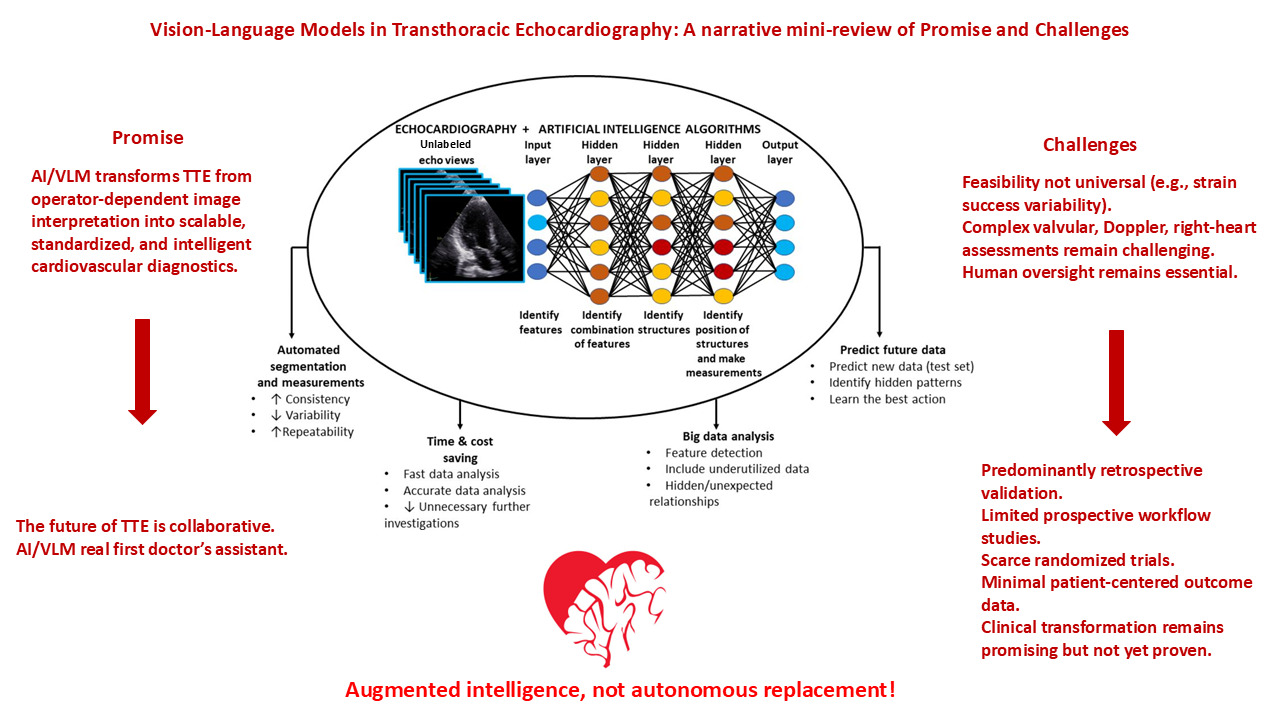
Echocardiography remains the cornerstone of non-invasive cardiac imaging. For patients with suspected or known cardiac disease—including heart failure, cardiomyopathies, valvular heart disease, or ischemic heart disease—transthoracic echocardiography (TTE) enables assessment of cardiac structure, function, valves, and hemodynamic. However, TTE interpretation is often labor-intensive, operator-dependent, and subject to inter- and intra-observer variability. Recently, advancements in deep learning (DL) and artificial intelligence (AI) have yielded automated or semi-automated tools for echocardiographic tasks, such as view classification, chamber segmentation, quantification of volumes and ejection fraction, and even detection of pathological patterns. The latest generation of AI—namely vision-language models (VLMs) and foundation models trained on vast datasets of echocardiogram videos paired with clinical reports—promise to push boundaries further: from isolated measurements to comprehensive, report-level interpretation of entire TTE studies. In this narrative mini-review, we examine whether, in patients undergoing TTE, the use of large VLMs vs standard echocardiographer interpretation without AI can improve diagnostic accuracy, report quality, efficiency, reduce variability, and maintain safety. We appraise current evidence, highlight strengths and limitations, and discuss future perspectives and challenges.
- Christensen M, Vukadinovic M, Yuan N, et al. Vision-language foundation model for echocardiogram interpretation. Nat Med. 2024;30(5):1481-1488. doi: 10.1038/s41591-024-02959-y
- Vukadinovic M, Chiu IM, Tang X, et al. Comprehensive echocardiogram evaluation with view-primed vision language AI. Nature. 2026;650:970–977. doi: 10.1038/s41586-025-09850-x
- Aziz D, Maganti K, Yanamala N, Sengupta P. The role of artificial intelligence in echocardiography: a clinical update. Curr Cardiol Rep. 2023;25(12):1897-1907. doi: 10.1007/s11886-023-02005-2
- Akkus Z, Aly YH, Attia IZ, et al. Artificial intelligence (AI)- empowered echocardiography interpretation: a state-of-the-art review. J Clin Med. 2021;10(7):1391. doi: 10.3390/jcm10071391
- Zhang J, Gajjala S, Agrawal P, et al. Fully automated echocardiogram interpretation in clinical practice. Circulation. 2018;138(16):1623-1635. doi: 10.1161/circulationaha.118.034338
- Shiokawa N, Izumo M, Shimamura T, et al. Accuracy and efficacy of artificial intelligence-derived automatic measurements of transthoracic echocardiography in routine clinical practice. J Clin Med. 2024;13(7):1861. doi: 10.3390/jcm13071861
- Salte IM, Østvik A, Olaisen SH, et al. Deep learning for improved precision and reproducibility of left ventricular strain in echocardiography: a test-retest study. J Am Soc Echocardiogr. 2023;36(7):788-799. doi: 10.1016/j.echo.2023.02.017
- Sveric KM, Botan R, Dindane Z, et al. Single-site experience with an automated artificial intelligence application for left ventricular ejection fraction measurement in echocardiography. Diagnostics. 2023;13(7):1298. doi: 10.3390/diagnostics13071298
- Holste G, Oikonomou EK, Tokodi M, et al. Complete AI-enabled echocardiography interpretation with multitask deep learning. JAMA. 2025;334(4):306-318. doi: 10.1001/jama.2025.8731
- Baggiano A, Mushtaq S, Fusini L, et al. Artificial intelligence in cardiovascular imaging: current applications and new horizons. J Cardiovasc Echogr. 2025;35(2):97-107. doi: 10.4103/jcecho.jcecho_62_25
- Vukadinovic M, Tang X, Yuan N, Cheng P, Li D, Cheng S, et al. EchoPrime: A Multi-Video View-Informed Vision- Language Model for Comprehensive Echocardiography Interpretation. arXiv. Preprint posted online 2024. doi: 10.48550/arXiv.2410.09704
- Jiang J, Liu B, Li YW, Hothi SS. Clinical service evaluation of the feasibility and reproducibility of novel artificial intelligence-based echocardiographic quantification of global longitudinal strain and left ventricular ejection fraction in trastuzumab-treated patients. Front Cardiovasc Med. 2023;10:1250311. doi: 10.3389/fcvm.2023.1250311
- Li X, Liao L, Wu K, et al. An automatic and real-time echocardiography quality scoring system based on deep learning to improve reproducible assessment of left ventricular ejection fraction. Quant Imaging Med Surg. 2025;15(1):770-785. doi: 10.21037/qims-24-512
- Karuzas A, Ciampi Q, Kazukauskiene I, et al. Stress Echo 2030 Study Group of the Italian Society of Echocardiography and Cardiovascular Imaging. Artificial intelligence implementation in automated heart chambers quantification during pharmacological stress echocardiography. Eur Heart J Digit Health. 2025;6:ztaf121. doi: 10.1093/ehjdh/ztaf121
- Karakuş G, Değirmencioğlu A, Nanda NC. Artificial intelligence in echocardiography: review and limitations including epistemological concerns. Echocardiography. 2022;39(8):1044-1053. doi: 10.1111/echo.15417
- Sahashi Y, Ieki H, Yuan V, et al. Artificial intelligence automation of echocardiographic measurements. medRxiv. Preprint posted online March 19, 2025. doi: 10.1016/j.jacc.2025.07.053
- GE HealthCare. The role of artificial intelligence in streamlining echocardiography quantification. Published 2022. Available from: https://www.gehealthcare.com/-/jssmedia/gehc/ us/files/products/ultrasound/vivid/redesign/resources/ whitepaper_the-role-of-artificial-intelligence__jb20789xx. pdf ?srslt id=AfmBOoqKbWqidwnxAiBIu9R1yZP dzn1KD55Ez_RPj94u5E03ig48-yTa [Last accessed on February 28, 2026].
- Philips Healthcare. AI ultrasound technology: technical description. Published 2025. Available from: https://www. philips.com.eg/healthcare/technology/ai-ultrasound [Last accessed on February 28, 2026].
- Venneri L, Aimo A, Porcari A, et al. Artificial intelligence-based echocardiographic assessment for monitoring disease progression in transthyretin cardiac amyloidosis. Eur J Heart Fail. 2025; 27(12):3392-3400. doi: 10.1002/ejhf.70073
- Chiu IM, Vukadinovic M, Sahashi Y, et al. Automated evaluation for pericardial effusion and cardiac tamponade with echocardiographic artificial intelligence. medRxiv. Preprint posted online 2024. doi: 10.1101/2024.11.27.24318110
- Ieki H, Sahashi Y, Vukadinovic M, et al. Comprehensive aortic stenosis characterization using multi-view deep learning. medRxiv. Preprint posted online 2025. doi: 10.1101/2025.09.26.25336778
- van der Boon RMA, Karper JC. Transforming echocardiography with artificial intelligence. Neth Heart J. 2025;33(10):319-321. doi: 10.1007/s12471-025-01987-8
- Raissi-Dehkordi N, Raissi-Dehkordi N, Xu B. Contemporary applications of artificial intelligence and machine learning in echocardiography. npj Cardiovasc Health. 2025;2:30. doi: 10.1038/s44325-025-00064-8
- Sakamoto A, Kaneko T, Sato E, et al. Artificial intelligence in echocardiography: current applications and future perspectives. J Echocardiogr. 2025;23(4):231-240. doi: 10.1007/s12574-025-00703-0
- Liu Y, Zhao L, Tu B, Wang J, He Y, Jiang R, et al. Application of artificial intelligence in echocardiography from 2009 to 2024: a bibliometric analysis. Front Med. 2025;12:1587364. doi: 10.3389/fmed.2025.1587364
- Hollitt KJ, Milanese S, Joseph M, Perry R. Can automation and artificial intelligence reduce echocardiography scan time and ultrasound system interaction? Echo Res Pract. 2025;12(1):11. doi: 10.1186/s44156-025-00077-0
- Lafitte S, Lafitte L, Jonveaux M, Pascual Z, Ternacle J, Dijos M, Bonnet G, Reant P, Bernard A. Integrating artificial intelligence into an echocardiography department: Feasibility and comparative study of automated versus human measurements in a high-volume clinical setting. Arch Cardiovasc Dis. 2025;118(8-9):477-488. doi: 10.1016/j.acvd.2025.04.051
- Hirata Y, Kusunose K. AI in echocardiography: state-of-the-art automated measurement techniques and clinical applications. JMA J. 2025;8(1):141-150. doi: 10.31662/jmaj.2024-0180
- Maturi B, Dulal S, Sayana SB, Ibrahim A, Ramakrishna M, Chinta V, Sharma A, Ravipati H. Revolutionizing Cardiology: The Role of Artificial Intelligence in Echocardiography. J Clin Med. 2025;14(2):625. doi: 10.3390/jcm14020625
- Naser JA, Lee E, Pislaru SV, et al. Artificial intelligence-based classification of echocardiographic views. Eur Heart J Digit Health. 2024;5(3):260-269. doi: 10.1093/ehjdh/ztae015
- Hu X, Zhu Y, Zhang Z, et al. Explainable artificial intelligence in echocardiography. Adv Ultrasound Diagn Ther. 2025;9(4):409-425. doi: 10.26599/AUDT.2025.250089
- Qayyum S. A comprehensive review of applications of artificial intelligence in echocardiography. Curr Probl Cardiol. 2024;49(2):102250. doi: 10.1016/j.cpcardiol.2023.102250
- Liao M, Lian Y, Yao Y, et al. Left ventricle segmentation in echocardiography with transformer. Diagnostics. 2023;13(14):2365. doi: 10.3390/diagnostics13142365
- Nemri S, Duong L. Automatic segmentation of echocardiographic images using a shifted windows vision transformer architecture. Biomed Phys Eng Express. 2024;10(6):065017. doi: 10.1088/2057-1976/ad7594
- Huang KC, Lin CE, Lin DSH, et al. Video transformer for segmentation of echocardiography images in myocardial strain measurement. J Imaging Informatics Med. 2025. doi: 10.1007/s10278-025-01682-5
- Chung DJ, Lee SM, Kaker V, et al. Echocardiogram vector embeddings via R3D transformer for the advancement of automated echocardiography. JACC Adv. 2024;3(9):101196. doi: 10.1016/j.jacadv.2024.101196
- Seetharam K, Thyagaturu H, Lora Ferreira G, et al. Broadening perspectives of artificial intelligence in echocardiography. Cardiol Ther. 2024;13(2):267-279. doi: 10.1007/s40119-024-00368-3