

Reinforcement and federated learning for privacy-preserving glucose regulation: A review

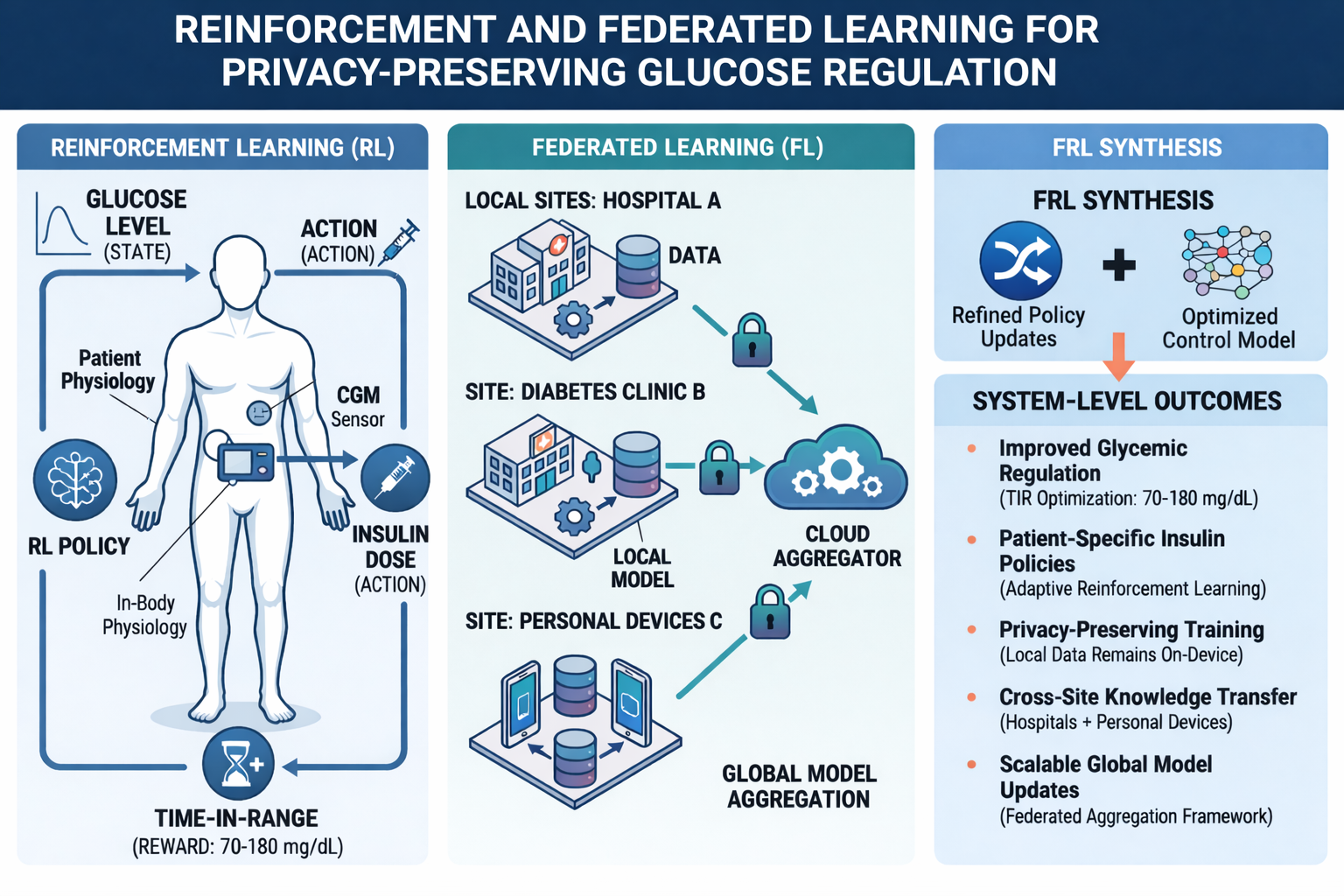
Type 1 diabetes mellitus (T1DM) requires continuous monitoring of blood glucose levels and careful insulin dosing to maintain safe glycemic control. Reinforcement learning (RL) has emerged as a promising approach for automated glucose regulation in T1DM by enabling adaptive insulin dosing through sequential decision-making. However, real-world deployment remains constrained by safety requirements, inter-patient variability, limited clinical data, and strict privacy regulations that hinder centralized model development. This review aims to synthesize recent advances in RL-based automated insulin delivery (AID) and examine how federated learning (FL) can enable privacy-preserving personalization across distributed clinical and device data. We organize the literature into key themes, including: (i) online RL controllers developed primarily in simulation environments, (ii) offline RL methods that learn dosing policies from logged glucose-insulin trajectories (e.g., batch-constrained and conservative value-learning approaches), (iii) safety-aware strategies aimed at minimizing hypoglycemia risk and improving robustness under practical disturbances, and (iv) hybrid architectures integrating glucose prediction and control. We further discuss FL designs for personalization in heterogeneous, non-identically distributed patient data and highlight their relevance to diabetes management. Across the studies reviewed, most reinforcement learning approaches for glucose control are evaluated in simulation environments, while only a limited number use real-world clinical or continuous glucose monitoring (CGM) datasets. Federated learning studies are emerging for privacy-preserving personalization, and only a small subset of works currently explore hybrid RL–FL or federated reinforcement learning frameworks. Finally, we identify open challenges related to sim-to-real generalization, clinical validation, interpretability, scalability, and privacy risks in distributed learning, and outline future directions for robust, clinically viable next-generation diabetes management systems.
- Alberti KGMM, Zimmet PZ. Definition, diagnosis and classification of diabetes mellitus and its complications. Part 1: diagnosis and classification of diabetes mellitus. Provisional report of a WHO Consultation. Diabet Med. 1998;15(7):539-553. doi: 10.1002/(SICI)1096-9136(199807)15:7<539::AID-DIA668>3.0.CO;2-S
- World Health Organization. Diabetes.Available from https://www.who.int/health-topics/diabetes [Last accessed on January 28, 2026].
- Singh A. Basal-bolus injection regimen. Diabetes. Updated 2023. Available from https://www.diabetes.co.uk/insulin/basal-bolus.html [Last accessed on January 28, 2026].
- Digitale E. New research keeps diabetics safer during sleep. Stanford Medicine. 2014. Available from https://med.stanford.edu/news/insights/2014/05/new-research-keeps-diabetics-safer-during-sleep.html [Last accessed on January 28, 2026].
- The Diabetes Control and Complications Trial Research Group. Resource utilization and costs of care in the diabetes control and complications trial. Diabetes Care. 1995;18(11):1468–1478. doi: 10.2337/diacare.18.11.1468
- Snell-Bergeon JK, Wadwa RP. Hypoglycemia, diabetes, and cardiovascular disease. Diabetes Technol Ther. 2012;14(S1):S51–S58. doi: 10.1089/dia.2012.0031
- Sumner CJ, Sheth S, Griffin JW, Cornblath DR, Polydefkis M. The spectrum of neuropathy in diabetes and impaired glucose tolerance. Neurology. 2003;60(1):108–111. doi: 10.1212/WNL.60.1.108
- Coffen RD, Dahlquist LM. Magnitude of type 1 diabetes self-management in youth: health care needs diabetes educators. Diabetes Educ. 2009;35(2):302–308. doi: 10.1177/0145721708327534
- Raheb MA, Niazmand VR, Eqra N, Vatankhah R. Subcutaneous insulin administration by deep reinforcement learning for blood glucose level control of type 2 diabetic patients. Comput Biol Med. 2022;148:105860. doi: 10.1016/j.compbiomed.2022.105860
- Sherwood A. Can you reverse type 2 diabetes? WebMD. Updated 2024. Available from: https://www.webmd.com/diabetes/can-you-reverse-type-2-diabetes [Last accessed on January 28, 2026].
- Piras de Oliveira C, Mitchell BD, Fan L, et al. Patient perspectives on the use of half-unit insulin pens by people with type 1 diabetes: a cross-sectional observational study. Curr Med Res Opin. 2021;37(1):45–51. doi: 10.1080/03007995.2020.1843423
- Forlenza GP, Lal RA. Current status and emerging options for automated insulin delivery systems. Diabetes Technol Ther. 2022;24(5):362–371. doi: 10.1089/dia.2021.0514
- Sherr JL, Cengiz E, Palerm CC, et al. Reduced hypoglycemia and increased time in target using closed-loop insulin delivery during nights with or without antecedent afternoon exercise in type 1 diabetes. Diabetes Care. 2013;36(10):2909– 2914. doi: 10.2337/dc13-0010
- Shin J, Badgwell TA, Liu KH, Lee JH. Reinforcement learning – overview of recent progress and implications for process control. Comput Chem Eng. 2019;127:282–294. doi: 10.1016/j.compchemeng.2019.05.029
- Sutton RS, Barto AG. Reinforcement Learning: An Introduction. 2nd ed. MIT Press; 2018. Available from https://web.stanford.edu/class/psych209/Readings/SuttonBartoIPRLBook2ndEd.pdf [Last accessed on January 28, 2026].
- Fox I, Lee J, Pop-Busui R, Wiens J. Deep reinforcement learning for closed-loop blood glucose control. In: Proceedings of the 5th Machine Learning for Healthcare Conference. 2020;126:508–536. Available from https://proceedings.mlr.press/v126/fox20a.html [Last accessed on January 28, 2026].
- Wilinska ME, Chassin LJ, Acerini CL, Allen JM, Dunger DB, Hovorka R. Simulation environment to evaluate closed-loop insulin delivery systems in type 1 diabetes. J Diabetes Sci Technol. 2010;4(1):132–144. doi: 10.1177/193229681000400117
- Shan Y, Yu J. Non-invasive blood glucose monitoring via multimodal features fusion with interpretable machine learning. Appl Sci. 2026;16(2):790. doi: 10.3390/app16020790
- Tassa Y, Doron Y, Muldal A, et al. DeepMind control suite. arXiv. Preprint posted online 2018. doi: 10.48550/arXiv.1801.00690
- Ahmad S, Beneyto A, Zhu T, Contreras I, Georgiou P, Vehi J. An automatic deep reinforcement learning bolus calculator for automated insulin delivery systems. Sci Rep. 2024;14(1):15245. doi: 10.1038/s41598-024-62912-4
- Man CD, Micheletto F, Lv D, Breton M, Kovatchev B, Cobelli C. The UVA/PADOVA type 1 diabetes simulator: new features. J Diabetes Sci Technol. 2014;8(1):26–34. doi: 10.1177/1932296813514502
- De Ferdinando MD, Pepe P, De Gennaro S, Palumbo P. Sampled-data static output feedback control of the glucose-insulin system. IFAC PapersOnLine. 2020;53(2):3626–3631. doi: 10.1016/j.ifacol.2020.12.2044
- Lehmann ED, Deutsch T. A physiological model of glucose-insulin interaction in type 1 diabetes mellitus. J Biomed Eng. 1992;14(3):235–242. doi: 10.1016/0141-5425(92)90058-S
- Shifrin M, Siegelmann H. Near-optimal insulin treatment for diabetes patients: a machine learning approach. Artif Intell Med. 2020;107:101917. doi: 10.1016/j.artmed.2020.101917
- Lee J, Kim S, Park SW, Jin SM, Park SM. Toward a fully automated artificial pancreas system using a bioinspired reinforcement learning design: in silico validation. IEEE J Biomed Health Inform. 2021;25(2):536–546. doi: 10.1109/JBHI.2020.3002022
- Bequette BW. Glucose clamp algorithms and insulin time-action profiles. J Diabetes Sci Technol. 2009;3(5):1005–1013. doi: 10.1177/193229680900300503
- Hovorka R, Shojaee-Moradie F, Carroll PV, Chassin LJ, Gowrie IJ, Jackson NC, et al. Partitioning glucose distribution, transport, disposal, and endogenous production during IVGTT. Am J Physiol Endocrinol Metab. 2002;282(5):E992–E1007. doi: 10.1152/ajpendo.00304.2001
- Schulman J, Wolski F, Dhariwal P, Radford A, Klimov O. Proximal policy optimization algorithms. arXiv. Preprint posted online 2017. doi: 10.48550/arXiv.1707.06347
- Marchetti A, Sasso D, D’Antoni F, et al. Deep reinforcement learning for type 1 diabetes: dual PPO controller for personalized insulin management. Comput Biol Med. 2025;191:110147. doi: 10.1016/j.compbiomed.2025.110147
- Zhao YF, Chaw JK, Ang MC, et al. A safe-enhanced fully closed-loop artificial pancreas controller based on deep reinforcement learning. PLoS ONE. 2025;20(1):e0317662. doi: 10.1371/journal.pone.0317662
- Lange S, Gabel T, Riedmiller M. Batch reinforcement learning. In: Wiering, M., van Otterlo, M. (eds) Reinforcement Learning. Adaptation, Learning, and Optimization. Springer; 2012;12:45–73. doi: 10.1007/978-3-642-27645-3_2
- Levine S, Kumar A, Tucker G, Fu J. Offline reinforcement learning: tutorial, review, and perspectives on open problems. arXiv. Preprint posted online 2020. doi: 10.48550/arXiv.2005.01643
- Emerson H, Guy M, McConville R. Offline reinforcement learning for safer blood glucose control in people with type 1 diabetes. J Biomed Inform. 2023;142:104376. doi: 10.1016/j.jbi.2023.104376
- Fujimoto S, Meger D, Precup D. Off-policy deep reinforcement learning without exploration. In: Proceedings of the 36th International Conference on Machine Learning; 2019;97:2052–2062. Available from: https://proceedings.mlr.press/v97/fujimoto19a.html [Last accessed on January 28, 2026].
- Kumar A, Zhou A, Tucker G, Levine S. Conservative Q-Learning for offline reinforcement learning. arXiv. Preprint posted online 2020. doi: 10.48550/arXiv.2006.04779
- Fujimoto S, Gu SS. A minimalist approach to offline reinforcement learning. arXiv. Preprint posted online 2021. doi: 10.48550/arXiv.2106.06860
- Emerson H, James SG, Guy M, McConville R. Flexible blood glucose control: Offline reinforcement learning from human feedback. arXiv. Preprint posted online 2025. doi: 10.48550/arXiv.2501.15972
- Mnih V, Kavukcuoglu K, Silver D, et al. Human-level control through deep reinforcement learning. Nature. 2015;518(7540):529–533. doi: 10.1038/nature14236
- Van Hasselt H, Guez A, Silver D. Deep reinforcement learning with double Q-learning. Proc Conf AAAI Artif Intel. 2016;30(1):2094–2100. doi: 10.1609/aaai.v30i1.10295
- Wang Z, Schaul T, Hessel M, Hasselt H, Lanctot M, Freitas N. Dueling network architectures for deep reinforcement learning. In: Proceedings of The 33rd International Conference on Machine Learning. 2016;48:1995–2003. Available from: https://proceedings.mlr.press/v48/wangf16.html [Last accessed on January 28, 2026].
- Schaul T, Quan J, Antonoglou I, Silver D. Prioritized experience replay. arXiv. Preprint posted online 2016. doi: 10.48550/arXiv.1511.05952
- Hessel M, Modayil J, Van Hasselt H, Schaul T, Ostrovski G, Dabney W, et al. Rainbow: combining improvements in deep reinforcement learning. Proc Conf AAAI Artif Intell. 2018;32(1):3215–3222. doi: 10.1609/aaai.v32i1.11796
- Bellemare MG, Dabney W, Munos R. A distributional perspective on reinforcement learning. In: Proceedings of the 34th International Conference on Machine Learning; 2017:70:449–458. Available from: https://proceedings.mlr. press/v70/bellemare17a.html [Last accessed on January 28, 2026].
- Wang S, Gu W. An improved strategy for blood glucose control using multi-step deep reinforcement learning. In: Proceedings of the 2024 16th International Conference on Bioinformatics and Biomedical Technology. ACM; 2024:196-203. doi: 10.1145/3674658.3674689
- Symeonidis P, Rizos E, Andras C, Hairistanidis S, Manolopoulos Y, Zanker M. Deep reinforcement learning for personalized insulin dosing and glucose control of hospitalized ICU patients. Int J Data Sci Anal. 2025;20(7):6841–6854. doi: 10.1007/s41060-025-00857-1
- Beolet T, Adenis A, Huneker E, Louis M. End-to-end offline reinforcement learning for glycemia control. Artif Intell Med. 2024;154:102920. doi: 10.1016/j.artmed.2024.102920
- Hettiarachchi C, Malagutti N, Nolan CJ, Suominen H, Daskalaki E. G2P2C: a modular reinforcement learning algorithm for glucose control by glucose prediction and planning in type 1 diabetes. Biomed Signal Process Control. 2024;90:105839. doi: 10.1016/j.bspc.2023.105839
- Adjevi A, Abdirashid AM, Aktaş F, Ucar MHB, Solak S. Explainable reinforcement learning for glucose monitoring based on Shapley value analysis. Comput Methods Programs Biomed. 2026;278:109266. doi: 10.1016/j.cmpb.2026.109266
- Jaloli M, Cescon M. Basal–bolus advisor for type 1 diabetes patients using multi-agent reinforcement learning methodology. Control Eng Pract. 2024;142:105762. doi: 10.1016/j.conengprac.2023.105762
- Dénes-Fazakas L, Szilágyi L, Kovács L, De Gaetano A, Eigner G. Reinforcement learning: a paradigm shift in personalized blood glucose management for diabetes. Biomedicines. 2024;12(9):2143. doi: 10.3390/biomedicines12092143
- Dulac-Arnold G, Levine N, Mankowitz DJ, et al. Challenges of real-world reinforcement learning: definitions, benchmarks and analysis. Mach Learn. 2021;110(9):2419- 2468. doi: 10.1007/s10994-021-05961-4
- Packer C, Gao K, Kos J, Krähenbühl P, Koltun V, Song D. Assessing generalization in deep reinforcement learning. arXiv. Preprint posted online 2018. doi: 10.48550/arXiv.1810.12282
- Kovatchev BP, Breton M, Man CD, Cobelli C. in silico preclinical trials: a proof of concept in closed-loop control of type 1 diabetes. Diabetes Sci Technol. 2009;3(1):44–55. doi: 10.1177/193229680900300106
- Yu X, Yang Z, Sun X, Liu H, Li H, Lu J et al. Deep reinforcement learning for automated insulin delivery systems: algorithms, applications, and prospects. AI. 2025;6(5):87. doi: 10.3390/ai6050087
- McMahan HB, Moore E, Ramage D, Hampson S, Arcas BA. Communication-efficient learning of deep networks from decentralized data. arXiv. Preprint posted online 2016. doi: 10.48550/arXiv.1602.05629
- Nguyen DC, Ding M, Pathirana PN, Seneviratne A, Li J, Niyato D, et al. Federated learning for industrial internet of things in future industries. IEEE Wirel Commun. 2021;28(6):192–199. doi: 10.1109/MWC.001.2100102
- Yang S, Varghese P, Stephenson E, Tu K, Gronsbell J. Machine learning approaches for electronic health records phenotyping: a methodical review. J Am Med Inform Assoc. 2022;30(2):367–381. doi: 10.1093/jamia/ocac216
- Guo W, Zhuang F, Zhang X, Tong Y, Dong J. A comprehensive survey of federated transfer learning: challenges, methods and applications. Front Comput Sci. 2024;18(6):186356. doi: 10.1007/s11704-024-40065-x
- Moore W, Frye S. Review of HIPAA, part 1: history, protected health information, and privacy and security rules. J Nucl Med Technol. 2019;47(4):269–272. doi: 10.2967/jnmt.119.227819
- Rieke N, Hancox J, Li W, et al. The future of digital health with federated learning. NPJ Digit Med. 2020;3(1):119. doi: 10.1038/s41746-020-00323-1
- Zhu H, Xu J, Liu S, Jin Y. Federated learning on non-IID data: A survey. Neurocomputing. 2021;465:371-390. doi: 10.1016/j.neucom.2021.07.098
- Ye M, Fang X, Du B, Yuen PC, Tao D. Heterogeneous federated learning: State-of-the-art and research challenges. ACM Comput Surv. 2024;56(3):1–44. doi: 10.1145/3625558
- Kairouz P, McMahan HB, Avent B, et al. Advances and open problems in federated learning. Found Trends Mach Learn. 2021;14(1–2):1–210. doi: 10.1561/2200000083
- Konečný J, McMahan HB, Ramage D, Richtárik P. Federated optimization: Distributed machine learning for on-device intelligence. arXiv. Preprint posted online 2016. doi: 10.48550/arXiv.1610.02527
- Astillo PV, Duguma DG, Park H, Kim J, Kim B, You I. Federated intelligence of anomaly detection agent in IoTMD-enabled diabetes management control system. Future Gener Comput Syst. 2021;128:395–405. doi: 10.1016/j.future.2021.10.023
- Jaramillo-Velez D, Rajput C, Freij-Hollanti R, Hollanti C, Amat AG. Perfectly-private analog secure aggregation in federated learning. In: Proceedings of the 2025 IEEE Information Theory Workshop (ITW). IEEE; 2025:1-6. doi: 10.1109/ITW62417.2025.11240508
- Xu R, Li B, Li C, Joshi JBD, Ma S, Li J. TAPFed: threshold secure aggregation for privacy-preserving federated learning. IEEE Trans Dependable Secur Comput. 2024;21(5):4309– 4323. doi: 10.1109/TDSC.2024.3350206
- Liu Y, Kang Y, Zhang X, et al. A communication-efficient vertical federated learning framework. arXiv. Preprint posted online 2019. doi: 10.48550/arXiv.1912.11187
- Briggs C, Fan Z, Andras P. Federated learning with hierarchical clustering. In: Proceedings of the 2020 International Joint Conference on Neural Networks (IJCNN); IEEE; 2020:1–9. doi: 10.1109/IJCNN48605.2020.9207469
- Singh JP, Aqsa A, Ghani I, Sonani R, Govindarajan V. Privacy-aware hierarchical federated learning in healthcare: integrating differential privacy and secure multi-party computation. Future Internet. 2025;17(8):345. doi: 10.3390/fi17080345
- Arivazhagan MG, Aggarwal V, Singh AK, Choudhary S. Federated learning with personalization layers. arXiv. Preprint posted online 2019. doi: 10.48550/arXiv.1912.00818
- Yang X, Li J. Edge AI empowered personalized privacy-preserving glucose prediction with federated deep learning. In: Proceedings of the 2023 IEEE International Conference on E-health Networking, Application & Services (Healthcom); IEEE; 2023:224–230. doi: 10.1109/Healthcom56612.2023.10472368
- Yang X, Li J. A clustering-based federated deep learning approach for enhancing diabetes management with privacy-preserving edge artificial intelligence. Healthc Anal. 2025;7:100392. doi: 10.1016/j.health.2025.100392
- Zhang X, Li C, Han C, Li S, Feng Y, Wang H, et al. A personalized federated meta-learning method for intelligent and privacy-preserving fault diagnosis. Adv Eng Inform. 2024;62:102781. doi: 10.1016/j.aei.2024.102781
- Oh J, Kim S, Yun SY. FedBABU: Towards enhanced representation for federated image classification. arXiv. Preprint posted online 2022. doi: 10.48550/arXiv.2106.06042.
- Dinh C, Tran T, Nguyen TD. Personalized federated learning with Moreau envelopes. In: Proceedings of the Advances in Neural Information Processing Systems (NeurIPS); 2020;33:21394–21405. Available from: https://proceedings.neurips.cc/paper_files/paper/2020/file/f4f1f13c8289ac1b1ee0ff176b56fc60-Paper.pdf [Last accessed on January 28, 2026].
- Gupta O, Raskar R. Distributed learning of deep neural network over multiple agents. J Netw Comput Appl. 2018;116:1–8. doi: 10.1016/j.jnca.2018.05.003
- Alrashed B, Nanda P, Dinh H, Aldahiri A, Alhosaini H, Alghamdi N. PPVFL-SplitNN: privacy-preserving vertical federated learning with split neural networks for distributed patient data. In: Proceedings of the 22nd International Conference on Security and Cryptography; 2025:13–24. doi: 10.5220/0013445300003979
- Fu X, Zhang B, Dong Y, Chen C, Li J. Federated graph machine learning: a survey of concepts, techniques, and applications. ACM SIGKDD Explor Newsl. 2022;24(2):32– 47. doi: 10.1145/3575637.3575644
- Piao C, Li K. Blood glucose level prediction: a graph-based explainable method with federated learning. arXiv. Preprint posted online 2023. doi: 10.48550/arXiv.2312.12541
- Marling C, Bunescu R. The OhioT1DM dataset for blood glucose level prediction. In: Proceedings of the 3rd International Workshop on Knowledge Discovery in Healthcare Data (KDH 2018). CEUR Workshop Proceedings; 2018:60-64. Available from: https://ceur-ws.org/Vol-2148/paper09.pdf [Last accessed on January 28, 2026].
- Marling C, Bunescu R. The OhioT1DM dataset for Blood Glucose Level Prediction: Update 2020. CEUR Workshop Proc. 2020;2675:71-74. Available from: https://pmc.ncbi.nlm.nih.gov/articles/PMC7881904/ [Last accessed on January 28, 2026].
- Xie C, Koyejo O, Gupta I. Asynchronous federated optimization. arXiv. Preprint posted online 2019. doi: 10.48550/arXiv.1903.03934
- Piao C, Zhu T, Wang Y, et al. Privacy-preserved blood glucose level cross-prediction: an asynchronous federated learning approach. IEEE J Biomed Health Inform. 2026; 30(2):839-852. doi: 10.1109/JBHI.2025.3573954
- Kalra S, Wen J, Cresswell JC, Volkovs M, Tizhoosh HR. Decentralized federated learning through proxy model sharing. Nat Commun. 2023;14(1):2899. doi: 10.1038/s41467-023-38569-4
- Tripathy SS, Bebortta S, Chowdhary CL, Mukherjee T, Kim S, Shafi J, et al. FedHealthFog: a federated learning-enabled approach towards healthcare analytics over fog computing platform. Heliyon. 2024;10(5):e26416. doi: 10.1016/j.heliyon.2024.e26416
- Liang X, Zhao J, Chen Y, Bandara E, Shetty S. Architectural design of a blockchain-enabled, federated learning platform for algorithmic fairness in predictive health care: design science study. JMIR Med Inform. 2023;25:e46547. doi: 10.2196/46547
- Yuan L, Wang Z, Sun L, Yu PS, Brinton CG. Decentralized federated learning: a survey and perspective. IEEE Internet Things J. 2024;11(21):34617–34638. doi: 10.1109/JIOT.2024.3407584
- Li T, Sahu AK, Zaheer M, Sanjabi M, Talwalkar A, Smith V. Federated optimization in heterogeneous networks. In: Proceedings of Machine Learning and Systems; 2020;2:429– 450. Available from: https://proceedings.mlsys.org/paper_files/paper/2020/file/1f5fe83998a09396ebe6477d9475b a0c-Paper.pdf [Last accessed on January 28, 2026].
- Wang J, Liu Q, Liang H, Joshi G, Poor HV. Tackling the objective inconsistency problem in heterogeneous federated optimization. In: Proceedings of the 33rd Conference on Neural Information Processing Systems; 2020;33:7611– 7623. Available from: https://proceedings.neurips.cc/paper/2020/hash/564127c03caab942e503ee6f810f54fd-Abstract.html [Last accessed on January 28, 2026].
- Reddi SJ, Charles Z, Zaheer M, et al. Adaptive federated optimization. arXiv. Preprint posted online 2021. doi: 10.48550/arXiv.2003.00295
- Darpit D, Vyas K, Jayagopal JK, Garcia A, Erraguntla M, Lawley M. FedGlu: A personalized federated learning-based glucose forecasting algorithm for improved performance in glycemic excursion regions FedGlu: Personalized federated-learning based glucose forecasting algorithm. Res Sq. Preprint posted online 2025. doi: 10.21203/rs.3.rs-7339691/v1
- Fung C, Yoon CJ, Beschastnikh I. The limitations of federated learning in sybil settings. In: Proceedings of the 23rd International Symposium on Research in Attacks, Intrusions and Defenses (RAID 2020); 2020:301-316. Available from: https://www.usenix.org/conference/raid2020/presentation/fung [Last accessed on January 28, 2026].
- Zhu L, Liu Z, Han S. Deep leakage from gradients. In: Proceedings of the 33rd Conference on Neural Information Processing Systems (NeurIPS 2019); 2019;32. Available from: https://proceedings.neurips.cc/paper/2019/hash/6 0a6c4002cc7b29142def8871531281a-Abstract.html [Last accessed on January 28, 2026].
- Shokri R, Stronati M, Song C, Shmatikov V. Membership inference attacks against machine learning models. In: Proceedings of the IEEE Symposium on Security and Privacy; 2017:3-18. doi: 10.1109/SP.2017.41
- Fredrikson M, Jha S, Ristenpart T. Model inversion attacks that exploit confidence information and basic countermeasures. In: Proceedings of the 22nd ACM SIGSAC Conference on Computer and Communications Security; 2015:1322–1333. doi: 10.1145/2810103.2813677
- Thakur A, Molaei S, Nganjimi PC, et al. Knowledge abstraction and filtering based federated learning over heterogeneous data views in healthcare. NPJ Digit Med. 2024;7(1):283. doi: 10.1038/s41746-024-01272-9
- Elkordy AR, Ezzeldin YH, Han S, et al. Federated analytics: A survey. APSIPA Trans Signal Inf Process. 2023;12(1):1-33. doi: 10.1561/116.00000063
- Wang J, Cao L, Chai C, Li G. Federated data analytics with differentially private density estimation model. In: Proceedings of the 2025 IEEE 41st International Conference on Data Engineering (ICDE); 2025:2768–2781. doi: 10.1109/ICDE65448.2025.00208
- Zhao Y, Li M, Lai L, Suda N, Civin D, Chandra V. Federated learning with non-IID data. arXiv. Preprint posted online 2018. doi: 10.48550/arXiv.1806.00582
- Konečný J, McMahan HB, Yu FX, Richtárik P, Suresh AT, Bacon D. Federated learning: strategies for improving communication efficiency. arXiv. Preprint posted online 2016. doi: 10.48550/arXiv.1610.05492
- Bagdasaryan E, Veit A, Hua Y, Estrin D, Shmatikov V. How to backdoor federated learning. In: Proceedings of the International Conference on Artificial Intelligence and Statistics; 2020;108:2938–2948. Available from: https://proceedings.mlr.press/v108/bagdasaryan20a [Last accessed on January 28, 2026].
- Shifa, A, Abdelfattah, S, Baniya, B. A Federated Deep Reinforcement Learning Approach for Reliable Glucose Regulation. In: Proceedings of IEEE World AI IoT Congress (AIIoT). 2025; 0574-0580. doi: 10.1109/AIIoT65859.2025.11105348
- Shifa, A, Abdelfattah, S, Badr, M. M., Baza, M., Rasheed, A. Personalized Federated Deep Reinforcement Learning System for Diabetes Management With LLM Integration. In: Proceedings of 2025 International Telecommunications Conference (ITC-Egypt). 2025; 394-399. doi: 10.1109/ITC-Egypt66095.2025.11186675
- Sankaradass V, Manindra Manish VK. Federated learning and deep reinforcement networks for privacy-preserving real-time data analytics in smart healthcare systems. Cluster Comput. 2025;28(16):1019. doi: 10.1007/s10586-025-05738-7
- Seid AM, Erbad A, Abishu HN, Albaseer A, Abdallah M, Guizani M. Multiagent federated reinforcement learning for resource allocation in UAV-enabled internet of medical things networks. IEEE Internet Things J. 2023;10(22):19695– 19711. doi: 10.1109/JIOT.2023.3283353
- Xue Z, Zhou P, Xu Z, et al. A resource-constrained and privacy-preserving edge-computing-enabled clinical decision system: a federated reinforcement learning approach. IEEE Internet Things J. 2021;8(11):9122–9138. doi: 10.1109/JIOT.2021.3057653
- Ahmed S, Groenli TM, Lakhan A, Chen Y, Liang G. A reinforcement federated learning based strategy for urinary disease dataset processing. Comput Biol Med. 2023;163:107210. doi: 10.1016/j.compbiomed.2023.107210
- Ahmed S, Shamim Kaiser M, Chaki S, Shawkat Ali ABM. Adaptive federated learning with reinforcement learning-based client selection for heterogeneous environments. IEEE Access. 2025;13:131671–131695. doi: 10.1109/ACCESS.2025.3591699
- Otoum S, Guizani N, Mouftah H. Federated reinforcement learning-supported IDS for IoT-steered healthcare systems. In: Proceedings of the ICC 2021—IEEE International Conference on Communications; 2021:1–6. doi: 10.1109/ICC42927.2021.9500698
- Goldberger AL, Amaral LA, Glass L, et al. PhysioBank, PhysioToolkit, and PhysioNet: components of a new research resource for complex physiologic signals. Circulation. 2000;101(23):e215–e220. doi: 10.1161/01.CIR.101.23.e215
- Johnson AE, Pollard TJ, Shen L, et al. MIMIC-III, a freely accessible critical care database. Sci Data. 2016;3(1):160035. doi: 10.1038/sdata.2016.35
- Behavioral Risk Factor Surveillance System. CDC–2015 BRFSS Survey Data and Documentation. Centers for Disease Control and Prevention. Published 2015. Available from: https://www.cdc.gov/brfss/annual_data/annual_2015.html [Last accessed on January 29, 2026].
114. Sharafaldin I, Lashkari AH, Ghorbani AA. Toward generating a new intrusion detection dataset and intrusion traffic characterization. In: Proceedings of the 4th International Conference on Information Systems Security and Privacy (ICISSP). 2018:108–116. doi: 10.5220/0006639801080116