
Fused granular fabrication of conformally cooled injection molding tools

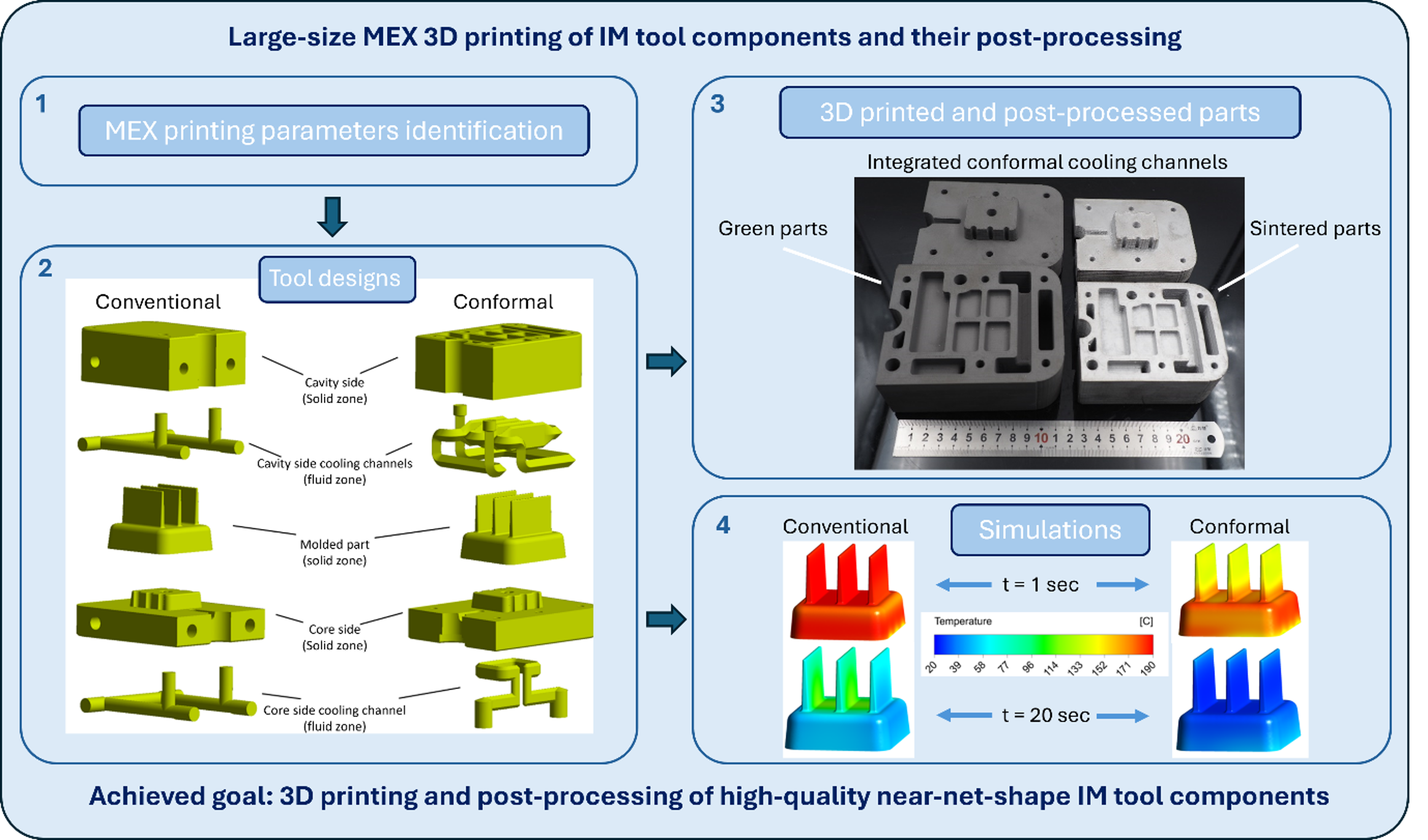
Injection molding (IM) is widely used for high-volume, small, and complex plastic components and is increasingly applied to ceramic and metallic parts. However, the high cost and long processing times of conventional tooling hinder its application in prototyping or small series production. Conventional molding tools with straight-drilled channels cool unevenly, causing shrinkage differences and longer cycle times. This study focused on material extrusion-based composite extrusion modeling three-dimensional (3D) printing of large-scale IM tools using metal IM feedstock. Conformal cooling channels were integrated into the tools to enhance cooling efficiency and temperature uniformity, reducing residual stress and defects. Large-scale IM tools were successfully fabricated via composite extrusion modeling 3D printing for the first time, achieving high green and sintered densities of 97.37 ± 0.24% and 98.08 ± 0.10%, respectively, without any visible cracks or delamination. Dimensional accuracy remained within ~0.7 mm, and surface roughness was comparable to that of conventional IM tools. Nevertheless, post-processing is required to address surface waviness and support removal marks. Simulations also demonstrated that conformal-designed tools cool molded parts below 80 °C in 5 s, compared with 20 s for conventional tools. These findings demonstrate the potential of material extrusion-based 3D printing as a cost-effective alternative for producing IM tools with conformal cooling, enabling faster production cycles and more efficient design for fragile geometries.
- Heaney DF, ed. Handbook of Metal Injection Molding. 2nd ed. Woodhead Publishing; 2019. doi: 10.1016/C2018-0-01641-2
- Heaney DF. Designing for metal injection molding (MIM). In: Handbook of Metal Injection Molding. Elsevier; 2012:29- 49. doi: 10.1533/9780857096234.1.29
- Lee SW, Ahn S, Whang CJ, et al. Effects of process parameters in plastic, metal, and ceramic injection molding processes. Korea-Aust Rheol J. 2011;23(3):127-138. doi: 10.1007/s13367-011-0016-4
- Franchetti M, Kress C. An economic analysis comparing the cost feasibility of replacing injection molding processes with emerging additive manufacturing techniques. Int J Adv Manuf Technol. 2016;88(9-12):2573-2579. doi: 10.1007/s00170-016-8968-7
- Dehghan-Manshadi A, Yu P, Dargusch M, et al. Metal injection moulding of surgical tools, biomaterials and medical devices: A review. Powder Technol. 2020;364:189- 204. doi: 10.1016/j.powtec.2020.01.073
- Feng S, Kamat AM, Pei Y. Design and fabrication of conformal cooling channels in molds: review and progress updates. Int J Heat Mass Transf. 2021;171:121082. doi: 10.1016/j.ijheatmasstransfer.2021.121082
- Kuo CC, Jiang ZF, Yang XY, et al. Characterization of a direct metal printed injection mold with different conformal cooling channels. Int J Adv Manuf Technol. 2020;107(3- 4):1223-1238. doi: 10.1007/s00170-020-05114-2
- Mendible GA, Rulander JA, Johnston SP. Comparative study of rapid and conventional tooling for plastics injection molding. Rapid Prototyp J. 2017;23(2):344-352. doi: 10.1108/RPJ-01-2016-0013
- Vaezi M, Drescher P, Seitz H. Beamless metal additive manufacturing. Materials. 2020;13(4):922. doi: 10.3390/ma13040922
- Khorasani M, Ghasemi A, Rolfe B, et al. Additive manufacturing a powerful tool for the aerospace industry. Rapid Prototyp J. 2022;28(1):87-100. doi: 10.1108/RPJ-01-2021-0009
- Gonzalez-Gutierrez J, Cano S, Schuschnigg S, et al. Additive manufacturing of metallic and ceramic components by the material extrusion of highly-filled polymers: a review and future perspectives. Materials. 2018;11(5):840. doi: 10.3390/ma11050840
- Nouri A, Rohani Shirvan A, Li Y, et al. Additive manufacturing of metallic and polymeric load-bearing biomaterials using laser powder bed fusion: a review. J Mater Sci Technol. 2021;94:196-215. doi: 10.1016/j.jmst.2021.03.058
- Rane K, Strano M. A comprehensive review of extrusion-based additive manufacturing processes for rapid production of metallic and ceramic parts. Adv Manuf. 2019;7(2):155- 173. doi: 10.1007/s40436-019-00253-6
- Cicconi P, Lezzi M, Bandinelli R, et al. Metal additive manufacturing for the rapid prototyping of shaped parts: a case study. Comput Des Appl. 2021;18:1061-1079. doi: 10.14733/cadaps.2021.1061-1079
- Xu W. Direct Additive Manufacturing Techniques for Metal Parts: SLM, EBM, Laser Metal Deposition. In: Encyclopedia of Materials: Metals and Alloys. Elsevier; 2022:290-318. doi: 10.1016/b978-0-12-819726-4.00095-8
- Paz R, Moriche R, Monzón M, et al. Influence of manufacturing parameters and post processing on the electrical conductivity of extrusion-based 3D printed nanocomposite parts. Polymers. 2020;12(4):733. doi: 10.3390/polym12040733
- Riaz A, Töllner P, Dreier T, et al. Optimization of the extrusion rate for different layer thicknesses to achieve controlled mechanical properties in MEX 3D printing of low-alloy steel. J Manuf Process. 2024;120:1075-1086. doi: 10.1016/j.jmapro.2024.05.008
- Riaz A, Töllner P, Dreier T, et al. Optimization of composite extrusion modeling process parameters for 3D printing of low-alloy steel AISI 8740 using metal injection moulding feedstock. Mater Des. 2022;219:110814. doi: 10.1016/j.matdes.2022.110814
- Dreier T, Riaz A, Ahrend A, et al. 3D printing of aluminum oxide via composite extrusion modeling using a ceramic injection molding feedstock. Mater Des. 2023;227:111806. doi: 10.1016/j.matdes.2023.111806
- Suwanpreecha C, Manonukul A. A review on material extrusion additive manufacturing of metal and how it compares with metal injection moulding. Metals. 2022;12(3):429. doi: 10.3390/met12030429
- Singh G, Missiaen JM, Bouvard D, et al. Copper additive manufacturing using MIM feedstock: adjustment of printing, debinding, and sintering parameters for processing dense and defectless parts. Int J Adv Manuf Technol. 2021;115(1- 2):449-462. doi: 10.1007/s00170-021-07188-y
- Singh G, Missiaen JM, Bouvard D, et al. Copper extrusion 3D printing using metal injection moulding feedstock: analysis of process parameters for green density and surface roughness optimization. Addit Manuf. 2021;38:101778. doi: 10.1016/j.addma.2020.101778
- Kanbur BB, Suping S, Duan F. Design and optimization of conformal cooling channels for injection molding: a review. Int J Adv Manuf Technol. 2020;106(7-8):3253-3271. doi: 10.1007/s00170-019-04697-9
- Jahan SA, El-Mounayri H. Optimal conformal cooling channels in 3D printed dies for plastic injection molding. Procedia Manuf. 2016;5:888-900. doi: 10.1016/j.promfg.2016.08.076
- Kuo CC, Xu WC. Effects of different cooling channels on the cooling efficiency in the wax injection molding process. Int J Adv Manuf Technol. 2018;98(1-4):887-895. doi: 10.1007/s00170-018-2345-7
- Smith AG, Wrobel LC, McCalla BA, et al. A computational model for the cooling phase of injection moulding. J Mater Process Technol. 2008;195(1-3):305-313. doi: 10.1016/j.jmatprotec.2007.05.018
- Silva HM. A review of the design optimization of conformal cooling channels in injection molds. Int J Adv Manuf Technol. 2025;138(7-8):2653-2671. doi: 10.1007/s00170-025-15234-2
- Homar D, Čerče L, Kopač J. Cooling simulation of conformal cooling injection mould insert produced by hybrid manufacturing. Teh Vjesn. 2017;24(4):981-986. doi: 10.17559/TV-20150909075338
- Silva HM, Noversa JT, Fernandes L, et al. Design, simulation and optimization of conformal cooling channels in injection molds: a review. Int J Adv Manuf Technol. 2022;120(7- 8):4291-4305. doi: 10.1007/s00170-022-08693-4
- Ba J, Li B, Zeng X, et al. Topology optimization of 3D conformal cooling channels using within-surface flow model. Appl Therm Eng. 2025;267:125765. doi: 10.1016/j.applthermaleng.2025.125765
- Karger-Kocsis J, Bárány T, eds. Polypropylene Handbook: Morphology, Blends and Composites. New York, NY: Springer International Publishing; 2019. doi: 10.1007/978-3-030-12903-3
- Patti A, Acierno D. Thermal conductivity of polypropylene-based materials. In: Polypropylene—Polymerization and Characterization of Mechanical and Thermal Properties. London: IntechOpen; 2020. doi: 10.5772/intechopen.84477
- Wunderlich B. Thermal Analysis of Polymeric Materials. New York, NY: Springer; 2005. doi: 10.1007/b137476
- Ansys Inc. Corporate Philanthropy Report. 2023. doi: 10.1002/cprt.31503
- PolyMIM GmbH. Product portfolio: water soluble debinding feedstock. PolyMIM GmbH. Published 2021. Accessed February 15, 2026. https://www.polymim.com/ fileadmin/user_upload/Portfolio_PolyMIM_Webseite.pdf
- Lengauer W, Duretek I, Fürst M, et al. Fabrication and properties of extrusion-based 3D-printed hardmetal and cermet components. Int J Refract Met Hard Mater. 2019;82:141-149. doi: 10.1016/j.ijrmhm.2019.04.011
- Westphal E, Seitz H. Porosity and density measurement of additively manufactured components: a comparative analysis of measurement methods across processes and materials. Mater Sci Addit Manuf. 2025;4(2):025090010. doi: 10.36922/MSAM025090010
- Anderson JD. Governing equations of fluid dynamics. In: Computational Fluid Dynamics: An Introduction. New York, NY: Springer; 2008. doi: 10.1007/978-3-540-85056-4
- ANSYS Inc. ANSYS Fluent Theory Guide. ANSYS Academic Research Fluent, Release 2020 R2; 2020.
- Hadian A, Morath B, Biedermann M, et al. Selected design rules for material extrusion-based additive manufacturing of alumina based nozzles and heat exchangers considering limitations in printing, debinding, and sintering. Addit Manuf. 2023;75:103719. doi: 10.1016/j.addma.2023.103719
- Pellegrini A, Guerra MG, Lavecchia F. Shrinkage evaluation and geometric accuracy assessment on 17–4 PH samples made by material extrusion additive manufacturing. J Manuf Process. 2024;109:394-406. doi: 10.1016/j.jmapro.2023.12.031
- Jevtić I, Mladenović G, Milošević M, et al. Dimensional accuracy of parts obtained by SLS technology. Struct Integr Life. 2022;22(3):288-292. Accessed Dec, 2024. https:// machinery.mas.bg.ac.rs/handle/123456789/5603
- Mantada P, Mendricky R, Safka J. Parameters influencing the precision of various 3D printing technologies. MM Sci J. 2017;5:2004-2012. doi: 10.17973/MMSJ.2017_12_201776
- Garcia de la Torre H, Pérez MA, Gómez-Gras G. Tailored mechanical performance of fused filament fabricated 316L steel components through printing parameter optimization. Theor Appl Fract Mech. 2023;128:104141. doi: 10.1016/j.tafmec.2023.104141
- Obadimu SO, Kourousis KI. Shrinkage behaviour of material extrusion steel 316L: influence of primary 3D printing parameters. Rapid Prototyp J. 2022;28(11):92-101. doi: 10.1108/RPJ-07-2022-0224
- Rafique AS, Munir A, Ghazali N, et al. Correlation between the part quality, strength and surface roughness of material extrusion process. Rapid Prototyp J. 2024;30(3):513-528. doi: 10.1108/RPJ-10-2023-0347
- Oliveira G, Senos A, Fernandes C, et al. Material extrusion to manufacture carbide-based advanced cutting tools. Materials. 2023;16(21):6902. doi: 10.3390/ma16216902
- Çalışkan Cİ, Koca A, Özer G, et al. Efficiency comparison of conformal cooling channels produced by additive and subtractive manufacturing in automotive industry plastic injection moulds: a hybrid application. Int J Adv Manuf Technol. 2023;126(9-10):4419-4437. doi: 10.1007/s00170-023-11389-y
- Mazur M, Szatkiewicz T, Zieliński A, et al. Numerical and experimental evaluation of a conformally cooled H13 steel injection mould manufactured with selective laser melting. Int J Adv Manuf Technol. 2017;93(1-4):881-900. doi: 10.1007/s00170-017-0426-7
- Kitayama S, Miyakawa H, Takano M, et al. Multi-objective optimization of injection molding process parameters for short cycle time and warpage reduction using conformal cooling channel. Int J Adv Manuf Technol. 2016;88(5- 8):1735-1744. doi: 10.1007/s00170-016-8904-x
- Kirchheim A, Katrodiya Y, Zumofen L, et al. Dynamic conformal cooling improves injection molding: hybrid molds manufactured by laser powder bed fusion. Int J Adv Manuf Technol. 2021;114(1-2):107-116. doi: 10.1007/s00170-021-06794-0
- Simiyu LW, Mutua JM, Muiruri PI, et al. Effect of conformal cooling design on residual stresses in injection molded parts. Int J Interact Des Manuf. 2025;19(3):1751-1766. doi: 10.1007/s12008-024-01795-1
- Merhar J. Overview of metal injection moulding. Met Powder Rep. 1990;45(5):339-342. doi: 10.1016/S0026-0657(10)80242-5
- Sefene EM. State-of-the-art of selective laser melting process: a comprehensive review. J Manuf Syst. 2022;63:250- 274. doi: 10.1016/j.jmsy.2022.04.002
- Meenashisundaram GK, Xu Z, Nai MLS, et al. Binder jetting additive manufacturing of high porosity 316L stainless steel metal foams. Materials. 2020;13(17):3744. doi: 10.3390/ma13173744
- Konda Gokuldoss P, Kolla S, Eckert J. Additive manufacturing processes: selective laser melting, electron beam melting and binder jetting—selection guidelines. Materials. 2017;10(6):672. doi: 10.3390/ma10060672
- Frazier WE. Metal additive manufacturing: a review. J Mater Eng Perform. 2014;23(6):1917-1928. doi: 10.1007/s11665-014-0958-z
- Golhin AP, Cavalieri S, Sorby G, et al. Surface roughness of as-printed polymers: a comprehensive review. Int J Adv Manuf Technol. 2023;127(3-4):987-1043. doi: 10.1007/s00170-023-11566-z
- Maleki E, Bagherifard S, Bandini M, et al. Surface post-treatments for metal additive manufacturing: progress, challenges, and opportunities. Addit Manuf. 2021;37:101619. doi: 10.1016/j.addma.2020.101619