
Laser powder bed fusion of Ni–Fe–Mo permalloy

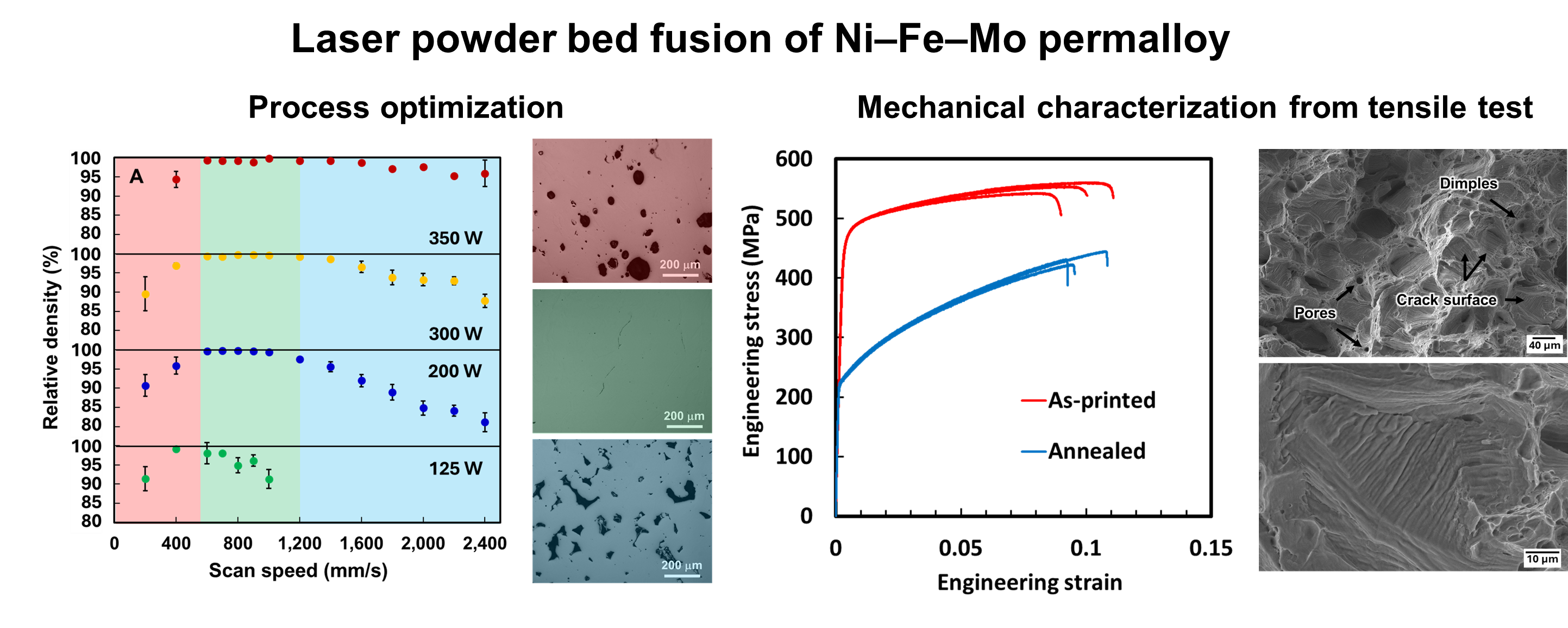
Nickel (Ni)–iron (Fe)–molybdenum (Mo) permalloy is a high-permeability soft magnetic alloy widely used for magnetic shielding, yet conventional processing limits geometric complexity. This study evaluates laser powder bed fusion (LPBF) processing of Ni–Fe–Mo permalloy and establishes a process–microstructure–property framework. A systematic parameter study identified an optimal condition of 200 W laser power and 900 mm/s scan speed, producing near-fully dense material (99.65%) with negligible, yet persistent solidification cracking. The as-built microstructure exhibited a pronounced <100> fiber texture and a fine cellular solidification structure with Mo segregation at cell boundaries. Annealing at 1,100°C reduced microstrain, weakened texture, and partially homogenized segregation through recrystallization. Tensile testing showed that the LPBF-processed material had higher yield strength but lower ductility than wrought permalloy due to residual microcracks. Magnetic measurements confirm soft-ferromagnetic behavior, with annealing reducing coercivity from 83 A/m to 10 A/m while preserving saturation magnetization. These results demonstrate that LPBF-processed Ni–Fe–Mo permalloy is a viable pathway for fabricating complex magnetic shielding components; however, effective crack mitigation and microstructural homogenization would likely require tailored post-LPBF heat treatments and, potentially, targeted alloy composition modifications.
- Jiles D. Recent advances and future directions in magnetic materials. Acta Mater. 2003;51(19):5907-5939. doi: 10.1016/j.actamat.2003.08.011
- O’Handley RC. Modern Magnetic Materials: Principles and Applications. 1st ed. New York, NY: John Wiley & Sons, Inc.; 2000.
- Chikazumi S, Graham CD. Physics of Ferromagnetism. 2nd ed. Oxford, UK: Oxford University Press; 1997.
- Xu X, Liu W, Huang Y, et al. Magnetic shielding mechanism and structure design of composites at low frequency: A review. J Magn Magn Mater. 2023;570:170509. doi: 10.1016/j.jmmm.2023.170509
- Sun J, Ren J, Li J, et al. Measurement and analysis of magnetic properties of permalloy for magnetic shielding devices under different temperature environments. Materials. 2023;16(8):3253. doi: 10.3390/ma16083253
- Song YL, Lin HY, Manikandan S, et al. A magnetic field canceling system design for diminishing electromagnetic interference to avoid environmental hazard. Int J Environ Res Public Health. 2022;19(6):3664. doi: 10.3390/ijerph19063664
- Kim ES, Haftlang F, Ahn SY, et al. Effects of processing parameters and heat treatment on the microstructure and magnetic properties of the in-situ synthesized Fe-Ni permalloy produced using direct energy deposition. J Alloys Compd. 2022;907:164415. doi: 10.1016/j.jallcom.2022.164415
- Rodriguez-Vargas BR, Stornelli G, Folgarait P, et al. Recent advances in additive manufacturing of soft magnetic materials: A review. Materials. 2023;16(16):5610. doi: 10.3390/ma16165610
- Hasselgren L, Luomi J. Geometrical aspects of magnetic shielding at extremely low frequencies. IEEE Trans Electromagn Compat. 1995;37(3):409-420. doi: 10.1109/15.406530
- Narasimharaju SR, Zeng W, See TL, et al. A comprehensive review on laser powder bed fusion of steels: Processing, microstructure, defects and control methods, mechanical properties, current challenges and future trends. J Manuf Process. 2022;75:375-414. doi: 10.1016/j.jmapro.2021.12.033
- Liu G, Zhang X, Chen X, et al. Additive manufacturing of structural materials. Mater Sci Eng R Rep. 2021;145:100596. doi: 10.1016/j.mser.2020.100596
- Haines MP, Rielli VV, Primig S, et al. Powder bed fusion additive manufacturing of Ni-based superalloys: a review of the main microstructural constituents and characterization techniques. J Mater Sci. 2022;57(30):14135-14187. doi: 10.1007/s10853-022-07501-4
- Hyer H, Zhou L, Park S, et al. Understanding the laser powder bed fusion of AlSi10Mg alloy. Metallogr Microstruct Anal. 2020;9(4):484-502. doi: 10.1007/S13632-020-00659-W
- Diaz Vallejo N, Lucas C, Ayers N, et al. Process optimization and microstructure analysis to understand laser powder bed fusion of 316L stainless steel. Metals. 2021;11(5):832. doi: 10.3390/met11050832
- Ayers N, Lucas C, Mahmud A, et al. Parameter Optimization and Flaw Type Dependent Tensile Properties of 15-5PH Stainless Steel Manufactured by Laser Powder Bed Fusion. Adv Eng Mater. 2024;26(23). doi: 10.1002/adem.202401346
- Cao S, Zou Y, Lim CVS, et al. Review of laser powder bed fusion (LPBF) fabricated Ti-6Al-4V: process, post-process treatment, microstructure, and property. Light: Adv Manuf. 2021;2(3):313-332. doi: 10.37188/lam.2021.020
- Huynh T, Mehta A, Graydon K, et al. Microstructural development in Inconel 718 nickel-based superalloy additively manufactured by laser powder bed fusion. Metallogr Microstruct Anal. 2022;11(1):88-107. doi: 10.1007/S13632-021-00811-0
- Mehta A, Zhou L, Huynh T, et al. Additive manufacturing and mechanical properties of the dense and crack free Zr-modified aluminum alloy 6061 fabricated by the laser-powder bed fusion. Addit Manuf. 2021;41:101966. doi: 10.1016/j.addma.2021.101966
- Mohamed AEMA, Zou J, Sheridan RS, et al. Magnetic shielding promotion via the control of magnetic anisotropy and thermal Post processing in laser powder bed fusion processed NiFeMo-based soft magnet. Addit Manuf. 2020;32:101079. doi: 10.1016/j.addma.2020.101079
- Zou J, Gaber Y, Voulazeris G, et al. Controlling the grain orientation during laser powder bed fusion to tailor the magnetic characteristics in a Ni-Fe based soft magnet. Acta Mater. 2018;158:230-238. doi: 10.1016/j.actamat.2018.07.064
- Yang J, Tian Y, Wang Z, et al. Research on the anisotropy of soft magnetic performance of SLM-fabricated NiFeMo alloys. J Alloys Compd. 2025;1018:179264. doi: 10.1016/j.jallcom.2025.179264
- Li B, Fu WQ, Xu HS, et al. Additively manufactured Ni-15Fe-5Mo Permalloy via selective laser melting and subsequent annealing for magnetic-shielding structures: Process, microstructural and soft-magnetic characteristics. J Magn Magn Mater. 2020;494:165754. doi: 10.1016/j.jmmm.2019.165754
- Mohamed AEMA, Sheridan RS, Bongs K, et al. Microstructure-magnetic shielding development in additively manufactured Ni-Fe-Mo soft magnet alloy in the as fabricated and post-processed conditions. J Alloys Compd. 2021;884:161112. doi: 10.1016/j.jallcom.2021.161112
- Marchese G, Basile G, Bassini E, et al. Study of the microstructure and cracking mechanisms of hastelloy X produced by laser powder bed fusion. Materials. 2018;11(1):106. doi: 10.3390/ma11010106
- Tomus D, Jarvis T, Wu X, et al. Controlling the microstructure of Hastelloy-X components manufactured by selective laser melting. Phys Procedia. 2013;41:823-827. doi: 10.1016/j.phpro.2013.03.154
- Razee SSA, Staunton JB, Ginatempo B, et al. Ab Initio theoretical description of the interrelation between magnetocrystalline anisotropy and atomic short-range order. Phys Rev Lett. 1999;82(26):5369. doi: 10.1103/PhysRevLett.82.5369
- Vahdati Yekta P, Ghasemi A, Sharifi EM. Magnetic and mechanical properties of cold-rolled permalloy. J Magn Magn Mater. 2018;468:155-163. doi: 10.1016/j.jmmm.2018.07.088
- ASTM A753-21 Standard Specification for Wrought Nickel- Iron Soft Magnetic Alloys. ASTM International; 2021.
- Yang J, Zhu Q, Wang Z, et al. Effects of metallurgical defects on magnetic properties of SLM NiFeMo permalloy. Mater Charact. 2023;197:112672. doi: 10.1016/j.matchar.2023.112672
- Bahl CRH. Estimating the demagnetization factors for regular permanent magnet pieces. AIP Advances. 2021;11(7). doi: 10.1063/5.0060897
- Aharoni A. Demagnetizing factors for rectangular ferromagnetic prisms. J Appl Phys. 1998;83(6):3432-3434. doi: 10.1063/1.367113
- Zhao Y, Ma Z, Yu L, et al. New alloy design approach to inhibiting hot cracking in laser additive manufactured nickel-based superalloys. Acta Mater. 2023;247:118736. doi: 10.1016/j.actamat.2023.118736
- Zhao C, Parab ND, Li X, et al. Critical instability at moving keyhole tip generates porosity in laser melting. Science. 2020;370(6520):1080-1086. doi: 10.1126/science.abd1587
- Afrasiabi M, Keller D, Lüthi C, et al. Effect of process parameters on melt pool geometry in laser powder bed fusion of metals: a numerical investigation. Procedia CIRP. 2022;113:378-384. doi: 10.1016/j.procir.2022.09.187
- Song X, Zhang W, Liu Z, et al. Microstructures and cracking behaviors of AlCoCrFeNiTi0.2 high-entropy alloy fabricated by laser powder bed fusion. J Alloys Compd. 2025;1031:180999. doi: 10.1016/j.jallcom.2025.180999
- Platl J, Bodner S, Hofer C, et al. Cracking mechanism in a laser powder bed fused cold-work tool steel: The role of residual stresses, microstructure and local elemental concentrations. Acta Mater. 2022;225:117570. doi: 10.1016/j.actamat.2021.117570
- Wang DZ, Li KL, Yu CF, et al. Cracking behavior in additively manufactured pure tungsten. Acta Metall Sin (Engl Lett). 2018;32(1):127-135. doi: 10.1007/s40195-018-0752-2
- Wang N, Mokadem S, Rappaz M, et al. Solidification cracking of superalloy single-and bi-crystals. Acta Mater. 2004;52(11):3173-3182. doi: 10.1016/j.actamat.2004.03.047
- Kou S. Welding Metallurgy. 2nd ed. New York, NY: John Wiley & Sons; 2003.
- Kou S. A criterion for cracking during solidification. Acta Mater. 2015;88:366-374. doi: 10.1016/j.actamat.2015.01.034
- Higashi M, Ozaki T. Selective laser melting of pure molybdenum: Evolution of defect and crystallographic texture with process parameters. Mater Des. 2020;191:108588. doi: 10.1016/j.matdes.2020.108588
- Hyer H, Zhou L, Mehta A, et al. Composition-dependent solidification cracking of aluminum-silicon alloys during laser powder bed fusion. Acta Mater. 2021;208:116698. doi: 10.1016/j.actamat.2021.116698
- Yakubu S. Domain and Domain Wall Motion. Ferroic Materials-Understanding, Development, and Utilization. 2025. doi: 10.5772/intechopen.1006892
- Li C, Ruan H, Chen D, et al. Effect of heat treatment on the microstructure and properties of Ni based soft magnetic alloy. Microsc Res Tech. 2018;81(7):796-802. doi: 10.1002/jemt.23038
- Fiorillo F. Measurements of magnetic materials. Metrologia. 2010;47(2):S114-S142. doi: 10.1088/0026-1394/47/2/S11
- Dodrill B, Lindemuth JR. Vibrating sample magnetometry. In: Magnetic Measurement Techniques for Materials Characterization. New York, NY: Springer International Publishing; 2021:15-37. doi: 10.1007/978-3-030-70443-8_2
- Sun Y, Hebert RJ, Aindow M. Non-metallic inclusions in 17-4PH stainless steel parts produced by selective laser melting. Mater Des. 2018;140:153-162. doi: 10.1016/j.matdes.2017.11.063
- Callister WD, Rethwisch DG, Blicblau A, et al. Materials Science and Engineering: An Introduction. 7th ed. New York, NY: John Wiley & Sons; 2007.