
Influence of gas metal arc welding-based wire arc additive manufacturing deposition modes on the hardness, wear, and corrosion behavior of Al5356 walls

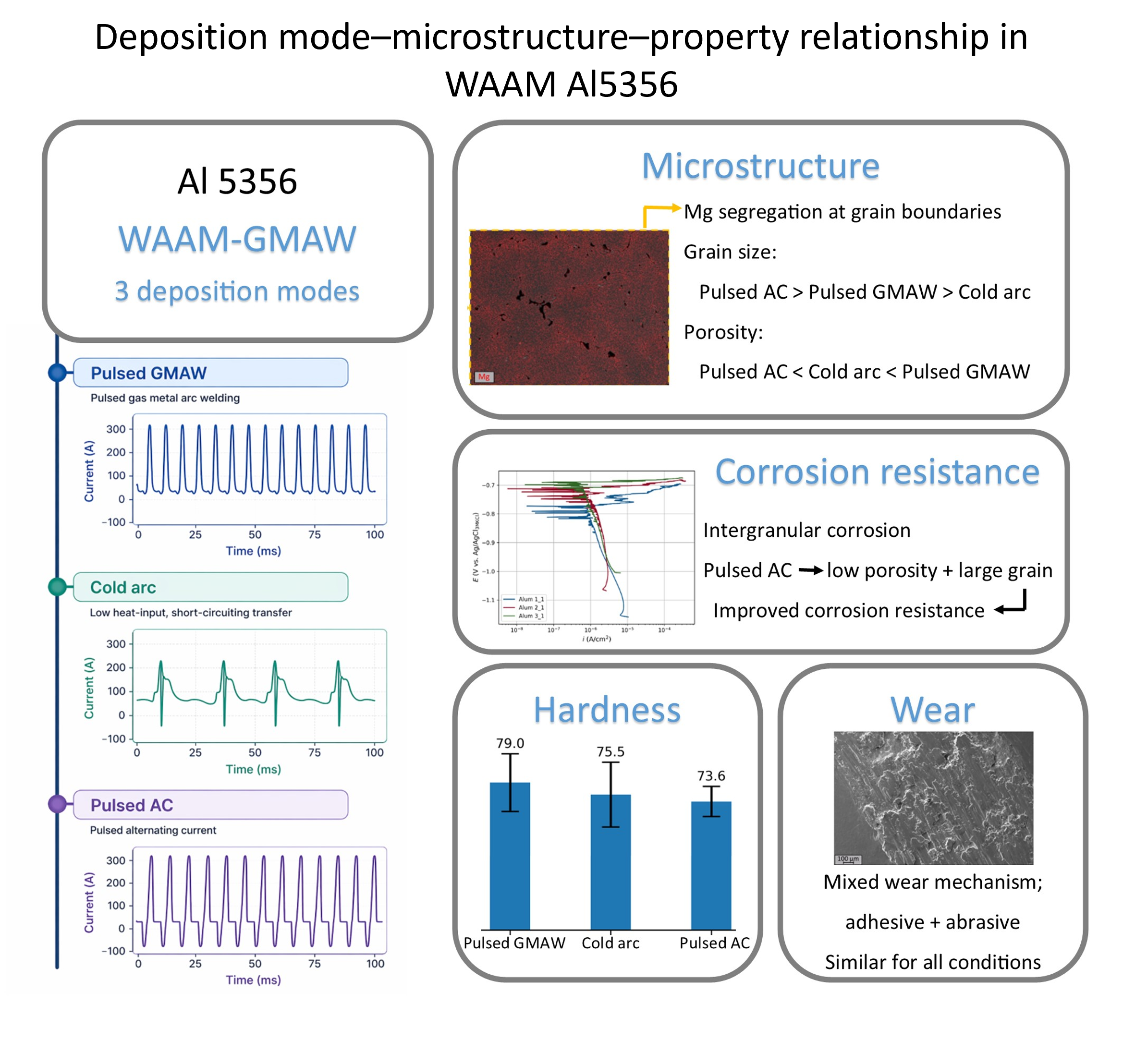
Wire arc additive manufacturing (WAAM) is a promising technique for producing large-scale aluminum components, although the deposition mode strongly affects thermal history, microstructure, and defect formation. This work investigates the influence of three gas metal arc welding (GMAW)-based WAAM modes (pulsed GMAW, cold arc, and pulsed alternating current [AC]) on the microstructure, hardness, wear, and corrosion behavior of Al5356 walls. Differences in heat input and arc characteristics led to variations in grain size and porosity. Pulsed AC showed the largest grain size and the lowest porosity; pulsed GMAW showed intermediate grain size and the highest porosity; and cold arc exhibited the finest microstructure with intermediate porosity. Magnesium segregation at grain boundaries was observed in all conditions, with possible formation of β (Al3Mg2) phase under localized thermal exposure. Hardness values were similar for all samples, although pulsed AC exhibited slightly lower and more homogeneous hardness due to its coarser microstructure. Tribological behavior showed no clear differences among deposition modes. Electrochemical testing revealed that pulsed AC provided the best corrosion resistance, attributed to its reduced porosity and lower grain boundary density, which limits intergranular attack. Overall, deposition mode primarily influences microstructure and corrosion behavior, while its effect on wear performance is limited under the studied conditions.
- Svetlizky D, Das M, Zheng B, et al. Directed energy deposition (DED) additive manufacturing: Physical characteristics, defects, challenges and applications. Mater Today. 2021;49:271-295. doi: 10.1016/j.mattod.2021.03.020
- Gürol U, Kocaman E, Dilibal S, Koçak M. A comparative study on the microstructure, mechanical properties, wear and corrosion behaviors of SS 316 austenitic stainless steels manufactured by casting and WAAM technologies. CIRP J Manuf Sci Technol. 2023;47:215-227. doi: 10.1016/j.cirpj.2023.10.005
- Geng H, Li J, Xiong J, Lin X, Zhang F. Optimization of wire feed for GTAW based additive manufacturing. J Mater Process Technol. 2017;243:40-47. doi: 10.1016/j.jmatprotec.2016.11.027
- Villabona E, Sandua X, Veiga F, Suárez A, Aldalur E, Rivero P. Corrosion analysis of plasma arc welded and gas metal arc welded 316L stainless steel in wire arc additive manufacturing. Int J Adv Manuf Technol. Published online October 14, 2025. doi: 10.1007/s00170-025-16724-z
- Kopf T, Glück T, Gruber D, et al. Process modeling and control for additive manufacturing of Ti-6Al-4V using plasma arc welding - methodology and experimental validation. J Manuf Process. 2024;126:12-23. doi: 10.1016/j.jmapro.2024.07.072
- Iván Tabernero, Paskual A, Álvarez P, Suárez A. Study on Arc Welding Processes for High Deposition Rate Additive Manufacturing. Procedia CIRP. 2018;68:358-362. doi: 10.1016/j.procir.2017.12.095
- Köhler M, Fiebig S, Hensel J, Dilger K. Wire and Arc Additive Manufacturing of Aluminum Components. Metals. 2019;9(5):608. doi: 10.3390/met9050608
- Derekar KS. A review of wire arc additive manufacturing and advances in wire arc additive manufacturing of aluminium. Mater Sci Technol. 2018;34(8):895-916. doi: 10.1080/02670836.2018.1455012
- Starke EA Jr, Staley JT. Application of modern aluminium alloys to aircraft. In: Fundamentals of Aluminium Metallurgy. Elsevier; 2011:747-783. doi: 10.1533/9780857090256.3.747
- Veiga F, Villabona E, Suárez A, Rivero P, Aldalur E. LFAM with Metallic Materials—Applications. In: Large Format Additive Manufacturing. Published online December 5, 2025:393-438. doi: 10.1002/9783527844807.ch14
- Su C, Chen X, Gao C, Wang Y. Effect of heat input on microstructure and mechanical properties of Al-Mg alloys fabricated by WAAM. Appl Surf Sci. 2019;486:431-440. doi: 10.1016/j.apsusc.2019.04.255
- Tawfik MM, Nemat-Alla MM, Dewidar MM. Effect of Travel Speed on the Properties of Al-Mg Aluminum Alloy Fabricated by Wire Arc Additive Manufacturing. J Mater Eng Perform. 2021;30(10):7762-7769. doi: 10.1007/s11665-021-05959-y
- Aldalur E, Suárez A, Veiga F. Metal transfer modes for Wire Arc Additive Manufacturing Al-Mg alloys: Influence of heat input in microstructure and porosity. J Mater Process Technol. 2021;297:117271. doi: 10.1016/j.jmatprotec.2021.117271
- Aldalur E, Suárez A, Veiga F, Holgado I, Ortega N. Tomography analysis of Al–Mg alloys manufactured by wire-arc directed energy deposition with different metal transfer modes. Alex Eng J. 2023;82:168-177. doi: 10.1016/j.aej.2023.10.002
- Pépe N, Egerland S, Colegrove PA, Yapp D, Leonhartsberger A, Scotti A. Measuring the process efficiency of controlled gas metal arc welding processes. Sci Technol Weld Join. 2011;16(5):412-417. doi: 10.1179/1362171810Y.0000000029
- ASTM International. ASTM G99-17: Standard Test Method for Wear Testing with a Pin-on-Disk Apparatus. West Conshohocken, PA: ASTM International; 2021.
- Zhao D, Long D, Niu T, Zhang T, Hu X, Liu Y. Effect of Mg Loss and Microstructure on Anisotropy of 5356 Wire Arc Additive Manufacturing. J Mater Eng Perform. 2022;31(10):8473-8482. doi: 10.1007/s11665-022-06802-8
- Liang J, Zheng Z, Xu Z, Wang S, Han H. Dianhu zengcai 5356 lu hejin weiguan zuzhi jiegou ji naifushi xingwei [Microstructure and corrosion resistance properties of 5356 aluminum alloy fabricated by wire and arc additive manufacturing]. Cailiao Gongcheng (Mater Eng). 2025;53(2):115-124. [In Chinese]. doi: 10.11868/j.issn.1001-4381.2023.000648
- Zhang J, Zhuo X, Shi M, et al. Near Immersion active cooling assisted WAAM of 5356 aluminum Alloy: Formability and microstructural evolution. J Mater Res Technol. 2025;38:5657-5667. doi: 10.1016/j.jmrt.2025.09.036
- Jeon MS, Huang Y, Kam DH, Oh MS, Lee KA. Interlayer integrity and mechanical anisotropy of WAAM-processed Al-Mg alloys. J Alloys Compd. 2025;1042:184124. doi: 10.1016/j.jallcom.2025.184124
- Zhang H, Yu S, Yang Z, Zhang C. The influence of porosity and precipitates on the corrosion behavior of A356 aluminum alloy. J Electroanal Chem. 2023;948:117796. doi: 10.1016/j.jelechem.2023.117796
- Lashgari HR, Xue Y, Onggowarsito C, Kong C, Li S. Microstructure, Tribological Properties and Corrosion Behaviour of Additively Manufactured 17-4PH Stainless Steel: Effects of Scanning Pattern, Build Orientation, and Single vs. Double scan. Mater Today Commun. 2020;25:101535. doi: 10.1016/j.mtcomm.2020.101535
- Sun Y, Moroz A, Alrbaey K. Sliding Wear Characteristics and Corrosion Behaviour of Selective Laser Melted 316L Stainless Steel. J Mater Eng Perform. 2014;23(2):518-526. doi: 10.1007/s11665-013-0784-8
- Su Y, Wang C, Xu X, Luo K, Lu J. Pore defects and corrosion behavior of AISI 316L stainless steel fabricated by laser directed energy deposition under closed-loop control. Surf Coat Technol. 2023;463:129527. doi: 10.1016/j.surfcoat.2023.129527
- Wang C, Jiang Z, Ma X, Zhang Y, He P, Han F. Effect of solid solution time on microstructure and corrosion property of wire arc additively manufactured 2319 aluminum alloy. J Mater Res Technol. 2023;26:2749-2758. doi: 10.1016/j.jmrt.2023.08.098
- Muthukumaran A, Jeyakumar S, Jayakumar K. Metallurgical and mechanical properties of marine grade AA5356 using wire arc additive manufacturing. Mater Res Express. 2024;11(7):076503. doi: 10.1088/2053-1591/ad5817
- Imširović M, Trdan U, Klobčar D, Bračun D, Nagode A, Berthe L. Mitigating defects in directed energy deposited aluminium 5356 alloy through in-situ workpiece vibration. J Mater Res Technol. 2024;33:1581-1599. doi: 10.1016/j.jmrt.2024.09.179
- Zuo X, Lv Z, Wang Y, Chen X, Qi W. Microstructural Organization and Mechanical Properties of 5356 Aluminum Alloy Wire Arc Additive Manufacturing Under Low Heat Input Conditions. Metals. 2025;15(2):116. doi: 10.3390/met15020116
- Wang J, Zhu K, Zhang W, Zhu X, Lu X. Microstructural and defect evolution during WAAM resulting in mechanical property differences for AA5356 component. J Mater Res Technol. 2023;22:982-996. doi: 10.1016/j.jmrt.2022.11.116
- Sharma SK, Chandra M, Kazmi KH, Shukla AK, Rajak S. Surface Characteristics, Microstructural, and Tribological Behavior of Wire Arc Additive Manufactured Aluminum-5356 Alloy. J Mater Eng Perform. 2025;34(4):3047-3055. doi: 10.1007/s11665-024-09320-x
- Miyajima T, Iwai Y. Effects of reinforcements on sliding wear behavior of aluminum matrix composites. Wear. 2003;255(1-6):606-616. doi: 10.1016/S0043-1648(03)00066-8
- Farhat ZN, Ding Y, Northwood DO, Alpas AT. Effect of grain size on friction and wear of nanocrystalline aluminum. Mater Sci Eng A. 1996;206(2):302-313. doi: 10.1016/0921-5093(95)10016-4
- Thasleem P, Kumar D, Joy ML, Kuriachen B. Effect of heat treatment and electric discharge alloying on the lubricated tribology of Al–Si alloy fabricated by selective laser melting. Wear. 2022;494-495:204244. doi: 10.1016/j.wear.2022.204244