
Effects of heat treatment temperature and time on the fitness accuracy, retentive force, and permanent deformation of selective laser melting Ti-6Al-4V clasps

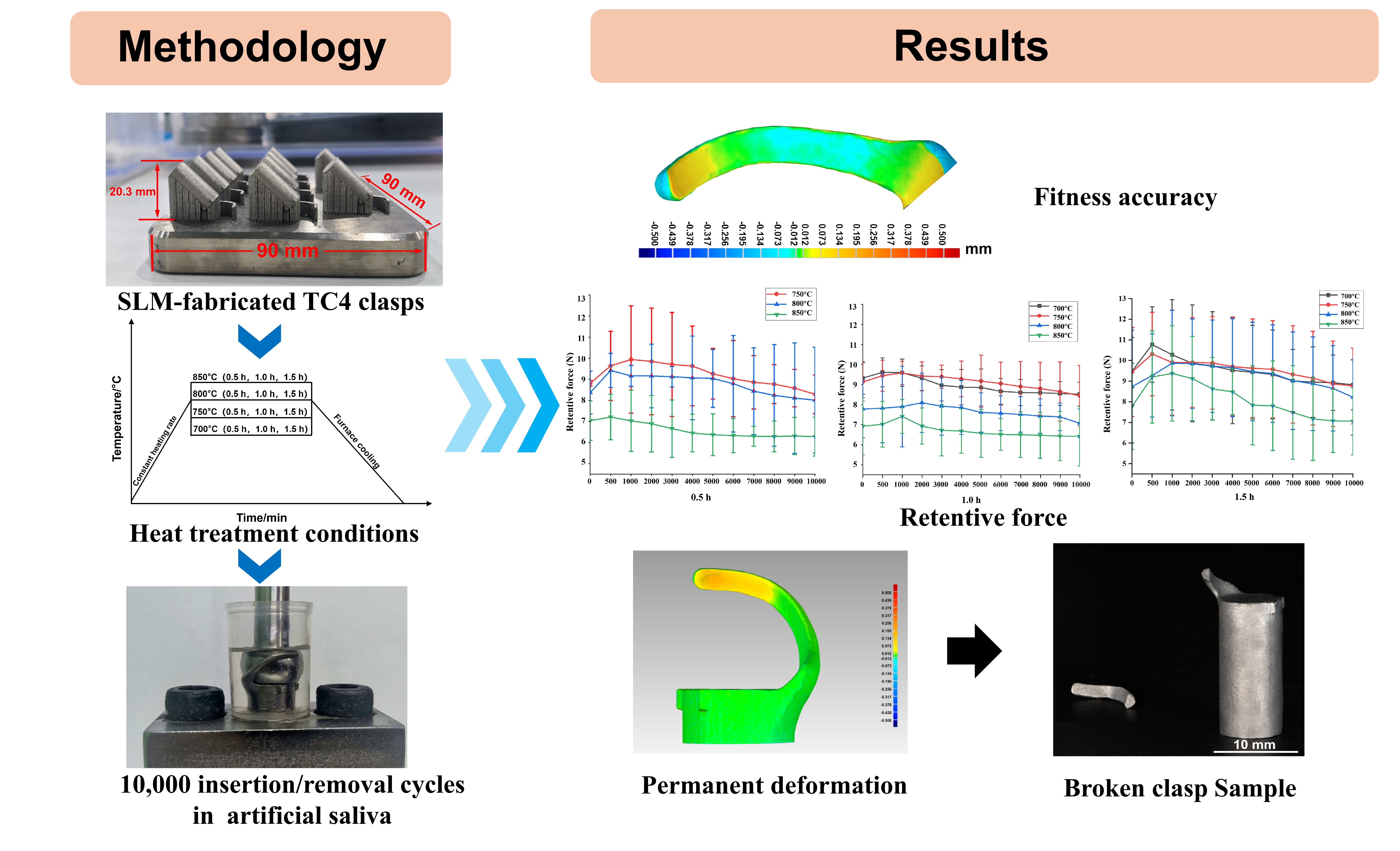
The selective laser melting (SLM) technology of Ti-6Al-4V (TC4) demonstrates significant advantages in fabricating clasps for removable partial dentures, whereas subsequent heat treatment plays a crucial role in performance optimization. This study systematically investigated the effects of heat treatment temperature and time on the fitness accuracy, retentive force, and permanent deformation of SLM TC4 clasps. TC4 clasp specimens were manufactured using SLM technology and subjected to heat treatment under different temperatures (700, 750, 800, and 850℃) and times (0.5, 1.0, and 1.5 h). The fitness accuracy, retentive force, and permanent deformation after 10,000 insertion/removal cycles were measured for each group and statistically analyzed. The results revealed that the 700℃/0.5 h group showed significantly reduced fitness accuracy. After cyclic testing, the retentive force of all groups decreased by 4.06%–12.18%, with heat treatment temperature significantly affecting both initial and final retentive forces. The time of heat treatment demonstrated no substantial influence. The permanent deformation of the clasps (31.15–38.05 μm) remained unaffected by variations in either heat treatment temperature or time. Based on overall performance, the 700℃/0.5 h heat treatment condition is not recommended. Instead, selecting shorter time protocols such as 0.5 h within the 750℃–850℃ range can help enhance production efficiency while maintaining performance standards.
- Ohkubo C, Hanatani S, Hosoi T. Present status of titanium removable dentures - a review of the literature. J Oral Rehabil. 2008;35(9):706-714. doi: 10.1111/j.1365-2842.2007.01821.x
- Ohkubo C, Sato Y, Nishiyama Y, Suzuki Y. Titanium removable denture based on a one-metal rehabilitation concept. Dent Mater J. 2017;36(5):517-523. doi: 10.4012/dmj.2017-137
- Da Silva L, Martinez A, Rilo B, Santana U. Titanium for removable denture bases. J Oral Rehabil. 2000;27(2):131-135. doi: 10.1046/j.1365-2842.2000.00506.x
- Miyazaki T, Hotta Y, Kunii J, Kuriyama S, Tamaki Y. A review of dental CAD/CAM: current status and future perspectives from 20 years of experience. Dent Mater J. 2009;28(1):44-56. doi: 10.4012/dmj.28.44
- Qiu J, Liu W, Wu D, Qiao F, Sui L. Fit accuracy in the rest region of RPDs fabricated by digital technologies and conventional lost-wax casting: A systematic review and meta-analysis. BMC Oral Health. 2023 23(1):667. doi: 10.1186/s12903-023-03348-6
- Watanabe I, Watanabe E, Yoshida K, Okabe T. Effect of surface contamination on adhesive bonding of cast pure titanium and Ti-6Al-4V alloy. J Prosthet Dent. 1999;81(3):270-276. doi: 10.1016/s0022-3913(99)70268-4
- Baltag L, Watanabe K, Kusakari H, Miyakawa O. Internal porosity of cast titanium removable partial dentures: Influence of sprue direction on porosity in circumferential clasps of a clinical framework design. J Prosthet Dent. 2002;88(2):151-158. doi: 10.1067/mpr.2002.127400
- Rodrigues RCS, Faria ACL, Orsi IA, De Mattos MDC, Macedo AP, Ribeiro RF. Comparative study of two commercially pure titanium casting methods. J Appl Oral Sci. 2010;18(5):487-492. doi: 10.1590/s1678-77572010000500010
- Takahashi K, Torii M, Nakata T, Kawamura N, Shimpo H, Ohkubo C. Fitness accuracy and retentive forces of additive manufactured titanium clasp. J Prosthodont Res. 2020;64(4):468-477. doi: 10.1016/j.jpor.2020.01.001
- Gao BW, Zhao HJ, Peng LQ, Sun ZX. A review of research progress in selective laser melting (SLM). Micromachines (Basel). 2023;14(1):57. doi: 10.3390/mi14010057
- Kessler A, Hickel R, Reymus M. 3D printing in dentistry-state of the art. Oper Dent. 2020;45(1):30-40. doi: 10.2341/18-229-l
- Lindner M, Hoeges S, Meiners W, et al. Manufacturing of individual biodegradable bone substitute implants using selective laser melting technique. J Biomed Mater Res Part A. 2011;97A(4):466-471. doi: 10.1002/jbm.a.33058
- Polozov I, Nefyodova V, Zolotarev A, Popovich A. Microstructural evolution and mechanical properties of laser-powder bed fusion-fabricated Ti-10Ta-2Nb-2Zr alloy as a potential orthopedic implant material. Mater Sci Addit Manuf. 2025;4(3):025220044. doi: 10.36922/msam025220044
- Zhenhuan W, Yu D, Junsi L, et al. Physiochemical and biological evaluation of SLM-manufactured Ti-10Ta-2Nb- 2Zr alloy for biomedical implant applications. Biomed Mater. 2020;15(4):045017. doi: 10.1088/1748-605X/ab7ff4
- Sabban R, Bahl S, Chatterjee K, Suwas S. Globularization using heat treatment in additively manufactured Ti-6Al-4V for high strength and toughness. Acta Mater. 2019;162:239-254. doi: 10.1016/j.actamat.2018.09.064
- Liu JW, Zhang K, Gao X, et al. Effects of the morphology of grain boundary α-phase on the anisotropic deformation behaviors of additive manufactured Ti-6Al-4V. Mater Des. 2022;223:111150. doi: 10.1016/j.matdes.2022.111150
- Wang CS, Lei Y, Li CL. Achieving an excellent strength and ductility balance in additive manufactured Ti-6Al-4V alloy through multi-step high-to-low-temperature heat treatment. Materials (Basel). 2023;16(21):6947. doi: 10.3390/ma16216947
- Gushchina M, Turichin G, Klimova-Korsmik O, Babkin K, Maggeramova L. Features of heat treatment the Ti-6Al-4V GTD blades manufactured by DLD additive technology. Materials (Basel). 2021;14(15):4159. doi: 10.3390/ma14154159
- Zou ZY, Simonelli M, Katrib J, Dimitrakis G, Hague R. Refinement of the grain structure of additive manufactured titanium alloys via epitaxial recrystallization enabled by rapid heat treatment. Scr Mater. 2020;180:66-70. doi: 10.1016/j.scriptamat.2020.01.027
- Zhang S, Zhang YQ, Zou ZY, Shi YS, Zang Y. The microstructure and tensile properties of additively manufactured Ti-6Al-2Zr-1Mo-1V with a trimodal microstructure obtained by multiple annealing heat treatment. Mater Sci Eng A Struct Mater Prop Microstruct Process. 2022;831:142241. doi: 10.1016/j.msea.2021.142241
- Chen J, Fabijanic D, Brandt M, Zhao Y, Ren SB, Xu W. Dynamic α globularization in laser powder bed fusion additively manufactured Ti-6Al-4V. Acta Mater. 2023;255:119076. doi: 10.1016/j.actamat.2023.119076
- Wang D, Wang H, Chen XJ, et al. Densification, tailored microstructure, and mechanical properties of selective laser melted Ti-6Al-4V alloy via annealing heat treatment. Micromachines (Basel). 2022;13(2):331. doi: 10.3390/mi13020331
- Ahn B. Microstructural tailoring and enhancement in compressive properties of additive manufactured Ti-6Al-4V alloy through heat treatment. Materials (Basel). 2021;14(19):5524. doi: 10.3390/ma14195524
- Fathy SM, Emera RMK, Abdallah RM. Surface microhardness, flexural strength, and clasp retention and deformation of acetal vs poly-ether-ether ketone after combined thermal cycling and pH aging. J Contemp Dent Pract. 2021;22(2):140-145. doi: 10.5005/jp-journals-10024-2937
- Zhang MM, Gan N, Qian HX, Jiao T. Retentive force and fitness accuracy of cobalt-chrome alloy clasps for removable partial denture fabricated with SLM technique. J Prosthodont Res. 2022;66(3):459-465. doi: 10.2186/jpr.jpr_d_21_00017
- Mahmoud AAA, Wakabayashi N, Takahashi H. Prediction of permanent deformation in cast clasps for denture prostheses using a validated nonlinear finite element model. Dent Mater. 2007;23(3):317-324. doi: 10.1016/j.dental.2005.10.012
- Benso B, Kovalik AC, Jorge JH, Campanha NH. Failures in the rehabilitation treatment with removable partial dentures. Acta Odontol Scand. 2013;71(6):1351-1355. doi: 10.3109/00016357.2013.777780
- Brandt S, Winter A, Lauer HC, Romanos G. Retrospective clinical study of 842 clasp-retained removable partial dentures with a metal framework: Survival, maintenance needs, and biologic findings. Quintessence Int. 2024;55(9):704-711. doi: 10.3290/j.qi.b5566187
- El-Tamimi KM, Bayoumi DA, Alshenaiber R, Aljulayfi I, Ahmed MMZ, El-Sayed ME. Deformation and retentive forces variations of the additively manufactured cobalt-chromium and titanium alloys dental clasps. Saudi Dent J. 2024;36(6):947-953. doi: 10.1016/j.sdentj.2024.04.001
- Behr M, Zeman F, Passauer T, et al. Clinical performance of cast clasp-retained removable partial dentures: A retrospective study. Int J Prosthodont. 2012;25(2):138-144. doi: 10.1016/j.joen.2011.12.003
- Zheng J, Aarts JM, Ma SY, Waddell JN, Choi JJE. Different Undercut depths influence on fatigue behavior and retentive force of removable partial denture clasp materials: A systematic review. J Prosthodont. 2023;32(2):108-115. doi: 10.1111/jopr.13519
- Tan FB, Song JL, Wang C, Fan YB, Dai HW. Titanium clasp fabricated by selective laser melting, CNC milling, and conventional casting: A comparative in vitro study. J Prosthodont Res. 2019;63(1):58-65. doi: 10.1016/j.jpor.2018.08.002
- Yan X, Lin H, Wu Y, Bai W. Effect of two heat treatments on mechanical properties of selective-laser-melted Co-Cr metal-ceramic alloys for application in thin removable partial dentures. J Prosthet Dent. 2018;119(6): 1028.e1-1028.e6. doi: 10.1016/j.prosdent.2018.04.002
- Xie WQ, Zheng MH, Wang JQ, Li XY. The effect of build orientation on the microstructure and properties of selective laser melting Ti-6Al-4V for removable partial denture clasps. J Prosthet Dent. 2020;123(1):163-172. doi: 10.1016/j.prosdent.2018.12.007
- Hussein MO, Hussein LA. Trueness of 3D printed partial denture frameworks: Build orientations and support structure density parameters. J Adv Prosthodont. 2022;14(3):150-161. doi: 10.4047/jap.2022.14.3.150
- Nakata T, Shimpo H, Ohkubo C. Clasp fabrication using one-process molding by repeated laser sintering and high-speed milling. J Prosthodont Res. 2017;61(3):276-282. doi: 10.1016/j.jpor.2016.10.002
- Shimpo H. Effect of arm design and chemical polishing on retentive force of cast titanium alloy clasps. J Prosthodont. 2010;17(4):300-307. doi: 10.1111/j.1532-849X.2007.00289.x
- Tokue A, Hayakawa T, Ohkubo C. Fatigue resistance and retentive force of cast clasps treated by shot peening. J Prosthodont Res. 2013;57(3):186-194. doi: 10.1016/j.jpor.2013.01.006
- Zhu YH, Zhang B, Liu YH, Qin F, Li HF, Zheng YF. [Fracture analyses of casting framework removable partial dentures]. Beijing Da Xue Xue Bao Yi Xue Ban. 2012;44(1):80-83. doi: 10.3969/j.issn.1671-167x.2012.01.017
- Ghouse S, Oosterbeek RN, Mehmood AT, Vecchiato F, Dye D, Jeffers JRT. Vacuum heat treatments of titanium porous structures. Addit Manuf. 2021;47:102262. doi: 10.1016/j.addma.2021.102262
- Wang QP, Kong J, Liu XK, et al. The effect of a novel low-temperature vacuum heat treatment on the microstructure and properties of Ti-6Al-4V alloys manufactured by selective laser melting. Vacuum. 2021;193:110554. doi: 10.1016/j.vacuum.2021.110554
- Singla AK, Banerjee M, Sharma A, et al. Selective laser melting of Ti6Al4V alloy: Process parameters, defects and post-treatments. J Manuf Processes. 2021;64:161-187. doi: 10.1016/j.jmapro.2021.01.009
- Zha S, Zhang H, Yang J, Zhang Z, Qi X, Zu Q. Fatigue threshold and microstructure characteristic of TC4 titanium alloy processed by laser shock. Metals. 2025;15(4):453. doi: 10.3390/met15040453
- Rodrigues RCS, Ribeiro RF, De Mattos MDC, Bezzon OL. Comparative study of circumferential clasp retention force for titanium and cobalt-chromium removable partial dentures. J Prosthet Dent. 2002;88(3):290-296. doi: 10.1067/mpr.2002.128128
- Chastand V, Quaegebeur P, Maia W, Charkaluk E. Comparative study of fatigue properties of Ti-6Al-4V specimens built by electron beam melting (EBM) and selective laser melting (SLM). Mater Charact. 2018;143:76-81. doi: 10.1016/j.matchar.2018.03.028
- Parry L, Ashcroft IA, Wildman RD. Understanding the effect of laser scan strategy on residual stress in selective laser melting through thermo-mechanical simulation. Addit Manuf. 2016;12:1-15. doi: 10.1016/j.addma.2016.05.014
- Li C, Fu CH, Guo YB, Fang FZ. Fast prediction and validation of part distortion in selective laser melting. Proced Manuf. 2015;1:355-365. doi: 10.1016/j.promfg.2015.09.042
- Yang JJ, Yu HC, Yin J, Gao M, Wang ZM, Zeng XY. Formation and control of martensite in Ti-6Al-4V alloy produced by selective laser melting. Mater Des. 2016;108:308-318. doi: 10.1016/j.matdes.2016.06.117
- Kok Y, Tan XP, Wang P, et al. Anisotropy and heterogeneity of microstructure and mechanical properties in metal additive manufacturing: A critical review. Mater Des. 2017;139(FEB.):565-586. doi: 10.1016/j.matdes.2017.11.021
- Cao S, Chu RK, Zhou XG, et al. Role of martensite decomposition in tensile properties of selective laser melted Ti-6Al-4V. J Alloy Compd. 2018;744:357-363. doi: 10.1016/j.jallcom.2018.02.111
- Kruth JP, Deckers J, Yasa E, Wauthlé R. Assessing and comparing influencing factors of residual stresses in selective laser melting using a novel analysis method. Proc Inst Mech Eng Part B J Eng Manuf. 2012;226(B6):980-991. doi: 10.1177/0954405412437085
- Han SJ, Bang GB, Kim WR, et al. Effect on microstructural and mechanical properties of selective laser melted pure Ti parts using stress relief heat-treatment process. J Mater Res Technol. 2023;27:200-208. doi: 10.1016/j.jmrt.2023.09.288
- Yu WL, Zhu WL, Yin A, et al. Investigation of thermal stability of residual stresses and microstructure of dual shot peened TC17 titanium alloy. J Alloy Compd. 2025;1010:178075. doi: 10.1016/j.jallcom.2024.178075
- Li H, Jia D, Yang Z, et al. Effect of heat treatment on microstructure evolution and mechanical properties of selective laser melted Ti-6Al-4V and TiB/Ti-6Al-4V composite: A comparative study. Mater Sci Eng A. 2021;801:140415. doi: 10.1016/j.msea.2020.140415
- Chen SG, Ma JL, Gao HJ, Wang YS, Chen X. Research on residual stresses and microstructures of selective laser melted Ti6Al4V treated by thermal vibration stress relief. Micromachines. 2023;14(2):354. doi: 10.3390/mi14020354
- Skvortsova SV, Ivanov AE, Spektor VS, Shalin AV, Smirnov PA. Effect of heat treatment on the residual stresses, mechanical properties, and texture formation in VT6 alloy samples fabricated by selective laser melting. In: Russian Metallurgy (Metally). Germany: Springer 2024;(2):2024. doi: 10.1134/S0036029524700794
- Tanaka A, Miyake N, Hotta H, Takemoto S, Yoshinari M, Yamashita S. Change in the retentive force of Akers clasp for zirconia crown by repetitive insertion and removal test. J Prosthodont Res. 2019;63(4):447-452. doi: 10.1016/j.jpor.2019.02.005
- Snyder HA, Duncanson MG Jr. The effect of clasp form on permanent deformation. Int J Prosthodont. 1992;5(4):345-350.
- Bergman B, Hugoson A, Olsson CO. A 25 year longitudinal study of patients treated with removable partial dentures. J Oral Rehabil. 1995;22(8):595-599. doi: 10.1111/j.1365-2842.1995.tb01055.x
- Torii M, Nakata T, Takahashi K, Kawamura N, Shimpo H, Ohkubo C. Fitness and retentive force of cobalt-chromium alloy clasps fabricated with repeated laser sintering and milling. J Prosthodont Res. 2018;62(3):342-346. doi: 10.1016/j.jpor.2018.01.001
- Rues S, Tasaka A, Fleckenstein I, et al. Fit and retention of cobalt-chromium removable partial denture frameworks fabricated with selective laser melting. J Funct Biomater. 2023;14(7):416. doi: 10.3390/jfb14080416
- Ahmed N, Abbasi MS, Haider S, et al. Fit accuracy of removable partial denture frameworks fabricated with CAD/ CAM, rapid prototyping, and conventional techniques: A systematic review. Biomed Res Int. 2021;2021:3194433. doi: 10.1155/2021/3194433
- Kola MZ, Raghav D, Kumar P, Alqahtani F, Murayshed MS, Bhagat TV. In vitro assessment of clasps of cobalt-chromium and nickel-titanium alloys in removable prosthesis. J Contemp Dent Pract. 2016;17(3):253-257. doi: 10.5005/jp-journals-10024-1836
- Ganor YI, Tiferet E, Vogel SC, et al. Tailoring microstructure and mechanical properties of additively-manufactured Ti6Al4V using post processing. Materials (Basel). 2021;14(3):658. doi: 10.3390/ma14030658
- Xu MR, Lin Y, Lin ZX, Cheng H. Elastic and fatigue properties of additively manufactured and milled Ti-6Al-4V removable partial denture clasps. J Prosthet Dent. 2025;133(1):230e1-230e8. doi: 10.1016/j.prosdent.2024.09.017
- Zhao ZY, Li L, Bai PK, et al. The heat treatment influence on the microstructure and hardness of TC4 titanium alloy manufactured via selective laser melting. Materials (Basel). 2018;11(8):1318. doi: 10.3390/ma11081318
- Marie A, Keeling A, Hyde TP, et al. Deformation and retentive force following in vitro cyclic fatigue of cobalt-chrome and aryl ketone polymer (AKP) clasps. Dent Mater. 2019;35(6):E113-E121. doi: 10.1016/j.dental.2019.02.028
- Vallittu PK, Kokkonen M. Deflection fatigue of cobalt-chromium, titanium, and gold alloy cast denture clasp. J Prosthet Dent. 1995;74(4):412-419. doi: 10.1016/s0022-3913(05)80384-1
- Mahmoud A, Wakabayashi N, Takahashi H, Ohyama T. Deflection fatigue of Ti-6Al-7Nb, Co-Cr, and gold alloy cast clasps. J Prosthet Dent. 2005;93(2):183-188. doi: 10.1016/j.prosdent.2004.11.011
- Chen JB, She Y, Du XY, Liu YF, Yang Y, Yang JS. Influence of oxygen content on selective laser melting leading to the formation of spheroidization in additive manufacturing technology. RSC Adv. 2024;14(5):3202-3208. doi: 10.1039/d3ra08627e
- Barriobero-Vila P, Artzt K, Stark A, et al. Mapping the geometry of Ti-6Al-4V: From martensite decomposition to localized spheroidization during selective laser melting. Scr Mater. 2020;182:48-52. doi: 10.1016/j.scriptamat.2020.02.043
- Yin A, Yu WL, Li WB, et al. Microstructural and thermal relaxation of residual stress in dual peened TA15 titanium alloy fabricated by SLM. Mater Charact. 2024;218:114496. doi: 10.1016/j.matchar.2024.114496