
Additively manufactured polymer punches for deep drawing: Influence of fiber deposition strategy on tool performance

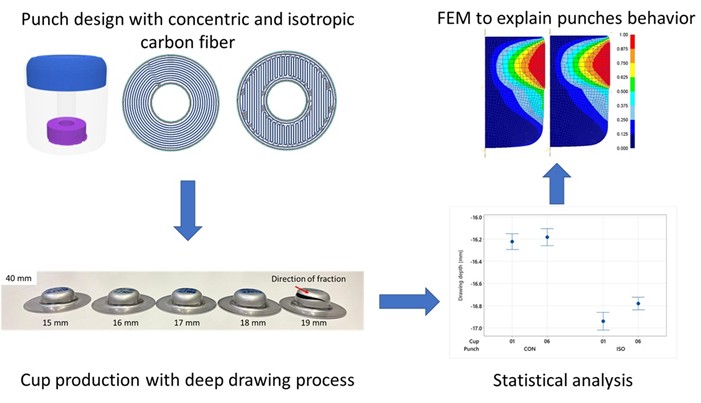
Additively manufactured composite tools are increasingly used in sheet forming, yet the influence of fiber orientation on tool durability remains poorly understood. In this context, the present study investigates the limited understanding of how different continuous-fiber deposition strategies affect the mechanical stability and durability of additively manufactured polymer punches for deep drawing. Polymer tools reinforced with continuous carbon fibers were fabricated using continuous fiber fabrication (CFF) with two reinforcement layouts—concentric and isotropic—and tested until fracture to assess the achievable drawing depth, punch deformation, and cup integrity. Failure onset was monitored and the dimensional stability of the produced cups was evaluated as indicators of tool performance. The results demonstrated that fiber reinforcement increased the maximum drawable depth from 15 mm (unreinforced onyx punch) to 18 mm for concentric and 19 mm for isotropic punches. Finite element simulations reproduced the deformation trends observed experimentally, confirming that concentric reinforcement leads to higher axial compression and radial expansion. The findings highlight the potential of CFF for producing lightweight, low-cost forming tools, underscoring that optimizing fiber orientation is critical for improving tool durability and process repeatability.
- Rosochowski A, Matuszak A. Rapid tooling: The State of the art. J Mater Process Technol. 2000;106(1-3):191-198. doi: 10.1016/S0924-0136(00)00613-0
- Levy GN, Schindel R, Kruth JP. Rapid manufacturing and rapid tooling with layer manufacturing technologies: State of the art and future perspectives. CIRP Ann. 2003;52(2):589-609. doi: 10.1016/S0007-8506(07)60206-6
- Merklein M, Allwood JM, Behrens BA, et al. Bulk forming of sheet metal. CIRP Ann Manuf Technol. 2012;61(2):725-745. doi: 10.1016/j.cirp.2012.05.007
- Kai DA, De Lima EP, Cunico MWM, Da Costa SEG. Additive Manufacturing: A New Paradigm for Manufacturing. In: Proceedings of the 2016 Industrial and Systems Engineering Research Conference; 2020. p. 452-457.
- Boparai KS, Singh R, Singh H. Development of rapid tooling using fused deposition modeling: A review. Rapid Prototyp J. 2016;22(2):281-299. doi: 10.1108/RPJ-04-2014-0048
- Hussin RB, Sharif SB, Abd Rahim SZB, et al. The potential of metal epoxy composite as hybrid mold inserts in rapid tooling application: A review. Rapid Prototyp J. 2021;27(6):1069-1100. doi: 10.1108/RPJ-01-2020-0025
- Vaghela JR, Valaki JB, Thanki SJ, Pandey AB. Sustainability analysis of rapid tooling-based investment casting: A comprehensive review. Smart Sustain Manuf Syst. 2023;7(1):54-81. doi: 10.1520/SSMS20220029
- Gülçür M, Rich A, Griffiths O, Wilson P, Williams M, Gibbons G. Rapid tooling: Comparative analysis of mechanical properties and energy efficiency in micro-injection mouldings using polymer and metal moulds. Manuf Lett. 2025;45:31-35. doi: 10.1016/j.mfglet.2025.06.204
- Frohn-Sörensen P, Geueke M, Engel B, et al. Design for 3D printed tools: Mechanical material properties for direct polymer additive tooling. Polymers. 2022;14(9):1694. doi: 10.3390/polym14091694
- Pelegatti M, Benasciutti D, De Bona F, et al. On the factors influencing the elastoplastic cyclic response and low cycle fatigue failure of AISI 316L steel produced by laser-powder bed fusion. Int J Fatigue. 2022;165:107224. doi: 10.1016/j.ijfatigue.2022.107224
- Kumar S, Singh AK. FDM modeled polymer tooling for plastic injection molding. Int J Adv Mater Sci Eng. 2018;7(1):9-19. doi: 10.14810/ijamse.2018.7102
- Giolu C, Pupăză C, Amza CG. Exploring polymer-based additive manufacturing for cost-effective stamping devices: A feasibility study with finite element analysis. Polymers (Basel). 2024;16(13):1894. doi: 10.3390/polym16131894
- Giorleo L, Deniz KI. Topology optimization of polymer-based bending tools manufactured via additive technology: Numerical and experimental validation. J Manuf Mater Process. 2025;9(9):310. doi: 10.3390/jmmp9090310
- Salifu S, Desai D, Ogunbiyi O, Mwale K. Recent development in the additive manufacturing of polymer-based composites for automotive structures: A review. Int J Adv Manuf Technol. 2022;119(11):6877-6891. doi: 10.1007/s00170-021-08569-z
- Pinto M, Santos AD, Teixeira P, Bolt PJ. Study on the usability and robustness of polymer and wood materials for tooling in sheet metal forming. J Mater Process Technol. 2008;202 (1-3):47-53. doi: 10.1016/j.jmatprotec.2007.08.082
- Liewald M, De Souza JHC. New developments on the use of polymeric materials in sheet metal forming. Prod Eng. 2008;2(1):63-72. doi: 10.1007/s11740-008-0077-5
- Giorleo L, Ceretti E. Aluminium deep drawing with additive manufacturing polymer punches: Performance analysis in small batch production. Int J Adv Manuf Technol. 2023;128(5):2175-2185. doi: 10.1007/s00170-023-12066-w
- Gaudenzi G, Giorleo L, Ceretti E. Performance analysis of composite and steel deep drawing tools combination. Int J Adv Manuf Technol. 2025;136(2):581-600. doi: 10.1007/s00170-024-14875-z
- Schuh G, Bergweiler G, Bickendorf P, Fiedler F, Colag C. Sheet metal forming using additively manufactured polymer tools. Procedia CIRP. 2020;93:20-25. doi: 10.1016/j.procir.2020.04.013
- Geueke M, Frohn-Sörensen P, Reuter J, Padavu N, Reinicke T, Engel B. Structural optimization of additively manufactured polymer tools for flexible sheet metal forming. Procedia CIRP. 2021;104:1345-1350. doi: 10.1016/j.procir.2021.11.226
- Pelin G, Sonmez M, Pelin CE. The use of additive manufacturing techniques in the development of polymeric molds: A review. Polymers (Basel). 2024;16(8):1055. doi: 10.3390/polym16081055
- Sathishkumar N, Arumaikkannu G, Hariharan K. Design of a direct rapid tool for hydroforming of metal bellows using additively manufactured polymer die. Int J Interact Des Manuf. 2024;18(7):4941-4962. doi: 10.1007/s12008-024-01821-2
- Giorleo L, Ceretti E. Deep drawing punches produced using fused filament fabrication technology: Performance evaluation. J Manuf Process. 2022;84:1-9. doi: 10.1016/j.jmapro.2022.09.054
- Burnett C, Graninger G, Eren Z, Falzon BG, Kazancı Z. Tensile performance of carbon fibre-reinforced 3D-printed polymers: Effect of printing parameters. Eng Fail Anal. 2025;175:109577. doi: 10.1016/j.engfailanal.2025.109577
- Available from: https://markforged.com/materials/plastics/ onyx visited 24/11/25
- Available from: https://www.matweb.com/visited 24/11/25
- Unal H, Mimaroglu A. Friction and wear performance of polyamide 6 and graphite and wax polyamide 6 composites under dry sliding conditions. Wear. 2012;289:132-137. doi: 10.1016/j.wear.2012.04.004
- Meng H, Sui GX, Xie GY, Yang R. Friction and wear behavior of carbon nanotubes reinforced polyamide 6 composites under dry sliding and water-lubricated condition. Compos Sci Technol. 2009;69(5):606-611. doi: 10.1016/j.compscitech.2008.12.004