
Effect of rotational speed on the microstructure and corrosion resistance of 2219 aluminum alloy manufactured by additive friction stir deposition

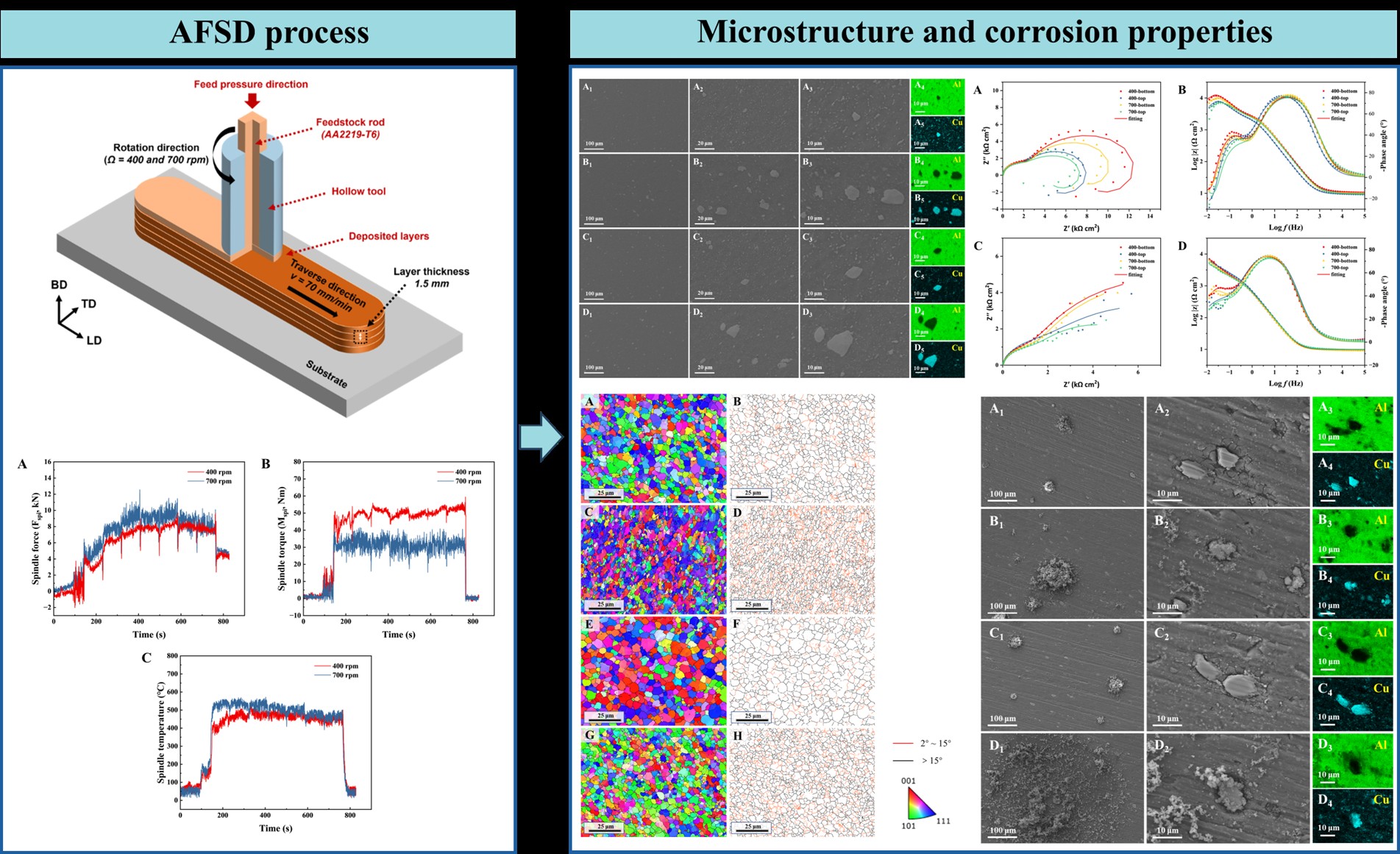
The 2219 aluminum alloy is widely utilized in critical structural components owing to its superior overall performance, while additive friction stir deposition (AFSD) exhibits potential for large-scale manufacturing. However, research on the corrosion behavior of AFSD-fabricated materials remains limited, and the influence of process parameters on corrosion mechanisms requires further exploration. This study compares the microstructure and corrosion resistance of different deposition layers in 2219 aluminum alloy fabricated by AFSD at rotational speeds of 400 rpm and 700 rpm. Higher rotational speed (700 rpm) generated greater thermal input and plastic deformation, promoting dynamic recrystallization and leading to larger grain sizes (bottom layer: 3.40 μm [400 rpm] vs. 3.83 μm [700 rpm]; top layer: 2.50 μm [400 rpm] vs. 3.01 μm [700 rpm]) and increased high-angle grain boundaries (bottom layer: 71.5% [400 rpm] vs. 75.2% [700 rpm], top layer: 57.3% [400 rpm] vs. 63.0% [700 rpm]). The bottom layer, experiencing more thermal cycles, showed further grain growth and resulted in larger grain sizes. At 700 rpm, greater precipitation of the Al2Cu phase increased the number of micro-galvanic couples between precipitates and the aluminum matrix, accelerating corrosion. Conversely, greater thermal input in the bottom layer promoted Cu dissolution and reduced precipitate formation, improving corrosion resistance compared to the top layer. Consequently, the bottom layer processed at 400 rpm exhibited the optimal corrosion resistance, with the highest Rct value of 4.17 × 10³ Ω·cm2. As the rotational speed decreased, the corrosion resistance was enhanced.
- Ghalandari MA, Mirsalehi SE, Kiani S. Production of nanocomposite parts using AA6061-T6 consumable rods via friction stir method: A novel approach of solid-state additive manufacturing of CNT-reinforced aluminum matrix nanocomposites. Mater Today Commun. 2025;42:111435. doi: 10.1016/j.mtcomm.2024.111435
- Sahraei A, Mirsalehi SE. An investigation on application of friction stir additive manufacturing (FSAM) for the production of AA6061/TiC-graphene hybrid nanocomposite in the shape of multi-layer cylindrical part. J Mater Res Technol. 2024;30:6737-6752. doi: 10.1016/j.jmrt.2024.05.043
- Li F, Zhang W, Kooi BJ, Pei Y. Eutectic aluminum alloys fabricated by additive manufacturing: A comprehensive review. J Mater Sci Technol. 2026;250:123-164. doi: 10.1016/j.jmst.2025.06.016
- Tao H, Cai Q, Chen M, Zhang W, Cao G, Zhang H. Effect of heat treatment on the microstructure and corrosion performance of 2219 Al alloy cold sprayed coatings. Corros Sci. 2024;241:112526. doi: 10.1016/j.corsci.2024.112526
- He H, Yi Y, Huang S, Zhang Y. An improved process for grain refinement of large 2219 Al alloy rings and its influence on mechanical properties. J Mater Sci Technol. 2019;35:55-63. doi: 10.1016/j.jmst.2018.09.007
- Han F, Li C, Wang Y, et al. Comparative study on corrosion property of 2219 aluminum alloy sheet and additively manufactured 2319 aluminum alloy. J Mater Res Technol. 2024;30:3178-3785. doi: 10.1016/j.jmrt.2024.04.036
- Grilli R, Baker MA, Castle JE, Dunn B, Watts JF. Localized corrosion of a 2219 aluminium alloy exposed to a 3.5% NaCl solution. Corros Sci. 2010;52:2855-2866. doi: 10.1016/j.corsci.2010.04.035
- Mao X, Yi Y, He H, Huang S, Guo W. Second phase particles and mechanical properties of 2219 aluminum alloys processed by an improved ring manufacturing process. Mater Sci Eng A. 2020;781:139226. doi: 10.1016/j.msea.2020.139226
- Qiao Q, Gong X, Guo D, et al. Influence of tool head geometry on in situ monitoring of temperature, force, and torque during additive friction deposition of aluminum alloy 2219. Mater Sci Addit Manuf. 2025;4:025280060. doi: 10.36922/MSAM025280060
- Chang W, Gao J, Qian H, et al. Microbiologically influenced corrosion of friction-surfaced 630 stainless steel coating in the presence of Pseudomonas aeruginosa. Corros Sci. 2025;245:112708. doi: 10.1016/j.corsci.2025.112708
- Zhao Y, Jin Z, Xu B, et al. Effect of surface cleaning on interface bonding performance for 316H stainless steel joints manufactured by additive forging. Mater Des. 2021;210:110025. doi: 10.1016/j.matdes.2021.110025
- Qiao Q, Zhou M, Gong X, et al. In-situ monitoring of additive friction stir deposition of AA6061: Effect of layer thickness on the microstructure and mechanical properties. Addit Manuf. 2024;84:104141. doi: 10.1016/j.addma.2024.104141
- Deng R, Wei R, Liang J, et al. Microstructure and wear characteristics of austenitic stainless steel coatings fabricated through various directed energy deposition. Mater Sci Addit Manuf. 2024;3:4974. doi: 10.36922/msam.4974
- Marchal V, Zhang Y, Labed N, Lachat R, Peyraut F. Fast layer fiber orientation optimization method for continuous fiber-reinforced material extrusion process. Mater Sci Addit Manuf. 2023;2:49. doi: 10.36922/msam.49
- Petram R, Wisdom C, Montelione A, et al. On the surface integrity resulting from laser powder bed fusion of Ti6Al4V: Improvements by cavitation abrasive surface finishing. Mater Sci Addit Manuf. 2025;5:025280062. doi: 10.36922/MSAM025280062
- Korgancı M, Bozkurt Y. Recent developments in additive friction stir deposition (AFSD). J Mater Res Technol. 2024;30:4572-4583. doi: 10.1016/j.jmrt.2024.04.179
- Tuncer N, Bose A. Solid-state metal additive manufacturing: A review. JOM. 2020;72:3090-3111. doi: 10.1007/s11837-020-04260-y
- Khodabakhshi F, Gerlich AP. Potentials and strategies of solid-state additive friction-stir manufacturing technology: A critical review. J Manuf Processes. 2018;36:77-92. doi: 10.1016/j.jmapro.2018.09.030
- Shao J, Samaei A, Xue T, et al. Additive friction stir deposition of metallic materials: Process, structure and properties. Mater Des. 2023;234:112356. doi: 10.1016/j.matdes.2023.112356
- Yasa E, Poyraz O, Molyneux A, Sharman A, Bilgin GM, Hughes J. Systematic review on additive friction stir deposition: Materials, processes, monitoring and modelling. Inventions. 2024;9:116. doi: 10.3390/inventions9060116
- Khan AS. Advanced Solid-State Dissimilar Material Joining and Additive Manufacturing for Enabling Multi-Material Lightweight Structures. Thesis; 2024. doi: 10.7302/23746
- Anderson-Wedge K, Avery DZ, Daniewicz SR, et al. Characterization of the fatigue behavior of additive friction stir-deposition AA2219. Int J Fatigue. 2021;142:105951. doi: 10.1016/j.ijfatigue.2020.105951
- Zhang M, Ye X, Li Y, Wang H, Lai R, Li Y. Effect of heat treatment states of feedstock on the microstructure and mechanical properties of AA2219 layers deposited by additive friction stir deposition. Materials. 2023;16:7591. doi: 10.3390/ma16247591
- Rivera OG, Allison PG, Brewer LN, et al. Influence of texture and grain refinement on the mechanical behavior of AA2219 fabricated by high shear solid state material deposition. Mater Sci Eng A. 2018;724:547-558. doi: 10.1016/j.msea.2018.03.088
- Wang Z, Qian H, Chang W, et al. Microstructure and localized corrosion properties of 2219 aluminum alloy manufactured by additive friction stir deposition. Corros Sci. 2024;240:112508. doi: 10.1016/j.corsci.2024.112508
- Elshaghoul YGY, El-Sayed Seleman MM, Bakkar A, et al. Additive friction stir deposition of AA7075-T6 alloy: Impact of process parameters on the microstructures and properties of the continuously deposited multilayered parts. Appl Sci. 2023;13:10255. doi: 10.3390/app131810255
- Qiao Q, Wang L, Tam CW, et al. In-situ monitoring of additive friction stir deposition of AA6061: Effect of rotation speed on the microstructure and mechanical properties. Mater Sci Eng A. 2024;902:146620. doi: 10.1016/j.msea.2024.146620
- Chen G, Wu K, Wang Y, Zhu Z, Nie P, Hu F. Effect of rotational speed and feed rate on microstructure and mechanical properties of 6061 aluminum alloy manufactured by additive friction stir deposition. Int J Adv Manuf Technol. 2023;127:1165-1176. doi: 10.1007/s00170-023-11527-6.
- Prabhakar DAP, Shettigar AK, Herbert MA, et al. A comprehensive review of friction stir techniques in structural materials and alloys: Challenges and trends. J Mater Res Technol. 2022;20:3025-3060. doi: 10.1016/j.jmrt.2022.08.034
- Qiao Q, Tam CW, Lam WI, et al. Hybrid heat-source solid-state additive manufacturing: A method to fabricate high performance AA6061 deposition. J Mater Sci Technol. 2025;228:107-124. doi: 10.1016/j.jmst.2024.11.079
- Garcia D. Investigation of the Processing History During Additive Friction Stir Deposition Using in-Process Monitoring Techniques. Doctoral Dissertations. Virginia Tech; 2021. Available from: https://hdl.handle.net/10919/111376
- Ambrosio D, Wagner V, Dessein G, Vivas J, Cahuc O. Machine learning tools for flow-related defects detection in friction stir welding. J Manuf Sci Eng. 2023;145:101005. doi: 10.1115/1.4062457
- Bourgeois L, Zhang Y, Zhang Z, Chen Y, Medhekar NV. Transforming solid-state precipitates via excess vacancies. Nat Commun. 2020;11:1248. doi: 10.1038/s41467-020-15087-1
- Krasnikov VS, Mayer AE, Pogorelko VV, Gazizov MR. Influence of θ’ phase cutting on precipitate hardening of Al-Cu alloy during prolonged plastic deformation: Molecular dynamics and continuum modeling. Appl Sci. 2021;11:4906. doi: 10.3390/app11114906
- Straumal BB, Kulagin R, Klinger L, et al. Structure refinement and fragmentation of precipitates under severe plastic deformation: A review. Materials (Basel). 2022;15:601. doi: 10.3390/ma15020601
- Xu D, Jiang M, Meng L, Zhu M, Liu Y, Zhang X. Interfacial characteristics, interfacial oxide evolution and bonding mechanism of 2219 aluminum alloy joints manufactured by hot-compression bonding. J Mater Res Technol. 2024;30:3036-3051. doi: 10.1016/j.jmrt.2024.04.080
- Tang W, Yang X, Tian C, Xu Y. Interfacial grain structure, texture and tensile behavior of multilayer deformation-based additively manufactured Al 6061 alloy. Mater Charact. 2023;196:112646. doi: 10.1016/j.matchar.2023.112646
- Li H, Lin J, Dean TA, Wen SW, Bannister AC. Modelling mechanical property recovery of a linepipe steel in annealing process. Int J Plast. 2009;25:1049-1065. doi: 10.1016/j.ijplas.2008.09.001
- Rizi MS, Minouei H, Lee BJ, Pouraliakbar H, Toroghinejad MR, Hong SI. Data supporting the hierarchically activated deformation mechanisms to form ultra-fine grain microstructure in carbon containing FeMnCoCr twinning induced plasticity high entropy alloy. Data Brief. 2022;42:108052. doi: 10.1016/j.dib.2022.108052
- Pouraliakbar H, Howells A, Gallerneault M, Fallah V. Fracture behavior of a rapidly solidified thin-strip continuous cast AA5182 Al-Mg alloy with the Portevin-Le Chatelier effect under varying strain rates. J Alloys Compd.2024;971:172810. doi: 10.1016/j.jallcom.2023.172810
- Doherty RD. The deformed state and nucleation of recrystallization. Met Sci. 1974;8:132-142. doi: 10.1179/msc.1974.8.1.132
- Hadadzadeh A, Mokdad F, Wells MA, Chen DL. A new grain orientation spread approach to analyze the dynamic recrystallization behavior of a cast-homogenized Mg-Zn-Zr alloy using electron backscattered diffraction. Mater Sci Eng A. 2018;709:285-289. doi: 10.1016/j.msea.2017.10.062
- Ayad A, Allain-Bonasso N, Rouag N, Wagner F. Grain orientation spread values in if steels after plastic deformation and recrystallization. Mater Sci Forum. 2012;702-703:269-272. doi: 10.4028/www.scientific.net/MSF.702-703.269
- Sprouster DJ, Streit Cunningham W, Halada GP, et al. Dislocation microstructure and its influence on corrosion behavior in laser additively manufactured 316L stainless steel. Addit Manuf. 2021;47:102263. doi: 10.1016/j.addma.2021.102263
- Chang W, Wang X, Qian H, et al. Effect of Sn addition on microstructure, hardness and corrosion behavior of CoCrFeNiSnx high entropy alloys in chloride environment. Corros Sci. 2024;227:111808. doi: 10.1016/j.corsci.2023.111808
- Lou Y, Chang W, Cui T, Qian H, Hao X, Zhang D. Microbiologically influenced corrosion inhibition induced by S. putriefaciens mineralization under extracellular polymeric substance regulation via FlrA and FlhG genes. Corros Sci. 2023;221:111350. doi: 10.1016/j.corsci.2023.111350
- Zhang HH, Liu YW, Bian H, et al. Electrodeposition of silane/ reduced graphene oxide nanocomposite on AA2024-T3 alloy with enhanced corrosion protection, chemical and mechanical stability. J Alloys Compd. 2022;911:165058. doi: 10.1016/j.jallcom.2022.165058
- Ameer MA, Fekry AM, Heakal FET. Electrochemical behaviour of passive films on molybdenum-containing austenitic stainless steels in aqueous solutions. Electrochim Acta. 2004;50:43-49. doi: 10.1016/j.electacta.2004.07.011
- Jorcin JB, Orazem ME, Pébère N, Tribollet B. CPE analysis by local electrochemical impedance spectroscopy. Electrochim Acta. 2006;51:1473-1479. doi: 10.1016/j.electacta.2005.02.128
- Cui T, Qian H, Chang W, et al. Towards understanding Shewanella algae-induced degradation of passive film of stainless steel based on electrochemical, XPS and multi-mode AFM analyses. Corros Sci. 2023;218:111174. doi: 10.1016/j.corsci.2023.111174
- Zhao L, Qian H, Chang W, et al. Effect of aging heat treatment on microbiologically influenced corrosion of 17-4PH stainless steel by Pseudomonas aeruginosa. Corros Sci. 2024;227:111739. doi: 10.1016/j.corsci.2023.111739
- Shoar Abouzari MR, Berkemeier F, Schmitz G, Wilmer D. On the physical interpretation of constant phase elements. Solid State Ionics. 2009;180:922-927. doi: 10.1016/j.ssi.2009.04.002
- Huang Y, Shih H, Mansfeld F. Concerning the use of constant phase elements (CPEs) in the analysis of impedance data. Mater Corros. 2010;61:302-305. doi: 10.1002/maco.200905385
- Wang B, Zhang L, Su Y, Mou X, Xiao Y, Liu J. Investigation on the corrosion behavior of aluminum alloys 3A21 and 7A09 in chloride aqueous solution. Mater Des. 2013;50:15-21. doi: 10.1016/j.matdes.2013.02.080
- Babu AP, Choudhary S, Griffith JC, Huang A, Birbilis N. On the corrosion of a high solute Al-Zn-Mg alloy produced by laser powder bed fusion. Corros Sci. 2021;189:109626. doi: 10.1016/j.corsci.2021.109626
- McCafferty E. Sequence of steps in the pitting of aluminum by chloride ions. Corros Sci. 2003;45:1421-1438. doi: 10.1016/S0010-938X(02)00231-7
- Li P, Du M. Effect of chloride ion content on pitting corrosion of dispersion-strengthened-high-strength steel. Corros Commun. 2022;7:23-34. doi: 10.1016/j.corcom.2022.03.005
- Bockris JO, Minevski LV. On the mechanism of the passivity of aluminum and aluminum alloys. J Electroanal Chem. 1993;349:375-414. doi: 10.1016/0022-0728(93)80186-L
- Abbasi-Nahr M, Mirsalehi SE. Additive friction stir deposition of AA5083/MoS2-diamond hybrid nanocomposites: Investigating their metallurgical, mechanical, tribological, and electrochemical characteristics, and process-structure-property relationships. J Alloys Compd. 2025;1013:178553. doi: 10.1016/j.jallcom.2025.178553
- Kiani S, Mirsalehi SE. Friction stir additive manufacturing of B4C and graphene reinforced aluminum matrix hybrid nanocomposites using consumable pins. J Mater Res Technol. 2024;28:1094-1110. doi: 10.1016/j.jmrt.2023.12.065
- Kiani S, Mirsalehi SE, Sahraei A. Linear and cylindrical friction stir additive manufacturing (FSAM) of AA6061-T6 by consumable rods: Metallurgical structure, wear, and corrosion properties. Weld World. 2024;68:2869-2889. doi: 10.1007/s40194-024-01839-w
- Obispo HM, Murr LE, Arrowood RM, Trillo EA. Copper deposition during the corrosion of aluminum alloy 2024 in sodium chloride solutions. J Mater Sci. 2000;35:3479-3495. doi: 10.1023/A:1004840908494
- Na KH, Pyun SI. Comparison of susceptibility to pitting corrosion of AA2024-T4, AA7075-T651 and AA7475-T761 aluminium alloys in neutral chloride solutions using electrochemical noise analysis. Corros Sci. 2008;50:248-258. doi: 10.1016/j.corsci.2007.05.028
- Suter T, Alkire RC. Microelectrochemical studies of pit initiation at single inclusions in Al 2024-T3. J Electrochem Soc. 2001;148:B36. doi: 10.1149/1.1344530
- Xu W, Liu J. Microstructure and pitting corrosion of friction stir welded joints in 2219-O aluminum alloy thick plate. Corros Sci. 2009;51:2743-2751. doi: 10.1016/j.corsci.2009.07.004
- Koteswara Rao SR, Madhusudhan Reddy G, Srinivasa Rao K, Kamaraj M, Prasad Rao K. Reasons for superior mechanical and corrosion properties of 2219 aluminum alloy electron beam welds. Mater Charact. 2005;55:345-354. doi: 10.1016/j.matchar.2005.07.006
- Zhu X, Wang R, Wang L, Liu M, Li S. Effect of rotational shear and heat input on the microstructure and mechanical properties of large-diameter 6061 aluminium alloy additive friction stir deposition. Crystals. 2024;14:581. doi: 10.3390/cryst14070581