
Antimicrobial resistance: A five-year bacterial surveillance study from a Jamaican tertiary hospital

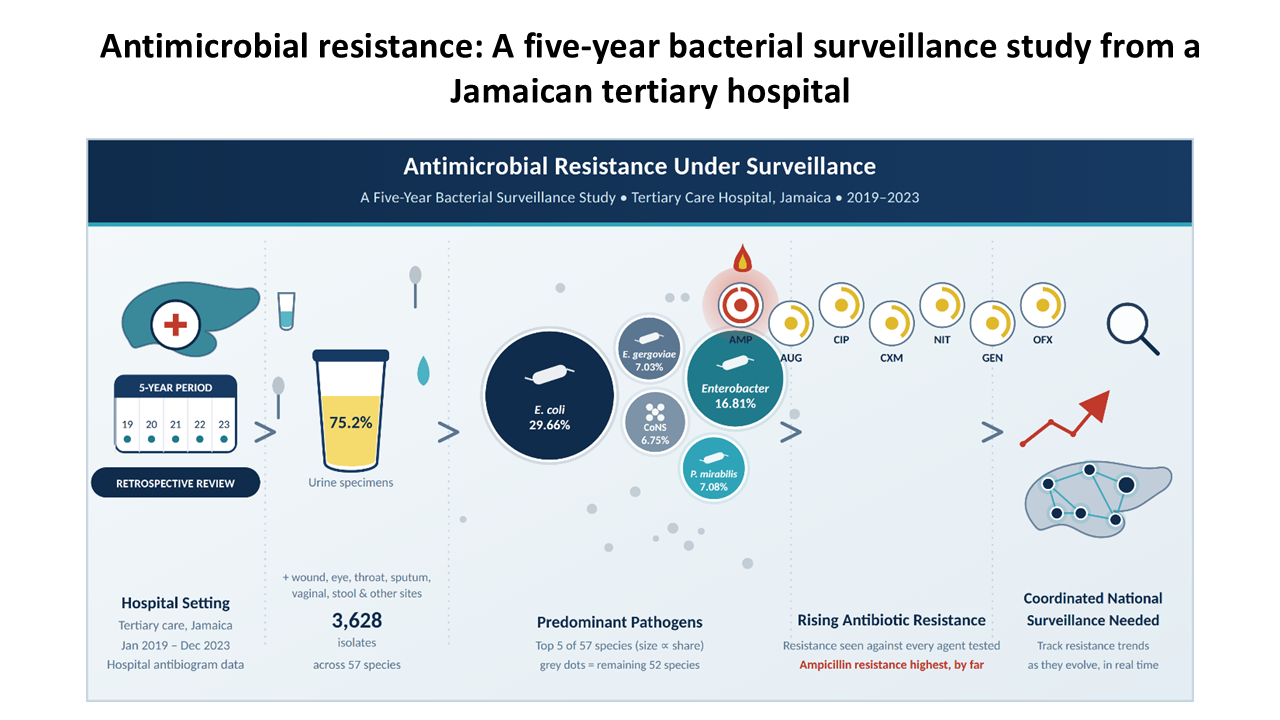
Antibiotic resistance continues to undermine treatment options worldwide, particularly in developing countries, where access to effective antibiotics is often delayed while resistant strains proliferate. This retrospective, cross-sectional study evaluated resistance patterns and the pathogens and specimen types most commonly isolated at a tertiary care hospital in Jamaica. Antibiograms from January 2019 to December 2023 were reviewed, and annual resistance patterns were compared using chi-square testing (p < 0.05). Over the five-year period, 3,885 pathogens representing 57 microbial species were isolated from specimens including urine, eye swabs, wound, vaginal swabs, aspirates, semen, catheters, stool, ulcer, throat, sputum, and abscess; urine predominated, accounting for 75.19% (n = 2,728) of isolates. Escherichia coli was the most frequently isolated organism (29.66%), followed by Enterobacter species (16.81%), Proteus mirabilis (7.08%), Enterobacter gergoviae (7.03%), coagulase-negative staphylococci (6.75%), Group D streptococci (5.62%), Pseudomonas aeruginosa (4.49%), and Staphylococcus aureus (3.25%). Susceptibility testing most often involved ampicillin, Augmentin, ciprofloxacin, cefuroxime, nitrofurantoin, gentamicin, and ofloxacin, with resistance emerging against all agents to varying degrees and ampicillin showing the highest rates by a clear margin. These findings raise concern about the extent of antimicrobial resistance in this setting, particularly given the pronounced resistance of E. coli to ampicillin and how frequently this drug is used empirically. As a single-center, retrospective analysis, this study cannot capture nationwide trends, underscoring the need for coordinated, country-wide antibiogram tracking to monitor resistance patterns as they evolve rather than assess them retrospectively at individual institutions.
- Kang CI, Kim SH, Park WB, et al. Bloodstream infections caused by antibiotic-resistant gram-negative bacilli: risk factors for mortality and impact of inappropriate initial antimicrobial therapy on outcome. Antimicrob Agents Chemother. 2005;49(2):760-766. doi: 10.1128/AAC.49.2.760-766.2005
- Cosgrove SE, Sakoulas G, Perencevich EN, et al. Comparison of mortality associated with methicillin-resistant and methicillin-susceptible Staphylococcus aureus bacteremia: a meta-analysis. Clin Infect Dis. 2003;36(1):53-59. doi: 10.1086/345476
- Yuan K, Yu K, Yang R, et al. Metagenomic characterization of antibiotic resistance genes in Antarctic soils. Ecotoxicol Environ Saf. 2019;176:300-308. doi: 10.1016/j.ecoenv.2019.03.099
- Rather IA, Kim BC, Bajpai VK, Park YH. Self-medication and antibiotic resistance: crisis, current challenges, and prevention. Saudi J Biol Sci. 2017;24(4):808-812. doi: 10.1016/j.sjbs.2017.01.004
- Sukumar S, Martin FE, Hughes TE, Adler CJ. Think before you prescribe: how dentistry contributes to antibiotic resistance. Aust Dent J. 2020;65(1):21-29. doi: 10.1111/adj.12727
- Murray CJL, Ikuta KS, Sharara F, et al. Global burden of bacterial antimicrobial resistance in 2019: a systematic analysis. Lancet. 2022;399(10325):629-655. doi: 10.1016/S0140-6736(21)02724-0
- Panda SK, Buroni S, Swain SS, et al. Recent advances to combat ESKAPE pathogens with special reference to essential oils. Front Microbiol. 2022;13:1029098. doi: 10.3389/fmicb.2022.1029098
- Nicholson AM, Ledgister S, Williams T, et al. Distribution of nosocomial organisms and their resistance patterns in the intensive care unit of the University Hospital of the West Indies, Kingston, Jamaica. West Indian Med J. 2009;58(2):142-148.
- Santajit S, Indrawattana N. Mechanisms of antimicrobial resistance in ESKAPE pathogens. Biomed Res Int. 2016;2016:2475067. doi: 10.1155/2016/2475067
- Walsh TR, Gales AC, Laxminarayan R, Dodd PC. Antimicrobial resistance: addressing a global threat to humanity. PLoS Med. 2023;20(7):e1004264. doi: 10.1371/journal.pmed.1004264
- World Health Organization. WHO Bacterial Priority Pathogens List, 2024: Bacterial Pathogens of Public Health Importance to Guide Research, Development and Strategies to Prevent and Control Antimicrobial Resistance. Geneva, Switzerland: World Health Organization; 2024. Accessed March 15, 2026. https://www.who.int/publications/i/item/9789240093461
- Thomsen J, Abdulrazzaq NM, AlRand H. Epidemiology and antimicrobial resistance trends of Acinetobacter species in the United Arab Emirates: a retrospective analysis of 12 years of national AMR surveillance data. Front Public Health. 2024;11:1245131. doi: 10.3389/fpubh.2023.1245131
- Aslam B, Wang W, Arshad MI, et al. Antibiotic resistance: a rundown of a global crisis. Infect Drug Resist. 2018;11:1645-1658. doi: 10.2147/IDR.S173867
- Harbarth S, Balkhy HH, Goossens H, et al. Antimicrobial resistance: one world, one fight! Antimicrob Resist Infect Control. 2015;4(1):49. doi: 10.1186/s13756-015-0091-2
- Mendoza AMB, Maliñana SAA, Maravillas SID, Moniva KC, Jazul JP. Relationship of self-medication and antimicrobial resistance (AMR) in low- and middle-income countries (LMICs): a scoping review. J Public Health Emerg. 2025;9:6. doi: 10.21037/jphe-23-184
- Klein Klouwenberg PMC, Oliveira dos Santos C, van de Wetering D, Provacia L. Temporal trends in antimicrobial resistance of medically important pathogens on Curaçao. Antimicrob Resist Infect Control. 2024;13(1):151. doi: 10.1186/s13756-024-01499-x
- Putnam SD, Riddle MS, Wierzba TF, Pittner BT, et al. Antimicrobial susceptibility trends among Escherichia coli and Shigella spp. isolated from rural Egyptian paediatric populations with diarrhoea between 1995 and 2000. Clin Microbiol Infect. 2004;10(9):804-810. doi: 10.1111/j.1469-0691.2004.00927.x
- Bertagnolio S, Suthar AB, Tosas O, Van Weezenbeek K. Antimicrobial resistance: strengthening surveillance for public health action. PLoS Med. 2023;20(7):e1004265. doi: 10.1371/journal.pmed.1004265
- Zimmer BL, Carpenter DE, Esparza G, et al. Performance Standards for Antimicrobial Disk Susceptibility Tests. 14th ed. CLSI standard M02. Wayne, PA: Clinical and Laboratory Standards Institute; 2024.
- Wang H, Han J, Li Y, Ding D, Li X. A new challenge of antibiotic-resistant bacteria: carbapenem-resistant Enterobacter cloacae complex in a One Health perspective. Microorganisms. 2026;14(3):594. doi: 10.3390/microorganisms14030594
- Aiesh BM, Nazzal MA, Abdelhaq AI, Abutaha SA, Zyoud SH, Sabateen A. Impact of an antibiotic stewardship program on antibiotic utilization, bacterial susceptibilities, and cost of antibiotics. Sci Rep. 2023;13(1):5040. doi: 10.1038/s41598-023-32329-6
- Morsi N, Mosaad E, Ahmed O. Evaluating the effects of antimicrobial stewardship program on antimicrobial consumption and resistance patterns: a quasi-experimental study. BMC Infect Dis. 2026;26(1):988. doi: 10.1186/s12879-026-13358-8
- Joseph AS, Manjari CVS, Lathakumari RH, Vajravelu LK. Emergence of β-lactamase-producing Proteus mirabilis in clinical settings: a genotypic investigation of resistance mechanisms and carbapenemase genes blaNDM-1 and blaKPC-2. Biotechnol Notes. 2025;6:177-182. doi: 10.1016/j.biotno.2025.07.001
- Ndialle CE, Nyincho MM, Eyong M, et al. Resistance profiling of predominant non-E coli Enterobacteriaceae isolated from humans, food animals, and the environment in the Fako Division of Cameroon. Biomed Res Int. 2025;2025(1):3947539. doi: 10.1155/bmri/3947539
- Yaikhan T, Suwannasin S, Singkhamanan K, et al. Genomic characterization of multidrug-resistant Enterobacteriaceae clinical isolates from southern Thailand hospitals: unraveling antimicrobial resistance and virulence mechanisms. Antibiotics. 2024;13(6):531. doi: 10.3390/antibiotics13060531
- Ödemiş İ, Arslan Gülen T. The effect of antibiotic resistance and inappropriate empirical antibiotic therapy on 3-day and 28-day mortality in bacteremic patients in the intensive care unit: 5-year retrospective analysis. Duzce Med J. 2022;24(2):187-192. doi: 10.18678/dtfd.1069393
- Hung YP, Lee CC, Ko WC. Effects of inappropriate administration of empirical antibiotics on mortality in adults with bacteraemia: systematic review and meta-analysis. Front Med. 2022;9:869822. doi: 10.3389/fmed.2022.869822
- Ku NS, Lee Y, Park DW. Appropriate timing of antibiotic initiation in patients with sepsis or septic shock: a systematic review and meta-analysis. Korean J Intern Med. 2025;40(5):725-733. doi: 10.3904/kjim.2025.037
- Giannella M, Bussini L, Pascale R, et al. Prognostic utility of the new definition of difficult-to-treat resistance among patients with gram-negative bloodstream infections. Open Forum Infect Dis. 2019;6(12):ofz505. doi: 10.1093/ofid/ofz505
- Mahony M, McMullan B, Brown J, Kennedy SE. Multidrug-resistant organisms in urinary tract infections in children. Pediatr Nephrol. 2020;35(9):1563-1573. doi: 10.1007/s00467-019-04316-5
- Spengler G, Kincses A, Gajdács M, Amaral L. New roads leading to old destinations: efflux pumps as targets to reverse multidrug resistance in bacteria. Molecules. 2017;22(3):468. doi: 10.3390/molecules22030468
- El-Saed A, Balkhy HH, Alshamrani MM, et al. High contribution and impact of resistant gram-negative pathogens causing surgical site infections at a multi-hospital healthcare system in Saudi Arabia, 2007-2016. BMC Infect Dis. 2020;20(1):275. doi: 10.1186/s12879-020-4939-6
- Ajulo S, Awosile B. Global antimicrobial resistance and use surveillance system (GLASS 2022): investigating the relationship between antimicrobial resistance and antimicrobial consumption data across the participating countries. PLoS One. 2024;19(2):e0297921. doi: 10.1371/journal.pone.0297921
- Anitha S, Sijimol S, Akila K, et al. Coagulase-negative staphylococci — a true pathogen in bloodstream infections and their resistance patterns in a tertiary care hospital. J Pure Appl Microbiol. 2024;18(2):1103-1109. doi: 10.22207/JPAM.18.2.27
- Rybak B, Werbowy O, Debowski K, Plotka M, Kocot AM. Coagulase-negative staphylococci determined as blood culture contamination have high virulence characteristic including transfer of antibiotic resistance determinants to Staphylococcus aureus and Escherichia coli. Int J Mol Sci. 2025;26(9):4424. doi: 10.3390/ijms26094424
- Goshorn ES, Viehman JA, Bariola JR, Khadem T, Potoski BA, Shields RK. Impact of rapid identification and stewardship intervention on coagulase-negative Staphylococcus bloodstream infection. Open Forum Infect Dis. 2023;10(8):ofad416. doi: 10.1093/ofid/ofad416
- Gautam G, Gogoi S, Saxena S, Kaur R, Dhakad MS. Nitrofurantoin susceptibility pattern in gram-negative urinary isolates: in need of increased vigilance. J Lab Physicians. 2021;13(3):252-256. doi: 10.1055/s-0041-1731106
- Harsh T, Patil HV, Patil SR. Prevalence and antimicrobial susceptibility pattern of Pseudomonas aeruginosa isolates from various clinical specimens in a tertiary care hospital: an analysis of resistance trends and implications for treatment strategies. Cureus. 2024;16(10):e72556. doi: 10.7759/cureus.72556
- Singh N, Saurabh K, Kumari N. Detection of methicillin resistance and β-lactamase production in Staphylococcus aureus isolates: a cross-sectional study from a tertiary care hospital. J Pure Appl Microbiol. 2022;16(3):1689-1695. doi: 10.22207/JPAM.16.3.09
- Gozzer E, Becerra-Chauca N, Abba-Aji M, et al. Antimicrobial resistance interventions in Latin America and the Caribbean: a scoping review of reported interventions between 2018-2024. Antimicrob Resist Infect Control. 2025;14(1):137. doi: 10.1186/s13756-025-01629-z
- Cheung DA, Nicholson A, Butterfield TR, DaCosta M. Prevalence, co-infection and antibiotic resistance of Escherichia Coli from blood and urine samples at a hospital in Jamaica. J Infect Dev Ctries. 2020;14(2):146-152. doi: 10.3855/jidc.11361
- Brown PD, Ngeno C. Antimicrobial resistance in clinical isolates of Staphylococcus aureus from hospital and community sources in southern Jamaica. Int J Infect Dis. 2007;11(3):220-225. doi: 10.1016/j.ijid.2006.04.005
- Cameron-McDermott SM, Barrow GJ, Webster AM, et al. Antimicrobial susceptibility of Neisseria gonorrhoeae isolates and syndromic treatment of men with urethral discharge in Kingston, Jamaica, 2018-19. J Antimicrob Chemother. 2022;77(1):218-222. doi: 10.1093/jac/dkab340
- Allydice-Francis K, Brown PD. Diversity of antimicrobial resistance and virulence determinants in Pseudomonas aeruginosa associated with fresh vegetables. Int J Microbiol. 2012;2012:426241. doi: 10.1155/2012/426241