
Antifungal and bioactive potential of Pleurotus ostreatus cultivated on agro-waste substrates with molecular identification and functional characterization

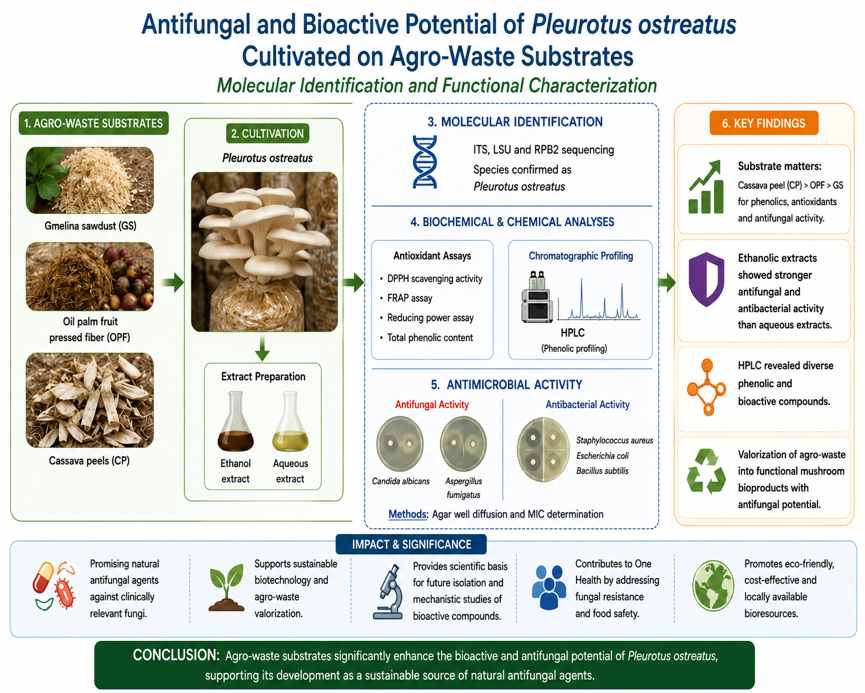
The rising incidence of antifungal resistance among clinically relevant pathogens such as Candida albicans and Aspergillus fumigatus necessitates the discovery of novel, sustainable bioactive compounds. Edible mushrooms are promising sources of antimicrobial agents; however, the influence of cultivation substrates on their antifungal potential remains insufficiently explored, particularly in tropical systems. This study evaluated the antifungal and bioactive properties of Pleurotus ostreatus cultivated on three agro-waste substrates (Gmelina sawdust, oil palm fruit fiber, and cassava peels) in Nigeria. Molecular identification using ITS, LSU, and RPB2 markers confirmed species identity. Extracts were evaluated for antifungal activity against C. albicans and A. fumigatus, alongside antibacterial and antioxidant assays. Results demonstrated that substrate type influenced mycochemical composition and antioxidant activity. Mushrooms cultivated on cassava peels gave the highest phenolic content and antioxidant activity, corresponding with enhanced antifungal efficacy. Ethanol extracts showed stronger antimicrobial activity and lower minimum inhibitory concentrations than aqueous extracts, indicating the role of moderately polar bioactive compounds. These findings establish a direct link between substrate composition, metabolite production, and antifungal activity, highlighting substrate-driven metabolic modulation as a key determinant of bioactivity. This study positions agro-waste cultivated P. ostreatus as a sustainable source of antifungal agents and supports substrate optimization as a scalable strategy for natural product discovery. Future integration of metabolomics and genome-guided approaches will be essential to elucidate active compounds and mechanisms of action.
- Adetuwo OJ, Ogundana FN. Phenotypic characterization and antifungal resistance profiles of Candida species obtained from clinical specimens in Okitipupa, Nigeria. Glob Sci J. 2021;9(12):724-737. Accessed March 24, 2026. https://www.globalscientificjournal.com/researchpaper/ PHENOTYPIC_CHARACTERIZATION_AND_ ANTIFUNGAL_SUSCEPTIBILITY_Profiles_OF_ Candida_species_Isolated_from_CLinICAL_SAMPLES_ IN_Okitipupa_Ondo_State_Nigeria_.pdf
- Abrams DI, Couey P, Shade SB, Kelly ME, Kamanu-Elias N, Stamets P. Antihyperlipidemic effects of Pleurotus ostreatus (oyster mushrooms) in HIV-infected individuals taking antiretroviral therapy. BMC Complement Altern Med. 2011;11(1):60. doi: 10.1186/1472-6882-11-60
- Brakhage AA. Microbial hub signaling compounds: natural products shape microbiome composition and structure. MicroLife. 2024;5:uqae017. doi: 10.1093/femsml/uqae017
- Chang ST, Miles PG. Mushrooms: Cultivation, Nutritional Value, Medicinal Effect, and Environmental Impact. 2nd ed. Boca Raton, FL: CRC Press; 2004. Accessed March 13, 2026. https://sayedmaulana.files.wordpress.com/2011/02/ mushrooms.pdf
- Younis AM, Wu FS, El Shikh HH. Antimicrobial activity of extracts of the oyster culinary medicinal mushroom Pleurotus ostreatus (Higher Basidiomycetes) and identification of a new antimicrobial compound. Int J Med Mushrooms. 2015;17(6):579-590. doi: 10.1615/IntJMedMushrooms.v17.i6.80
- Adedokun OM, Odiketa JK, Afieroho OE, Afieroho MC. Importance of Mushrooms for Food Security in Africa. In: Sustainability Sciences in Asia and Africa. Singapore: Springer Nature; 2022:343-360. doi: 10.1007/978-981-16-6771-8_20
- Ahmadi A, Jamialahmadi T, Sahebkar A. Polyphenols and Atherosclerosis: A Critical Review of Clinical Effects on LDL Oxidation. Pharmacol Res. 2022;184: 106414. doi: 10.1016/j.phrs.2022.106414
- Mayirnao H, Sharma SK, Jangir P, Kaur S, Kapoor R. Mushroom-Derived Nutraceuticals in the 21st Century: An Appraisal and Future Perspectives. J Future Foods. 2025;(5)4: 342–360. doi: 10.1016/j.jfutfo.2024.07.013
- Ahmed OM, Ebaid H, El-Nahass ES, Ragab M, Alhazza IM. Nephroprotective Effect of Pleurotus ostreatus and Agaricus bisporus Extracts and Carvedilol on Ethylene Glycol- Induced Urolithiasis: Roles of NF-κB, p53, Bcl-2, Bax and Bak. Biomolecules. 2020;10(9):1317. doi: 10.3390/biom10091317
- AlAli M, Alqubaisy M, Aljaafari MN, et al. Nutraceuticals: Transformation of Conventional Foods into Health Promoters/Disease Preventers and Safety Considerations. Molecules. 2021;26(9):2540. doi: 10.3390/molecules26092540
- Albertó E. Naturally Occurring Strains of Edible Mushrooms: A Source to Improve the Mushroom Industry. In: Edible and Medicinal Mushrooms (eds C.Z. Diego and A. Pardo-Giménez). Chichester, UK: John Wiley & Sons Ltd; 2021;415–425. doi: 10.1002/9781119149446.ch19
- Ali A, Ahmad U, Akhtar J, Badruddeen J, Khan MM. Engineered Nano Scale Formulation Strategies to Augment Efficiency of Nutraceuticals. J Funct Foods. 2019;62:103554. doi: 10.1016/j.jff.2019.103554
- Allam EAH. Urolithiasis Unveiled: Pathophysiology, Stone Dynamics, Types, and Inhibitory Mechanisms: A Review. Afr J Urol. 2024;(30)1:34. doi: 10.1186/s12301-024-00436-z
- Anachad O, Taouil A, Taha W, Bennis F, Chegdani, F. The Implication of Short-Chain Fatty Acids in Obesity and Diabetes. Microbiol Insights. 2023;(16):1–10. doi: 10.1177/11786361231162720
- Andrade GM, Souza ELD, Zárate-Salazar JR, et al. Unveiling the Potential Prebiotic Effects of Edible Mushroom Pleurotus djamor During in Vitro Colonic Fermentation. J Agric Food Chem. 2024;(72)48:26722–26732. doi: 10.1021/acs.jafc.4c06620
- Fakoya S, Adegbehingbe KT, Ademakinwa IS. Bio-therapeutic, phytochemical screening and antioxidant efficacies of oyster mushroom (Pleurotus ostreatus) obtained from the wild. Open J Med Microbiol. 2020;10:58–70. doi: 10.4236/ojmm.2020.102006
- Lavelli V, Proserpio C, Gallotti F, Laureati M, Pagliarini E. Circular reuse of bio-resources: the role of Pleurotus spp. in the development of functional foods. Food Function. 2018;9(3):1353–72. doi: 10.1039/c7fo01747b
- Shirur M, Barh A, Annepu SK. Sustainable Production of Edible and Medicinal Mushrooms: Implications on Mushroom Consumption. In: Hebsale VK, Climate Change and Resilient Food Systems. 1st ed. Singapore: Springer; 2021:315–346 doi: 10.1007/978-981-33-4538-6_12
- Ferreira ICFR, Barros L, Abreu RMV. Antioxidants in wild mushrooms. Curr Med Chem. 2009;16(12):1543-1560. doi: 10.2174/092986709787909587
- Guzmán, G. Diversity and use of traditional medicinal fungi. Int J Med Mushrooms. 2008;10(3):209-217. doi: 10.1615/IntJMedMushr.v10.i3.20
- Zaidman BZ, Yassin M, Mahajna J, Wasser SP. Medicinal mushroom modulators of molecular targets as cancer therapeutics. Appl Microbiol Biotechnol. 2005;67(4):453-468. doi: 10.1007/s00253-004-1787-z
- Hasan GQ, Abdulhadi SY. Molecular characterization of wild Pleurotus ostreatus (MW457626) and evaluation of β-glucans polysaccharide activities. Karbala Int J Mod Sci. 2022;8(1):52-62. doi: 10.33640/2405-609x.3204
- European Committee on Antimicrobial Susceptibility Testing (EUCAST). EUCAST antimicrobial susceptibility testing guidelines. 2023. Accessed May 19, 2026. https:// www.eucast.org/bacteria/guidance-documents/
- Newman DJ, Cragg GM. Natural products as sources of new drugs over nearly four decades from 01/1981 to 09/2019. J Nat Prod. 2020;83(3):770-803. doi: 10.1021/acs.jnatprod.9b01285
- Oyetayo VO. Medicinal uses of mushrooms in Nigeria: towards full and sustainable exploitation. Afr J Biotechnol. 2011;8(3). doi: 10.4314/ajtcam.v8i3.65289
- Patel S, Goyal A. Recent developments in mushrooms as anti-cancer therapeutics: a review. 3 Biotech. 2012;2(1):1-15. doi: 10.1007/s13205-011-0036-2
- Paterson RRM. Ganoderma—a therapeutic fungal biofactory. Phytochemistry. 2006;67(18):1985-2001. doi: 10.1016/j.phytochem.2006.07.004
- Valverde ME, Hernández-Pérez T, Paredes-López O. Edible mushrooms: improving human health and promoting quality life. Int J Microbiol. 2015;2015:376387. doi: 10.1155/2015/376387
- Vamanu E. In vitro antimicrobial and antioxidant activities of ethanolic extract of Pleurotus ostreatus PQMZ91109. Molecules. 2012;17(3):3653-3671. doi: 10.3390/molecules17043653
- Wasser S. Medicinal mushroom science: Current perspectives, advances, evidences, and challenges. Biomed J. 2014;37(6):345. doi: 10.4103/2319-4170.138318
- Phillips JM, Ooi SL, Pak SC. Health-promoting properties of medicinal mushrooms and their bioactive compounds for the COVID-19 era. Molecules. 2022;27(7):2302. doi: 10.3390/molecules27072302
- Mohamed EM, Farghaly FA. Bioactive compounds of fresh and dried Pleurotus ostreatus mushroom. Int J Biotechnol Wellness Ind. 2014;3(1):4-14. doi: 10.6000/1927-3037.2014.03.01.2
- Carrasco-Cabrera CP, Bell TL, Kertesz MA. Caffeine Metabolism During Cultivation of Oyster Mushroom (Pleurotus ostreatus) With Spent Coffee Grounds. Appl Microbiol Biotechnol. 2019;(103)14:5831–5841. doi: 10.1007/s00253-019-09883-z
- Carrasco-González JA, Serna-Saldívar SO, Gutiérrez-Uribe JA. Nutritional composition and nutraceutical properties of the Pleurotus fruiting bodies: Potential use as food ingredient. J Food Compos Anal. 2017;58:69-81. doi: 10.1016/j.jfca.2017.01.016
- Elhusseiny SM, El-Mahdy TS, Awad MF, et al. Proteome Analysis and in Vitro Antiviral, Anticancer and Antioxidant Capacities of the Aqueous Extracts of Lentinula edodes and Pleurotus ostreatus Edible Mushrooms. Molecules. 2021;26(15): 4623. doi: 10.3390/molecules26154623
- Fernandes F, Carocho AM, Prieto MA, Barros L, Ferreira CFR, Heleno SA. Nutraceuticals and Dietary Supplements: Balancing out the Pros and Cons. Food Funct. 2024;15(12):6289–6303. doi: 10.1039/D4FO01113A
- Heleno SA, Martins A, Queiroz MJRP, Ferreira ICFR. Bioactivity of phenolic acids: metabolites versus parent compounds: a review. Food Chem. 2015;173:501-513. doi: 10.1016/j.foodchem.2014.10.057
- Fu TT, Shen L. Ergothioneine as a Natural Antioxidant Against Oxidative Stress-Related Diseases. Front Pharmacol. 2022;13: 850813. doi: 10.3389/fphar.2022.850813
- Alves M, Ferreira IFR, Dias J, Teixeira V, Martins A, Pintado M. A review on antimicrobial activity of mushroom (Basidiomycetes) extracts and isolated compounds. Planta Med. 2012;78(16):1707–18. doi: 10.1055/s-0032-1315370
- Gao W, Wang Y, Wang F, Wu X, Lu F, Liu F. Ergothioneine Exerts Neuroprotective Effects in Parkinson’s Disease: Targeting αSynuclein Aggregation and Oxidative Stress. Food Res Int. 2025; 201: 115590. doi: 10.1016/j.foodres.2024.115590
- Medeiros RLD, Andrade GM, Crispim RB, et al. “Nutritional and Antioxidant Potential of Pleurotus djamor (Rumph. ex Fr.) Boedijn Produced on Agronomic Wastes Banana Leaves and Sugarcane Bagasse Substrates. Braz J Microbiol. 2024;55(2): 1117–1129. doi: 10.1007/s42770-024-01336-8
- Ferraro V, Gargano ML, Procida G, Venturella G, Cirlincione F, Cateni F. Mycochemicals in wild and cultivated mushrooms: nutrition and health. Phytochem Rev. 2021;21(2):339–383. doi: 10.1007/s11101-021-09748-2
- Shi L, Zhao W, Yang Z, Subbiah V, Suleria HAR. Extraction and characterization of phenolic compounds and their potential antioxidant activities. Environ Sci Pollut Res. 2022;29(54):81112–81129. doi: 10.1007/s11356-022-23337-6
- Muszyńska B, Grzywacz-Kisielewska A, Kała K, Gdula- Argasińska J. Anti-inflammatory properties of edible mushrooms: a review. Food Chem. 2018;243:373-381. doi: 10.1016/j.foodchem.2017.09.149
- Hummell NA, Kirienko NV. Repurposing bioactive compounds for treating multidrug-resistant pathogens. J Med Microbiol. 2020;69(6):881–894. doi: 10.1099/jmm.0.001172
- Bains A, Chawla P, Kaur S, Najda A, Fogarasi M, Fogarasi S. Bioactives from mushroom: health attributes and food industry applications. Materials. 2021;14:p. 7640. doi: 10.3390/ma14247640
- Yakobi SH, Mkhize S, Pooe OJ. Screening of antimicrobial properties and bioactive compounds of Pleurotus ostreatus against Staphylococcus aureus, Escherichia coli, and Neisseria gonorrheae. Biochem Res Int. 2023;1777039. doi: 10.1155/2023/1777039