

Chlorine-resistant Salmonella Typhimurium and Campylobacter jejuni in the poultry processing line

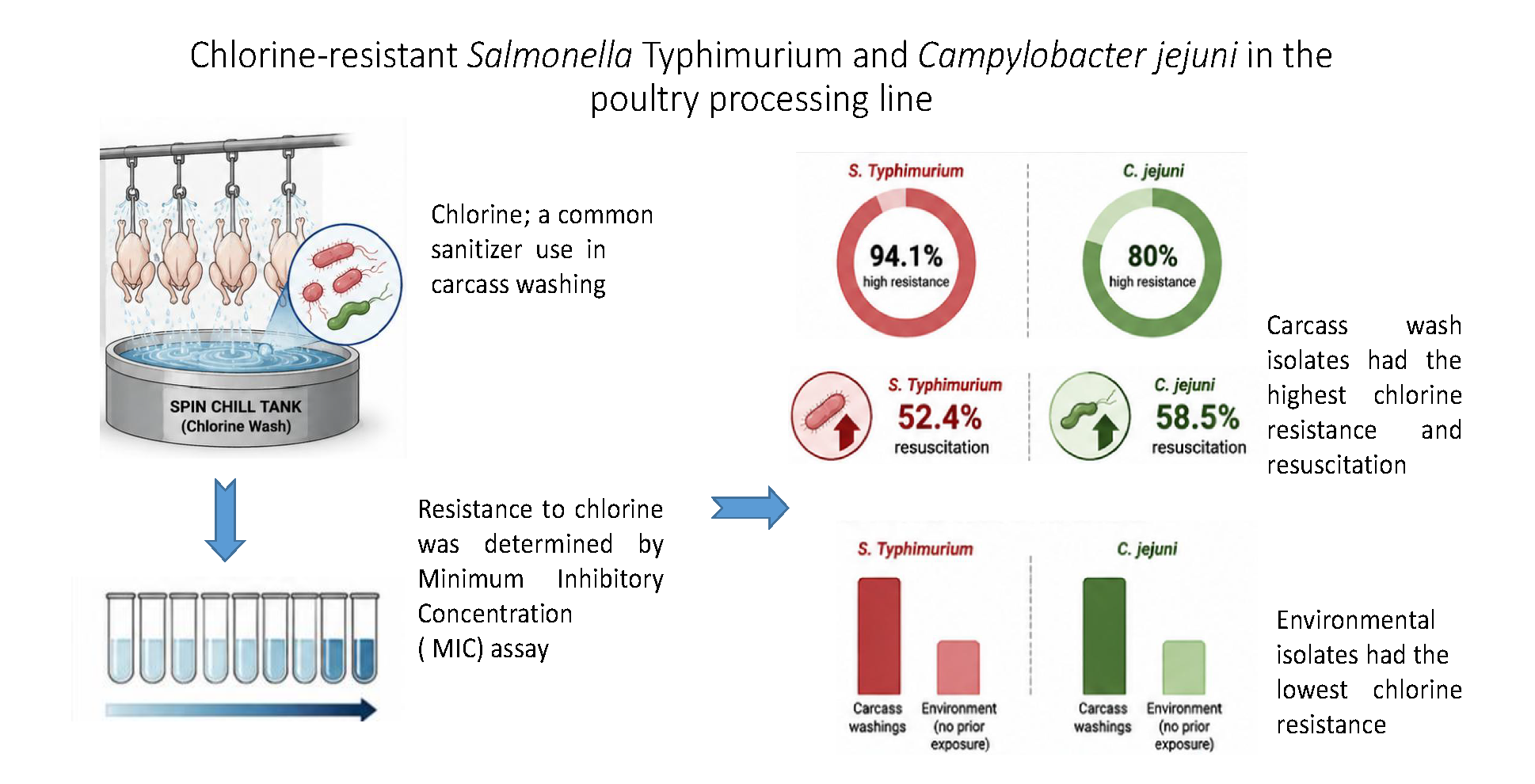
Salmonella Typhimurium and Campylobacter jejuni are major foodborne pathogens that persist along the poultry processing line, posing public health risks and significant economic burdens. Chlorine is commonly used in spin chill tanks to wash poultry carcasses and mitigate carcass contamination during processing. Although chlorine concentrations vary across the poultry industry, the prevalence of foodborne pathogens in poultry remains significant. This study determined the chlorine resistance in S. Typhimurium and C. jejuni isolated from caecal, neck skin, carcass washings, and environmental samples using minimum inhibitory concentration/minimum bactericidal concentration assays. Regardless of the chlorine concentration in the chill tank, higher tolerance levels were observed in S. Typhimurium and C. jejuni isolated from carcass washings. The lowest tolerance level was observed in environmental isolates that had not been previously exposed to chlorine. Notably, 60% of carcass-washing C. jejuni pre-exposed to 40 ppm chlorine in the chill tank showed a higher tolerance level of 160 ppm chlorine, while 80% of S. Typhimurium pre-exposed to 20 ppm showed an 80 ppm tolerance level. Notably, 94.1% of S. Typhimurium and 80% of C. jejuni, isolated from the carcass washing, were resistant to chlorine in the present study. Similarly, the highest resuscitation rates were detected in the same isolates at 52.4% and 58.5%, respectively. The lowest resistance and the highest resuscitation rate were observed in the environmental isolates. Pre-exposure to chlorine during processing has increased the chlorine resistance of both pathogens. The observed resistance may limit the effectiveness of mitigation protocols that rely on concentration adjustments in the chill tank. Therefore, an alternative chemical with a novel disinfection protocol is crucial to mitigate bacterial contamination in poultry processing.
- EFSA, European Food Safety Authority; European Centre for Disease Prevention and Control. The European Union One Health 2019 Zoonoses Report. EFSA J. 2021:19(2). doi: 10.2903/j.efsa.2021.6406
- Antunes P, Mourao J, Campos J, Peixe L. Salmonellosis: the role of poultry meat. Clin Microbiol Infect. 2016;22(2):110- 121. doi: 10.1016/j.cmi.2015.12.004
- Thames HT, Theradiyil Sukumaran A. A review of Salmonella and Campylobacter in broiler meat: Emerging challenges and food safety measures. Foods. 2020;9(6):776. doi: 10.3390/foods9060776
- Akil L, Ahmad HA. Quantitative risk assessment model of human salmonellosis resulting from consumption of broiler chicken. Diseases. 2019;7(1):19. doi: 10.3390/diseases7010019
- Fouts DE, Mongodin EF, Mandrell RE, et al. Major structural differences and novel potential virulence mechanisms from the genomes of multiple Campylobacter species. PLoS Biol. 2005;3(1):e15. doi: 10.1371/journal.pbio.0030015
- Hardie KM, Guerin MT, Ellis A, Leclair D. Associations of processing level variables with Salmonella prevalence and concentration on broiler chicken carcasses and parts in Canada. Prev Vet Med. 2019;168:39-51. doi: 10.1016/j.prevetmed.2019.03.027
- Pavic A, Cox JM, Chenu JW. Effect of extending processing plant operating time on the microbiological quality and safety of broiler carcasses. Food Control. 2015;56:103-109. doi: 10.1016/j.foodcont.2014.11.048
- Chen Fur C, Godwin SL, Kilonzo-Nthenge A. Relationship between cleaning practices and microbiological contamination in domestic kitchens. Food Prot Trends. 2011;31(11):672-679. https://www.foodprotection.org/files/ food-protection-trends/Nov-11-Chen.pdf
- Donelan AK, Chambers DH, CHAMBERS IV E, Godwin SL, Cates SC. Consumer poultry handling behavior in the grocery store and in-home storage. J Food Prot.2016;79(4):582-588. doi: 10.4315/0362-028x.jfp-15-282
- Northcutt J, Smith D, Musgrove M, Ingram K, Hinton Jr A. Microbiological impact of spray washing broiler carcasses using different chlorine concentrations and water temperatures. Poult Sci. 2005;84(10):1648-1652. doi: 10.1093/ps/84.10.1648
- Virto R, Manas P, Alvarez I, Condon S, Raso J. Membrane damage and microbial inactivation by chlorine in the absence and presence of a chlorine-demanding substrate. Appl Environ Microbiol. 2005;71(9):5022-5028. doi: 10.1128/AEM.71.9.5022-5028.2005
- Mizozoe M., Otaki M., Aikawa K. The mechanism of chlorine damage using enhanced green fluorescent protein-expressing Escherichia coli. Water. 2019;11(10):2156. doi: 10.3390/w11102156
- Bridges D.F., Lacombe A., Wu V.C. Integrity of the Escherichia coli O157: H7 cell wall and membranes after chlorine dioxide treatment. Front Microbiol. 2020;11:888. doi: 10.3389/fmicb.2020.00888.
- FSANZ. Scientific Assessment of the Public Health and Safety of Poultry Meat in Australia. FSANZ Canberra FSANZ. 2005:1-223. https://www.foodstandards.gov. au/sites/default/files/food-standards-code/proposals/ Documents/P282_Poultry%20_%20DAR%20Attach3.pdf
- EFSA Panel on Contaminants in the Food Chain (CONTAM). Risks for public health related to the presence of chlorate in food. EFSA J.2015: 13(6): 4135. doi: 10.2903/j. efsa.2015.4135
- Chousalkar K, Sims S, McWhorter A, Khan S, Sexton M. The effect of sanitizers on microbial levels of chicken meat collected from commercial processing plants. Int J Environ Res Public Health.2019;16(23):4807. doi: 10.3390/ijerph16234807
- Lillard H. Factors affecting the persistence of Salmonella during the processing of poultry. J Food Prot. 1989;52(11):829-832. doi: 10.4315/0362-028x-52.11.829
- Muhandiramlage GK, McWhorter AR, Chousalkar KK. Chlorine Induces Physiological and Morphological Changes on Chicken Meat Campylobacter Isolates. Front Microbiol. 2020;11:503. doi: 10.3389/fmicb.2020.00503
- Obe T, Kiess AS, Nannapaneni R. Antimicrobial Tolerance in Salmonella: Contributions to Survival and Persistence in Processing Environments. Animals. 2024;14(4):578. doi: 10.3390/ani14040578
- Weerasooriya G, Khan S, Chousalkar KK, McWhorter AR. Invasive potential of sub-lethally injured Campylobacter jejuni and Salmonella Typhimurium during storage in chicken meat juice. Food Control. 2022;135:108823. doi: 10.1016/j.foodcont.2022.108823
- Keener K, Bashor M, Curtis P, Sheldon B, Kathariou S. Comprehensive review of Campylobacter and poultry processing. Compr Rev Food Sci Food Saf. 2004;3(2):105- 116. doi: 10.1111/j.1541-4337.2004.tb00060.x
- Weerasooriya G, McWhorter AR, Khan S, Chousalkar KK. Transcriptomic response of Campylobacter jejuni following exposure to acidified sodium chlorite. Microbiol Spectr. 2021;5(1):1-9. doi: 10.1038/s41538-021-00103-5
- Sheridan À, Lenahan M, Duffy G, Fanning S, Burgess C. The potential for biocide tolerance in Escherichia coli and its impact on the response to food processing stresses. Food Control. 2012; 26(1):98-106. doi: 10.1016/j.foodcont.2012.01.018
- Braoudaki M, Hilton A. Adaptive resistance to biocides in Salmonella enterica and Escherichia coli O157 and cross-resistance to antimicrobial agents. J Clin Microbiol. 2004;42(1):73-78. doi: 10.1128/jcm.42.1.73-78.2004
- Weerasooriya G, Dulakshi H, de Alwis P, et al. Persistence of Salmonella and Campylobacter on Whole Chicken Carcasses under the Different Chlorine Concentrations Used in the Chill Tank of Processing Plants in Sri Lanka. Pathogens. 2024; 13(8): 664. doi: 10.3390/pathogens13080664
- ISO 6579-1:2017; Microbiology of the Food Chain— Horizontal Method for the Detection, Enumeration and Serotyping of Salmonella—Part 1: Detection of Salmonella spp. ISO: Geneva, Switzerland; 2017;pp. 1–50. Accessed June 1, 2024. https://www.iso.org/obp/ui/en/#iso:std:iso:6579:- 1:ed-1:v1:en
- Wang W, Liu F, Huang K, Yu X, Xiao X. Chlorine tolerance in foodborne pathogens: definitions, identification methods, and mechanisms. Curr Opin Food Sci. 2025;62:101271. doi: 10.1016/j.cofs.2025.101271
- CLSI, M07 Methods for Dilution Antimicrobial Susceptibility Tests for Bacteria That Grow Aerobically; Approved Standard-12th edition. 2024. Accessed March 19, 2024. https://clsi.org/shop/standards/m07
- Murphy C, Carroll C, Jordan KN. Environmental survival mechanisms of the foodborne pathogen Campylobacter jejuni. J Appl Microbiol. 2006;100(4):623-632. doi: 10.1111/j.1365-2672.2006.02903.x
- Karki AB, Wells H, Fakhr MK. Retail liver juices enhance the survivability of Campylobacter jejuni and Campylobacter coli at low temperatures. Sci Rep. 2019;9(1):1-13. doi: 10.1038/s41598-018-35820-7
- Touati D, Jacques M, Tardat B, Bouchard L, Despied S. Lethal oxidative damage and mutagenesis are generated by iron in delta fur mutants of Escherichia coli: protective role of superoxide dismutase. J Bacteriol. 1995;177(9):2305- 2314. doi: 10.1128/jb.177.9.2305-2314.1995
- Tamblyn KC, Conner DE. Bactericidal activity of organic acids against Salmonella Typhimurium attached to broiler chicken skint. J Food Prot. 1997;60(6):629-633. doi: 10.4315/0362-028x-60.6.629
- Thames HT, Theradiyil Sukumaran A. A review of Salmonella and Campylobacter in broiler meat: emerging challenges and food safety measures. Foods. 2020;9(6):776. doi: 10.3390/foods9060776
- Xiao X, Bai L, Wang S, et al. Chlorine tolerance and cross-resistance to antibiotics in poultry-associated Salmonella isolates in China. Front Microbiol. 2022;12:833743. doi: 10.3389/fmicb.2021.833743
- USDA-FSIS. (United States Department of Agriculture, FSIS). Safe and Suitable Ingredients Used in the Production of Meat, Poultry, and Egg Products–Revision.2026;61. Accessed May 14, 2026. https://www.fsis.usda.gov/policy/ fsis-directives/7120.1
- Condell O, Iversen C, Cooney S, et al. Efficacy of biocides used in the modern food industry to control Salmonella enterica, and links between biocide tolerance and resistance to clinically relevant antimicrobial compounds. Appl Environ Microbiol. 2012;78(9):3087-3097. doi: 10.1128/aem.07534-11
- Molina-González D, Alonso-Calleja C, Alonso-Hernando A, Capita R. Effect of sub-lethal concentrations of biocides on the susceptibility to antibiotics of multi-drug resistant Salmonella enterica strains. Food Control. 2014;40:329-334. doi: 10.1016/j.foodcont.2013.11.046
- Bauermeister LJ, Bowers JW, Townsend JC, McKee SR. Validating the efficacy of peracetic acid mixture as an antimicrobial in poultry chillers. J Food Prot. 2008;71(6):1119-1122. doi: 10.4315/0362-028x-71.6.1119
- Wesche AM, Gurtler JB, Marks BP, Ryser ET. Stress, sublethal injury, resuscitation, and virulence of bacterial foodborne pathogens. J Food Prot. 2009;72(5):1121-1138. doi: 10.4315/0362-028x-72.5.1121
- Rhouma M, Romero-Barrios P, Gaucher M-L, Bhachoo S. Antimicrobial resistance associated with the use of antimicrobial processing aids during poultry processing operations: cause for concern? Crit Rev Food Sci Nutr. 2021;61(19):3279-3296. doi: 10.1080/10408398.2020.1798345
- Guillén S, Nadal L, Álvarez I, Mañas P, Cebrián G. Impact of the Resistance Responses to Stress Conditions Encountered in Food and Food Processing Environments on the Virulence and Growth Fitness of Non-Typhoidal Salmonellae. Foods. 2021;10(3):617. doi: 10.3390/foods10030617
- Liao X, Ma Y, Daliri EBM, et al. Interplay of antibiotic resistance and food-associated stress tolerance in foodborne pathogens. Trends Food Sci Technol. 2020;95:97-106. doi: 10.1016/j.tifs.2019.11.006
- Wu-Chen RA, Feng J, Elhadidy M, et al. Long-term exposure to food-grade disinfectants causes cross-resistance to antibiotics in Salmonella enterica serovar Typhimurium strains with different antibiograms and sequence types. Antimicrob Resist Infect Control. 2023;12(1):145. doi: 10.1186/s13756-023-01333-w