
Spatiotemporal regulation of chemokine gradients in infection, inflammation, and cancer

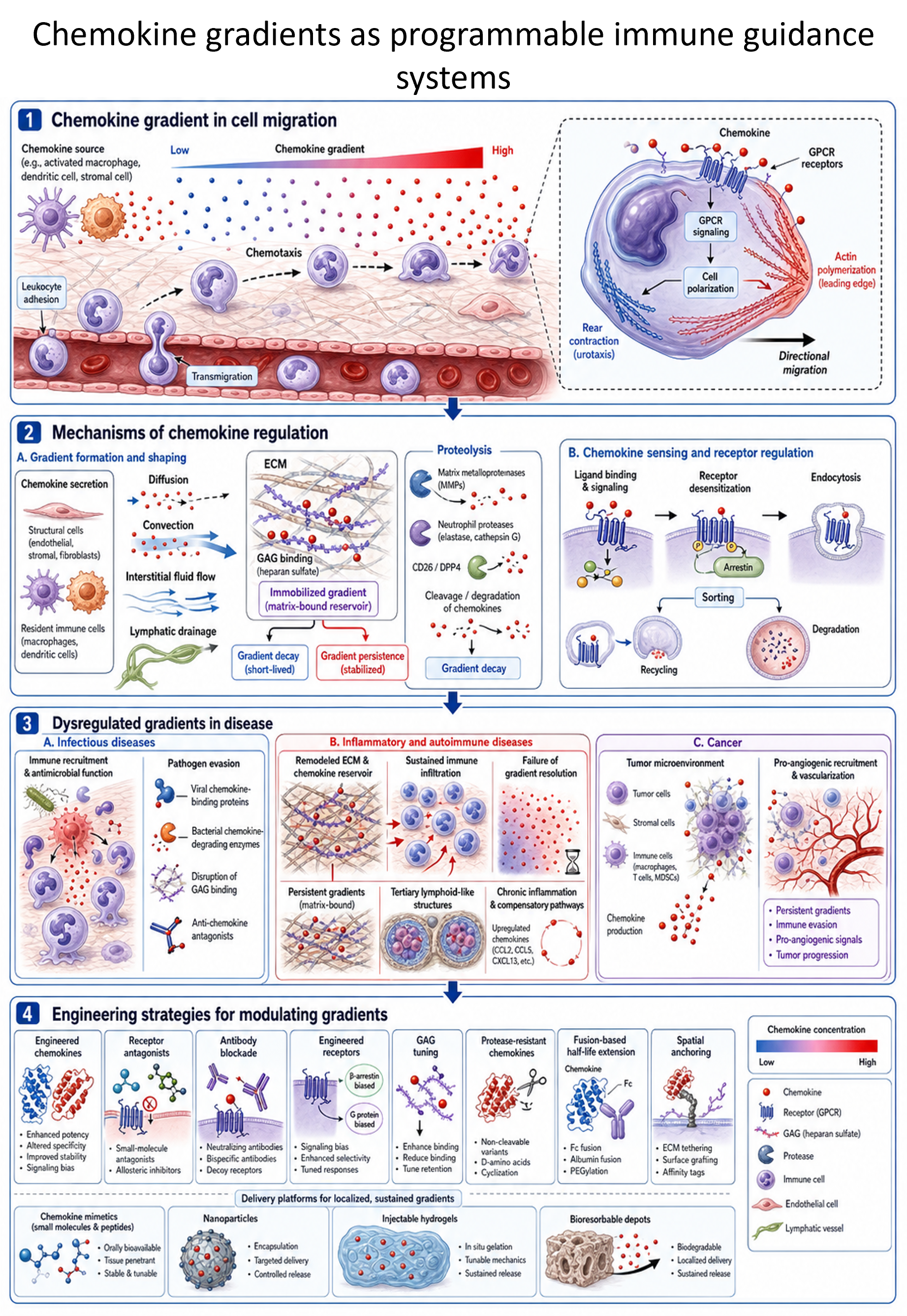
Chemokines direct cell movement by establishing concentration gradients that provide spatial and directional cues for migration. The formation of these gradients is essential for guiding immune cells to precise sites of action, while their persistence over time ensures sustained cellular flux and effective responses. Such chemotactic behavior is central to host defense during infection and to the organization of immune activity within tumors, whereas timely degradation and resolution of gradients are necessary to prevent pathological inflammation. This review examines the fundamental mechanisms governing chemokine gradient formation and persistence under normal physiological conditions, including chemokine production, transport, matrix interactions, and regulated degradation. It further discusses how these processes are altered in infectious diseases, chronic inflammatory disorders, and cancer, where dysregulated gradients contribute to pathology or immune evasion. Finally, the review highlights emerging engineering strategies that position chemokines as programmable tools—leveraging synthetic chemokines, chemokine mimetics, and nanoparticle-based delivery systems—to precisely reprogram cell trafficking and ameliorate disease.
- Hughes CE, Nibbs RJB. A guide to chemokines and their receptors. FEBS J. 2018;285(16):2944-2971. doi:10.1111/febs.14466
- Patel J, Channon KM, McNeill E. The downstream regulation of chemokine receptor signalling: implications for atherosclerosis. Mediators Inflamm. 2013;2013(1-2):459520. doi:10.1155/2013/459520
- Graham GJ, Handel TM, Proudfoot AEI. Leukocyte adhesion: reconceptualizing chemokine presentation by glycosaminoglycans. Trends Immunol. 2019;40(6):472-481. doi:10.1016/j.it.2019.03.009
- Raman D, Sobolik-Delmaire T, Richmond A. Chemokines in health and disease. Exp Cell Res. 2011;317(5):575-589. doi:10.1016/j.yexcr.2011.01.005
- Korbecki J, Kojder K, Kapczuk P, et al. The effect of hypoxia on the expression of CXC chemokines and CXC chemokine receptors—a review of literature. Int J Mol Sci. 2021;22(2):843. doi:10.3390/ijms22020843
- Korbecki J, Kojder K, Barczak K, et al. Hypoxia alters the expression of CC chemokines and CC chemokine receptors in a tumor—a literature review. Int J Mol Sci. 2020;21(16):5647. doi:10.3390/ijms21165647
- Galindo M, Santiago B, Alcami J, Rivero M, Martin- Serrano J, Pablos JL. Hypoxia induces expression of the chemokines monocyte chemoattractant protein-1 (MCP-1) and IL-8 in human dermal fibroblasts. Clin Exp Immunol. 2001;123(1):36-41. doi:10.1046/j.1365-2249.2001.01412.x
- Schumann K, Lämmermann T, Bruckner M, et al. Immobilized chemokine fields and soluble chemokine gradients cooperatively shape migration patterns of dendritic cells. Immunity. 2010;32(5):703-713. doi:10.1016/j.immuni.2010.04.017
- Stine CA, Munson JM. Autologous gradient formation under differential interstitial fluid flow environments. Biophysica. 2022;2(1):16-33. doi:10.3390/biophysica2010003
- Xue J, Lin Y, Oo D, et al. Lymph-derived chemokines direct early neutrophil infiltration in the lymph nodes upon Staphylococcus aureus skin infection. Proc Natl Acad Sci USA. 2022;119(32):e2111726119. doi:10.1073/pnas.2111726119
- Pruenster M, Mudde L, Bombosi P, et al. The Duffy antigen receptor for chemokines transports chemokines and supports their promigratory activity. Nat Immunol. 2009;10(1):101-108. doi:10.1038/ni.1675
- Bonecchi R, Graham GJ. Atypical chemokine receptors and their roles in the resolution of the inflammatory response. Front Immunol. 2016;7:224. doi:10.3389/fimmu.2016.00224
- Proudfoot AEI, Johnson Z, Bonvin P, Handel TM. Glycosaminoglycan interactions with chemokines add complexity to a complex system. Pharmaceuticals. 2017;10(3):70. doi:10.3390/ph10030070
- Thompson S, Martínez-Burgo B, Sepuru KM, Rajarathnam K, Kirby JA, Sheerin NS, Ali S. Regulation of chemokine function: the roles of GAG-binding and post-translational nitration. Int J Mol Sci. 2017;18(8):1692. doi:10.3390/ijms18081692
- Proudfoot AEI, Handel TM, Johnson Z, et al. Glycosaminoglycan binding and oligomerization are essential for the in vivo activity of certain chemokines. Proc Natl Acad Sci USA. 2003;100(4):1885-1890. doi:10.1073/pnas.0334864100
- Crijns H, Vanheule V, Proost P. Targeting chemokine-glycosaminoglycan interactions to inhibit inflammation. Front Immunol. 2020;11:483. doi:10.3389/fimmu.2020.00483
- Monneau Y, Arenzana-Seisdedos F, Lortat-Jacob H. The sweet spot: how GAGs help chemokines guide migrating cells. J Leukoc Biol. 2016;99(6):935-953. doi:10.1189/jlb.3MR0915-440R
- Schwarz J, Bierbaum V, Vaahtomeri K, et al. Dendritic cells interpret haptotactic chemokine gradients in a manner governed by signal-to-noise ratio and dependent on GRK6. Curr Biol. 2017;27(9):1314-1325.e7. doi:10.1016/j.cub.2017.04.004
- De Oliveira S, Reyes-Aldasoro CC, Candel S, Renshaw SA, Mulero V, Calado A. Cxcl8 (IL-8) mediates neutrophil recruitment and behavior in the zebrafish inflammatory response. J Immunol. 2013;190(8):4349-4359. doi:10.4049/jimmunol.1203266
- Artinger M, Gerken OJ, Purvanov V, Legler DF. Distinct fates of chemokine and surrogate molecule gradients: consequences for CCR7-guided dendritic cell migration. Front Immunol. 2022;13:913366. doi:10.3389/fimmu.2022.913366
- Hillyer P, Male D. Expression of chemokines on the surface of different human endothelia. Immunol Cell Biol. 2005;83(4):375-382. doi:10.1111/j.1440-1711.2005.01345.x
- Crossley RM, Johnson S, Tsingos E, et al. Modeling the extracellular matrix in cell migration and morphogenesis: a guide for the curious biologist. Front Cell Dev Biol. 2024;12:1354132. doi:10.3389/fcell.2024.1354132
- Arruda J, Alamoudi E, Mueller R, et al. Simulation-based inference of cell migration dynamics in complex spatial environments. npj Syst Biol Appl. 2026;12(1):20. doi:10.1038/s41540-026-00648-9
- Stein JV, Nombela-Arrieta C. Chemokine control of lymphocyte trafficking: a general overview. Immunology. 2005;116(1):1-12. doi:10.1111/j.1365-2567.2005.02183.x
- Wolf M, Albrecht S, Märki C. Proteolytic processing of chemokines: implications in physiological and pathological conditions. Int J Biochem Cell Biol. 2008;40(6-7):1185-1198. doi:10.1016/j.biocel.2007.12.009
- Van den Steen PE, Husson SJ, Proost P, Van Damme J, Opdenakker G. Carboxyterminal cleavage of the chemokines MIG and IP-10 by gelatinase B and neutrophil collagenase. Biochem Biophys Res Commun. 2003;310(3):889-896. doi:10.1016/j.bbrc.2003.09.098
- Metzemaekers M, Van Damme J, Mortier A, Proost P. Regulation of chemokine activity—a focus on the role of dipeptidyl peptidase IV/CD26. Front Immunol. 2016;7:483. doi:10.3389/fimmu.2016.00483
- Bronger H, Magdolen V, Goettig P, Dreyer T. Proteolytic chemokine cleavage as a regulator of lymphocytic infiltration in solid tumors. Cancer Metastasis Rev. 2019;38(3):417-430.
doi:10.1007/s10555-019-09807-3
- Perez Almeria CV, Otun O, Schlimgen R, et al. Constitutive activity of an atypical chemokine receptor revealed by inverse agonistic nanobodies. Nat Commun. 2025;16(1):10828. doi:10.1038/s41467-025-65858-x
- Hernández GC, López MF, Ramírez JL, Martínez A. Chemokine gradient formation and receptor signaling in leukocyte trafficking, tissue homing, and wound repair processes. Int J Adv Biochem Res. 2025;9(11):91-95. doi:10.33545/26174693.2025.v9.i11a.7509
- Haessler U, Pisano M, Wu M, Swartz MA. Dendritic cell chemotaxis in 3D under defined chemokine gradients reveals differential response to ligands CCL21 and CCL19. Proc Natl Acad Sci USA. 2011;108(14):5614-5619. doi:10.1073/pnas.1014920108
- Marchese A. Endocytic trafficking of chemokine receptors. Curr Opin Cell Biol. 2014;27:72-77. doi:10.1016/j.ceb.2013.11.011
- Lin F, Butcher EC. Modeling the role of homologous receptor desensitization in cell gradient sensing. J Immunol. 2008;181(12):8335-8343. doi:10.4049/jimmunol.181.12.8335
- Steen A, Larsen O, Thiele S, Rosenkilde MM. Biased and G protein-independent signaling of chemokine receptors. Front Immunol. 2014;5:277. doi:10.3389/fimmu.2014.00277
- Boldajipour B, Mahabaleshwar H, Kardash E, et al. Control of chemokine-guided cell migration by ligand sequestration. Cell. 2008;132(3):463-473. doi:10.1016/j.cell.2007.12.034
- Dixit N, Simon SI. Chemokines, selectins and intracellular calcium flux: temporal and spatial cues for leukocyte arrest. Front Immunol. 2012;3:188. doi:10.3389/fimmu.2012.00188
- Montresor A, Toffali L, Constantin G, Laudanna C. Chemokines and the signaling modules regulating integrin affinity. Front Immunol. 2012;3:127. doi:10.3389/fimmu.2012.00127
- Sadik CD, Luster AD. Lipid-cytokine-chemokine cascades orchestrate leukocyte recruitment in inflammation. J Leukoc Biol. 2012;91(2):207-215. doi:10.1189/jlb.0811402
- Ward PA. Role of complement, chemokines, and regulatory cytokines in acute lung injury. Ann NY Acad Sci. 1996;796:104-112. doi:10.1111/j.1749-6632.1996.tb32572.x
- Fahey S, Dempsey E, Long A. The role of chemokines in acute and chronic hepatitis C infection. Cell Mol Immunol. 2014;11(1):25-40. doi:10.1038/cmi.2013.37
- Murdoch C, Finn A. Chemokine receptors and their role in inflammation and infectious diseases. Blood. 2000;95(10):3032-3043. doi:10.1182/blood.V95.10.3032.010k27_3032_3043
- Puneet P, Moochhala S, Bhatia M. Chemokines in acute respiratory distress syndrome. Am J Physiol Lung Cell Mol Physiol. 2005;288(1):L3-L15. doi:10.1152/ajplung.00405.2003
- Danese S, Gasbarrini A. Chemokines in inflammatory bowel disease. J Clin Pathol. 2005;58(10):1025-1027. doi:10.1136/jcp.2005.030916
- Alcami A, Saraiva M. Chemokine Binding Proteins Encoded by Pathogens. In: Advances in Experimental Medicine and Biology. New York: Springer; 2009;666:167-179. doi:10.1007/978-1-4419-1601-3_13
- Fritzer A, Noiges B, Schweiger D, et al. Chemokine degradation by the Group A streptococcal serine proteinase ScpC can be reconstituted in vitro and requires two separate domains. Biochem J. 2009;422(3):533-542. doi:10.1042/BJ20090278
- Aquino RS, Park PW. Glycosaminoglycans and infection. Front Biosci. 2016;21(6):1260-1277. doi:10.2741/4455
- Murphy PM. Viral antichemokines: from pathogenesis to drug discovery. J Clin Invest. 2000;105(11):1515-1517. doi:10.1172/JCI10211
- Filer A, Raza K, Salmon M, Buckley CD. The role of chemokines in leucocyte-stromal interactions in rheumatoid arthritis. Front Biosci. 2008;13:2674-2685. doi:10.2741/2874
- Sutherland TE, Dyer DP, Allen JE. The extracellular matrix and the immune system: a mutually dependent relationship. Science. 2023;379(6633):eabp8964. doi:10.1126/science.abp8964
- Yang F, Yang J, Wu M, Chen C, Chu X. Tertiary lymphoid structures: new immunotherapy biomarker. Front Immunol. 2024;15:1394505. doi:10.3389/fimmu.2024.1394505
- Dyer DP. Understanding the mechanisms that facilitate specificity, not redundancy, of chemokine-mediated leukocyte recruitment. Immunology. 2020;160(4):336-344. doi:10.1111/imm.13200
- Zdanowska N, Kasprowicz-Furmańczyk M, Placek W, Owczarczyk-Saczonek A. The role of chemokines in psoriasis—an overview. Medicina. 2021;57(8):754. doi:10.3390/medicina57080754
- Kim HO, Cho SI, Chung BY, Ahn HK, Park CW, Lee CH. Expression of CCL1 and CCL18 in atopic dermatitis and psoriasis. Clin Exp Dermatol. 2012;37(5):521-526. doi:10.1111/j.1365-2230.2011.04295.x
- Mishra P, Banerjee D, Ben-Baruch A. Chemokines at the crossroads of tumor-fibroblast interactions that promote malignancy. J Leukoc Biol. 2010;89(1):31-39. doi:10.1189/jlb.0310182
- Muz B, De La Puente P, Azab F, Azab AK. The role of hypoxia in cancer progression, angiogenesis, metastasis, and resistance to therapy. Hypoxia. 2015;3:83-92. doi:10.2147/HP.S93413
- Raza S, Rajak S, Tewari A, Gupta P, Chattopadhyay N, Sinha RA, Chakravarti B. Multifaceted role of chemokines in solid tumors: From biology to therapy. Semin Cancer Biol. 2022;86(Pt 3):1105-1121. doi:10.1016/j.semcancer.2021.12.011
- Hussain S, Peng B, Cherian M, Song JW, Ahirwar DK, Ganju RK. The roles of stroma-derived chemokine in different stages of cancer metastases. Front Immunol. 2020;11:598532. doi:10.3389/fimmu.2020.598532
- Wang SW, Wu HH, Liu SC, Wang PC, Ou WC, Chou WY, Shen YS, Tang CH. CCL5 and CCR5 interaction promotes cell motility in human osteosarcoma. PLoS ONE. 2012;7(4):e35101. doi:10.1371/journal.pone.0035101
- Qi S, Perrino S, Miao X, Lamarche-Vane N, Brodt P. The chemokine CCL7 regulates invadopodia maturation and MMP-9 mediated collagen degradation in liver-metastatic carcinoma cells. Cancer Lett. 2020;483:98-113. doi:10.1016/j.canlet.2020.03.018
- Do HTT, Lee CH, Cho J. Chemokines and their receptors: Multifaceted roles in cancer progression and potential value as cancer prognostic markers. Cancers. 2020;12(2):287. doi:10.3390/cancers12020287
- Wang Z, Wang Z, Li G, Wu H, Sun K, Chen J, Feng Y, et al. CXCL1 from tumor-associated lymphatic endothelial cells drives gastric cancer cell into lymphatic system via activating integrin β1/FAK/AKT signaling. Cancer Lett. 2017;385:28-38. doi:10.1016/j.canlet.2016.10.043
- Scholten DJ, Canals M, Maussang D, Roumen L, Smit MJ, Wijtmans M, De Graaf C, Vischer HF, Leurs R. Pharmacological modulation of chemokine receptor function. Br J Pharmacol. 2012;165(6):1617-1643. doi:10.1111/j.1476-5381.2011.01551.x
- Takacs GP, Flores-Toro JA, Harrison JK. Modulation of the chemokine/chemokine receptor axis as a novel approach for glioma therapy. Pharmacol Ther. 2021;222:107790. doi:10.1016/j.pharmthera.2020.107790
- Hosking M, Shirinbak S, Grant J, et al. 120 Chemokine receptor engineering enhances trafficking and homing of primary and iPSC-derived CAR-T cells to solid tumors. In: Regular and Young Investigator Award Abstracts. BMJ Publishing Group Ltd; 2021:A129-A129. doi:10.1136/jitc-2021-sitc2021.120
- Bleuez C, Koch WF, Urbach C, Hollfelder F, Jermutus L. Exploiting protease activation for therapy. Drug Discov Today. 2022;27(6):1743-1754. doi:10.1016/j.drudis.2022.03.011
- Zaman R, Islam RA, Ibnat N, Othman I, Zaini A, Lee CY, Chowdhury EH. Current strategies in extending half-lives of therapeutic proteins. J Control Release. 2019;301:176-189. doi:10.1016/j.jconrel.2019.02.016
- Liaqat I, Hilska I, Saario M, Jakobsson E, Crivaro M, Peränen J, Vaahtomeri K. Spatially targeted chemokine exocytosis guides transmigration at lymphatic endothelial multicellular junctions. EMBO J. 2024;43(15):3141-3174. doi:10.1038/s44318-024-00129-x
- Nedjai B, Li H, Stroke IL, Wise EL, Webb ML, Merritt JR, Henderson I, et al. Small molecule chemokine mimetics suggest a molecular basis for the observation that CXCL10 and CXCL11 are allosteric ligands of CXCR3. Br J Pharmacol. 2012;166(3):912-923. doi:10.1111/j.1476-5381.2011.01660.x
- Kazmierski WM, Kenakin TP, Gudmundsson KS. Peptide, peptidomimetic and small-molecule drug discovery targeting HIV-1 host-cell attachment and entry through gp120, gp41, CCR5 and CXCR4. Chem Biol Drug Des. 2006;67(1):13-26. doi:10.1111/j.1747-0285.2005.00319.x
- Corbisier J, Huszagh A, Galés C, Parmentier M, Springael JY. Partial agonist and biased signaling properties of the synthetic enantiomers J113863/UCB35625 at chemokine receptors CCR2 and CCR5. J Biol Chem. 2017;292(2):575- 584. doi:10.1074/jbc.M116.757559
- Eiger DS, Boldizsar N, Honeycutt CC, Gardner J, Rajagopal S. Biased agonism at chemokine receptors. Cell Signal. 2021;78:109862. doi:10.1016/j.cellsig.2020.109862
- Abboud D, Daubeuf F, Do QT, Utard V, Villa P, Haiech J, Bonnet D, et al. A strategy to discover decoy chemokine ligands with an anti-inflammatory activity. Sci Rep. 2015;5(1):14746. doi:10.1038/srep14746
- Bonecchi R, Garlanda C, Mantovani A, Riva F. Cytokine decoy and scavenger receptors as key regulators of immunity and inflammation. Cytokine. 2016;87:37-45. doi:10.1016/j.cyto.2016.06.023
- Mantovani A, Bonecchi R, Locati M. Tuning inflammation and immunity by chemokine sequestration: decoys and more. Nat Rev Immunol. 2006;6(12):907-918. doi:10.1038/nri1964
- Popova TG, Teunis A, Magni R, Luchini A, Espina V, Liotta LA, Popov SG. Chemokine-releasing nanoparticles for manipulation of the lymph node microenvironment. Nanomaterials. 2015;5(1):298-320. doi:10.3390/nano5010298
- Henriques SR, Glass EB, Hoek KL, Chalom OZ, Manning AE, Roy S, Graves DK, et al. Locally reprogramming tumor-associated macrophages with cytokine-loaded injectable cryogels for breast cancer. Ann Biomed Eng. 2025;53(11):3081-3095.
doi:10.1007/s10439-025-03823-x
- Da Silva PHR, Borges BC, Uehara IA, Soldi LR, de Araújo RA, Silva MJB. Chemokines and the extracellular matrix: Set of targets for tumor development and treatment. Cytokine. 2021;144:155548. doi:10.1016/j.cyto.2021.155548
- Zhao W, Zhao H, Li M, Huang C. Microfluidic devices for neutrophil chemotaxis studies. J Transl Med. 2020;18(1):168. doi:10.1186/s12967-020-02335-7
- Liu J, Jia B, Li Z, Li W. Reactive oxygen species-responsive polymer drug delivery systems. Front Bioeng Biotechnol. 2023;11:1115603. doi:10.3389/fbioe.2023.1115603
- Mohit E, Rafati S. Chemokine-based immunotherapy: delivery systems and combination therapies. Immunotherapy. 2012;4(8):807-840. doi:10.2217/imt.12.72
- Mohan T, Zhu W, Wang Y, Wang BZ. Applications of chemokines as adjuvants for vaccine immunotherapy. Immunobiology. 2018;223(6-7):477-485. doi:10.1016/j.imbio.2017.12.001
- Idorn M, thor Straten P. Chemokine receptors and exercise to tackle the inadequacy of T cell homing to the tumor site. Cells. 2018;7(8):108. doi:10.3390/cells7080108
- Li J, Luo Y, Li B, Xia Y, Wang H, Fu C. Implantable and injectable biomaterial scaffolds for cancer immunotherapy. Front Bioeng Biotechnol. 2020;8:612950. doi:10.3389/fbioe.2020.612950
- Roth GA, Picece VCTM, Ou BS, et al. Designing spatial and temporal control of vaccine responses. Nat Rev Mater. 2021;7(3):174-195. doi:10.1038/s41578-021-00372-2
- Mantovani A. The chemokine system: redundancy for robust outputs. Immunol Today. 1999;20(6):254-257. doi:10.1016/S0167-5699(99)01469-3