
Nosocomial infections in intensive care units: Bacterial profiles and microbial resistance patterns

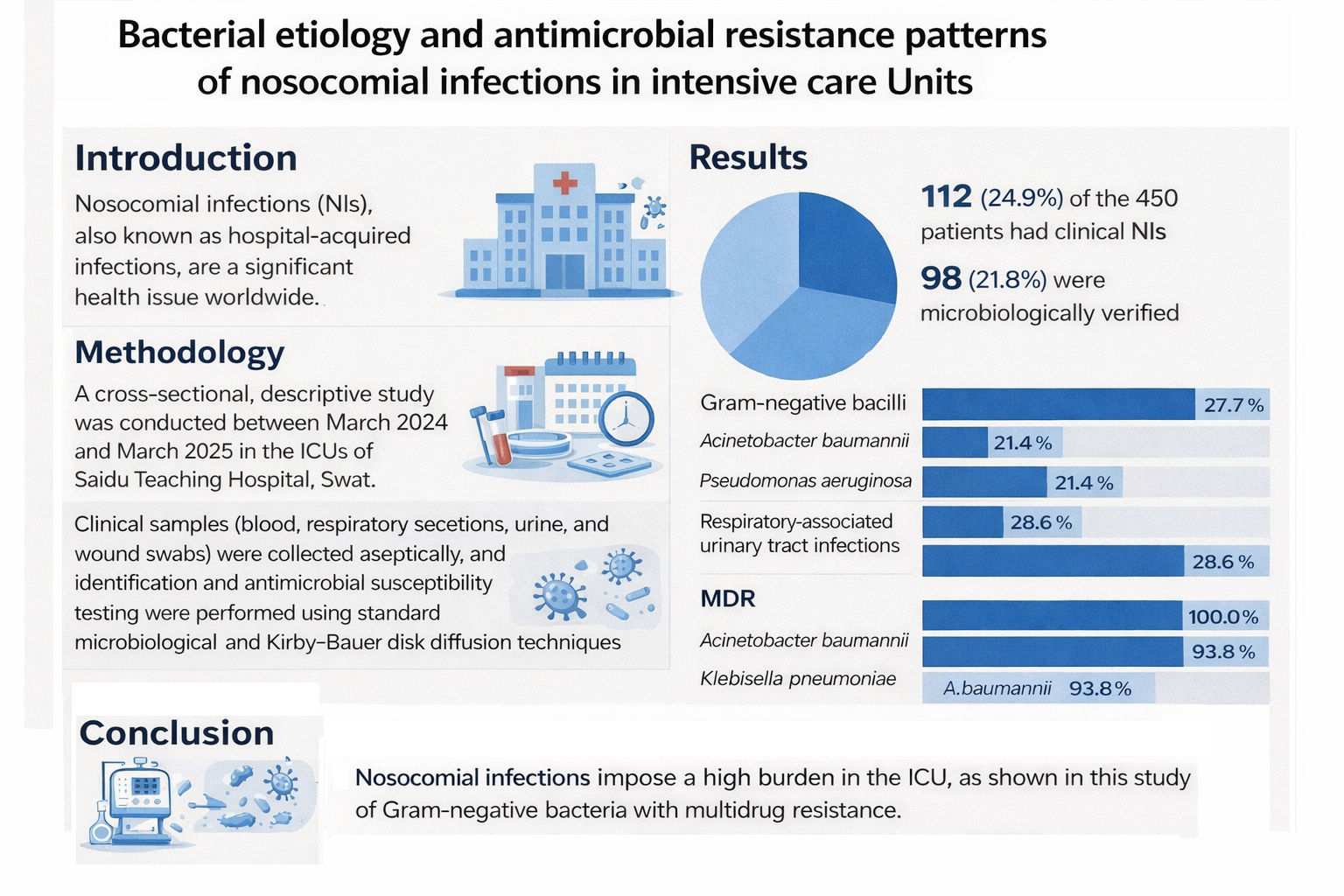
Nosocomial infections (NIs) are a significant global health issue, specifically in intensive care units (ICUs). The study aims to identify the bacterial profiles and antimicrobial resistance patterns of NI pathogens in the ICU of a tertiary care hospital, with the goal of informing effective treatment and infection control approaches. This cross-sectional, descriptive study was conducted between March 2024 and March 2025 in the ICUs of Saidu Teaching Hospital. Clinical samples were collected from patients who had acquired signs of infection after 48 h of admission. Identification and antimicrobial susceptibility of bacteria were conducted using standard microbiological and Kirby–Bauer disc diffusion techniques. Multidrug resistance (MDR) was defined as non-susceptibility to at least one agent in three or more antimicrobial categories. Among 450 admitted patients, 112 (24.9%) had clinical NIs, and 98 (21.8%) were microbiologically verified. Gram-negative bacilli predominated (78.6%), followed by Acinetobacter baumannii (27.7%) and Pseudomonas aeruginosa (21.4%). Ventilator-associated pneumonia (45.5%) and catheter-associated urinary tract infections (28.6%) were the most common sites of infection. The prevalence of MDR was alarming, 76.8% overall, with 100% of A. baumannii and K. pneumoniae being MDR. Carbapenem resistance was found to be high (A. baumannii: 93.5, K. pneumoniae: 72.2). Most Gram-negative isolates were mostly susceptible to colistin. NIs tend to have a high burden in the ICU, as observed in this study, particularly with Gram-negative bacteria that exhibit MDR. The extreme prevalence of carbapenem-resistant A. baumannii and K. pneumoniae signals an highlights a crisis in antimicrobial resistance. These findings underscore the importance of implementing robust infection prevention and control policies, executing rigorous antibiotic stewardship initiatives, and maintaining ongoing local surveillance to inform empirical treatment and improve patient outcomes.
- Liu JY, Dickter JK. Nosocomial infections: A history of hospital-acquired infections. Gastrointest Endosc Clin N Am. 2020;30(4):637-652. doi: 10.1016/j.giec.2020.06.001
- Ndlovu B. Nosocomial Infections in Neonatal Intensive Care Unit of a Public Healthcare Facility in Saudi Arabia. University of South Africa (South Africa); 2021. Available from: https://www.proquest.com/openview/f5ac71c877ede 83cd24395277c098697/1?pq-origsite=gscholar&cbl=20263 66&diss=y [Last accessed on 2025 Dec 25].
- Garzotto F, Comoretto RI, Ostermann M, et al. Preventing infectious diseases in intensive care unit by medical devices remote control: Lessons from COVID-19. J Crit Care. 2021;61:119-124. doi: 10.1016/j.jcrc.2020.10.014
- Gouel-Cheron A, Swihart BJ, Warner S, et al. Epidemiology of ICU-onset bloodstream infection: Prevalence, pathogens, and risk factors among 150,948 ICU patients at 85 US hospitals. Crit Care Med. 2022;50(12):1725-1736. doi: 10.1097/CCM.0000000000005662
- Dadi NCT, Radochová B, Vargová J, Bujdáková H. Impact of healthcare-associated infections connected to medical devices-an update. Microorganisms. 2021;9(11):2332. doi: 10.3390/microorganisms9112332
- Zjajo A. The Influence of Antimicrobial Stewardship Measures on Outcome of Patients with Severe Infections treated in Intensive Care Unit. University of Zagreb. School of Medicine. Department of Infectious Diseases; 2024. Available from: https://urn.nsk.hr/urn: nbn:hr:105:735179 [Last accessed on 2025 Dec 25].
- Yetkin F, Yakupogullari Y, Kuzucu C, et al. Pathogens of intensive care unit-acquired infections and their antimicrobial resistance: A 9-year analysis of data from a university hospital. Jundish J Microbiol. 2018;11(10):1-8. doi: 10.5812/jjm.67716
- MacVane SH. Antimicrobial resistance in the intensive care unit: A focus on gram-negative bacterial infections. J Intensive Care Med. 2017;32(1):25-37. doi: 10.1177/0885066615619895
- Husna A, Rahman MM, Badruzzaman A, et al. Extended-spectrum β-lactamases (ESBL): Challenges and opportunities. Biomedicines. 2023;11(11):2937. doi: 10.3390/biomedicines11112937
- Nimer NA. Nosocomial infection and antibiotic-resistant threat in the Middle East. Infect Drug Resist. 2022;15:631-639. doi: 10.2147/IDR.S351755
- Gajic I, Tomic N, Lukovic B, et al. A comprehensive overview of antibacterial agents for combating Multidrug-Resistant bacteria: The current landscape, development, future opportunities, and challenges. Antibiotics. 2025;14(3):221. doi: 10.3390/antibiotics14030221
- Zulfkar Q, Humaira A, Mohd AD, Afshana Q. The growing threat of antibiotic resistance: Mechanisms, causes, consequences, and solutions. Int J Cognit Neurosci Psychol. 2025;3(3):28-36.
- Calvo M, Stefani S, Migliorisi G. Bacterial infections in intensive care units: Epidemiological and microbiological aspects. Antibiotics (Basel). 2024;13(3):238. doi: 10.3390/antibiotics13030238
- Zhu Y, Huang WE, Yang Q. Clinical perspective of antimicrobial resistance in bacteria. Infect Drug Resist. 2022;15:735-746. doi: 10.2147/IDR.S345574
- Ippolito M, Cortegiani A. Empirical decision-making for antimicrobial therapy in critically ill patients. BJA Educ. 2023;23(12):480-487. doi: 10.1016/j.bjae.2023.09.001
- Giamarellou H, Galani L, Karavasilis T, Ioannidis K, Karaiskos I. Antimicrobial stewardship in the hospital setting: A narrative review. Antibiotics (Basel). 2023;12(10):1557. doi: 10.3390/antibiotics12101557
- Connor L, Dean J, McNett M, et al. Evidence‐based practice improves patient outcomes and healthcare system return on investment: Findings from a scoping review. Worldviews Evid Based Nurs. 2023;20(1):6-15. doi: 10.1111/wvn.12621
- Assefa M, Tigabu A, Belachew T, Tessema B. Bacterial profile, antimicrobial susceptibility patterns, and associated factors of community-acquired pneumonia among adult patients in Gondar, Northwest Ethiopia: A cross-sectional study. PLoS One. 2022;17(2):e0262956. doi: 10.1371/journal.pone.0262956
- Gaur P, Hada V, Rath RS, Mohanty A, Singh P, Rukadikar A. Interpretation of antimicrobial susceptibility testing using European committee on antimicrobial susceptibility testing (EUCAST) and clinical and laboratory standards institute (CLSI) breakpoints: Analysis of agreement. Cureus. 2023;15(3):e36977. doi: 10.7759/cureus.36977
- Allegranzi B, Nejad SB, Combescure C, et al. Burden of endemic health-care-associated infection in developing countries: Systematic review and meta-analysis. Lancet. 2011;377(9761):228-241. doi: 10.1016/S0140-6736(10)61458-4
- Rosenthal VD, Desse J, Maurizi DM, et al. Impact of the international nosocomial infection control consortium’s multidimensional approach on rates of ventilator-associated pneumonia in 14 intensive care units in 11 hospitals of 5 cities within Argentina. Am J Infect Control. 2018;46(6):674- 679. doi: 10.1016/j.ajic.2017.11.021
- Mengistu DA, Alemu A, Abdukadir AA, Mohammed Husen A, Ahmed F, Mohammed B. Incidence of urinary tract infection among patients: Systematic review and meta-analysis. Inquiry. 2023;60:1-12. doi: 10.1177/00469580231168746
- Koulenti D, Lisboa T, Brun-Buisson C, et al. Spectrum of practice in the diagnosis of nosocomial pneumonia in patients requiring mechanical ventilation in European intensive care units. Crit Care Med. 2009;37(8):2360-2369. doi: 10.1097/CCM.0b013e3181a037ac
- Manchanda V, Sanchaita S, Singh N. Multidrug resistant Acinetobacter. J Glob Infect Dis. 2010;2(3):291-304. doi: 10.4103/0974-777X.68538
- Borgio JF, Rasdan AS, Sonbol B, fAlhamid G, Almandil NB, AbdulAzeez S. Emerging status of multidrug-resistant bacteria and fungi in the Arabian Peninsula. Biology (Basel). 2021;10(11):1144. doi: 10.3390/biology10111144
- Logan LK, Weinstein RA. The epidemiology of carbapenem-resistant Enterobacteriaceae: The impact and evolution of a global menace. J Infect Dis. 2017;215(Suppl_1):S28-S36. doi: 10.1093/infdis/jiw282
- Lee CR, Lee JH, Park KS, Kim YB, Jeong BC, Lee SH. Global dissemination of carbapenemase-producing Klebsiella pneumoniae: Epidemiology, genetic context, treatment options, and detection methods. Front Microbiol. 2016;7:895. doi: 10.3389/fmicb.2016.00895
- Sakr A, Brégeon F, Rolain JM, Blin O. Staphylococcus aureus nasal decolonization strategies: A review. Expert Rev Anti Infect Ther. 2019;17(5):327-340. doi: 10.1080/14787210.2019.1604220