
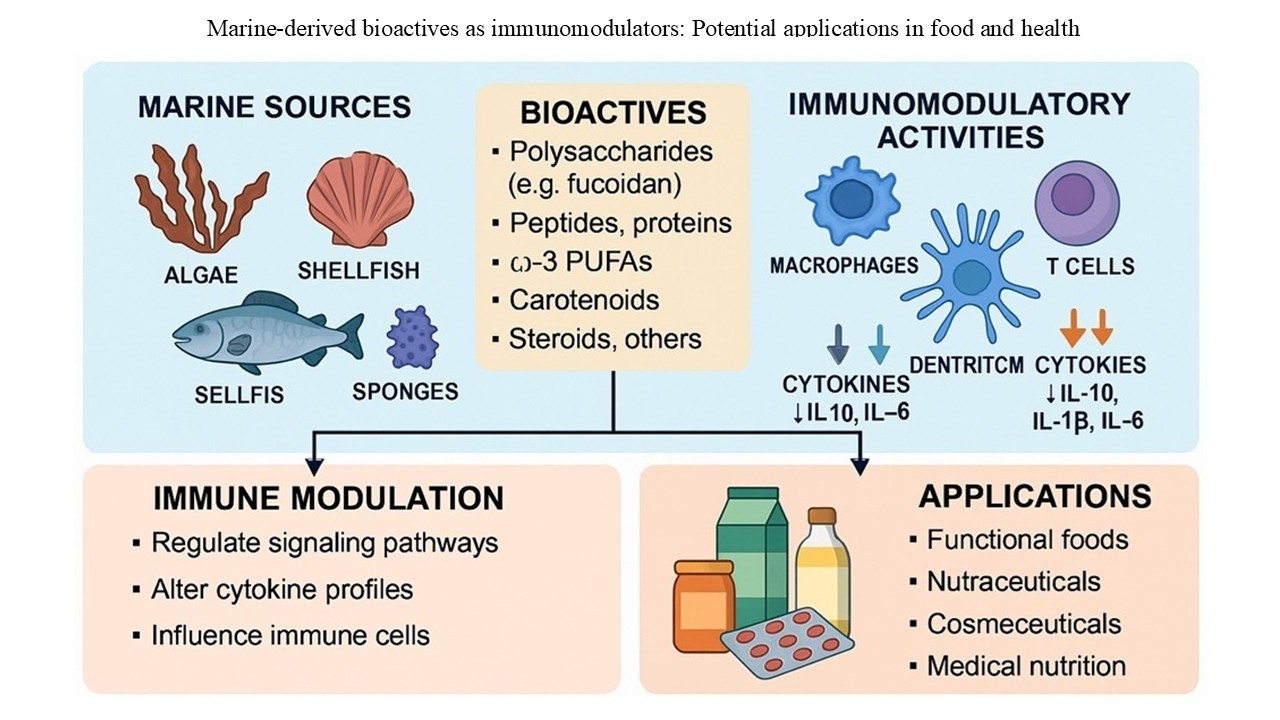
Marine-derived bioactives as immunomodulators: Potential applications in food and health

Marine ecosystems are prolific sources of structurally diverse bioactives—including polysaccharides (e.g., alginate, fucoidan, laminarin, and carrageenan), peptides/proteins, ω-3 long-chain polyunsaturated fatty acids, carotenoids (e.g., astaxanthin and fucoxanthin), steroids, macrolides, and alkaloids—that modulate innate and adaptive immunity through convergent pathways. Evidence across algae, fish, shellfish, microbes, and sponges shows these molecules regulate toll-like receptor signaling, nuclear factor κB/mitogen-activated protein kinase axes, cyclooxygenase/lipoxygenase-derived eicosanoids, complement activation, and redox tone; rebalance cytokine profiles (↓ tumor necrosis factor-α/interleukin (IL)-1β/IL-6; ↑ IL-10); and influence effector functions of macrophages, natural killer and T cells. Marine peptides and protein hydrolysates, often generated through enzymatic hydrolysis or fermentation and purified by membrane fractionation and chromatography, display antioxidant, antimicrobial, antihypertensive, antihyperlipidemic, anti-inflammatory, immunostimulatory, and anticancer activities in vitro and in vivo. Polysaccharide structure (e.g., molecular weight, linkage, and sulfation) and peptide sequence/composition drive bioactivity, whereas ω-3–derived specialized pro-resolving mediators contribute to inflammation resolution. Beyond direct immune effects, several marine bioactives exert prebiotic-like actions that reshape gut microbiota and mucosal defenses. Advances in extraction, stabilization, and delivery are accelerating incorporation into functional foods, nutraceuticals, cosmeceuticals, and medical nutrition. Key translation barriers remain—heterogeneity of sources, batch-to-batch variability, processing stability, bioavailability and pharmacokinetics, allergenicity, and limited standardized immune endpoints and human trials. This review synthesizes mechanistic and application-oriented evidence for marine-derived immunomodulators, outlines safety and regulatory considerations, and prioritizes research needed to enable evidence-based deployment in food and health.
- Senadheera TRL, Hossain A, Shahidi F. Marine bioactives and their application in the food industry: A review. Appl Sci. 2023;13(21):12088. doi: 10.3390/app132112088
- Shahidi F, Ambigaipalan P. Novel functional food ingredients from marine sources. Curr Opin Food Sci. 2015;2:123-129. doi: 10.1016/j.cofs.2014.12.009
- Hosseini SF, Rezaei M, McClements DJ. Bioactive functional ingredients from aquatic origin: A review of recent progress in marine-derived nutraceuticals. Crit Rev Food Sci Nutr. 2022;62(5):1242-1269. doi: 10.1080/10408398.2020.1839855
- Huang IS, Pietrasiak N, Gobler CJ, et al. Diversity of bioactive compound content across 71 genera of marine, freshwater, and terrestrial cyanobacteria. Harmful Algae. 2021;109:102116. doi: 10.1016/j.hal.2021.102116
- Montuori E, de Pascale D, Lauritano C. Recent discoveries on marine organism immunomodulatory activities. Mar Drugs. 2022;20(7):422. doi: 10.3390/md20070422
- Wani SN, Zahoor I. Bioactive compounds from marine organisms and their potential applications. In: Handbook of Research in Marine Pharmaceutics. New York: Apple Academic Press; 2025.
- Iqbal A, Murtaza A, Hu W, Ahmad I, Ahmed A, Xu X. Activation and inactivation mechanisms of polyphenol oxidase during thermal and non-thermal methods of food processing. Food Bioproducts Process. 2019;117:170-182. doi: 10.1016/j.fbp.2019.07.006
- Suleria HAR, Osborne S, Masci P, Gobe G. Marine-based nutraceuticals: An innovative trend in the food and supplement industries. Mar Drugs. 2015;13(10):6336-6351. doi: 10.3390/md13106336
- El-Seedi HR, Refaey MS, Elias N, et al. Marine natural products as a source of novel anticancer drugs: An updated review (2019–2023). Nat Prod Bioprospect. 2025;15(1):13. doi: 10.1007/s13659-024-00493-5
- Zhao H, Zhou Z, Feng F, et al. SMART-assisted discovery of butenolides from the marine-derived Aspergillus sp. NBU4698 with multidrug resistance reversing and anti-inflammatory activity. Phytochemistry. 2025;236:114487. doi: 10.1016/j.phytochem.2025.114487
- Apostolova E, Lukova P, Baldzhieva A, et al. Immunomodulatory and anti-inflammatory effects of fucoidan: A review. Polymers (Basel). 2020;12(10):2338. doi: 10.3390/polym12102338
- Meenakshi DU, Narde GK, Siddiqui S, Ahuja A. Marine bioactive phytoconstituents in autoimmune disorders: Role and mechanism - a review. Antiinflamm Antiallergy Agents Med Chem. 2023;22(1):10-29. doi: 10.2174/1871523022666230731104529
- Jin JO, Chauhan PS, Arukha AP, Chavda V, Dubey A, Yadav D. The therapeutic potential of the anticancer activity of fucoidan: Current advances and hurdles. Mar Drugs. 2021;19(5):265. doi: 10.3390/md19050265
- Naya-Català F, Wiggers GA, Piazzon MC, et al. Modulation of gilthead sea bream gut microbiota by a bioactive egg white hydrolysate: Interactions between bacteria and host lipid metabolism. Front Mar Sci. 2021;8:265. doi: 10.3389/fmars.2021.698484
- Adıgüzel E, Ülger TG. A marine-derived antioxidant astaxanthin as a potential neuroprotective and neurotherapeutic agent: A review of its efficacy on neurodegenerative conditions. Eur J Pharmacol. 2024;977:176706. doi: 10.1016/j.ejphar.2024.176706
- Ali A, Wei S, Liu Z, et al. Non-thermal processing technologies for the recovery of bioactive compounds from marine by-products. LWT. 2021;147:111549. doi: 10.1016/j.lwt.2021.111549
- Hossain A, Dave D, Shahidi F. Northern sea cucumber (Cucumaria frondosa): A potential candidate for functional food, nutraceutical, and pharmaceutical sector. Mar Drugs. 2020;18(5):274. doi: 10.3390/md18050274
- Ghosh S, Sarkar T, Pati S, Kari ZA, Edinur HA, Chakraborty R. Novel bioactive compounds from marine sources as a tool for functional food development. Front Mar Sci. 2022;9:832957. doi: 10.3389/fmars.2022.832957
- Guryanova SV, Ovchinnikova TV. Multifaceted marine peptides and their therapeutic potential. Mar Drugs. 2025;23(7):288. doi: 10.3390/md23070288
- Kang HK, Lee HH, Seo CH, Park Y. Antimicrobial and immunomodulatory properties and applications of marine-derived proteins and peptides. Mar Drugs. 2019;17(6):350. doi: 10.3390/md17060350
- Lobine D, Rengasamy KRR, Mahomoodally MF. Functionalfoods and bioactive ingredients harnessed from the ocean: Current status and future perspectives. Crit Rev Food Sci Nutr. 2022;62(21):5794-5823. doi: 10.1080/10408398.2021.1893643
- Shahidi F, Santhiravel S. Novel marine bioactives: Application in functional foods, nutraceuticals, and pharmaceuticals. J Food Bioact. 2022;19:4-96. doi: 10.31665/JFB.2022.18316
- Wells ML, Trainer VL, Smayda TJ, et al. Harmful algal blooms and climate change: Learning from the past and present to forecast the future. Harmful Algae. 2015;49:68-93. doi: 10.1016/j.hal.2015.07.009
- Krasner AE, Martinez ME, Field CL, Fire SE. The toxic effects of environmental domoic acid exposure on humans and marine wildlife. Mar Drugs. 2025;23(2):61. doi: 10.3390/md23020061
- McCabe RM, Hickey BM, Kudela RM, et al. An unprecedented coastwide toxic algal bloom linked to anomalous ocean conditions. Geophys Res Lett. 2016;43(19):10366-10376. doi: 10.1002/2016GL070023
- Gobler CJ. Climate change and harmful algal blooms: Insights and perspective. Harmful Algae. 2020;91:101731. doi: 10.1016/j.hal.2019.101731
- Otero P, Silva M. Emerging marine biotoxins in European waters: Potential risks and analytical challenges. Mar Drugs. 2022;20(3):199. doi: 10.3390/md20030199
- Patocka J, Gupta RC, Wu QH, Kuca K. Toxic potential of palytoxin. J Huazhong Univ Sci Technolog Med Sci. 2015;35(5):773-780. doi: 10.1007/s11596-015-1506-3
- Ramos V, Vasconcelos V. Palytoxin and analogs: Biological and ecological effects. Mar Drugs. 2010;8(7):2021-2037. doi: 10.3390/md8072021
- Reguera B, Velo-Suárez L, Raine R, Park MG. Harmful Dinophysis species: A review. Harmful Algae. 2012;14:87-106. doi: 10.1016/j.hal.2011.10.016
- Kamble NS, Bera S, Bhedase SA, Gaur V, Chowdhury D. Review on applied applications of microbiome on human lives. Bacteria. 2024;3(3):141-159. doi: 10.3390/bacteria3030010
- Rafieezadeh D, Esfandyari G. Marine bioactive peptides with anticancer potential, a narrative review. Int J Biochem Mol Biol. 2024;15(4):118-126. doi: 10.62347/TUVQ7468
- D’Orazio N, Gammone MA, Gemello E, De Girolamo M, Cusenza S, Riccioni G. Marine bioactives: Pharmacological properties and potential applications against inflammatory diseases. Mar Drugs. 2012;10(4):812-833. doi: 10.3390/md10040812
- Lichtenstein AH. Nutrient supplements and cardiovascular disease: A heartbreaking story. J Lipid Res. 2009;50:S429-S433. doi: 10.1194/jlr.R800027-JLR200
- Riccioni G, Bucciarelli T, D’Orazio N, et al. Plasma antioxidants and asymptomatic carotid atherosclerotic disease. Ann Nutr Metab. 2008;53(2):86-90. doi: 10.1159/000164691
- Riccioni G, D’Orazio N, Palumbo N, et al. Relationship between plasma antioxidant concentrations and carotid intima-media thickness: The Asymptomatic Carotid Atherosclerotic Disease in Manfredonia Study. Eur J Cardiovasc Prev Rehabil. 2009;16(3):351-357. doi: 10.1097/HJR.0b013e328325d807
- Allen RG, Tresini M. Oxidative stress and gene regulation. Free Radical Biol Med. 2000;28(3):463-499. doi: 10.1016/S0891-5849(99)00242-7
- Perugini M, Dorazio N, Manera M, et al. Total Mercury in Fish from the Central Adriatic Sea in Relation to Levels Found in the Hair of Fishermen; 2006. Available from: https://cris.unibo.it/handle/11585/41335 [Last accessed on 2025 Aug 24].
- Zaccaroni A, Perugini M, Dorazio N, et al. Investigation of Total Arsenic in Fish from the Central Adriatic Sea (Italy) in Relation to Levels Found in Fisherman’s Hair; 2006. Available from: https://cris.unibo.it/handle/11585/41338 [Last accessed on 2025 Aug 24].
- Jackson H, Braun CL, Ernst H. The chemistry of novel xanthophyll carotenoids. Am J Cardiol. 2008;101(10A):50D-57D. doi: 10.1016/j.amjcard.2008.02.008
- Alasalvar C, Miyashita K, Shahidi F, Wanasundara U. Handbook of Seafood Quality, Safety and Health Applications. United States: John Wiley & Sons; 2011.
- Ribas-Taberner MM, Mir-Rossello PM, Gil L, Sureda A, Capó X. Potential use of marine plants as a source of bioactive compounds. Molecules. 2025;30(3):485. doi: 10.3390/molecules30030485
- Higuera-Ciapara I, Félix-Valenzuela L, Goycoolea FM. Astaxanthin: A review of its chemistry and applications. Crit Rev Food Sci Nutr. 2006;46(2):185-196. doi: 10.1080/10408690590957188
- Shimidzu N, Goto M, Miki W. Carotenoids as singlet oxygen quenchers in marine organisms. Fish Sci. 1996;62(1):134-137. doi: 10.2331/fishsci.62.134
- Naguib YMA. Antioxidant activities of astaxanthin and related carotenoids. J Agric Food Chem. 2000;48(4):1150-1154. doi: 10.1021/jf991106k
- Bennedsen M, Wang X, Willén R, Wadström T, Andersen LP. Treatment of H. pylori infected mice with antioxidant astaxanthin reduces gastric inflammation, bacterial load and modulates cytokine release by splenocytes. Immunol Lett. 2000;70(3):185-189. doi: 10.1016/S0165-2478(99)00145-5
- PubChem. Astaxanthin. Available from: https://pubchem. ncbi.nlm.nih.gov/compound/5281224 [Last accessed on 2025 Dec 09].
- Riccioni G, D’Orazio N, Franceschelli S, Speranza L. Marine carotenoids and cardiovascular risk markers. Mar Drugs. 2011;9(7):1166-1175. doi: 10.3390/md9071166
- Yuan JP, Peng J, Yin K, Wang JH. Potential health-promoting effects of astaxanthin: A high-value carotenoid mostly from microalgae. Mol Nutr Food Res. 2011;55(1):150-165. doi: 10.1002/mnfr.201000414
- Pashkow FJ, Watumull DG, Campbell CL. Astaxanthin: A novel potential treatment for oxidative stress and inflammation in cardiovascular disease. Am J Cardiol. 2008;101(10 Supplement):S58-S68. doi: 10.1016/j.amjcard.2008.02.010
- Guerin M, Huntley ME, Olaizola M. Haematococcus astaxanthin: Applications for human health and nutrition. Trends Biotechnol. 2003;21(5):210-216. doi: 10.1016/S0167-7799(03)00078-7
- Rambaldi A, Paris F, Marrazzo P, Costa R, Ratti S, Alviano F. Marine-derived astaxanthin: Molecular mechanisms, biomedical applications, and roles in stem cell biology. Mar Drugs. 2025;23(6):235. doi: 10.3390/md23060235
- Hu T, Liu D, Chen Y, Wu J, Wang S. Antioxidant activity of sulfated polysaccharide fractions extracted from Undaria pinnitafida in vitro. Int J Biol Macromol. 2010;46(2):193-198. doi: 10.1016/j.ijbiomac.2009.12.004
- Nomura T, Kikuchi M, Kubodera A, Kawakami Y. Proton-donative antioxidant activity of fucoxanthin with 1,1-diphenyl-2-picrylhydrazyl (DPPH). IUBMB Life. 1997;42(2):361-370. doi: 10.1080/15216549700202761
- Woo MN, Jeon SM, Shin YC, Lee MK, Kang MA, Choi MS. Anti-obese property of fucoxanthin is partly mediated by altering lipid-regulating enzymes and uncoupling proteins of visceral adipose tissue in mice. Mol Nutr Food Res. 2009;53(12):1603-1611. doi: 10.1002/mnfr.200900079
- Jeon SM, Kim HJ, Woo MN, et al. Fucoxanthin-rich seaweed extract suppresses body weight gain and improves lipid metabolism in high-fat-fed C57BL/6J mice. Biotechnol J. 2010;5(9):961-969. doi: 10.1002/biot.201000215
- Kim KN, Heo SJ, Kang SM, Ahn G, Jeon YJ. Fucoxanthin induces apoptosis in human leukemia HL-60 cells through a ROS-mediated Bcl-xL pathway. Toxicol In Vitro. 2010;24(6):1648-1654. doi: 10.1016/j.tiv.2010.05.023
- Shiratori K, Ohgami K, Ilieva I, et al. Effects of fucoxanthin on lipopolysaccharide-induced inflammation in vitro and in vivo. Exp Eye Res. 2005;81(4):422-428. doi: 10.1016/j.exer.2005.03.002
- PubChem. Fucoxanthin. Available from: https://pubchem. ncbi.nlm.nih.gov/compound/5281239 [Last accessed on 2025 Dec 09].
- Ambati GG, Jachak SM. Natural product inhibitors of cyclooxygenase (COX) enzyme: A review on current status and future perspectives. Curr Med Chem. 2021;28(10):1877-1905. doi: 10.2174/0929867327666200602131100
- Dannhardt G, Kiefer W. Cyclooxygenase inhibitors – current status and future prospects. Eur J Med Chem. 2001;36(2):109-126. doi: 10.1016/S0223-5234(01)01197-7
- Sims JJ, Fenical W, Wing RM, Radlick P. Marine natural products. I. Pacifenol, a rare sesquiterpene containing bromine and chlorine from the red alga, Laurencia pacifica. J Am Chem Soc. 1971;93:3774-3775 doi: 10.1021/ja00744a041
- Baker JT. Some metabolites from australian marine organisms. In: Thomson RH, editor. International Symposium on Marine Natural Products. Pergamon; 1976. p. 35-44. doi: 10.1016/B978-0-08-021242-5.50008-6
- Chang CWJ. Marine natural products other than pigments. J Chem Educ. 1973;50:260. doi: 10.1021/ed050p260
- Le Bideau F, Kousara M, Chen L, Wei L, Dumas F. Tricyclic sesquiterpenes from marine origin. Chem Rev. 2017;117(9):6110-6159. doi: 10.1021/acs.chemrev.6b00502
- San-Martín A, Rovirosa J, Astudillo L, Sepúlveda B, Ruiz D, San-Martín C. Biotransformation of the marine sesquiterpene pacifenol by a facultative marine fungus. Nat Prod Res. 2008;22(18):1627-1632. doi: 10.1080/14786410701869440
- PubChem. Pacifenol. Available from: https://pubchem. ncbi.nlm.nih.gov/compound/122808 [Last accessed on 2025 Dec 09].
- Sanchez-Ferrando F, San-Martin A. Epitaondiol: The first polycyclic meroditerpenoid containing two fused six-membered rings forced into the twist-boat conformation. J Org Chem. 1995;60:1475-1478. doi: 10.1021/jo00110a062
- Muñoz MA, Areche C, San-Martín A, Rovirosa J, Joseph-Nathan P. VCD determination of the absolute configuration of stypotriol. Nat Prod Commun. 2009;4(8):1934578X0900400804. doi: 10.1177/1934578X0900400804
- Bramley AM, Langlands JM, Jones AK, et al. Effects of IZP-94005 (contignasterol) on antigen-induced bronchial responsiveness in ovalbumin-sensitized guinea-pigs. Br J Pharmacol. 1995;115(8):1433-1438. doi: 10.1111/j.1476-5381.1995.tb16634.x
- Tan AS, Berridge MV. Superoxide produced by activated neutrophils efficiently reduces the tetrazolium salt, WST-1 to produce a soluble formazan: A simple colorimetric assay for measuring respiratory burst activation and for screening anti-inflammatory agents. J Immunol Methods. 2000;238(1):59-68. doi: 10.1016/S0022-1759(00)00156-3
- Gil B, Ferrándiz ML, Sanz MJ, et al. Inhibition of inflammatory responses by epitaondiol and other marine natural products. Life Sci. 1995;57(2):PL25-PL30. doi: 10.1016/0024-3205(95)00260-D
- Rovirosa J, San Martín Barrientos A. Antimicrobial activity of the brown alga Stypopodium flabelliforme constituents. Fitoterapia. 2018;68:473-475.
- Pereira DM, Cheel J, Areche C, et al. Anti-proliferative activity of meroditerpenoids isolated from the brown alga Stypopodium flabelliforme against several cancer cell lines. Mar Drugs. 2011;9(5):852-862. doi: 10.3390/md9050852
- Abril SP, Rincón-Díaz N, Puyana M, Castellanos L, Ramos FA. Photoprotective activity from Colombian Caribbean brown algae using HPLC-DAD metabolic profiling by MCR-ALS data analysis. Sci Rep. 2025;15(1):16204. doi: 10.1038/s41598-025-00734-8
- PubChem. Stypotriol. Available from: https://pubchem. ncbi.nlm.nih.gov/compound/23424859 [Last accessed on 2025 Dec 04].
- Areche C, Vaca I, Labbe P, et al. Biotransformation of stypotriol triacetate by Aspergillus niger. J Mol Struct. 2011;998(1):167-170. doi: 10.1016/j.molstruc.2011.05.026
- Areche C, San-Martín A, Rovirosa J, et al. Stereostructure reassignment and absolute configuration of isoepitaondiol, a meroditerpenoid from Stypopodium flabelliforme. J Nat Prod. 2010;73(1):79-82. doi: 10.1021/np900553p
- Llanio M, Fernández MD, Cabrera B, et al. The marine plant Thalassia testudinum possesses anti-inflammatory and analgesic properties. Pharmacologyonline. 2006;3:594-600.
- Soares AR, Abrantes JL, Souza TML, et al. In vitro antiviral effect of meroditerpenes isolated from the Brazilian Seaweed Stypopodium zonale (dictyotales). Planta Med. 2007;73:1221-1224. doi: 10.1055/s-2007-981589
- Al-Sabi A, McArthur J, Ostroumov V, French RJ. Marine toxins that target voltage-gated sodium channels. Mar Drugs. 2006;4(3):157-192. doi: 10.3390/md403157
- Nahas R, Abatis D, Anagnostopoulou MA, Kefalas P, Vagias C, Roussis V. Radical-scavenging activity of Aegean Sea marine algae. Food Chem. 2007;102(3):577-581. doi: 10.1016/j.foodchem.2006.05.036
- PubChem. Epitaondiol. Available from: https://pubchem. ncbi.nlm.nih.gov/compound/156834 [Last accessed on 2025 Dec 04].
- Zhidkova EM, Savina ED, Yurchenko EA, Lesovaya EA. Marine-derived steroids for cancer treatment: Search for potential selective glucocorticoid receptor agonists/ modulators (SEGRAMs). Mar Drugs. 2025;23(10):399. doi: 10.3390/md23100399
- Mishra S, Mishra Y, Kumar A. Marine-derived bioactive compounds for neuropathic pain: Pharmacology and therapeutic potential. Naunyn Schmiedebergs Arch Pharmacol. 2025;398(6):6193-6220. doi: 10.1007/s00210-024-03667-7
- Keyzers RA, Northcote PT, Berridge MV. Clathriol B, a new 14β marine sterol from the new zealand sponge Clathria lissosclera. Aust J Chem. 2003;56(4):279-282. doi: 10.1071/ch02167
- Terracciano S, Aquino M, Rodriquez M, et al. Chemistry and biology of anti-inflammatory marine natural products: molecules interfering with cyclooxygenase, NF-kB and other unidentified targets. Curr Med Chem. 2006;13(16):1947-1969. doi: 10.2174/092986706777585095
- Joseph B, Sujatha S. Pharmacologically important natural products from marine sponges. J Nat Prod. 2011;4:12.
- Mayer AMS, Rodríguez AD, Berlinck RGS, Hamann MT. Marine pharmacology in 2005-6: Marine compounds with anthelmintic, antibacterial, anticoagulant, antifungal, anti-inflammatory, antimalarial, antiprotozoal, antituberculosis, and antiviral activities; affecting the cardiovascular, immune and nervous systems, and other miscellaneous mechanisms of action. Biochim Biophys Acta. 2009;1790(5):283-308. doi: 10.1016/j.bbagen.2009.03.011
- Kobayashi J, Shinonaga H, Shigemori H, Umeyama A, Shoji N, Arihara S. Xestobergsterol C, a new pentacyclic steroid from the okinawan marine sponge Ircinia sp. and absolute stereochemistry of xestobergsterol A. J Nat Prod. 1995;58(2):312-318. doi: 10.1021/np50116a029
- Nakamura A, Kaji Y, Saida K, et al. Synthesis of xestobergsterol A from dehydroepiandrosterone. Tetrahedron Lett. 2005;46(37):6373-6376. doi: 10.1016/j.tetlet.2005.07.042
- Burgoyne DL, Andersen RJ, Allen TM. Contignasterol, a highly oxygenated steroid with the unnatural 14.beta. configuration from the marine sponge Petrosia contignata Thiele, 1899. J Org Chem. 1992;57:525-528. doi: 10.1021/jo00028a024
- Takei M, Burgoyne DL, Andersen RJ. Effect of contignasterol on histamine release induced by anti-immunoglobuline from rat peritoneal mast cells. J Pharm Sci. 1994;83(9):1234-1235. doi: 10.1002/jps.2600830909
- Jung ME, Johnson TW. First total synthesis of xestobergsterol A and active structural analogues of the xestobergsterols. Tetrahedron. 2001;57(8):1449-1481. doi: 10.1016/S0040-4020(00)01086-3
- Izzo I, Pironti V, Monica CD, Sodano G, De Riccardis F. Stereocontrolled synthesis of contignasterol’s side chain. Tetrahedron Lett. 2001;42(51):8977-8980. doi: 10.1016/S0040-4039(01)01964-5
- Andersen RJ, Allen TM, Burgoyne DL. Contignasterol, and Related 3-Alpha Hydroxy-6-Alpha Hydroxy-7-Beta Hydroxy- 15-Keto-14-Beta Steroids Useful as Anti-Inflammatory and Anti-Thrombosis Agents; 1996. Available from: https:// patents.google.com/patent/US5506221A/en [Last accessed on 2025 Aug 24].
- Gross H, König GM. Terpenoids from marine organisms: Unique structures and their pharmacological potential. Phytochem Rev. 2006;5(1):115-141. doi: 10.1007/s11101-005-5464-3
- Ortega-Vidal J, Reddy MM, Pérez-Fuentes N, et al. Contignasterines, anti-inflammatory 2-aminoimidazole steroids from the sponge Neopetrosia cf. rava collected in the bismarck sea. J Nat Prod. 2025;88(5):1244-1252. doi: 10.1021/acs.jnatprod.5c00118
- Higa T, Tanaka J. Bioactive marine macrolides. In: Atta-ur-Rahman, editor. Studies in Natural Products Chemistry. Structure and Chemistry (Part E). Vol. 19. Amsterdam: Elsevier; 1996. p. 549-626. doi: 10.1016/S1572-5995(96)80015-9
- Zhang H, Zou J, Yan X, et al. Marine-derived macrolides 1990–2020: An overview of chemical and biological diversity. Mar Drugs. 2021;19(4):180. doi: 10.3390/md19040180
- Napolitano JG, Daranas AH, Norte M, Fernandez JJ. Marine macrolides, a promising source of antitumor compounds. Anticancer Agents Med Chem. 2009;9(2):122-137. doi: 10.2174/187152009787313800
- Qi Y, Ma S. The medicinal potential of promising marine macrolides with anticancer activity. ChemMedChem. 2011;6(3):399-409. doi: 10.1002/cmdc.201000534
- Paterson I, Findlay AD. Total synthesis of cytotoxic marine macrolides: Callipeltoside A, aurisides A and B, and dolastatin 19. Pure Appl Chem. 2008;80(8):1773-1782. doi: 10.1351/pac200880081773
- Jensen PR, Williams PG, Oh DC, Zeigler L, Fenical W. Species-specific secondary metabolite production in marine actinomycetes of the genus Salinispora. Appl Environ Microbiol. 2007;73(4):1146-1152. doi: 10.1128/AEM.01891-06
- D’Auria MV, Debitus C, Paloma LG, Minale L, Zampella A. Superstolide A: A potent cytotoxic macrolide of a new type from the New Caledonian deep water marine sponge Neosiphonia superstes. J Nat Prod. 1994;57(11):1595-1597. doi: 10.1021/ja00094a022
- Ishibashi M, Moore RE, Patterson GML, Xu C, Clardy J. Scytophycins, cytotoxic and antimycotic agents from the cyanophyte Scytonema pseudohofmanni. J Org Chem. 1986;51:5300-5306. doi: 10.1021/jo00376a047
- Paterson I, Britton R, Ashton K, Knust H, Stafford J. Synthesis of antimicrofilament marine macrolides: Synthesis and configurational assignment of a C5-C16 degradation fragment of reidispongiolide A. Proc Natl Acad Sci. 2004;101(33):11986-11991. doi: 10.1073/pnas.0401548101
- Jacobson PB, Jacobs RS. Fuscoside: An anti-inflammatory marine natural product which selectively inhibits 5-lipoxygenase. Part I: Physiological and biochemical studies in murine inflammatory models. J Pharmacol Exp Ther. 1992;262(2):866-873. doi: 10.1016/S0022-3565(25)10834-3
- Yamada K, Ojika M, Ishigaki T, Yoshida Y, Ekimoto H, Arakawa M. Aplyronine A, a potent antitumor substance and the congeners aplyronines B and C isolated from the sea hare Aplysia kurodai. J Am Chem Soc. 1993;115:11020-11021. doi: 10.1021/ja00076a082
- Trischman JA, Tapiolas DM, Jensen PR, et al. Salinamides A and B: Anti-inflammatory depsipeptides from a marine streptomycete. J Am Chem Soc. 1994;116:757-758. doi: 10.1021/ja00081a042
- Russo N, Quaini G, Ziaco M, et al. Bioactive polyketides from Amphidinium spp.: An in-depth review of biosynthesis, applications, and current research trends. Mar Drugs. 2025;23(6):255. doi: 10.3390/md23060255
- Tasdemir D, Mallon R, Greenstein M, et al. Aldisine alkaloids from the philippine sponge Stylissa massa are potent inhibitors of mitogen-activated protein kinase kinase-1 (MEK-1). J Med Chem. 2002;45(2):529-532. doi: 10.1021/jm0102856
- Skropeta D, Pastro N, Zivanovic A. Kinase inhibitors from marine sponges. Mar Drugs. 2011;9(10):2131-2154. doi: 10.3390/md9102131
- Meijer L, Thunnissen AM, White AW, et al. Inhibition of cyclin-dependent kinases, GSK-3β and CK1 by hymenialdisine, a marine sponge constituent. Chem Biol. 2000;7(1):51-63. doi: 10.1016/S1074-5521(00)00063-6
- PubChem. Hymenialdisine. Available from: https://pubchem. ncbi.nlm.nih.gov/compound/135413546 [Last accessed on 2025 Dec 04].
- DiMartino M, Wolff C, Patil A, Nambi P. Effects of a protein kinase C inhibitor (PKCI) on the development of adjuvant-induced arthritis (AA) in rats. Inflamm Res. 1995;44 Suppl 2:S123-S124. doi: 10.1007/BF01778293
- Breton JJ, Chabot-Fletcher MC. The natural product hymenialdisine inhibits interleukin-8 production in U937 cells by inhibition of nuclear factor-κb. J Pharmacol Exp Ther. 1997;282(1):459-466. doi: 10.1016/S0022-3565(24)36795-3
- Badger AM, Cook MN, Swift BA, Newman-Tarr TM, Gowen M, Lark M. Inhibition of interleukin-1-induced proteoglycan degradation and nitric oxide production in bovine articular cartilage/chondrocyte cultures by the natural product, hymenialdisine. J Pharmacol Exp Ther. 1999;290(2):587-593. doi: 10.1016/S0022-3565(24)34938-9
- Tsukamoto S. Natural products that target p53 for cancer therapy. J Nat Med. 2025;79(4):725-737. doi: 10.1007/s11418-025-01906-6
- Lattasch H, Thomson RH. A revised structure for cycloprodigiosin. Tetrahedron Lett. 1983;24(26):2701-2704. doi: 10.1016/S0040-4039(00)87981-2
- Lee JS, Kim YS, Park S, et al. Exceptional production of both prodigiosin and cycloprodigiosin as major metabolic constituents by a novel marine bacterium, Zooshikella rubidus S1-1. Appl Environ Microbiol. 2011;77(14):4967-4973. doi: 10.1128/AEM.01986-10
- Kitahara J, Sakamoto H, Tsujimoto M, Nakagawa Y. Involvement of NF-κB in the protection of cell death by tumor necrosis factor in L929 derived TNF resistant C12 cells. Biol Pharm Bull. 2000;23(4):397-401. doi: 10.1248/bpb.23.397
- Yamamoto D, Kiyozuka Y, Uemura Y, et al. Cycloprodigiosin hydrochloride, a H+/Cl− symporter, induces apoptosis in human breast cancer cell lines. J Cancer Res Clin Oncol. 2000;126(4):191-197. doi: 10.1007/s004320050032
- Kamata K, Okamoto S, Oka SI, Kamata H, Yagisawa H, Hirata H. Cycloprodigiosin hydrocloride suppresses tumor necrosis factor (TNF) α-induced transcriptional activation by NF-κB. FEBS Lett. 2001;507(1):74-80. doi: 10.1016/S0014-5793(01)02946-5
- Kawauchi K, Shibutani K, Yagisawa H, et al. A possible immunosuppressant, cycloprodigiosin hydrochloride, obtained from Pseudoalteromonas denitrificans. Biochem Biophys Res Commun. 1997;237(3):543-547. doi: 10.1006/bbrc.1997.7186
- Teshima S, Nakanishi H, Kamata K, et al. Cycloprodigiosin up-regulates inducible nitric oxide synthase gene expression in hepatocytes stimulated by interleukin-1β. Nitric Oxide. 2004;11(1):9-16. doi: 10.1016/j.niox.2004.07.009
- Dijkstra G, Moshage H, Jansen PLM. Blockade of NF- κ B activation and donation of nitric oxide: New treatment options in inflammatory bowel disease? Scand J Gastroenterol. 2002;37(236):37-41. doi: 10.1080/003655202320621436
- Ban JO, Oh JH, Kim TM, et al. Anti-inflammatory and arthritic effects of thiacremonone, a novel sulfurcompound isolated from garlic via inhibition of NF-κB. Arthritis Res Ther. 2009;11(5):R145. doi: 10.1186/ar2819
- Lesco KC, Williams SKR, Laurens LML. Marine algae polysaccharides: An overview of characterization techniques for structural and molecular elucidation. Mar Drugs. 2025;23(3):105. doi: 10.3390/md23030105
- Premarathna AD, Sooäär A, Humayun S, et al. Structural characterization and in vitro bioactivity of Furcellaria lumbricalis polysaccharides: Implications for skin, immune, and gut health applications. Int J Biol Macromol. 2025;330:147696. doi: 10.1016/j.ijbiomac.2025.147696
- Yi X, Xie J, Mei J. Recent advances in marine-derived polysaccharide hydrogels: Innovative applications and challenges in emerging food fields. Polymers (Basel). 2025;17(18):2553. doi: 10.3390/polym17182553
- Carrasqueira J, Bernardino S, Bernardino R, Afonso C. Marine-derived polysaccharides and their potential health benefits in nutraceutical applications. Mar Drugs. 2025;23(2):60. doi: 10.3390/md23020060
- Dobrinčić A, Balbino S, Zorić Z, et al. Advanced technologies for the extraction of marine brown algal polysaccharides. Mar Drugs. 2020;18(3):168. doi: 10.3390/md18030168
- Kadam SU, Tiwari BK, O’Donnell CP. Extraction, structure and biofunctional activities of laminarin from brown algae. Int J Food Sci Tech. 2015;50(1):24-31. doi: 10.1111/ijfs.12692
- Trang Thuy NN, Men TT. Phytochemical and bioactive analysis of extracted brown macroalgae (Dictyota implexa) collected in vietnam. Biochem Res Int. 2025;2025(1):9461117. doi: 10.1155/bri/9461117
- Nussinovitch A. Hydrocolloid Applications. Berlin: Springer US; 1997. doi: 10.1007/978-1-4615-6385-3
- Rioux LE, Turgeon SL, Beaulieu M. Characterization of polysaccharides extracted from brown seaweeds. Carbohydr Polym. 2007;69(3):530-537. doi: 10.1016/j.carbpol.2007.01.009
- Abraham RE, Su P, Puri M, Raston CL, Zhang W. Optimisation of biorefinery production of alginate, fucoidan and laminarin from brown seaweed Durvillaea potatorum. Algal Res. 2019;38:101389. doi: 10.1016/j.algal.2018.101389
- Hernández-Carmona G, Freile-Pelegrín Y, Hernández- Garibay E. 14 - Conventional and alternative technologies for the extraction of algal polysaccharides. In: Domínguez H, editor. Functional Ingredients from Algae for Foods and Nutraceuticals. Woodhead Publishing Series in Food Science, Technology and Nutrition. United Kingdom: Woodhead Publishing; 2013. p. 475-516. doi: 10.1533/9780857098689.3.475
- Sterner M, Gröndahl F. Extraction of laminarin from Saccharina latissima seaweed using cross-flow filtration. J Appl Phycol. 2021;33(3):1825-1844. doi: 10.1007/s10811-021-02398-z
- Nurkolis F. Marine bioactives: Pioneering sustainable solutions for advanced cosmetics and therapeutics. Pharmacol Res. 2025;218:107868. doi: 10.1016/j.phrs.2025.107868
- Rodriguez-Jasso RM, Mussatto SI, Pastrana L, Aguilar CN, Teixeira JA. Microwave-assisted extraction of sulfated polysaccharides (fucoidan) from brown seaweed. Carbohydr Polym. 2011;86(3):1137-1144. doi: 10.1016/j.carbpol.2011.06.006
- Hahn T, Lang S, Ulber R, Muffler K. Novel procedures for the extraction of fucoidan from brown algae. Process Biochem. 2012;47(12):1691-1698. doi: 10.1016/j.procbio.2012.06.016
- Zayed A, Ulber R. Fucoidans: Downstream processes and recent applications. Mar Drugs. 2020;18(3):170. doi: 10.3390/md18030170
- Sellimi S, Maalej H, Rekik DM, et al. Antioxidant, antibacterial and in vivo wound healing properties of laminaran purified from Cystoseira barbata seaweed. Int J Biol Macromol. 2018;119:633-644. doi: 10.1016/j.ijbiomac.2018.07.171
- Zargarzadeh M, Amaral AJR, Custódio CA, Mano JF. Biomedical applications of laminarin. Carbohydr Polym. 2020;232:115774. doi: 10.1016/j.carbpol.2019.115774
- Carpena M, Garcia-Perez P, Garcia-Oliveira P, et al. Biological properties and potential of compounds extracted from red seaweeds. Phytochem Rev. 2023;22(6):1509-1540. doi: 10.1007/s11101-022-09826-z
- Zhu B, Ni F, Xiong Q, Yao Z. Marine oligosaccharides originated from seaweeds: Source, preparation, structure, physiological activity and applications. Crit Rev Food Sci Nutr. 2021;61(1):60-74. doi: 10.1080/10408398.2020.1716207
- Imeson A. Food Stabilisers, Thickeners and Gelling Agents. United States: John Wiley & Sons; 2011.
- Torres MD, Flórez-Fernández N, Domínguez H. Integral utilization of red seaweed for bioactive production. Mar Drugs. 2019;17(6):314. doi: 10.3390/md17060314
- EFSA Panel on Food Additives and Nutrient SourcesAdded to Food (ANS), Mortensen A, Aguilar F, et al. Re-evaluation of agar (E 406) as a food additive. EFSA J. 2016;14(12):e04645. doi: 10.2903/j.efsa.2016.4645
- Ścieszka S, Klewicka E. Algae in food: A general review. Crit Rev Food Sci Nutr. 2019;59(21):3538-3547. doi: 10.1080/10408398.2018.1496319
- Cian RE, Drago SR, De Medina FS, Martínez-Augustin O. Proteins and carbohydrates from red seaweeds: Evidence for beneficial effects on gut function and microbiota. Mar Drugs. 2015;13(8):5358-5383. doi: 10.3390/md13085358
- du Preez R, Paul N, Mouatt P, et al. Carrageenans from the red seaweed sarconema filiforme attenuate symptoms of diet-induced metabolic syndrome in rats. Mar Drugs. 2020;18(2):97. doi: 10.3390/md18020097
- Prasetyaningrum A, Praptyana IR, AQ4 Nurfiningsih, Ratnawati. Carrageenan: Nutraceutical and functional food as future food. IOP Conf Ser Earth Environ Sci. 2019;292(1):012068. doi: 10.1088/1755-1315/292/1/012068
- Dong Y, Wei Z, Xue C. Recent advances in carrageenan-based delivery systems for bioactive ingredients: A review. Trends Food Sci Technol. 2021;112:348-361. doi: 10.1016/j.tifs.2021.04.012
- Zhong Q, Wei B, Wang S, et al. The antioxidant activity of polysaccharides derived from marine organisms: An overview. Mar Drugs. 2019;17(12):674. doi: 10.3390/md17120674
- Kelishomi ZH, Goliaei B, Mahdavi H, et al. Antioxidant activity of low molecular weight alginate produced by thermal treatment. Food Chem. 2016;196:897-902. doi: 10.1016/j.foodchem.2015.09.091
- Veena CK, Josephine A, Preetha SP, Varalakshmi P, Sundarapandiyan R. Renal peroxidative changes mediated by oxalate: The protective role of fucoidan. Life Sci. 2006;79(19):1789-1795. doi: 10.1016/j.lfs.2006.06.014
- Anraku M, Fujii T, Kondo Y, et al. Antioxidant properties of high molecular weight dietary chitosan in vitro and in vivo. Carbohydr Polym. 2011;83(2):501-505. doi: 10.1016/j.carbpol.2010.08.009
- Wu S, Liu G, Jin W, Xiu P, Sun C. Antibiofilm and anti-infection of a marine bacterial exopolysaccharide against Pseudomonas aeruginosa. Front Microbiol. 2016;7:102. doi: 10.3389/fmicb.2016.00102
- Sanjeewa KKA, Herath KHINM, Yang HW, Choi CS, Jeon YJ. Anti-inflammatory mechanisms of fucoidans to treat inflammatory diseases: A review. Mar Drugs. 2021;19(12):678. doi: 10.3390/md19120678
- Jeong HJ, Lee SA, Moon PD, et al. Alginic acid has anti-anaphylactic effects and inhibits inflammatory cytokine expression via suppression of nuclear factor-κB activation. Clin Exp Allergy. 2006;36(6):785-794. doi: 10.1111/j.1365-2222.2006.02508.x
- Aleissa MS, Alkahtani S, Abd Eldaim MA, et al. Fucoidan ameliorates oxidative stress, inflammation, DNA damage, and hepatorenal injuries in diabetic rats intoxicated with aflatoxin B1. Oxid Med Cell Longev. 2020;2020(1):9316751. doi: 10.1155/2020/9316751
- Rattigan R, O’Doherty JV, Vigors S, et al. The effects of the marine-derived polysaccharides laminarin and chitosan on aspects of colonic health in pigs challenged with dextran sodium sulphate. Mar Drugs. 2020;18(5):262. doi: 10.3390/md18050262
- Niu W, Dong Y, Fu Z, et al. Effects of molecular weight of chitosan on anti-inflammatory activity and modulation of intestinal microflora in an ulcerative colitis model. Int J Biol Macromol. 2021;193:1927-1936. doi: 10.1016/j.ijbiomac.2021.11.024
- Pai AA, Chakraborty K, Dhara S, Raj A, Kariyil BJ, Anoopraj R. Therapeutic potential of sulfated glycosaminoglycan from seafood Asian green mussel (Perna viridis): Insights from an in vivo study. Food Biosci. 2024;61:104837. doi: 10.1016/j.fbio.2024.104837
- Zhang R, Ren Y, Ren T, Yu Y, Li B, Zhou X. Marine-derived antioxidants: A comprehensive review of their therapeutic potential in oxidative stress-associated diseases. Mar Drugs. 2025;23(6):223. doi: 10.3390/md23060223
- Du J, Xiao M, Sudo N, Liu Q. Bioactive peptides of marine organisms: Roles in the reduction and control of cardiovascular diseases. Food Sci Nutr. 2024;12(8):5271-5284. doi: 10.1002/fsn3.4183
- Lim YS, Ok YJ, Hwang SY, Kwak JY, Yoon S. Marine collagen as a promising biomaterial for biomedical applications. Mar Drugs. 2019;17(8):467. doi: 10.3390/md17080467
- Masso-Silva JA, Diamond G. Antimicrobial peptides from fish. Pharmaceuticals (Basel). 2014;7(3):265-310. doi: 10.3390/ph7030265
- Portelinha J, Heilemann K, Jin J, Angeles-Boza AM. Unraveling the implications of multiple histidine residues in the potent antimicrobial peptide Gaduscidin-1. J Inorg Biochem. 2021;219:111391. doi: 10.1016/j.jinorgbio.2021.111391
- Krichen F, Sila A, Caron J, et al. Identification and molecular docking of novel ACE inhibitory peptides from protein hydrolysates of shrimp waste. Eng Life Sci. 2018;18(9):682-691. doi: 10.1002/elsc.201800045
- Liu Z, Li M, Yi Q, Wang L, Song L. The neuroendocrine-immune regulation in response to environmental stress in marine bivalves. Front Physiol. 2018;9:1456. doi: 10.3389/fphys.2018.01456
- Zheng SL, Wang YZ, Zhao YQ, Chi CF, Zhu WY, Wang B. High Fischer ratio oligopeptides from hard-shelled mussel: Preparation and hepatoprotective effect against acetaminophen-induced liver injury in mice. Food Biosci. 2023;53:102638. doi: 10.1016/j.fbio.2023.102638
- Harnedy PA, FitzGerald RJ. Bioactive peptides from marine processing waste and shellfish: A review. J Funct Foods. 2012;4(1):6-24. doi: 10.1016/j.jff.2011.09.001
- Neves AC, Harnedy PA, O’Keeffe MB, Alashi MA, Aluko RE, FitzGerald RJ. Peptide identification in a salmon gelatin hydrolysate with antihypertensive, dipeptidyl peptidase IV inhibitory and antioxidant activities. Food Res Int. 2017;100:112-120. doi: 10.1016/j.foodres.2017.06.065
- Maselli V, Galdiero E, Salzano AM, et al. OctoPartenopin: Identification and preliminary characterization of a novel antimicrobial peptide from the suckers of octopus vulgaris. Mar Drugs. 2020;18(8):380. doi: 10.3390/md18080380
- Oh R, Lee MJ, Kim YO, et al. Myticusin-beta, antimicrobial peptide from the marine bivalve, Mytilus coruscus. Fish Shellfish Immunol. 2020;99:342-352. doi: 10.1016/j.fsi.2020.02.020
- Wang Z, Hu S, Gao Y, Ye C, Wang H. Effect of collagen-lysozyme coating on fresh-salmon fillets preservation. LWT. 2017;75:59-64. doi: 10.1016/j.lwt.2016.08.032
- Romano S, Jackson SA, Patry S, Dobson ADW. Extending the “one strain many compounds” (OSMAC) principle to marine microorganisms. Mar Drugs. 2018;16(7):244. doi: 10.3390/md16070244
- Shin D, Byun WS, Moon K, et al. Coculture of marine Streptomyces sp. with Bacillus sp. produces a new piperazic acid-bearing cyclic peptide. Front Chem. 2018;6. doi: 10.3389/fchem.2018.00498
- Aulia G, Rachman F, Untari F, et al. Utilizing the co-culture method to improve the investigation of secondary metabolites of marine bacteria. J App Pharm Sci. 2024;14,(1):286-290. doi: 10.7324/JAPS.2024.136305
- Li YZ, Zhang WQ, Hu PF, et al. Harnessing microbial co-culture to increase the production of known secondary metabolites. Nat Prod Rep. 2025;42(3):623-637. doi: 10.1039/D4NP00052H
- Abdelhedi O, Nasri M. Basic and recent advances in marine antihypertensive peptides: Production, structure-activity relationship and bioavailability. Trends Food Sci Technol. 2019;88:543-557. doi: 10.1016/j.tifs.2019.04.002
- Slizyte R, Rommi K, Mozuraityte R, Eck P, Five K, Rustad T. Bioactivities of fish protein hydrolysates from defatted salmon backbones. Biotechnol Rep. 2016;11:99-109. doi: 10.1016/j.btre.2016.08.003
- Wang K, Siddanakoppalu PN, Ahmed I, Pavase TR, Lin H, Li Z. Purification and identification of anti-allergic peptide from Atlantic Salmon (Salmo salar) byproduct enzymatic hydrolysates. J Funct Foods. 2020;72:104084. doi: 10.1016/j.jff.2020.104084
- Lin YH, Chen CA, Tsai JS, Chen GW. Preparation and identification of novel antihypertensive peptides from the in vitro gastrointestinal digestion of marine cobia skin hydrolysates. Nutrients. 2019;11(6):1351. doi: 10.3390/nu11061351
- Xia E, Zhai L, Huang Z, et al. Optimization and identification of antioxidant peptide from underutilized Dunaliella salina protein: Extraction, in vitro gastrointestinal digestion, and fractionation. Biomed Res Int. 2019;2019(1):6424651. doi: 10.1155/2019/6424651
- Lu Z, Sun N, Dong L, Gao Y, Lin S. Production of bioactive peptides from sea cucumber and its potential health benefits: A comprehensive review. J Agric Food Chem. 2022;70(25):7607-7625. doi: 10.1021/acs.jafc.2c02696
- Lee HG, Kim HS, Oh JY, et al. Potential antioxidant properties of enzymatic hydrolysates from Stichopus japonicus against hydrogen peroxide-induced oxidative stress. Antioxidants (Basel). 2021;10(1):110. doi: 10.3390/antiox10010110
- Jin HX, Xu HP, Li Y, Zhang QW, Xie H. Preparation and evaluation of peptides with potential antioxidant activity by microwave assisted enzymatic hydrolysis of collagen from sea cucumber Acaudina molpadioides obtained from Zhejiang province in China. Mar Drugs. 2019;17(3):169. doi: 10.3390/md17030169
- Sridhar K, Inbaraj BS, Chen BH. Recent developments on production, purification and biological activity of marine peptides. Food Res Int. 2021;147:110468. doi: 10.1016/j.foodres.2021.110468
- Suo SK, Zhao YQ, Wang YM, Pan XY, Chi CF, Wang B. Seventeen novel angiotensin converting enzyme (ACE) inhibitory peptides from the protein hydrolysate of Mytilus edulis: Isolation, identification, molecular docking study, and protective function on HUVECs. Food Funct. 2022;13(14):7831-7846. doi: 10.1039/D2FO00275B
- Cerezo IM, Pérez-Gómez O, Rohra-Benítez S, Domínguez- Maqueda M, García-Márquez J, Arijo S. Postbiotics of marine origin and their therapeutic application. Mar Drugs. 2025;23(9):335. doi: 10.3390/md23090335
- Peng H, Shahidi F. Bioactive compounds and bioactive properties of chaga (Inonotus obliquus) mushroom: A review. J Food Bioact. 2020;12:9-75.
- Pisoschi AM, Pop A, Iordache F, Stanca L, Predoi G, Serban AI. Oxidative stress mitigation by antioxidants - An overview on their chemistry and influences on health status. Eur J Med Chem. 2021;209:112891. doi: 10.1016/j.ejmech.2020.112891
- Shrivastava A, Mishra SP, Pradhan S, et al. An assessment of serum oxidative stress and antioxidant parameters in patients undergoing treatment for cervical cancer. Free Radic Biol Med. 2021;167:29-35. doi: 10.1016/j.freeradbiomed.2021.02.037
- Taira Y, Yamashita T, Bian Y, et al. Antioxidative effects of a novel dietary supplement Neumentix in a mouse stroke model. J Stroke Cerebrovasc Dis. 2020;29(8):104818. doi: 10.1016/j.jstrokecerebrovasdis.2020.104818
- Peña-Bautista C, López-Cuevas R, Cuevas A, Baquero M, Cháfer-Pericás C. Lipid peroxidation biomarkers correlation with medial temporal atrophy in early Alzheimer Disease. Neurochem Int. 2019;129:104519. doi: 10.1016/j.neuint.2019.104519
- Vijayan DK, Perumcherry Raman S, Dara PK, et al. In vivo anti-lipidemic and antioxidant potential of collagen peptides obtained from great hammerhead shark skin waste. J Food Sci Technol. 2022;59(3):1140-1151. doi: 10.1007/s13197-021-05118-0
- Wang Q, Shi J, Zhong H, et al. High-degree hydrolysis sea cucumber peptides improve exercise performance and exert antifatigue effect via activating the NRF2 and AMPK signaling pathways in mice. J Funct Foods. 2021;86:104677. doi: 10.1016/j.jff.2021.104677
- Jegani KT, Balde A, Nazeer RA. A review on anti-inflammatory and antioxidant peptides derived from marine organisms: Mechanism of action and therapeutic applications. Food Biosci. 2025;63:105745. doi: 10.1016/j.fbio.2024.105745
- Pratama IS, Putra Y, Pangestuti R, Kim SK, Siahaan EA. Bioactive peptides-derived from marine by-products: Development, health benefits and potential application in biomedicine. Fish Aquat Sci. 2022;25(7):357-379. doi: 10.47853/FAS.2022.e33
- Leong YK, Chang JS. Proteins and bioactive peptides from algae: Insights into antioxidant, anti-hypertensive, anti-diabetic and anti-cancer activities. Trends Food Sci Technol. 2024;145:104352. doi: 10.1016/j.tifs.2024.104352
- Safari R, Yaghoubzadeh Z. Antioxidant activity of bioactive peptides extracted from sea cucumber (Holothuria leucospilata). Int J Pept Res Ther. 2020;26(4):2393-2398. doi: 10.1007/s10989-020-10031-9
- Senadheera TRL, Dave D, Shahidi F. Antioxidant potential and physicochemical properties of protein hydrolysates from body parts of North Atlantic sea cucumber (Cucumaria frondosa). Food Prod Process Nutr. 2021;3(1):3. doi: 10.1186/s43014-020-00049-3
- Ambigaipalan P, Shahidi F. Bioactive peptides from shrimp shell processing discards: Antioxidant and biological activities. J Funct Foods. 2017;34:7-17. doi: 10.1016/j.jff.2017.04.013
- Zhang SY, Zhao GX, Suo SK, Wang YM, Chi CF, Wang B. Purification, identification, activity evaluation, and stability of antioxidant peptides from alcalase hydrolysate of antarctic krill (Euphausia superba) proteins. Mar Drugs. 2021;19(6):347. doi: 10.3390/md19060347
- Zhang Y, He S, Bonneil É, Simpson BK. Generation of antioxidative peptides from Atlantic sea cucumber using alcalase versus trypsin: In vitro activity, de novo sequencing, and in silico docking for in vivo function prediction. Food Chem. 2020;306:125581. doi: 10.1016/j.foodchem.2019.125581
- Najafian L, Babji AS. Isolation, purification and identification of three novel antioxidative peptides from patin (Pangasius sutchi) myofibrillar protein hydrolysates. LWT Food Sci Technol. 2015;60(1):452-461. doi: 10.1016/j.lwt.2014.07.046
- Bashir KMI, Sohn JH, Kim JS, Choi JS. Identification and characterization of novel antioxidant peptides from mackerel (Scomber japonicus) muscle protein hydrolysates. Food Chem. 2020;323:126809. doi: 10.1016/j.foodchem.2020.126809
- Zhang Y, Duan X, Zhuang Y. Purification and characterization of novel antioxidant peptides from enzymatic hydrolysates of tilapia (Oreochromis niloticus) skin gelatin. Peptides. 2012;38(1):13-21. doi: 10.1016/j.peptides.2012.08.014
- Saidi S, Saoudi M, Ben Amar R. Valorisation of tuna processing waste biomass: Isolation, purification and characterisation of four novel antioxidant peptides from tuna by-product hydrolysate. Environ Sci Pollut Res. 2018;25(18):17383-17392. doi: 10.1007/s11356-018-1809-5
- Kim NY, Jung HY, Kim JK. Identification and characterisation of a novel heptapeptide mackerel by-product hydrolysate, and its potential as a functional fertiliser component. J Chromatogr B Analyt Technol Biomed Life Sci. 2021;1180:122881. doi: 10.1016/j.jchromb.2021.122881
- Li J, Li Q, Li J, Zhou B. Peptides derived from Rhopilema esculentum hydrolysate exhibit angiotensin converting enzyme (ACE) inhibitory and antioxidant abilities. Molecules. 2014;19(9):13587-13602. doi: 10.3390/molecules190913587
- Ballesteros A, Torres R, Pascual-Torner M, et al. Jellyfish collagen in the mediterranean spotlight: Transforming challenges into opportunities. Mar Drugs. 2025;23(5):200. doi: 10.3390/md23050200
- Terriente-Palacios C, Rubiño S, Hortós M, Peteiro C, Castellari M. Taurine, homotaurine, GABA and hydrophobic amino acids content influences “in vitro” antioxidant and SIRT1 modulation activities of enzymatic protein hydrolysates from algae. Sci Rep. 2022;12(1):20832. doi: 10.1038/s41598-022-25130-4
- Wang K, Han L, Tan Y, Hong H, Fan H, Luo Y. Novel hypocholesterolemic peptides derived from silver carp muscle: The modulatory effects on enterohepatic cholesterol metabolism in vitro and in vivo. J Agric Food Chem. 2023;71(14):5565-5575. doi: 10.1021/acs.jafc.2c09092
- Zhang L, Yang D, Wang Q, et al. A defensin from clam Venerupis philippinarum: Molecular characterization, localization, antibacterial activity, and mechanism of action. Dev Comp Immunol. 2015;51(1):29-38. doi: 10.1016/j.dci.2015.02.009
- Kumar P, Kannan M, ArunPrasanna V, Vaseeharan B, Vijayakumar S. Proteomics analysis of crude squid ink isolated from Sepia esculenta for their antimicrobial, antibiofilm and cytotoxic properties. Microb Pathog. 2018;116:345-350. doi: 10.1016/j.micpath.2018.01.039
- Djellouli M, López-Caballero ME, Arancibia MY, Karam N, Martínez-Alvarez O. Antioxidant and antimicrobial enhancement by reaction of protein hydrolysates derived from shrimp by-products with glucosamine. Waste Biomass Valor. 2020;11(6):2491-2505. doi: 10.1007/s12649-019-00607-y
- Ma L, Ye X, Sun P, et al. Antimicrobial and antibiofilm activity of the EeCentrocin 1 derived peptide EC1-17KV via membrane disruption. EBioMedicine. 2020;55:102775. doi: 10.1016/j.ebiom.2020.102775
- Solstad RG, Johansen C, Stensvåg K, Strøm MB, Haug T. Structure-activity relationship studies of shortened analogues of the antimicrobial peptide EeCentrocin 1 from the sea urchin Echinus esculentus. J Peptide Sci. 2020;26(2):e3233. doi: 10.1002/psc.3233
- Nikapitiya C, Dananjaya SHS, Chandrarathna HPSU, De Zoysa M, Whang I. Octominin: A novel synthetic anticandidal peptide derived from defense protein of octopus minor. Mar Drugs. 2020;18(1):56. doi: 10.3390/md18010056
- Rajapaksha DC, Jayathilaka EHTT, Edirisinghe SL, et al. Octopromycin: Antibacterial and antibiofilm functions of a novel peptide derived from Octopus minor against multidrug-resistant Acinetobacter baumannii. Fish Shellfish Immunol. 2021;117:82-94. doi: 10.1016/j.fsi.2021.07.019
- Zheng L, Li Y, Wang J, et al. Antibacterial and antiparasitic activities analysis of a hepcidin-like antimicrobial peptide from Larimichthys crocea. Acta Oceanol Sin. 2020;39(10):129-139. doi: 10.1007/s13131-020-1580-6
- Zhou Y, Zhou QJ, Qiao Y, Chen J, Li MY. The host defense peptide β-defensin confers protection against Vibrio anguillarum in ayu, Plecoglossus altivelis. Dev Comp Immunol. 2020;103:103511. doi: 10.1016/j.dci.2019.103511
- Marggraf MB, Panteleev PV, Emelianova AA, et al. Cytotoxic potential of the novel horseshoe crab peptide polyphemusin III. Mar Drugs. 2018;16(12):466. doi: 10.3390/md16120466
- Wang J, Wei R, Song R. Novel antibacterial peptides isolated from the maillard reaction products of half-fin anchovy (Setipinna taty) hydrolysates/glucose and their mode of action in Escherichia coli. Mar Drugs. 2019;17(1):47. doi: 10.3390/md17010047
- Jemil I, Abdelhedi O, Nasri R, et al. Novel bioactive peptides from enzymatic hydrolysate of Sardinelle (Sardinella aurita) muscle proteins hydrolysed by Bacillus subtilis A26 proteases. Food Res Int. 2017;100:121-133. doi: 10.1016/j.foodres.2017.06.018
- Sila A, Nedjar-Arroume N, Hedhili K, et al. Antibacterial peptides from barbel muscle protein hydrolysates: Activity against some pathogenic bacteria. LWT Food Sci Technol. 2014;55(1):183-188. doi: 10.1016/j.lwt.2013.07.021
- Chen L, Deng H, Cui H, et al. Inflammatory responses and inflammation-associated diseases in organs. Oncotarget. 2017;9(6):7204-7218. doi: 10.18632/oncotarget.23208
- Huang J, Li L, Xu L, et al. Methyl 3-bromo-4,5- dihydroxybenzoate attenuates inflammatory bowel disease by regulating TLR/NF-κB pathways. Mar Drugs. 2025;23(1):47. doi: 10.3390/md23010047
- Domper Arnal MJ, Hijos-Mallada G, Lanas A. Gastrointestinal and cardiovascular adverse events associated with NSAIDs. Expert Opin Drug Saf. 2022;21(3):373-384. doi: 10.1080/14740338.2021.1965988
- Narayanasamy A, Balde A, Raghavender P, et al. Isolation of marine crab (Charybdis natator) leg muscle peptide and its anti-inflammatory effects on macrophage cells. Biocatal Agric Biotechnol. 2020;25:101577. doi: 10.1016/j.bcab.2020.101577
- Shen J, Zeng M, Huang P, et al. Purification and activity evaluation of novel anti-inflammatory peptides from pearl oyster (Pinctada martensii) hydrolysates. Food Funct. 2023;14(9):4242-4253. doi: 10.1039/D2FO04046H
- Joshi I, Nazeer RA. EGLLGDVF: A novel peptide from green mussel perna viridis foot exerts stability and anti-inflammatory effects on LPS-stimulated RAW264.7 Cells. Protein Pept Lett. 2020;27(9):851-859. doi: 10.2174/0929866527666200224111832
- Joshi I, Sudhakar S, Nazeer RA. Anti-inflammatory properties of bioactive peptide derived from gastropod influenced by enzymatic hydrolysis. Appl Biochem Biotechnol. 2016;180(6):1128-1140. doi: 10.1007/s12010-016-2156-y
- Wan H, Han J, Tang S, et al. Comparisons of protective effects between two sea cucumber hydrolysates against diet induced hyperuricemia and renal inflammation in mice. Food Funct. 2020;11(1):1074-1086. doi: 10.1039/C9FO02425E
- Chen J, Bai W, Cai D, Yu Z, Xu B. Characterization and identification of novel anti-inflammatory peptides from Baijiao sea bass (Lateolabrax maculatus). LWT. 2021;147:111521. doi: 10.1016/j.lwt.2021.111521
- Ahn CB, Cho YS, Je JY. Purification and anti-inflammatory action of tripeptide from salmon pectoral fin byproduct protein hydrolysate. Food Chem. 2015;168:151-156. doi: 10.1016/j.foodchem.2014.05.112
- Gao R, Shu W, Shen Y, et al. Sturgeon protein-derived peptides exert anti-inflammatory effects in LPS-stimulated RAW264.7 macrophages via the MAPK pathway. J Funct Foods. 2020;72:104044. doi: 10.1016/j.jff.2020.104044
- Suttisuwan R, Phunpruch S, Saisavoey T, Sangtanoo P, Thongchul N, Karnchanatat A. Isolation and characterization of anti-inflammatory peptides derived from trypsin hydrolysis of microalgae protein (Synechococcus sp. VDW). Food Biotechnol. 2019;33(4):303-324. doi: 10.1080/08905436.2019.1673171
- Hayes M, Naik A, Mora L, et al. Generation, characterisation and identification of bioactive peptides from mesopelagic fish protein hydrolysates using in silico and in vitro approaches. Mar Drugs. 2024;22(7):297. doi: 10.3390/md22070297
- Park YR, Park CI, Soh Y. Antioxidant and anti-inflammatory effects of NCW peptide from clam worm (Marphysa sanguinea). J Microbiol Biotechnol. 2020;30(9):1387-1394. doi: 10.4014/jmb.2003.03050
- Sangtanoo P, Srimongkol P, Saisavoey T, Reamtong O, Karnchanatat A. Anti-inflammatory action of two novel peptides derived from peanut worms (Sipunculus nudus) in lipopolysaccharide-induced RAW264.7 macrophages. Food Funct. 2020;11(1):552-560. doi: 10.1039/C9FO02178G
- Vieira EF, Van Camp J, Ferreira IMPLVO, Grootaert C. Protein hydrolysate from canned sardine and brewing by-products improves TNF-α-induced inflammation in an intestinal-endothelial co-culture cell model. Eur J Nutr. 2018;57(6):2275-2286. doi: 10.1007/s00394-017-1503-2
- Feng S, Limwachiranon J, Luo Z, Shi X, Ru Q. Preparation and purification of angiotensin-converting enzyme inhibitory peptides from hydrolysate of shrimp (Litopenaeus vannamei) shell waste. Int J Food Sci Tech. 2016;51(7):1610-1617. doi: 10.1111/ijfs.13131
- Hu YD, Xi QH, Kong J, Zhao YQ, Chi CF, Wang B. Angiotensin-I-converting enzyme (ACE)-inhibitory peptides from the collagens of monkfish (Lophius litulon) swim bladders: Isolation, characterization, molecular docking analysis and activity evaluation. Mar Drugs. 2023;21(10):516. doi: 10.3390/md21100516
- Deng Z, Liu Y, Wang J, et al. Antihypertensive effects of two novel angiotensin I-converting enzyme (ACE) inhibitory peptides from Gracilariopsis lemaneiformis (Rhodophyta) in spontaneously hypertensive rats (SHRs). Mar Drugs. 2018;16(9):299. doi: 10.3390/md16090299
- Cermeño M, Stack J, Tobin PR, et al. Peptide identification from a Porphyra dioica protein hydrolysate with antioxidant, angiotensin converting enzyme and dipeptidyl peptidase IV inhibitory activities. Food Funct. 2019;10(6):3421-3429. doi: 10.1039/C9FO00680J
- Anekthanakul K, Senachak J, Hongsthong A, Charoonratana T, Ruengjitchatchawalya M. Natural ACE inhibitory peptides discovery from Spirulina (Arthrospira platensis) strain C1. Peptides. 2019;118:170107. doi: 10.1016/j.peptides.2019.170107
- Sadegh Vishkaei M, Ebrahimpour A, Abdul-Hamid A, Ismail A, Saari N. Angiotensin-I converting enzyme (ACE) inhibitory and anti-hypertensive effect of protein hydrolysate from Actinopyga lecanora (sea cucumber) in rats. Mar Drugs. 2016;14(10):176. doi: 10.3390/md14100176
- Forghani B, Zarei M, Ebrahimpour A, et al. Purification and characterization of angiotensin converting enzyme-inhibitory peptides derived from Stichopus horrens: Stability study against the ACE and inhibition kinetics. J Funct Foods. 2016;20:276-290. doi: 10.1016/j.jff.2015.10.025
- Malaguti M, Dinelli G, Leoncini E, et al. Bioactive peptides in cereals and legumes: Agronomical, biochemical and clinical aspects. Int J Mol Sci. 2014;15(11):21120-21135. doi: 10.3390/ijms151121120
- Zare A, Afshar A, Mussin NM, et al. Uncovering novel anti-lung cancer compounds: Insights from marine sponge-derived agents: A bibliometric review. Iran J Med Sci. 2025;50(5):278-303. doi: 10.30476/ijms.2024.103270.3646
- de la Fuente B, Pallarés N, Berrada H, Barba FJ. Development of antioxidant protein extracts from gilthead sea bream (Sparus aurata) side streams assisted by pressurized liquid extraction (PLE). Mar Drugs. 2021;19(4):199. doi: 10.3390/md19040199
- Li M, Zhou M, Wei Y, et al. The beneficial effect of oyster peptides and oyster powder on cyclophosphamide-induced reproductive impairment in male rats: A comparative study. J Food Biochem. 2020;44(11):e13468. doi: 10.1111/jfbc.13468
- Méresse S, Fodil M, Fleury F, Chénais B. Fucoxanthin, a marine-derived carotenoid from brown seaweeds and microalgae: A promising bioactive compound for cancer therapy. Int J Mol Sci. 2020;21(23):9273. doi: 10.3390/ijms21239273
- Kandyliari A, Golla JP, Chen Y, Papandroulakis N, Kapsokefalou M, Vasiliou V. Antiproliferative activity of protein hydrolysates derived from fish by-products on human colon and breast cancer cells. Proc Nutr Soc. 2020;79(OCE2):E282. doi: 10.1017/S002966512000230X
- Hamzeh A, Rezaei M, Khodabandeh S, Motamedzadegan A, Noruzinia M. Antiproliferative and antioxidative activities of cuttlefish (Sepia pharaonis) protein hydrolysates as affected by degree of hydrolysis. Food Measure. 2018;12(2):721-727. doi: 10.1007/s11694-017-9685-0
- Eghtedari M, Jafari Porzani S, Nowruzi B. Anticancer potential of natural peptides from terrestrial and marine environments: A review. Phytochem Lett. 2021;42:87-103. doi: 10.1016/j.phytol.2021.02.008
- Ting CH, Chen JY. Nile Tilapia derived TP4 shows broad cytotoxicity toward to non-small-cell lung cancer cells. Mar Drugs. 2018;16(12):506. doi: 10.3390/md16120506
- Su BC, Wu TH, Hsu CH, Chen JY. Distribution of positively charged amino acid residues in antimicrobial peptide epinecidin-1 is crucial for in vitro glioblastoma cytotoxicity and its underlying mechanisms. Chem Biol Interact. 2020;315:108904. doi: 10.1016/j.cbi.2019.108904
- Yu F, Zhang Y, Ye L, et al. A novel anti‑proliferative pentapeptide (ILYMP) isolated from Cyclina sinensis protein hydrolysate induces apoptosis of DU‑145 prostate cancer cells. Mol Med Rep. 2018;18(1):771-778. doi: 10.3892/mmr.2018.9019
- Qu B, Yuan J, Liu X, Zhang S, Ma X, Lu L. Anticancer activities of natural antimicrobial peptides from animals. Front Microbiol. 2024;14:1321386. doi: 10.3389/fmicb.2023.1321386
- Schweikart K, Guo L, Shuler Z, et al. The effects of jaspamide on human cardiomyocyte function and cardiac ion channel activity. Toxicol In Vitro. 2013;27(2):745-751. doi: 10.1016/j.tiv.2012.12.005
- Hansen IKØ, Isaksson J, Poth AG, et al. Isolation and characterization of antimicrobial peptides with unusual disulfide connectivity from the colonial ascidian Synoicum turgens. Mar Drugs. 2020;18(1):51. doi: 10.3390/md18010051
- Mao J, Zhang Z, Chen Y, et al. Sea cucumber peptides inhibit the malignancy of NSCLC by regulating miR-378a-5p targeted TUSC2. Food Funct. 2021;12(24):12362-12371. doi: 10.1039/D1FO02267A
- Wargasetia TL, Ratnawati H, Widodo N, Widyananda MH. Bioinformatics study of sea cucumber peptides as antibreast cancer through inhibiting the activity of overexpressed protein (EGFR, PI3K, AKT1, and CDK4). Cancer Inform. 2021;20:11769351211031864. doi: 10.1177/11769351211031864
- Cha M, Yan S, Zhang Y, Wang P. Progress in the application of marine polysaccharide drug delivery systems in tumor immunotherapy: Multiple mechanisms and material forms. Mar Drugs. 2025;23(10):384. doi: 10.3390/md23100384
- Li Y, Li J, Lin SJ, Yang ZS, Jin HX. Preparation of antioxidant peptide by microwave- assisted hydrolysis of collagen and its protective effect against H2O2-induced damage of RAW264.7 cells. Mar Drugs. 2019;17(11):642. doi: 10.3390/md17110642
- Xu X, Liang R, Li D, Jiang C, Lin S. Evaluation of sea cucumber peptides-assisted memory activity and acetylation modification in hippocampus of test mice based on scopolamine-induced experimental animal model of memory disorder. J Funct Foods. 2020;68:103909. doi: 10.1016/j.jff.2020.103909
- He LX, Zhang ZF, Sun B, et al. Sea cucumber (Codonopsis pilosula) oligopeptides: Immunomodulatory effects based on stimulating Th cells, cytokine secretion and antibody production. Food Funct. 2016;7(2):1208-1216. doi: 10.1039/C5FO01480H
- Du X, Lian F, Li Y, et al. Peptides from Colochirus robustus enhance immune function via activating CD3ζ- and ZAP- 70-mediated signaling in C57BL/6 mice. Int J Mol Sci. 2017;18(10):2110. doi: 10.3390/ijms18102110
- Ahn CB, Je JY. Anti-adipogenic peptides from ark shell protein hydrolysate: Purification, identification and anti-adipogenic effect. Process Biochem. 2021;109:143-147. doi: 10.1016/j.procbio.2021.07.013
- Woo M, Seol BG, Kang KH, Choi YH, Cho EJ, Noh JS. Effects of collagen peptides from skate (Raja kenojei) skin on improvements of the insulin signaling pathway via attenuation of oxidative stress and inflammation. Food Funct. 2020;11(3):2017-2025. doi: 10.1039/C9FO02667C
- Jiang Y, Lei Z, Fang J, Wu Y, Sun C. Non-steroidal FXR agonistic dimeric 2-methyl-4-(1-glycerol)furan with lipid-lowering activities from marine-derived Nocardiopsis sp. ZSN1. Mar Drugs. 2025;23(3):92. doi: 10.3390/md23030092
- Villarruel-López A, Ascencio F, Nuño K. Microalgae, a potential natural functional food source - a review. Pol J Food Nutr Sci. 2017;67(4):251-263. doi: 10.1515/pjfns-2017-0017
- Chaudhary R, Nawaz A, Fouillaud M, Dufossé L, Haq I, Mukhtar H. Microbial cell factories: Biodiversity, pathway construction, robustness, and industrial applicability. Microbiol Res. 2024;15(1):247-272. doi: 10.3390/microbiolres15010018
- Pavlicevic M, Maestri E, Marmiroli M. Marine bioactive peptides-an overview of generation, structure and application with a focus on food sources. Mar Drugs. 2020;18(8):424. doi: 10.3390/md18080424
- Lee EJ, Hur J, Ham SA, et al. Fish collagen peptide inhibits the adipogenic differentiation of preadipocytes and ameliorates obesity in high fat diet-fed mice. Int J Biol Macromol. 2017;104:281-286. doi: 10.1016/j.ijbiomac.2017.05.151
- Lassoued I, Trigui M, Ghlissi Z, et al. Evaluation of hypocholesterolemic effect and antioxidant activity of Boops boops proteins in cholesterol-fed rats. Food Funct. 2014;5(6):1224-1231. doi: 10.1039/C3FO60705D
- Athmani N, Dehiba F, Allaoui A, et al. Sardina pilchardus and Sardinella aurita protein hydrolysates reduce cholesterolemia and oxidative stress in rat fed high cholesterol diet. J Exp Integr Med. 2015;5(1):47. doi: 10.5455/jeim.180115.or.119
- Pesterau AM, Popescu A, Sirbu R, et al. Marine jellyfish collagen and other bioactive natural compounds from the sea, with significant potential for wound healing and repair materials. Mar Drugs. 2025;23(6):252. doi: 10.3390/md23060252
- Geahchan S, Baharlouei P, Rahman A. Marine collagen: A promising biomaterial for wound healing, skin anti-aging, and bone regeneration. Mar Drugs. 2022;20(1):61. doi: 10.3390/md20010061
- Hu Z, Yang P, Zhou C, Li S, Hong P. Marine collagen peptides from the skin of nile tilapia (Oreochromis niloticus): Characterization and wound healing evaluation. Mar Drugs. 2017;15(4):102. doi: 10.3390/md15040102
- Yang T, Zhang K, Li B, Hou H. Effects of oral administration of peptides with low molecular weight from Alaska Pollock (Theragra chalcogramma) on cutaneous wound healing. J Funct Foods. 2018;48:682-691. doi: 10.1016/j.jff.2018.08.006
- Pozzolini M, Millo E, Oliveri C, et al. Elicited ROS scavenging activity, photoprotective, and wound-healing properties of collagen-derived peptides from the marine sponge Chondrosia reniformis. Mar Drugs. 2018;16(12):465. doi: 10.3390/md16120465
- Dang QF, Liu H, Yan JQ, et al. Characterization of collagen from haddock skin and wound healing properties of its hydrolysates. Biomed Mater. 2015;10(1):015022. doi: 10.1088/1748-6041/10/1/015022
- Veeruraj A, Liu L, Zheng J, Wu J, Arumugam M. Evaluation of astaxanthin incorporated collagen film developed from the outer skin waste of squid Doryteuthis singhalensis for wound healing and tissue regenerative applications. Mater Sci Eng C Mater Biol Appl. 2019;95:29-42. doi: 10.1016/j.msec.2018.10.055
- Chen J, Gao K, Liu S, et al. Fish collagen surgical compress repairing characteristics on wound healing process in vivo. Mar Drugs. 2019;17(1):33. doi: 10.3390/md17010033
- Melotti L, Martinello T, Perazzi A, et al. A prototype skin substitute, made of recycled marine collagen, improves the skin regeneration of sheep. Animals. 2021;11(5):1219. doi: 10.3390/ani11051219