
Complex associations among weight selfstigma, depression, and treatment acceptance self-efficacy in Japan

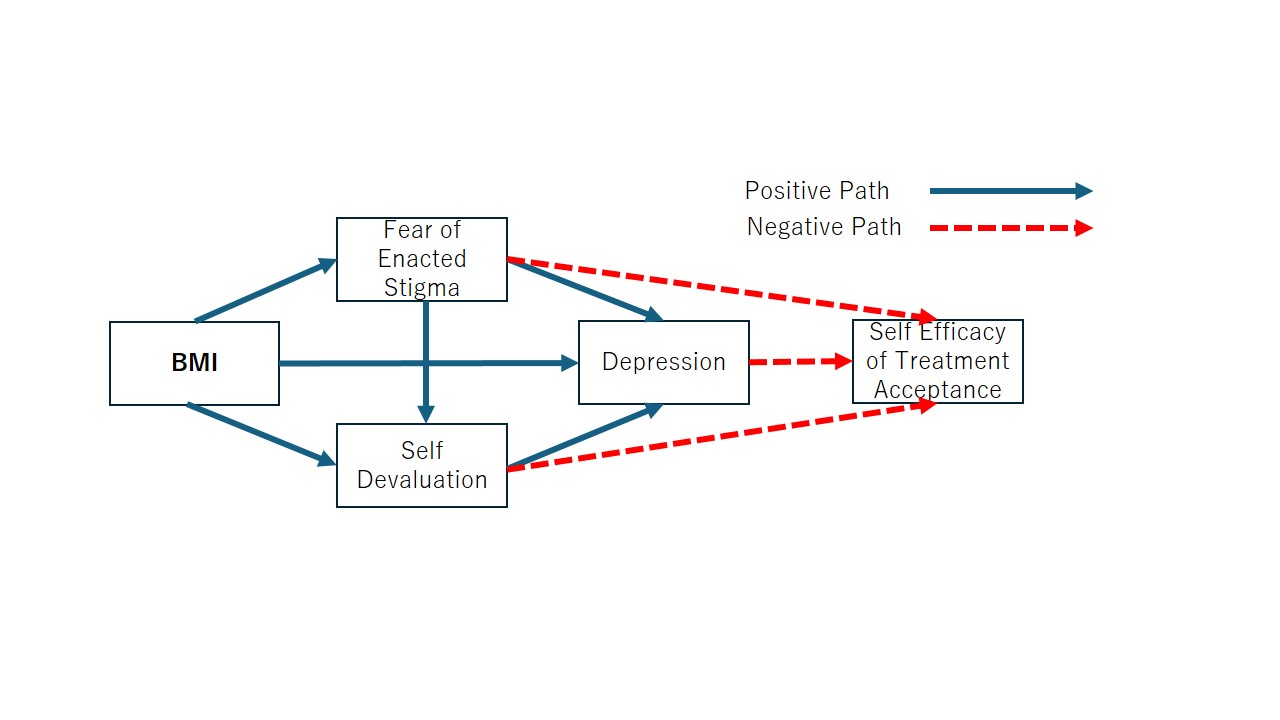
Weight-related self-stigma has been recognized as an important psychosocial factor associated with obesity, depression, and reduced healthcare engagement. However, its characteristics and clinical implications in Japan remain insufficiently understood. This study aimed to examine the relationships among body mass index (BMI), weight self-stigma, depressive symptoms, and treatment acceptance in a Japanese population. A cross-sectional web-based survey was conducted among 309 Japanese adults recruited through a commercial survey panel. Participants completed the Japanese versions of the Weight Self-Stigma Questionnaire (WSSQ-J), Patient Health Questionnaire-9, and Self-Efficacy Scale for Treatment Acceptance (SESTA). Participants were classified into three BMI groups: Low BMI (<18.5 kg/m2, n = 32), Middle BMI (18.5–24.9 kg/m2, n = 223), and High BMI (>25.0 kg/m2, n = 54). The mean BMI of the sample was 22.3 kg/m2, which falls within the normal range according to international criteria. Nevertheless, participants reported relatively high levels of weight self-stigma, with mean WSSQ scores comparable to those observed among patients with obesity in Western countries. Depressive symptom scores did not differ significantly across BMI groups. However, MGSEM revealed distinct structural patterns. In the Middle BMI group, BMI showed a significant negative direct association with depressive symptoms, whereas the pathway from self-devaluation to depressive symptoms was attenuated in the High BMI group. Furthermore, a significant negative indirect effect of BMI on SESTA was observed exclusively in the High BMI group, suggesting that body weight itself may function as a barrier to healthcare engagement.
- Ogawa W, Shimomura I, Yamauchi T, Yokote K. Clinical obesity and Himan-sho (obesity disease): Lessons from Japan’s 25 years of experience toward a new era of obesity care. J Diabetes Investig. 2026;17(1):5-8. doi: 10.1111/jdi.70178
- WHO Expert Consultation. Appropriate body-mass index for Asian populations and its implications for policy and intervention strategies. Lancet. 2004;363(9403):157-163. doi: 10.1016/S0140-6736(03)15268-3
- Ohta M, Kasama K, Sasaki A, et al. Current status of laparoscopic bariatric/metabolic surgery in Japan: The sixth nationwide survey by the Japan Consortium of Obesity and Metabolic Surgery. Asian J Endosc Surg. 2021;14(2):170-177. doi: 10.1111/ases.12836
- Ministry of Health, Labour and Welfare. The National Health and Nutrition Survey in Japan, 2023. Tokyo, Japan: Ministry of Health, Labour and Welfare; 2025. Accessed June 16, 2026. https://www.mhlw.go.jp/content/001435384.pdf
- Kowner R. Japanese body image: Structure and esteem scores in a cross-cultural perspective. Int J Psychol. 2002;37(3):149-159. doi: 10.1080/00207590143000298
- Iwabu M, Yamauchi T, Shimomura I, Eguchi K, Ogawa Y. Perceptions, attitudes and barriers to obesity management: Japanese data from the ACTION-IO study. J Diabetes Investig. 2021;12(5):845-858. doi: 10.1111/jdi.13427
- Puhl RM, Heuer CA. The stigma of obesity: A review and update. Obesity. 2009;17(5):941-964. doi: 10.1038/oby.2008.636
- Tomiyama AJ. Weight stigma is stressful. A review of evidence for the Cyclic Obesity/Weight-Based Stigma model. Appetite. 2014;82:8-15. doi: 10.1016/j.appet.2014.06.108
- Puhl RM, King KM. Weight discrimination and bullying. Best Pract Res Clin Endocrinol Metab. 2013;27(2):117-127. doi: 10.1016/j.beem.2012.12.002
- Papadopoulos S, Brennan L. Correlates of weight stigma in adults with overweight and obesity: A systematic literature review. Obesity. 2015;23(9):1743-1760. doi: 10.1002/oby.21187
- Pearl RL, Puhl RM. Weight bias internalization and health: A systematic review. Obes Rev. 2018;19(8):1141-1163. doi: 10.1111/obr.12701
- Tomiyama AJ, Carr D, Granberg EM, et al. How and why weight stigma drives the obesity ‘epidemic’ and harms health. BMC Med. 2018;16(1):123. doi: 10.1186/s12916-018-1116-5
- Kanazawa M, Yoshiike N, Osaka T, Numba Y, Zimmet P, Inoue S. Criteria and classification of obesity in Japan and Asia-Oceania. World Rev Nutr Diet. 2005;94:1-12. doi: 10.1159/000088200
- Pike KM, Borovoy A. The rise of eating disorders in Japan: Issues of culture and limitations of the model of Westernization. Cult Med Psychiatry. 2004;28(4):493-531. doi: 10.1007/s11013-004-1066-6
- Harris ER, Hahn SL, Forney KJ. The Unique Associations of Thin‐Ideal Internalization and Internalized Weight Stigma With Body Dissatisfaction Across Body Sizes. J Clin Psychol. 2025;81(7):577-582. doi: 10.1002/jclp.23793
- Imataka K, Ida S, Tanaka T, Murata K. Weight stigma is associated with reduced dietary diversity in women and older adults with diabetes. BMC Nutr. 2026;12(1):136. doi: 10.1186/s40795-026-01361-w
- Nakamura Y, Asano M. Developing and validating a Japanese version of the Weight Self-Stigma Questionnaire. Eat Weight Disord. 2023;28(1):44. doi: 10.1007/s40519-023-01573-0
- Luppino FS, de Wit LM, Bouvy PF, et al. Overweight, obesity, and depression: a systematic review and meta-analysis of longitudinal studies. Arch Gen Psychiatry. 2010;67(3):220-229. doi: 10.1001/archgenpsychiatry.2010.2
- Mitchell JE, Steffen KJ, de Zwaan M, Ertelt TW, Marino JM, Mueller A. Congruence between clinical and research-based psychiatric assessment in bariatric surgical candidates. Surg Obes Relat Dis. 2010;6(6):628-634. doi: 10.1016/j.soard.2010.01.007
- DiMatteo MR, Lepper HS, Croghan TW. Depression is a risk factor for noncompliance with medical treatment: meta-analysis of the effects of anxiety and depression on patient adherence. Arch Intern Med. 2000;160(14):2101-2107. doi: 10.1001/archinte.160.14.2101
- Hakariya H, Ohnishi M, Tanimoto T. Japan initiates market authorization of weight-loss drug semaglutide under universal health coverage, but with stringent prescription restrictions. Diabetes Obes Metab. 2024;26(8):3006-3008. doi: 10.1111/dom.15638
- Nabekura T, Oshiro T, Wakamatsu K. Proximal jejunal bypass with sleeve gastrectomy for severe obesity and type 2 diabetes: First case report in Japan. Surg Case Rep. 2025;11(1):25-0392. doi: 10.70352/scrj.cr.25-0392
- Ogawa W, Hirota Y, Miyazaki S, et al. Definition, criteria, and core concepts of guidelines for the management of obesity disease in Japan. Endocr J. 2024;71(3):223-231. doi: 10.1507/endocrj.EJ23-0593
- Muramatsu K, Miyaoka H, Kamijima K, et al. Performance of the Japanese version of the Patient Health Questionnaire-9 (J-PHQ-9) for depression in primary care. Gen Hosp Psychiatry. 2018;52:64-69. doi: 10.1016/j.genhosppsych.2018.03.007
- Shimotsu S, Sakamoto S, Horikawa N, Tomitaka S, Sakamoto K, Sakano Y . Development of the Self-Efficacy Scale for Treatment Acceptance (SESTA). Jpn J Behav Med. 2005;11(1):7-13. doi: 10.11331/jjbm.11.7
- Kenny DA, Kaniskan B, McCoach DB. The performance of RMSEA in models with small degrees of freedom. Sociol Methods Res. 2015;44(3):486-507. doi: 10.1177/0049124114543236
- Rossi AA, Manzoni GM, Pietrabissa G, Di Pauli D, Mannarini S, Castelnuovo G. Weight stigma in patients with overweight and obesity: validation of the Italian Weight Self-Stigma Questionnaire (WSSQ). Eat Weight Disord. 2022;27(7):2459-2472. doi: 10.1007/s40519-022-01385-8
- Hübner C, Schmidt R, Selle N, et al. Comparing self-report measures of internalized weight stigma: the Weight Self-Stigma Questionnaire versus the Weight Bias Internalization Scale. PLoS ONE. 2016;11(10):e0165566. doi: 10.1371/journal.pone.0165566
- Lillis J, Luoma JB, Levin ME, Hayes SC. Measuring weight self-stigma: the weight self-stigma questionnaire. Obesity. 2010;18(5):971-976. doi: 10.1038/oby.2009.353
- Almutairi BF, Alsaygh KW, Altamimi MM, et al. Internalized Weight Stigma: Prevalence and Association With Psychiatric Disorder Among Overweight and Obese Individuals. Cureus. 2021;13(10):e18577. doi: 10.7759/cureus.18577
- Khodari BH, Shami MO, Shajry RM, et al. The Relationship Between Weight Self-Stigma and Quality of Life Among Youth in the Jazan Region, Saudi Arabia. Cureus. 2021;13(9):e18158. doi: 10.7759/cureus.18158
- Woods R, Lavoie KL, Bacon SL. The Factor Structure and Stability of the Beck Depression Inventory-II (BDI-II) in a Population Undergoing Bariatric Surgery. Obes Surg. 2022;32(11):3732-3739. doi: 10.1007/s11695-022-06277-5
- Khantzian EJ. The self-medication hypothesis of substance use disorders: a reconsideration and recent applications. Harv Rev Psychiatry. 1997;4(5):231-244. doi: 10.3109/10673229709030550
- Puhl RM, Brownell KD. Confronting and coping with weight stigma: an investigation of overweight and obese adults. Obesity (Silver Spring). 2006;14(10):1802-1815. doi: 10.1038/oby.2006.208
- Swencionis C, Rendell SL. The psychology of obesity. Abdom Imaging. 2012;37(5):733-737. doi: 10.1007/s00261-012-9863-9