
Association of baseline platelet-to-lymphocyte ratio with early treatment response in patients with eating disorders: A retrospective study

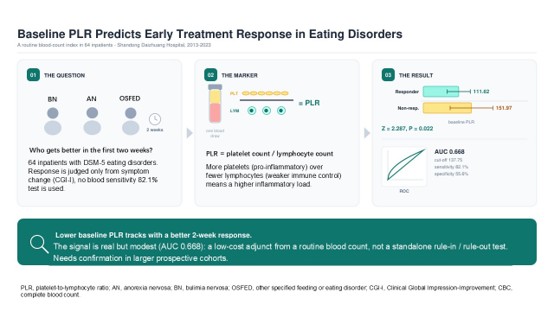
Early prediction of treatment response in eating disorders remains challenging, and the platelet-to-lymphocyte ratio (PLR) is a readily available inflammatory biomarker. This study aims to investigate the association between PLR and early treatment response in patients with eating disorders. We retrospectively examined whether the PLR, a routine inflammatory index, tracked with early improvement in 64 inpatients treated at Shandong Daizhuang Hospital from June 2013 to December 2023. Response was defined using the Clinical Global Impression-Improvement scale after two weeks of treatment. Twenty-eight patients (43.8%) responded. Responders had lower baseline PLR (111.62 ± 36.50 vs. 151.97 ± 67.38, Z = 2.287, p = 0.022) and shorter illness duration (Z = 2.000, p = 0.046). In a multivariable model adjusting for duration, PLR was marginally associated with response (odds ratio = 0.987, 95% CI: 0.9747–0.99996, p = 0.049); because covariates were selected based on univariate significance rather than prespecified clinical criteria, this estimate should not be read as an independently adjusted effect. On the receiver operating characteristic analysis, the area under the curve for PLR was 0.668 (95% CI: 0.535–0.801), with 82.1% sensitivity and 55.6% specificity at a cutoff of 137.75. The signal is real but weak: the CI barely excludes the null, the result would not survive multiple-testing correction, and specificity is modest. PLR is thus unlikely to stand alone in clinical decision-making, though it may serve as a low-cost adjunct. These preliminary findings require confirmation in larger prospective cohorts.
- Treasure J, Duarte TA, Schmidt U. Eating disorders. Lancet. 2020;395(10227):899-911. doi: 10.1016/s0140-6736(20)30059-3
- Schaumberg K, Welch E, Breithaupt L, et al. The Science Behind the Academy for Eating Disorders’ Nine Truths About Eating Disorders. Eur Eat Disord Rev. 2017;25(6):432-450. doi: 10.1002/erv.2553
- Galmiche M, Déchelotte P, Lambert G, Tavolacci MP. Prevalence of eating disorders over the 2000-2018 period: a systematic literature review. Am J Clin Nutr. 2019;109(5):1402-1413. doi: 10.1093/ajcn/nqy342
- Grilo CM. Treatment of Eating Disorders: Current Status, Challenges, and Future Directions. Annu Rev Clin Psychol. 2024;20(1):97-123. doi: 10.1146/annurev-clinpsy-080822-043256
- Phillipou A, Schmidt U, Neill E, Miles S, McGorry P, Eddy KT. Anorexia Nervosa-Facts, Frustrations, and the Future. JAMA Psychiatry. 2025;82(8):844-847. doi: 10.1001/jamapsychiatry.2025.0812
- Koreshe E, Paxton S, Miskovic-Wheatley J, et al. Prevention and early intervention in eating disorders: findings from a rapid review. J Eat Disord. 2023;11(1):38. doi: 10.1186/s40337-023-00758-3
- Halbeisen G, Laskowski N, Brandt G, Waschescio U, Paslakis G. Eating Disorders in Men. Dtsch Arztebl Int. 2024;121(3):86-91. doi: 10.3238/arztebl.m2023.0246
- van Eeden AE, van Hoeken D, Hoek HW. Incidence, prevalence and mortality of anorexia nervosa and bulimia nervosa. Curr Opin Psychiatry. 2021;34(6):515-524. doi: 10.1097/yco.0000000000000739
- Himmerich H, Treasure J. Anorexia nervosa: diagnostic, therapeutic, and risk biomarkers in clinical practice. Trends Mol Med. 2024;30(4):350-360. doi: 10.1016/j.molmed.2024.01.002
- Rösch SA, Schmidt R, Hilbert A. Predictors of neurofeedback treatment outcome in binge-eating disorder: An exploratory study. Int J Eat Disord. 2023;56(12):2283-2294. doi: 10.1002/eat.24062
- Schreglmann B, Schmidt R, Lührs M, Hilbert A. Neurofeedback for Binge-Eating Disorder: Neurophysiological Outcome Predictors and Rapid Response. Int J Eat Disord. 2026;59(4):766-777. doi: 10.1002/eat.70023
- Flanagan K, Pacheco LB, Gao M, Verdejo-Garcia A. Harnessing food cue evoked neuroimaging towards treatment optimisation for obesity and binge eating disorder. Rev Endocr Metab Disord. 2026. doi: 10.1007/s11154-026-10045-6
- Yu H, Li S, Wu Y, Ren X. Prognostic Value of Platelet to Lymphocyte Ratio for Myocardial Infarction: A Systematic Review and Meta-Analysis. Clin Cardiol. 2025;48(10):e70215. doi: 10.1002/clc.70215
- Wang ZY, Xu B, Wang LN, et al. Platelet-to-lymphocyte ratio predicts tumor response and survival of patients with hepatocellular carcinoma undergoing immunotherapies. Int Immunopharmacol. 2024;131:111863. doi: 10.1016/j.intimp.2024.111863
- Liao QQ, Mo YJ, Zhu KW, et al. Platelet-to-Lymphocyte Ratio (PLR), Neutrophil-to-Lymphocyte Ratio (NLR), Monocyte-to-Lymphocyte Ratio (MLR), and Eosinophil-to-Lymphocyte Ratio (ELR) as Biomarkers in Patients with Acute Exacerbation of Chronic Obstructive Pulmonary Disease (AECOPD). Int J Chron Obstruct Pulmon Dis. 2024;19:501-518. doi: 10.2147/copd.S447519
- Li C, Yang Z, Yang P, et al. Association between post-trauma platelet-lymphocyte ratio and nonunion in patients with extremity fractures: a multicenter retrospective cohort study. Int J Surg. 2025;111(12):8943-8952. doi: 10.1097/js9.0000000000003265
- Wang W, Ju H, Zhang W, Ma C, He C. Relationship between platelet-to-lymphocyte ratio and early rebleeding after endoscopic variceal ligation: a bicenter retrospective study. Ann Med. 2024;56(1):2400315. doi: 10.1080/07853890.2024.2400315
- Ninla-Aesong P, Kietdumrongwong P, Neupane SP, et al. Relative value of novel systemic immune-inflammatory indices and classical hematological parameters in predicting depression, suicide attempts and treatment response. Sci Rep. 2024;14(1):19018. doi: 10.1038/s41598-024-70097-z
- Zeng Y, Chourpiliadis C, Hammar N, et al. Inflammatory Biomarkers and Risk of Psychiatric Disorders. JAMA Psychiatry. 2024;81(11):1118-1129. doi: 10.1001/jamapsychiatry.2024.2185
- Rog J, Karakuła K, Rząd Z, et al. The Prognostic Value of Hematological, Immune-Inflammatory, Metabolic, and Hormonal Biomarkers in the Treatment Response of Hospitalized Patients with Anorexia Nervosa. Nutrients. 2025;17(14):2260. doi: 10.3390/nu17142260
- do Rosário Caldas N, Braulio VB, Brasil MAA, et al. Binge eating disorder, frequency of depression, and systemic inflammatory state in individuals with obesity - A cross sectional study. Arch Endocrinol Metab. 2022;66(4):489-497. doi: 10.20945/2359-3997000000489
- Romeo M, Cavaliere G, Traina G. Bulimia Nervosa and Depression, from the Brain to the Gut Microbiota and Back. Front Biosci (Landmark Ed). 2024;29(8):277. doi: 10.31083/j.fbl2908277
- Iordache MP, Buliman A, Costea-Firan C, et al. Immunological and Inflammatory Biomarkers in the Prognosis, Prevention, and Treatment of Ischemic Stroke: A Review of a Decade of Advancement. Int J Mol Sci. 2025;26(16):7928. doi: 10.3390/ijms26167928
- Buonacera A, Stancanelli B, Colaci M, Malatino L. Neutrophil to Lymphocyte Ratio: An Emerging Marker of the Relationships between the Immune System and Diseases. Int J Mol Sci. 2022;23(7):3636. doi: 10.3390/ijms23073636
- Busner J, Targum SD. The clinical global impressions scale: applying a research tool in clinical practice. Psychiatry (Edgmont). 2007;4(7):28-37.
- Wang J, Zhang F, Jiang F, Hu L, Chen J, Wang Y. Distribution and reference interval establishment of neutral-to-lymphocyte ratio (NLR), lymphocyte-to-monocyte ratio (LMR), and platelet-to-lymphocyte ratio (PLR) in Chinese healthy adults. J Clin Lab Anal. 2021;35(9):e23935. doi: 10.1002/jcla.23935
- Marazziti D, Torrigiani S, Carbone MG, et al. Neutrophil/Lymphocyte, Platelet/Lymphocyte, and Monocyte/Lymphocyte Ratios in Mood Disorders. Curr Med Chem. 2022;29(36):5758-5781. doi: 10.2174/0929867328666210922160116
- Mojadadi MS, Mahjour M, Fahimi H, Raoofi A, Shobeiri SS. Relationship between blood-based inflammatory indices and clinical score of schizophrenia patients: A cross-sectional study. Behav Brain Res. 2024;460:114807. doi: 10.1016/j.bbr.2023.114807
- Fusar-Poli L, Natale A, Amerio A, et al. Neutrophil-to-Lymphocyte, Platelet-to-Lymphocyte and Monocyte-to-Lymphocyte Ratio in Bipolar Disorder. Brain Sci. 2021;11(1):58. doi: 10.3390/brainsci11010058
- Stumpf F, Keller B, Gressies C, Schuetz P. Inflammation and Nutrition: Friend or Foe? Nutrients. 2023;15(5):1159. doi: 10.3390/nu15051159
- Dalton B, Bartholdy S, Robinson L, et al. A meta-analysis of cytokine concentrations in eating disorders. J Psychiatr Res. 2018;103:252-264. doi: 10.1016/j.jpsychires.2018.06.002
- Gaertner F, Ishikawa-Ankerhold H, Stutte S, et al. Plasmacytoid dendritic cells control homeostasis of megakaryopoiesis. Nature. 2024;631(8021):645-653. doi: 10.1038/s41586-024-07671-y
- De Luca SN, Sominsky L, Soch A, et al. Conditional microglial depletion in rats leads to reversible anorexia and weight loss by disrupting gustatory circuitry. Brain Behav Immun. 2019;77:77-91. doi: 10.1016/j.bbi.2018.12.008
- Howard D, Negraes P, Voineskos AN, et al. Molecular neuroanatomy of anorexia nervosa. Sci Rep. 2020;10(1):11411. doi: 10.1038/s41598-020-67692-1
- Milton LK, Patton T, O’Keeffe M, Oldfield BJ, Foldi CJ. In pursuit of biomarkers for predicting susceptibility to activity-based anorexia in adolescent female rats. Int J Eat Disord. 2022;55(5):664-677. doi: 10.1002/eat.23705
- Sirufo MM, Magnanimi LM, Ginaldi L, De Martinis M. Anorexia nervosa and autoimmune comorbidities: A bidirectional route? CNS Neurosci Ther. 2022;28(12):1921-1929. doi: 10.1111/cns.13953
- Fornaro M, Mondin AM, Billeci M, et al. Psychopharmacology of eating disorders: Systematic review and meta-analysis of randomized controlled trials. J Affect Disord. 2023;338:526-545. doi: 10.1016/j.jad.2023.06.068
- Solmi M, Veronese N, Favaro A, et al. Inflammatory cytokines and anorexia nervosa: A meta-analysis of cross-sectional and longitudinal studies. Psychoneuroendocrinology. 2015;51:237-252. doi: 10.1016/j.psyneuen.2014.09.031
- Succurro E, Segura-Garcia C, Ruffo M, et al. Obese Patients With a Binge Eating Disorder Have an Unfavorable Metabolic and Inflammatory Profile. Medicine (Baltimore). 2015;94(52):e2098. doi: 10.1097/md.0000000000002098
- Butler MJ, Perrini AA, Eckel LA. The Role of the Gut Microbiome, Immunity, and Neuroinflammation in the Pathophysiology of Eating Disorders. Nutrients. 2021;13(2):500. doi: 10.3390/nu13020500
- Vidmar P, Altenburg J, van Leeuwen EM, et al. Lymphocyte subsets and the increased risk for opportunistic infections in severe restrictive anorexia nervosa. J Eat Disord. 2025;13(1):84. doi: 10.1186/s40337-025-01235-9
- Camici M, Del Duca G, Brita AC, Antinori A. Connecting dots of long COVID-19 pathogenesis: a vagus nerve- hypothalamic-pituitary- adrenal-mitochondrial axis dysfunction. Front Cell Infect Microbiol. 2024;14:1501949. doi: 10.3389/fcimb.2024.1501949
- Monaco F, Vignapiano A, Di Gruttola B, et al. Neuroimaging and machine learning in eating disorders: a systematic review. Eat Weight Disord. 2025;30(1):46. doi: 10.1007/s40519-025-01757-w
- Caso JR, MacDowell KS, Soto M, et al. Dysfunction of Inflammatory Pathways and Their Relationship With Psychological Factors in Adult Female Patients With Eating Disorders. Front Pharmacol. 2022;13:846172. doi: 10.3389/fphar.2022.846172
- Li Y, Chen L, Yang X, et al. Dynamic association of serum albumin changes with inflammation, nutritional status and clinical outcomes: a secondary analysis of a large prospective observational cohort study. Eur J Med Res. 2025;30(1):679. doi: 10.1186/s40001-025-02925-5