

Effects of Mongolian Mind-Body Interactive Therapy on blood pressure control among people with essential hypertension during the COVID-19 pandemic: An exploratory online intervention study

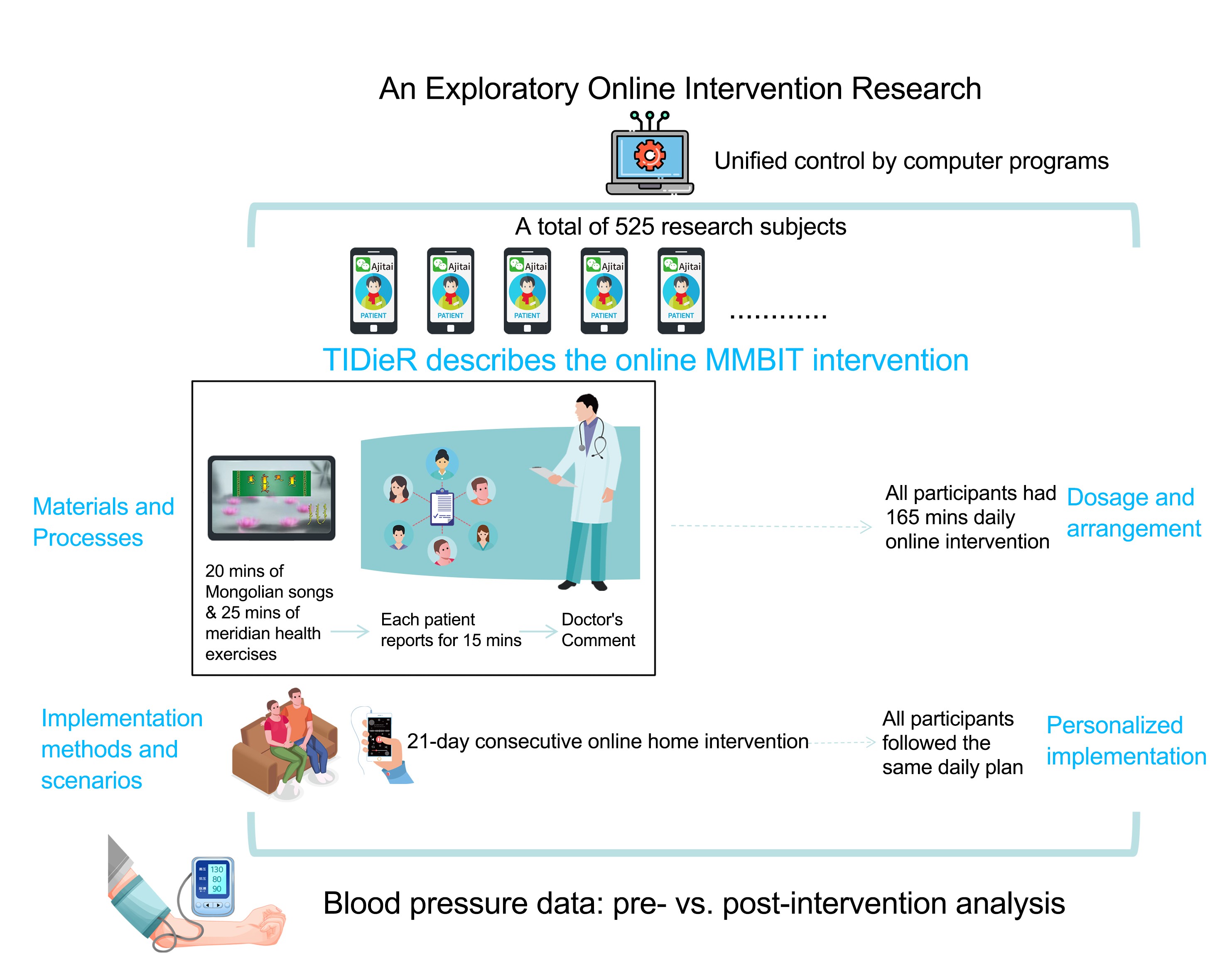
Mongolian Mind-Body Interactive Therapy (MMBIT) is based on the unified theory of Mongolian medicine and the knowledge and methods of modern medical psychology. This study investigated the effect of online MMBIT on the blood pressure of patients with essential hypertension (EH). During the COVID-19 pandemic, an online questionnaire was conducted among patients with EH who received MMBIT. A total of 525 patients participated in the study, of whom 149 were male and 376 were female; 319 were <60 years old and 206 were ≥60 years old. Furthermore, 394 patients had taken oral antihypertensive drugs in the past month, and 131 had not. Among the 525 patients with complete blood pressure data, systolic blood pressure decreased from 135 mmHg (interquartile range: 21.0) pre-MMBIT to 132 (22.5) mmHg post-MMBIT (p=0.001), while diastolic blood pressure decreased from 83 (16) mmHg pre-MMBIT to 82 (15) mmHg post-MMBIT (p=0.008). The proportions of participants meeting the target blood pressure were 36.952% pre-MMBIT and 42.476% post-MMBIT (χ2 = 0.750; p=0.386). Using the chi-square test, no significant difference in blood pressure reduction was observed between patients who did and did not receive medication; however, the rate of achieving target blood pressure after MMBIT treatment differed significantly across patient educational levels. Overall, MMBIT was associated with modest reductions in blood pressure among patients with EH.
- Mills KT, Bundy JD, Kelly TN, et al. Global disparities of hypertension prevalence and control: A systematic analysis of population-based studies from 90 countries. Circulation. 2016;134(6):441-450. doi: 10.1161/CIRCULATIONAHA.115.018912
- Hu SS, Writing Committee of the Report on Cardiovascular Health and Diseases in China. Cardiovascular risk factors in China. J Geriatr Cardiol. 2024;21(2):153-199. doi: 10.26599/1671-5411.2024.02.008
- Townsend N, Kazakiewicz D, Lucy Wright F, et al. Epidemiology of cardiovascular disease in Europe. Nat Rev Cardiol. 2022;19(2):133-143. doi: 10.1038/s41569-021-00607-3
- NCD Risk Factor Collaboration (NCD-RisC). Worldwide trends in hypertension prevalence and progress in treatment and control from 1990 to 2019: A pooled analysis of 1201 population-representative studies with 104 million participants. Lancet. 2021;398:957-980. doi: 10.1016/S0140-6736(21)01330-1
- De Boer IH, Bakris G, Cannon CP. Individualizing blood pressure targets for people with diabetes and hypertension: Comparing the ADA and the ACC/AHA recommendations. JAMA. 2018;319(13):1319-1320. doi: 10.1001/jama.2018.0642
- Ponte Márquez PH, Feliu-Soler A, Solé-Villa MJ, et al. Benefits of mindfulness meditation in reducing blood pressure and stress in patients with arterial hypertension. J Hum Hypertension. 2019;33:237-247. doi: 10.1038/s41371-018-0130-6
- Brindle RC, Ginty AT, Whittaker AC, Carroll D, Lucas SJE. Assessment of the cerebral pressure-flow relationship using psychological stress to manipulate blood pressure. Psychophysiology. 2018;55(12):e13265. doi: 10.1111/psyp.13265
- Casagrande M, Favieri F, Langher V, et al. The night side of blood pressure: Nocturnal blood pressure dipping and emotional (dys)regulation. Int J Environ Res Public Health. 2020;17(23):8892. doi: 10.3390/ijerph17238892
- Wang C, Fang J, Liu X, et al. The cognitive behavioral theory analysis of Mongolian mind-body interactive therapy. Med Philos. 2024;45(20):54-58. [In Chinese] doi: 10.12014/j.issn.1002-0772.2024.20.12
- He N, B W, Wu H, Fang J. Chief characteristics of Mongolian mind-body interactive psychotherapy. Med Philos. 2023;44(18):52-55. [In Chinese] doi: 10.12014/j.issn.1002-0772.2023.18.12
- Chagan-Yasutan H, Arlud S, Zhang L, Hattori T, Heriyed B, He N. Mongolian mind-body interactive psychotherapy enhances the quality of life of patients with esophageal cancer: A pilot study. J Complement Ther Clin Pract. 2020;38:101082. doi: 10.1016/j.ctcp.2019.101082
- He N, Lan W, Jiang A, et al. New method for insomnia mongolian mind-body interactive psychotherapy in the assessment of chronic insomnia: A retrospective study. Adv Ther. 2018;35(7):993-1000. doi: 10.1007/s12325-018-0726-9
- Fang J, Bao W, Chagan-Yasutan H, et al. Mechanism of Mongolian mind-body interactive therapy in regulating essential hypertension through HTR2B: A metabolome- and transcriptome-based study. Heliyon. 2024;10(17):e37113. doi: 10.1016/j.heliyon.2024.e37113
- Johnson CC, Ezouah P. Online yoga pilot intervention for black women at high cardiovascular risk: Internet-based recruitment and engagement. JMIR Form Res. 2025;9:e41221. doi: 10.2196/41221
- Cunningham JA, Hendershot CS, Kay-Lambkin F, et al. Does providing a brief internet intervention for hazardous alcohol use to people seeking online help for depression reduce both alcohol use and depression symptoms among participants with these co-occurring disorders? Study protocol for a randomised controlled trial. BMJ Open. 2018;8(7):e022412. doi: 10.1136/bmjopen-2018-022412
- Chao WC, Huang JC, Young SL, et al. Interplay of yoga, physical activity, and probiotics in irritable bowel syndrome management: A double-blind randomized study. Complement Ther Clin Pract. 2024;57:101892. doi: 10.1016/j.ctcp.2024.101892
- Hulsbosch LP, Potharst ES, Schwabe I, Boekhorst MG, Pop VJ, Nyklíček I. Online mindfulness-based intervention for women with pregnancy distress: A randomized controlled trial. J Affect Disord. 2023;332:262-272. doi: 10.1016/j.jad.2023.04.009
- Guideline Committee on Home Blood Pressure Monitoring Chinese Hypertension League. 2019 China family blood pressure monitoring guidelines. Chin J Hyperten. 2019;27(08):708-711. doi: 10.16439/j.cnki.1673-7245.2019.08.005
- Hughes JW, Fresco DM, Myerscough R, Van Dulmen MH, Carlson LE, Josephson R. Randomized controlled trial of mindfulness-based stress reduction for prehypertension. Psychosom Med. 2013;75:721-728. doi: 10.1097/PSY.0b013e3182a3e4e5
- Haller H. Effective management of hypertension with dihydropyridine calcium channel blocker-based combination therapy in patients at high cardiovascular risk. Int J Clin Pract. 2008;62(5):781-790. doi: 10.1111/j.1742-1241.2008.01713.x
- Patel JS, Berntson J, Polanka BM, Stewart JC. Cardiovascular risk factors as differential predictors of incident atypical and typical major depressive disorder in US adults. Psychosom Med. 2018;80:508-514. doi: 10.1097/PSY.0000000000000583
- Herrmann-Lingen C, Meyer T, Bosbach A, et al. Cross-sectional and longitudinal associations of systolic blood pressure with quality of life and depressive mood in older adults with cardiovascular risk factors: Results from the observational DIAST-CHF study. Psychosom Med. 2018;80:468-474. doi: 10.1097/PSY.0000000000000591
- Berendes A, Meyer T, Hulpke-Wette M, Herrmann-Lingen C. Association of elevated blood pressure with low distress and good quality of life: Results from the nationwide representative German health interview and examination survey for children and adolescents. Psychosom Med. 2013;75:422-428. doi: 10.1097/PSY.0b013e31828ef0c2
- Hassoun L, Herrmann-Lingen C, Hapke U, Neuhauser H, Scheidt-Nave C, Meyer T. Association between chronic stress and blood pressure: Findings from the German health interview and examination survey for adults 2008-2011. Psychosom Med. 2015;77:575-582. doi: 10.1097/PSY.0000000000000183
- Nakamura Y, Kabayama M, Godai K, et al. Longitudinal association of hypertension and dyslipidemia with cognitive function in community-dwelling older adults: The SONIC study. Hypertens Res. 2023;46:1829-1839. doi: 10.1038/s41440-023-01271-5
- Fort MP, Murillo S, López E, et al. Impact evaluation of a healthy lifestyle intervention to reduce cardiovascular disease risk in health centers in San José, Costa Rica and Chiapas, Mexico. BMC Health Serv Res. 2015;15(1):577. doi: 10.1186/s12913-015-1248-7
- Islam KF, Awal A, Mazumder H, et al. Social cognitive theory-based health promotion in primary care practice: A scoping review. Heliyon. 2023;9(4):e14889. doi: 10.1016/j.heliyon.2023.e14889
- Barzegar H, Sodagar S, Seirafi M, Farahbakhsh M, Hashemi T. Blood pressure management protocol based on transtheoretical model effectiveness on self- care: A systematic review. Health Promot Perspect. 2024;14(3):207-220. doi: 10.34172/hpp.42814
- Howcroft M, Walters EH, Wood-Baker R, Walters JA. Action plans with brief patient education for exacerbations in chronic obstructive pulmonary disease. Cochrane Database Syst Rev. 2016;12(12):CD005074. doi: 10.1002/14651858.CD005074
- Wang Z, Yang Y, Wang W, et al. New characteristics of hypertension epidemic in China: Highlights and inspirations from China hypertension survey. Chin J Circ. 2018;33(10):937-939.