

Neural network surrogate model analysis of couple stress squeeze film flow with slip velocity and piezo-viscous effects over rough circular plates

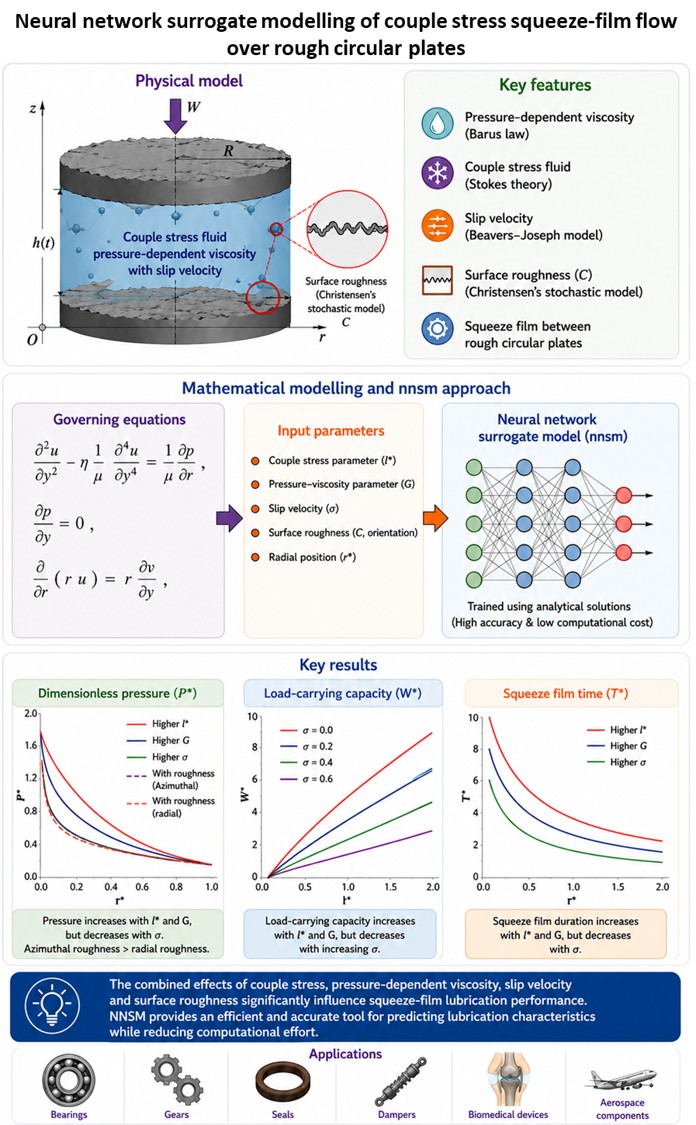
Squeeze-film lubrication plays a crucial role in enhancing the performance, reliability, and service life of tribological components operating under high loads and varying lubrication conditions. This study investigates the squeeze-film lubrication characteristics of rough circular plates lubricated with a pressure-dependent viscous couple-stress fluid under slip velocity. A modified Reynolds equation is developed by incorporating Stokes’ couple stress fluid theory, the Barus pressure–viscosity relationship, slip boundary conditions, and Christensen’s stochastic surface roughness model. The governing equation is analyzed using a Neural network surrogate model (NNSM) to efficiently predict lubrication performance. The effects of the couple stress parameter, pressure–viscosity parameter, slip velocity, and surface roughness on dimensionless pressure, loadcarrying capacity, and squeeze-film time are examined through analytical and numerical analyses. Results indicate that increasing the couple stress parameter enhanced pressure generation, load-carrying capacity, and squeeze-film duration, whereas increasing slip velocity generally reduced pressure and load-carrying capacity. Pressure-dependent viscosity significantly affects pressure distribution and load-supporting capability, while surface roughness produced distinct effects depending on its statistical orientation. The novelty of this work lies in integrating the NNSM with a lubrication model that simultaneously accounts for couple-stress fluid behavior, pressure-dependent viscosity, slip velocity, and surface roughness. The proposed approach provides an efficient method for predicting lubrication characteristics and offers valuable insights for the design and optimization of bearings, gears, seals, dampers, biomedical devices, and other tribological systems.
- Barus C. Isothermals, isopiestics and isometrics relative to viscosity. Am J Sci. 1893;45(266):87-96. https://doi.org/10.2475/ajs.s3-45.266.87
- Stokes VK. Couple stresses in fluids. Phys Fluids. 1966;9(9):1709-1715. https://doi.org/10.1063/1.1761925
- Bujurke NM, Jayaraman G. The influence of couple stresses in squeeze films. Int J Mech Sci. 1982;24(6):369-376. https://doi.org/10.1016/0020-7403(82)90070-4
- Cameron AGW. The Principles of Lubrication. London, UK: Longmans; 1966. Accessed January 1, 1966. https://cir.nii.ac.jp/crid/1970304959943447071
- Kudenatti RB, Basti DP, Bujurke NM. Numerical solution of the MHD Reynolds equation for squeeze film lubrication between two parallel surfaces. Appl Math Comput. 2012;218(18):9372-9382. https://doi.org/10.1016/j.amc.2012.03.019
- Ramanaiah G. Squeeze films between finite plates lubricated by fluids with couple stress. Wear. 1979;54(2):315-320. https://doi.org/10.1016/0043-1648(79)90123-6
- Elrod HG. A general theory for laminar lubrication with Reynolds roughness. J Lubr Technol. 1979;101(1):8-14. https://doi.org/10.1115/1.3453283
- Tripathi JP, Singh UP, Singh BK. Homotopy analysis of circular plates squeeze film bearings lubricated with couple stress fluids: piezo-viscous model. Sci Technol J. 2020;8(2):95-102. https://doi.org/10.22232/stj.2020.08.02.14
- Hanumagowda BN, Salma A, Raju BT, Nagarajappa CS. The magnetohydrodynamic lubrication of curved circular plates with couple stress fluid. Int J Pure Appl Math. 2017;113(6):307-315. Accessed February 13, 2017. https://www.researchgate.net/publication/349589539_The_Magneto-hydrodynamic_Lubrication_of_Curved_Circular_Plates_With_Couple_Stress_Fluid
- Lin JR, Chu LM, Liang LJ, Lee PH. Derivation of a modified lubrication equation for hydromagnetic non-Newtonian cylindrical squeeze films and its application to circular plates. J Eng Math. 2012;77(1):69-75. https://doi.org/10.1007/s10665-012-9540-6
- Lin JR, Chu LM, Li WL, Lu RF. Combined effects of piezo-viscous dependency and non-Newtonian couple stresses in wide parallel-plate squeeze-film characteristics. Tribol Int. 2011;44(12):1598-1602. https://doi.org/10.1016/j.triboint.2011.04.003
- Lin JR, Chu LM, Liang LJ. Effects of viscosity-pressure dependency on the non-Newtonian squeeze film of parallel circular plates. Lubr Sci. 2013;25(1):1-9. https://doi.org/10.1002/ls.1188
- Hanumagowda BN. Combined effect of pressure-dependent viscosity and couple stress on squeeze-film lubrication between circular step plates. Proc Inst Mech Eng J J Eng Tribol. 2015;229(9):1056-1064. https://doi.org/10.1177/1350650115572449
- Tzeng ST, Saibel E. Surface roughness effect on slider bearing lubrication. ASLE Trans. 1967;10(3):334-348. https://doi.org/10.1080/05698196708972191
- Christensen H. Stochastic models for hydrodynamic lubrication of rough surfaces. Proc Inst Mech Eng. 1969;184(1):1013-1026. https://doi.org/10.1243/PIME_PROC_1969_184_074_02
- Prakash J, Tonder K. Roughness effects in circular squeeze-plates. ASLE Trans. 1977;20(3):257-263. https://doi.org/10.1080/05698197708982840
- Gupta JL, Deheri GM. Effect of roughness on the behaviour of squeeze film in a spherical bearing. Tribol Trans. 1996;39(1):99-102. https://doi.org/10.1080/10402009608983508
- Andharia PI, Gupta JL, Deheri GM. Effect of transverse surface roughness on the behaviour of squeeze film in a spherical bearing. Appl Mech Eng. 1999;4(Spec Iss):19-24. Accessed January 9, 1999. http://yadda.icm.edu.pl/baztech/element/bwmeta1.element.baztech-article-BPZ2-0012-0002
- Andharia PI, Deheri GM, Gupta JL. Effect of longitudinal surface roughness on the behaviour of squeeze film in a spherical bearing. Int J Appl Mech Eng. 2001;6(4):885-897. Accessed January 11, 2011. https://www.researchgate.net/publication/255939889_Effect_of_Longitudinal_Surface_Roughness_on_Hydrodynamic_Lubrication_of_Slider_Bearings
- Naduvinamani NB, Hiremath PS, Gurubasavaraj G. Effect of surface roughness on the couple-stress squeeze film between a sphere and a flat plate. Tribol Int. 2005;38(5):451-458. https://doi.org/10.1016/j.triboint.2004.09.001
- Naduvinamani NB, Apparao S, Hiremath AG. Effect of surface roughness and viscosity-pressure dependency on the couple stress squeeze film characteristics of parallel circular plates. Adv Tribol. 2014;2014:387413. https://doi.org/10.1155/2014/387413
- Hanumagowda BN, Raju BT, Santhosh Kumar J, Vasanth KR. Combined effect of surface roughness and pressure-dependent viscosity over couple stress squeeze film lubrication between circular stepped plates. Proc Inst Mech Eng J J Eng Tribol. 2018;232(5):525-534. https://doi.org/10.1177/1350650117721432
- Fathima ST, Naduvinamani NB, Santhosh Kumar J, Hanumagowda BN. Effect of surface roughness on the squeeze film characteristics of circular plates in the presence of conducting couple stress fluid and transverse magnetic field. Adv Tribol. 2015;2015:302396. https://doi.org/10.1155/2015/302396
- Hanumagowda BN, Salma A, Nagarajappa CS. Effects of surface roughness, MHD and couple stress on squeeze film characteristics between curved circular plates. J Phys Conf Ser. 2018;1000:012075. https://doi.org/10.1088/1742-6596/1000/1/012075
- Awati VB, Kengangutti A. Surface roughness effect on thermohydrodynamic analysis of journal bearings lubricated with couple stress fluids. Nonlinear Eng. 2019;8(1):397-406. https://doi.org/10.1515/nleng-2018-0017
- Byeon H, Latha YL, Hanumagowda BN, et al. Magnetohydrodynamics and viscosity variation in couple stress squeeze film lubrication between rough flat and curved circular plates. Sci Rep. 2023;13(1):22960. https://doi.org/10.1038/s41598-023-50326-7
- Kalavathi GK, Najar FA, Vasundhara MG. Performance characteristics of journal bearings (porous type): a coupled solution using Hartmann number and roughness parameter. Proc Inst Mech Eng J J Eng Tribol. 2020;234(5):668-675. https://doi.org/10.1177/1350650119886709
- Hanumagowda BN, Sreekala CK, Kumar V, Kodekalmath VI. An analysis about MHD, couple stress, and the roughness of the surface on a long cylinder and infinite porous plate. In: Proceedings of the 2022 IEEE 2nd Mysore Sub Section International Conference (MysuruCon). IEEE; 2022:16-17. https://doi.org/10.1109/MysuruCon55714.2022.9972468
- Patel JR, Deheri G. Combined effect of surface roughness and slip velocity on Jenkins model based magnetic squeeze film in curved rough circular plates. Int J Comput Math. 2014;2014:367618. https://doi.org/10.1155/2014/367618
- Patel JR, Deheri GM. Jenkins model based magnetic squeeze film in curved rough circular plates considering slip velocity: A comparison of shapes. FME Trans. 2015;43(2):144-153. https://doi.org/10.5937/fmet1502144P
- Sekar S, Nathan SL, Saravanathan LP. Velocity slip with viscosity variation for rough porous circular stepped plates using couple stress fluid. Math Model Eng Probl. 2022;9(6):1631-1638. https://doi.org/10.18280/mmep.090624
- Dass TD, Gunakala SR, Comissiong DM. Combined effect of variable viscosity and surface roughness on the squeeze film characteristics of infinitely wide rectangular plate with couple stress fluid, velocity-slip and ferrofluid lubricant. Mater Today Proc. 2022;56:1717-1725. https://doi.org/10.1016/j.matpr.2021.10.355
- Vasanth KR, Mallesh N, Hanumagowda BN, D'Silva SP. A theoretical investigation into the effects of slip velocity and piezo-viscous behaviour on couple stress fluids along circular plates. Int J Thermofluids. 2025;27:101176. https://doi.org/10.1016/j.ijft.2025.101176
- Mallesh N, Vasanth KR, Hanumagowda BN, D'Silva SP. Analysis of viscosity variation and couple stress fluid based squeezed film lubrication between porous circular plates considering effect of slip velocity. Surf Rev Lett. https://doi.org/10.1142/S0218625X26500514
- Ang EHW, Wang G, Ng BF. Physics-informed neural networks for low Reynolds number flows over cylinder. Energies. 2023;16(12):4558. https://doi.org/10.3390/en16124558
- Chen RTQ, Rubanova Y, Bettencourt J, Duvenaud DK. Neural ordinary differential equations. arXiv. 2018. https://doi.org/10.48550/arXiv.1806.07366
- Eivazi H, Tahani M, Schlatter P, Vinuesa R. Physics-informed neural networks for solving Reynolds-averaged Navier-Stokes equations. Phys Fluids. 2022;34(7):075117. https://doi.org/10.1063/5.0095270
- Jin X, Cai S, Li H, Karniadakis GE. NSFnets (Navier-Stokes flow nets): physics-informed neural networks for the incompressible Navier-Stokes equations. J Comput Phys. 2021;426:109951. https://doi.org/10.1016/j.jcp.2020.109951
- Jafari A. Transport-Embedded Neural Architecture: Redefining the Landscape of Physics-Aware Neural Models in Fluid Mechanics. arXiv. 2024. https://doi.org/10.48550/arXiv.2410.04114
- Varun Kumar RS, Sowmya G, Prakash C, Chandan K, Prasannakumara BC. Shape factor effect on the thermal variation of a wavy fin wetted by ternary hybrid nanofluid using an extended physics-informed Laguerre neural network. Neural Comput Appl. 2025;37(32):27083-27115. https://doi.org/10.1007/s00521-025-11658-9
- Chandan K, Karthik K, Nagaraja KV, Prasannakumara BC, Varun Kumar RS, Muhammad T. Radiative heat transfer analysis of a concave porous fin under the local thermal non-equilibrium condition: application of the clique polynomial method and physics-informed neural networks. Appl Math Mech. 2024;45(9):1613-1632. https://doi.org/10.1007/s10483-024-3143-6
- Sanju BS, Naveen Kumar R, Varun Kumar RS, Abdulrahman A. Physics-informed neural network approach to analyze the onset of oscillatory and stationary convections in chemically triggered Navier-Stokes-Voigt fluid layer heated and salted from below. Appl Math Mech. 2025;46(11):2199-2220. https://doi.org/10.1007/s10483-025-3316-7
- Chandan K, Varun Kumar RS, Sharma N, et al. Advanced deep learning approach with physics-informed neural networks for analysing the thermal variation through a radial fin applicable in heat exchangers. Pramana. 2024;98(3):123. https://doi.org/10.1007/s12043-024-02823-1
- Varun Kumar RS, Chandan K, Venkadeshwaran K, Muhammad T, Punith Gowda RJ, Prasannakumara BC. Influence of magnetic dipole on the hybrid nanofluid flow with chemical reactions due to the generated and absorbed heat. Pramana. 2025;99(2):65. https://doi.org/10.1007/s12043-025-02917-4
- Varun Kumar RS, Abhilasha SK, Raghunandan ME, Abdulrahman A, Naveen Kumar R. Comprehensive analysis on the thermal performance of circular-perforated rectangular fin with internal heat generation using Chelyshkov polynomial operational matrix-based collocation approach. Int J Mech Mater Des. 2025;21(6):2105-2128. https://doi.org/10.1007/s10999-025-09815-y
- Shah K, Abdeljawad T, Abdalla B, Ali Z. Analyzing a coupled dynamical system of materials recycling in chemostat systems with artificial deep neural network. Model Earth Syst Environ. 2025;11(5):313. https://doi.org/10.1007/s40808-025-02473-1
- Shah K, Khan A, Abdeljawad T, Eiman T. Using deep neural network and fractional derivative to investigate evolution of virulence. Contemp Math. 2026;7(2):1386-1415. https://doi.org/10.37256/cm.7220269398
- Shah K, Sarwar M, Abdeljawad T. Study of fractional order epidemic compartmental model by using artificial deep neural networks. Neural Netw. 2025;192:107944. https://doi.org/10.1016/j.neunet.2025.107944