

Dynamic scheduling of hybrid additive manufacturing–injection molding for surge capacity in polymer supply chains

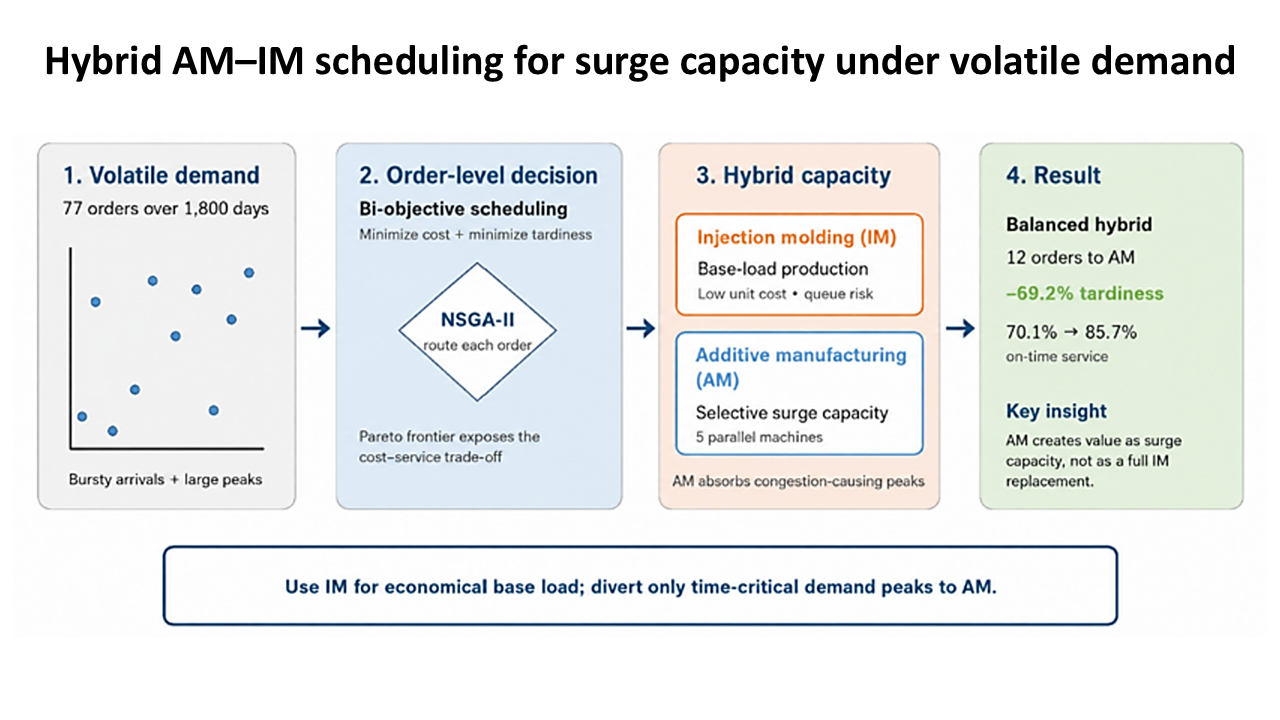
Demand volatility creates a persistent challenge for manufacturers seeking to balance the cost efficiency of conventional high-volume production with the responsiveness offered by additive manufacturing. This study develops a data-driven decision-support framework to deploy additive manufacturing (AM) as strategic surge capacity in a polymer pipe-fitting supply chain facing volatile demand. Following a 48-month screening of four unplasticized polyvinyl chloride tee joints, the 3/4-in. variant was selected, and a validated stream of 77 stochastic orders was used in a bi-objective order-assignment model that minimizes production cost and tardiness across injection molding (IM) and AM. The novelty lies in combining order-level hybrid routing, build-level parallel AM capacity, practical heuristic benchmarks, due-window sensitivity analysis, and a multi-run stability assessment within one industrially grounded framework. Under the baseline 48 h service target, the IM-only approach cost the least (EUR 296,396.19) but produced 244.15 h of tardiness and 23 late orders, whereas the AM-only approach eliminated tardiness at EUR 1,008,780.00. The non-dominated sorting genetic algorithm II Pareto frontier identifies a balanced solution that assigns 12 peak orders to AM, reduces tardiness by 69.2%, and improves on-time service from 70.1% to 85.7% at an 85.9% cost premium over the IM-only approach. The zero-tardiness endpoint requires 23 AM-assigned orders and costs EUR 759,250.77. Sensitivity analysis shows that the value of hybridization depends on the responsiveness requirement: at 24 h, AM capacity is stressed, whereas at 72 h or longer, the IM-only approach meets all due dates. The results therefore position AM as a selective surge capacity rather than a universal substitute for IM.
- Bauer D, Böhm M, Bauernhansl T, Sauer A. Increased resilience for manufacturing systems in supply networks through data-based turbulence mitigation. Prod Eng Res Dev. 2021;15(3-4):385-395. https://doi.org/10.1007/s11740-021-01036-4
- Nitsche B, Straube F. Efficiently managing supply chain volatility – a management framework for the manufacturing industry. Procedia Manuf. 2020;43:320-327. https://doi.org/10.1016/j.promfg.2020.02.166
- Razavi Hajiagha SH, Hashemi SS, Sadeghi M. Hybrid fuzzy-stochastic approach for multi-product, multi-period, and multi-resource master production scheduling problem: case of a polyethylene pipe and fitting manufacturer. Sci Iran. 2018;1809-1823. https://doi.org/10.24200/sci.2018.20329
- Tosello G, Charalambis A, Kerbache L, et al. Value chain and production cost optimization by integrating additive manufacturing in injection molding process chain. Int J Adv Manuf Technol. 2018;100(1-4):783-795. https://doi.org/10.1007/s00170-018-2762-7
- Thomas D. Costs, benefits, and adoption of additive manufacturing: a supply chain perspective. Int J Adv Manuf Technol. 2015;85(5-8):1857-1876. https://doi.org/10.1007/s00170-015-7973-6
- Naghshineh B. Mapping the enhancing effects of additive manufacturing technology adoption on supply chain agility. Manag Rev Q. 2024;75(1):119-137. https://doi.org/10.1007/s11301-023-00376-y
- Zijm H, Knofius N, van der Heijden M. Additive Manufacturing and Its Impact on the Supply Chain. In: Lecture Notes in Logistics. Cham, Switzerland: Springer International Publishing; 2018:521-543. https://doi.org/10.1007/978-3-319-92447-2_23
- Fernandez E, Edeleva M, Fiorio R, Cardon L, D'hooge DR. Increasing the Sustainability of the Hybrid Mold Technique through Combined Insert Polymeric Material and Additive Manufacturing Method Design. Sustainability. 2022;14(2):877. https://doi.org/10.3390/su14020877
- Alogla AA, Baumers M, Tuck C, Elmadih W. The Impact of Additive Manufacturing on the Flexibility of a Manufacturing Supply Chain. Appl Sci. 2021;11(8):3707. https://doi.org/10.3390/app11083707
- Alogla AA, Alzahrani A, Alghamdi A. The Role of Additive Manufacturing in Reducing Demand Volatility in Aerospace: A Conceptual Framework. Aerospace. 2023;10(4):381. https://doi.org/10.3390/aerospace10040381
- Becerra-Borges YE, Cazón-Martín A, Rodríguez-Ferradas MI, et al. Transforming plastic injection molding with additive manufacturing: a novel systematic review of innovative approaches to insert production. Rapid Prototyp J. 2025;31(11):200-217. https://doi.org/10.1108/rpj-10-2024-0444
- Didilis K, Marani D, Bihlet UD, Haugen AB, Esposito V. Freeform injection molding of functional ceramics by hybrid additive manufacturing. Addit Manuf. 2022;60:103197. https://doi.org/10.1016/j.addma.2022.103197
- Zhang W, Bao X, Hao X, Gen M. Metaheuristics for multi-objective scheduling problems in industry 4.0 and 5.0: a state-of-the-arts survey. Front Ind Eng. 2025;3:1540022. https://doi.org/10.3389/fieng.2025.1540022
- uz Zaman UK. Intégration Produit-Process appliquée à la sélection de procédés de Fabrication Additive [Integrated product process design applied to the selection of additive manufacturing processes] [dissertation]. Paris, France: École Nationale Supérieure des Arts et Métiers; National University of Sciences and Technology (Pakistan); 2019. [In French]. Accessed July 15, 2026. https://pastel.archives-ouvertes.fr/tel-02065495
- Liao J. Uncertainty Quantification and Reduction for Environmental Impact Modeling of Manufacturing Processes and Systems. Dissertation. Ann Arbor, MI: University of Michigan; 2025. https://doi.org/10.7302/26910
- Mischkot M. Advanced Process Chains for Prototyping and Pilot Production based on Direct Rapid Soft Tooling. Dissertation. Lundtofte, Denmark: Technical University of Denmark; 2018.
- Zipfel B, Neufeld JS, Buscher U. Customer Order Scheduling in an Additive Manufacturing Environment. In: IFIP Advances in Information and Communication Technology. Cham, Switzerland: Springer International Publishing; 2021:101-109. https://doi.org/10.1007/978-3-030-85910-7_11
- Tavakkoli-Moghaddam R, Shirazian S, Vahedi-Nouri B. A Bi-objective Scheduling Model for Additive Manufacturing with Multiple Materials and Sequence-Dependent Setup Time. In: IFIP Advances in Information and Communication Technology. Cham, Switzerland: Springer International Publishing; 2020:451-459. https://doi.org/10.1007/978-3-030-57997-5_52
- Fera M, Fruggiero F, Lambiase A, Macchiaroli R, Todisco V. A modified genetic algorithm for time and cost optimization of an additive manufacturing single-machine scheduling. Int J Ind Eng Comput. 2018;9(4):423-438. https://doi.org/10.5267/j.ijiec.2018.1.001
- Li Q, Zhang D, Wang S, Kucukkoc I. A dynamic order acceptance and scheduling approach for additive manufacturing on-demand production. Int J Adv Manuf Technol. 2019;105(9):3711-3729. https://doi.org/10.1007/s00170-019-03796-x
- Alogla A, Baumers M, Tuck C. Characterising the cost of additive manufacturing: demand volatility and absence of inventory. Eur J Ind Eng. 2025;20(3):411-447. https://doi.org/10.1504/ejie.2025.148094
- Alfattani R. Hybrid Manufacturing Systems: Integrating Additive and Subtractive Techniques for Precision and Versatility. Preprint. Posted online 2024. https://doi.org/10.21203/rs.3.rs-5141947/v1
- Kwon S, Oh Y. Optimal process planning for hybrid additive–subtractive manufacturing using recursive volume decomposition with decision criteria. J Manuf Syst. 2023;71:360-376. https://doi.org/10.1016/j.jmsy.2023.09.018
- Sugarindra M, Edy Tontowi A, Herianto H. Multitask scheduling on cloud additive manufacturing using NSGA-II. JIEM. 2024;17(3):809. https://doi.org/10.3926/jiem.7083
- Kucukkoc I, Finco S, Peron M, Aydin Keskin G. Including mechanical requirements in a bi-objective nesting and scheduling model for additive manufacturing. Eur J Oper Res. 2025;325(3):416-432. https://doi.org/10.1016/j.ejor.2025.03.022
- Liu X, Chen X, Zhao Y, Liu X, Wu CC, Lin WC. A multi-objective flexible flow shop scheduling problem with an improved NSGA-Ⅱ algorithm. J Ind Manag Optim. 2025;21(5):4041-4062. https://doi.org/10.3934/jimo.2025042
- Tasé Velázquez DR, Simon AT, Helleno AL, Mastrapa LH. Implications of additive manufacturing on supply chain and logistics. Ind J Manag Prod. 2020;11(4):1279-1302. https://doi.org/10.14807/ijmp.v11i4.1139
- Patel P, Defersha F, Yang S. Resilience Analysis of Additive Manufacturing-enabled Supply Chains: An Exploratory Study. Front Manuf Technol. 2022;2:884164. https://doi.org/10.3389/fmtec.2022.884164
- Bui TD, Tsai FM, Tseng ML, Tan RR, Yu KDS, Lim MK. Sustainable supply chain management towards disruption and organizational ambidexterity: A data driven analysis. Sustain Prod Consum. 2021;26:373-410. https://doi.org/10.1016/j.spc.2020.09.017
- Okumoto Y, Fujioka S. Application of Fuzzy Scheduling to Pipe Assembly Process. J Soc Nav Archit Jpn. 2003;2003(194):227-232. https://doi.org/10.2534/jjasnaoe1968.2003.194_227
- Framinan JM, Perez-Gonzalez P, Fernandez-Viagas V. An overview on the use of operations research in additive manufacturing. Ann Oper Res. 2022;322(1):5-40. https://doi.org/10.1007/s10479-022-05040-4
- Dvorak F, Micali M, Mathieug M. Planning and Scheduling in Additive Manufacturing. Int J Artif Intell. 2018;21(62):40-52. https://doi.org/10.4114/intartif.vol21iss62pp40-52
- Khalili Goudarzi F, Maleki HR, Niroomand S. An optimization framework for scheduling multi-period multi-product oil pipeline systems under belief degree-based uncertain parameters. J Appl Math Comput. 2022;69(1):37-68. https://doi.org/10.1007/s12190-022-01727-w
- Khalili Goudarzi F, Maleki HR, Niroomand S. An interactive fuzzy programming approach for a new multi-objective multi-product oil pipeline scheduling problem. Iran J Fuzzy Syst. 2021;18(4). https://doi.org/10.22111/ijfs.2021.6179
- Khalili Goudarzi F, Maleki HR, Niroomand S. Mathematical formulation and hybrid meta-heuristic algorithms for multiproduct oil pipeline scheduling problem with tardiness penalties. Concurrency Comput. 2021;33(17):e6299. https://doi.org/10.1002/cpe.6299
- Deb K, Pratap A, Agarwal S, Meyarivan T. A fast and elitist multiobjective genetic algorithm: NSGA-II. IEEE Trans Evol Comput. 2002;6(2):182-197. https://doi.org/10.1109/4235.996017
- Barman A, Kumar Chakraborty A, Goswami A, Banerjee P, De PK. Pricing and inventory decision in a two-layer supply chain under the Weibull distribution product deterioration: an application of NSGA-II. RAIRO-Oper Res. 2023;57(4):2279-2300. https://doi.org/10.1051/ro/2023105
- Barman A, Chakraborty AK, Sana SS, Banerjee P. Pricing Strategy and Risk-Averse Flexibility in Sustainable Supply Chain: A Dual-Channel Logistics Process Under Reward Contracts and Demand Uncertainty. Glob J Flex Syst Manag. 2024;25(4):733-762. https://doi.org/10.1007/s40171-024-00407-x
- Sadeghi J, Sadeghi S, Niaki STA. A hybrid vendor managed inventory and redundancy allocation optimization problem in supply chain management: An NSGA-II with tuned parameters. Comput Oper Res. 2014;41:53-64. https://doi.org/10.1016/j.cor.2013.07.024
- Mashhadi F, Monroy SAS. Economically-Robust Dynamic Control of the Additive Manufacturing Cloud. IEEE Trans Serv Comput. 2022;15(1):527-538. https://doi.org/10.1109/tsc.2019.2954137
- Lee UN, Su X, Guckenberger DJ, et al. Fundamentals of rapid injection molding for microfluidic cell-based assays. Lab Chip. 2018;18(3):496-504. https://doi.org/10.1039/c7lc01052d
- Hayashi K, Inoue Y, Takine T. Time-dependent queue length distribution in queues fed by K customers in a finite interval. Preprint. Posted online 2024. arXiv. https://doi.org/10.48550/ARXIV.2412.06452
- Palmer R, Utley M. On the modelling and performance measurement of service networks with heterogeneous customers. Ann Oper Res. 2019;293(1):237-268. https://doi.org/10.1007/s10479-019-03391-z
- Chua PC, Moon SK, Ng YT. Multi-Objective Implementation of Additive Manufacturing in Make-to-Stock Production. In: Volume 9: 40th Computers and Information in Engineering Conference (CIE). New York, NY: American Society of Mechanical Engineers; 2020. https://doi.org/10.1115/detc2020-22085
- Ekren BY, Stylos N, Zwiegelaar J, Turhanlar EE, Kumar V. Additive manufacturing integration in E-commerce supply chain network to improve resilience and competitiveness. Simul Model Pract Theory. 2023;122:102676. https://doi.org/10.1016/j.simpat.2022.102676
- Ahmed R, Heese HS, Kay M. Designing a manufacturing network with additive manufacturing using stochastic optimisation. Int J Prod Res. 2022;61(7):2267-2287. https://doi.org/10.1080/00207543.2022.2056723
- Cokyasar T, Jin M. Additive manufacturing capacity allocation problem over a network. IISE Trans. 2022;55(8):807-820. https://doi.org/10.1080/24725854.2022.2120222
- Fine CH, Freund RM. Optimal Investment in Product-Flexible Manufacturing Capacity. Manage Sci. 1990;36(4):449-466. https://doi.org/10.1287/mnsc.36.4.449
- Gupta JND. Part dispatching and machine loading in flexible manufacturing systems using central queues. Int J Prod Res. 1999;37(6):1427-1435. https://doi.org/10.1080/002075499191337
- Li M, Qu T, Liu B, et al. Out-of-Order Architecture for Real-Time Data-Driven Resilient Planning and Scheduling of Cyber-Physical Manufacturing Systems. IEEE Trans Autom Sci Eng. 2026;23:2983-2994. https://doi.org/10.1109/tase.2025.3563084
- Elyasi M, Altan B, Ekici A, Özener OÖ, Yanıkoğlu İ, Dolgui A. Production planning with flexible manufacturing systems under demand uncertainty. Int J Prod Res. 2023;62(1-2):157-170. https://doi.org/10.1080/00207543.2023.2288722
- Talebi A. A multi-objective mixed integer linear programming model for supply chain planning of 3D printing. Preprint. Posted online 2024. arXiv. https://doi.org/10.48550/ARXIV.2408.05213
- Yu C, Andreotti P, Semeraro Q. Multi-objective scheduling in hybrid flow shop: Evolutionary algorithms using multi-decoding framework. Comput Ind Eng. 2020;147:106570. https://doi.org/10.1016/j.cie.2020.106570
- Burmeister SC, Guericke D, Schryen G. A memetic NSGA-II for the multi-objective flexible job shop scheduling problem with real-time energy tariffs. Flex Serv Manuf J. 2023;36(4):1530-1570. https://doi.org/10.1007/s10696-023-09517-7
- Destouet C, Tlahig H, Bettayeb B, Mazari B. NSGA-II for Solving a Multi-objective, Sustainable and Flexible Job Shop Scheduling Problem. In: IFIP Advances in Information and Communication Technology. Cham, Switzerland: Springer Nature Switzerland; 2023:548-562. https://doi.org/10.1007/978-3-031-43670-3_38
- Alogla A, Baumers M, Tuck C. Analysis of the effects of operator experience and learning in laser sintering. Int J Manuf Manag. 2021;14(2):87. https://doi.org/10.1504/ijmms.2021.119153