
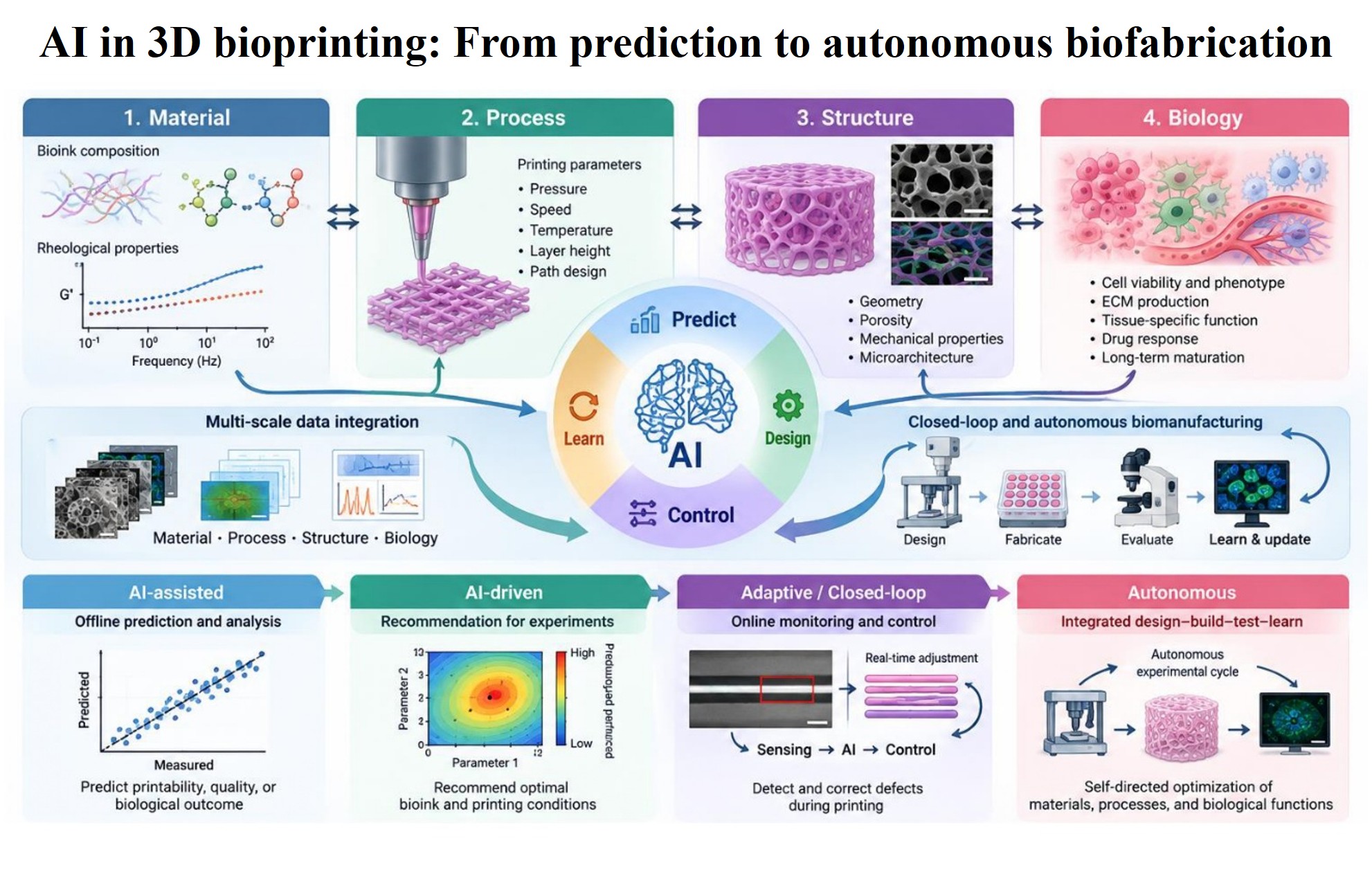
Artificial intelligence in 3D bioprinting: From predictive modeling to autonomous biofabrication

Three-dimensional bioprinting is shifting from empirically tuned fabrication toward workflows that integrate quantitative data on materials, printing, structure, and biology. This review summarizes how artificial intelligence (AI) and machine learning are being used across these areas, with particular attention to studies that include experimental validation. We first discuss conventional measurements such as rheology, filament formation, shape fidelity, and biological assays because these measurements define the inputs and labels used by AI models. We then examine how data from materials, processes, structures, and biology can be linked within the same experiment. Representative studies are compared with respect to the models used, the amount and type of data, validation methods, and whether model outputs were tested in new experiments. Current evidence is strongest for printability prediction, structural quality assessment, and image-based monitoring, while several studies have also demonstrated cell-viability prediction, parameter optimization, transfer learning, Bayesian optimization, and closed-loop correction. We also discuss inverse design, active learning, uncertainty-aware optimization, physics-informed learning, and biological feedback as approaches to reducing the experimental burden. Finally, we use a five-level maturity framework to distinguish AI-assisted analysis, AI-driven recommendations, adaptive control, and autonomous biofabrication. AI is increasingly influencing experimental planning and process control, but fully integrated autonomous workflows remain uncommon. Further progress will depend on validation across materials and platforms, longer-term biological readouts, traceable data, and the reliable integration of experimental feedback.
- Groll J, Boland T, Blunk T, et al. Biofabrication: reappraising the definition of an evolving field. Biofabrication. 2016;8(1):013001. doi: 10.1088/1758-5090/8/1/013001
- Zhang Y, Yue K, Aleman J, et al. 3D bioprinting for tissue and organ fabrication. Ann Biomed Eng. 2017;45(1):148-163. doi: 10.1007/s10439-016-1612-8
- Murphy S, De Coppi P, Atala A. Opportunities and challenges of translational 3D bioprinting. Nat Biomed Eng. 2020;4(4):370-380. doi: 10.1038/s41551-019-0471-7
- Sun W, Starly B, Daly A, et al. The bioprinting roadmap. Biofabrication. 2020;12(2):022002. doi: 10.1088/1758-5090/ab5158
- Schwab A, Levato R, D'Este M, Piluso S, Eglin D, Malda J. Printability and shape fidelity of bioinks in 3D bioprinting. Chem Rev. 2020;120(19):11028-11055. doi: 10.1021/acs.chemrev.0c00084
- Gillispie G, Prim P, Copus J, et al. Assessment methodologies for extrusion-based bioink printability. Biofabrication. 2020;12(2):022003. doi: 10.1088/1758-5090/ab6f0d
- Resende MAA, Rigo ECS, Vercik A. Printability of bioinks: a consolidated definition for additive manufacturing. ACS Omega. 2025;10(48):58110-58122. doi: 10.1021/acsomega.5c00727
- Lee JS, Cha JH, Kim BS. Artificial intelligence in 3D bioprinting and biofabrication: a validation-stringency assessment. Biofabrication. 2026;18(3):032003. doi: 10.1088/1758-5090/ae7b07
- Al-Kharusi G, Dunne NJ, Little S, Levingstone TJ. The role of machine learning and design of experiments in the advancement of biomaterial and tissue engineering research. Bioengineering (Basel). 2022;9(10):561. doi: 10.3390/bioengineering9100561
- Yu C, Jiang J. A perspective on using machine learning in 3D bioprinting. Int J Bioprint. 2020;6(1):253. doi: 10.18063/ijb.v6i1.253
- Sun J, Yao K, An J, Jing L, Huang K, Huang D. Machine learning and 3D bioprinting. Int J Bioprint. 2023;9(4):717. doi: 10.18063/ijb.717
- Freeman S, Calabro S, Williams R, Jin S, Ye K. Bioink formulation and machine learning-empowered bioprinting optimization. Front Bioeng Biotechnol. 2022;10:913579. doi: 10.3389/fbioe.2022.913579
- Ng WL, Goh GL, Goh GD, Ten JSJ, Yeong WY. Progress and opportunities for machine learning in materials and processes of additive manufacturing. Adv Mater. 2024;36(34):e2310006. doi: 10.1002/adma.202310006
- Ning H, Zhou T, Joo SW. Machine learning boosts three-dimensional bioprinting. Int J Bioprint. 2023;9(4):739. doi: 10.18063/ijb.739
- Filippi M, Mekkattu M, Katzschmann RK. Sustainable biofabrication: from bioprinting to AI-driven predictive methods. Trends Biotechnol. 2025;43(2):290-303. doi: 10.1016/j.tibtech.2024.07.002
- Chen H, Zhang B, Huang J. Recent advances and applications of artificial intelligence in 3D bioprinting. Biophys Rev. 2024;5(3):031301. doi: 10.1063/5.0190208
- Bonatti A, Vozzi G, De Maria C. Enhancing quality control in bioprinting through machine learning. Biofabrication. 2024;16(2):022001. doi: 10.1088/1758-5090/ad2189
- Zhou C, Liu C, Liao Z, Pang Y, Sun W. AI for biofabrication. Biofabrication. 2025;17(1):012004. doi: 10.1088/1758-5090/ad8966
- Zhang Z, Zhou X, Fang Y, Xiong Z, Zhang T. AI-driven 3D bioprinting for regenerative medicine: from bench to bedside. Bioact Mater. 2025;45:201-230. doi: 10.1016/j.bioactmat.2024.11.021
- Robazzi J, Derman I, Gupta D, et al. The synergy of artificial intelligence and 3D bioprinting: unlocking new frontiers in precision and tissue fabrication. Adv Funct Mater. 2026;36(1):e09530. doi: 10.1002/adfm.202509530
- Ramesh S, Deep A, Tamayol A, Kamaraj A, Mahajan C, Madihally S. Advancing 3D bioprinting through machine learning and artificial intelligence. Bioprinting. 2024;38:e00331. doi: 10.1016/j.bprint.2024.e00331
- Liu S, Kaur N, Song D, Moses J, Ozbolat I. Self-driving bioprinting laboratories. Biofabrication. 2026;18(1):013001. doi: 10.1088/1758-5090/ae3645
- Naghieh S, Chen X. Printability—a key issue in extrusion-based bioprinting. J Pharm Anal. 2021;11(5):564-579. doi: 10.1016/j.jpha.2021.02.001
- Paxton N, Smolan W, Böck T, Melchels F, Groll J, Jungst T. Proposal to assess printability of bioinks for extrusion-based bioprinting and evaluation of rheological properties governing bioprintability. Biofabrication. 2017;9(4):044107. doi: 10.1088/1758-5090/aa8dd8
- Theus A, Ning L, Hwang B, et al. Bioprintability: physiomechanical and biological requirements of materials for 3D bioprinting processes. Polymers (Basel). 2020;12(10):2262. doi: 10.3390/polym12102262
- Strauß S, Grijalva Garces D, Hubbuch J. Analytics in extrusion-based bioprinting: standardized methods improving quantification and comparability of the performance of bioinks. Polymers (Basel). 2023;15(8):1829. doi: 10.3390/polym15081829
- Ribeiro A, Blokzijl M, Levato R, et al. Assessing bioink shape fidelity to aid material development in 3D bioprinting. Biofabrication. 2018;10(1):014102. doi: 10.1088/1758-5090/aa90e2
- Ouyang L, Yao R, Zhao Y, Sun W. Effect of bioink properties on printability and cell viability for 3D bioplotting of embryonic stem cells. Biofabrication. 2016;8(3):035020. doi: 10.1088/1758-5090/8/3/035020
- Gillispie GJ, Han A, Uzun-Per M, et al. The influence of printing parameters and cell density on bioink printing outcomes. Tissue Eng Part A. 2020;26(23-24):1349-1358. doi: 10.1089/ten.TEA.2020.0210
- Malekpour A, Chen X. Printability and cell viability in extrusion-based bioprinting from experimental, computational, and machine learning views. J Funct Biomater. 2022;13(2):40. doi: 10.3390/jfb13020040
- Derman I, Kim M, Dogan Sarikaya M. Unconventional bioprinting modalities for advanced tissue biofabrication. Biomaterials. 2026;326:123704. doi: 10.1016/j.biomaterials.2025.123704
- Cui X, Li J, Hartanto Y. Advances in extrusion 3D bioprinting: a focus on multicomponent hydrogel-based bioinks. Adv Healthc Mater. 2020;9(15):e1901648. doi: 10.1002/adhm.201901648
- Hinton T, Jallerat Q, Palchesko R, et al. Three-dimensional printing of complex biological structures by freeform reversible embedding of suspended hydrogels. Sci Adv. 2015;1(9):e1500758. doi: 10.1126/sciadv.1500758
- Kolesky D, Truby R, Gladman A, Busbee T, Homan K, Lewis J. 3D bioprinting of vascularized, heterogeneous cell-laden tissue constructs. Adv Mater. 2014;26(19):3124-3130. doi: 10.1002/adma.201305506
- Michel R, Auzély-Velty R. Hydrogel-colloid composite bioinks for targeted tissue-printing. Biomacromolecules. 2020;21(8):2949-2965. doi: 10.1021/acs.biomac.0c00305
- Vrana N, Gupta S, Mitra K. From 3D printing to 3D bioprinting: the material properties of polymeric material and its derived bioink for achieving tissue specific architectures. Cell Tissue Bank. 2022;23(3):417-440. doi: 10.1007/s10561-021-09975-z
- Papaioannou T, Manolesou D, Dimakakos E, Tsoucalas G, Vavuranakis M, Tousoulis D. 3D bioprinting methods and techniques: applications on artificial blood vessel fabrication. Acta Cardiol Sin. 2019;35(3):284-289. doi: 10.6515/ACS.201905_35(3).20181115A
- Li X, Zheng F, Wang X. Biomaterial inks for extrusion-based 3D bioprinting: property, classification, modification, and selection. Int J Bioprint. 2023;9(2):649. doi: 10.18063/ijb.v9i2.649
- García-Villén F, Ruiz-Alonso S, Lafuente-Merchan M. Clay minerals as bioink ingredients for 3D printing and 3D bioprinting: application in tissue engineering and regenerative medicine. Pharmaceutics. 2021;13(11):1806. doi: 10.3390/pharmaceutics13111806
- Lee S, Gillispie G, Prim P, Lee S. Physical and chemical factors influencing the printability of hydrogel-based extrusion bioinks. Chem Rev. 2020;120(19):10834-10886. doi: 10.1021/acs.chemrev.0c00015
- Hölzl K, Lin S, Tytgat L, Van Vlierberghe S, Gu L, Ovsianikov A. Bioink properties before, during and after 3D bioprinting. Biofabrication. 2016;8(3):032002. doi: 10.1088/1758-5090/8/3/032002
- Cooke M, Rosenzweig D. The rheology of direct and suspended extrusion bioprinting. APL Bioeng. 2021;5(1):011502. doi: 10.1063/5.0031475
- Lan X, Adesida A, Boluk Y. Rheological and viscoelastic properties of collagens and their role in bioprinting by micro-extrusion. Biomed Mater. 2022;17(6):062005. doi: 10.1088/1748-605X/ac9b06
- Amorim P, d'Ávila M, Anand R, Moldenaers P, Van Puyvelde P, Bloemen V. Insights on shear rheology of inks for extrusion-based 3D bioprinting. Bioprinting. 2021;22:e00129. doi: 10.1016/j.bprint.2021.e00129
- Ouyang L. Pushing the rheological and mechanical boundaries of extrusion-based 3D bioprinting. Trends Biotechnol. 2022;40(7):891-902. doi: 10.1016/j.tibtech.2022.01.001
- Das S, Jegadeesan J, Basu B. Gelatin methacryloyl (GelMA)-based biomaterial inks: process science for 3D/4D printing and current status. Biomacromolecules. 2024;25(4):2156-2221. doi: 10.1021/acs.biomac.3c01271
- Elango J, Zamora-Ledezma C. Rheological, structural, and biological trade-offs in bioink design for 3D bioprinting. Gels. 2025;11(8):659. doi: 10.3390/gels11080659
- Gao T, Gillispie G, Copus J, et al. Optimization of gelatin-alginate composite bioink printability using rheological parameters: a systematic approach. Biofabrication. 2018;10(3):034106. doi: 10.1088/1758-5090/aacdc7
- da Silva V, Yu B, Willerth S. Early-stage material properties as predictors of neural bioink performance during extrusion 3D bioprinting. Biofabrication. 2026;18(2):025002. doi: 10.1088/1758-5090/ae46e2
- Sarah R, Rohauer R, Schimmelpfennig K, Limon S, Lewis C, Habib A. Data-driven optimization of bioink formulations for extrusion-based bioprinting: a predictive modeling approach. J Manuf Sci Eng. 2025;147(10):101001. doi: 10.1115/1.4069041
- Chen XB, Anvari-Yazdi AF, Duan X, et al. Biomaterials/bioinks and extrusion bioprinting. Bioact Mater. 2023;28:511-536. doi: 10.1016/j.bioactmat.2023.06.006
- Gharraei R, Bergstrom D, Chen X. Extrusion bioprinting from a fluid mechanics perspective. Int J Bioprint. 2024;10(6):3973. doi: 10.36922/ijb.3973
- Reina-Romo E, Mandal S, Amorim P, Bloemen V, Ferraris E, Geris L. Towards the experimentally-informed in silico nozzle design optimization for extrusion-based bioprinting of shear-thinning hydrogels. Front Bioeng Biotechnol. 2021;9:701778. doi: 10.3389/fbioe.2021.701778
- Kyle S, Jessop Z, Al-Sabah A, Whitaker I. "Printability" of candidate biomaterials for extrusion based 3D printing: state-of-the-art. Adv Healthc Mater. 2017;6(16):e1700264. doi: 10.1002/adhm.201700264
- Fu Z, Naghieh S, Xu C, Wang C, Sun W, Chen X. Printability in extrusion bioprinting. Biofabrication. 2021;13(3):033001. doi: 10.1088/1758-5090/abe7ab
- Stringer C, Wang T, Michaelos M, Pachitariu M. Cellpose: a generalist algorithm for cellular segmentation. Nat Methods. 2021;18(1):100-106. doi: 10.1038/s41592-020-01018-x
- Wang J, Cui Z, Maniruzzaman M. Bioprinting: a focus on improving bioink printability and cell performance based on different process parameters. Int J Pharm. 2023;640:123020. doi: 10.1016/j.ijpharm.2023.123020
- Grijalva Garces D, Strauss S, Gretzinger S. On the reproducibility of extrusion-based bioprinting: round robin study on standardization in the field. Biofabrication. 2024;16(1):015002. doi: 10.1088/1758-5090/acfe3b
- Yu J, Yao D, Wang L, Xu M. Machine learning in predicting and optimizing polymer printability for 3D bioprinting. Polymers (Basel). 2025;17(13):1873. doi: 10.3390/polym17131873
- Conev A, Litsa EE, Perez MR, Diba M, Mikos AG, Kavraki LE. Machine learning-guided three-dimensional printing of tissue engineering scaffolds. Tissue Eng Part A. 2020;26(23-24):1359-1368. doi: 10.1089/ten.tea.2020.0191
- Varoquaux G, Cheplygina V. Machine learning for medical imaging: methodological failures and recommendations for the future. NPJ Digit Med. 2022;5:48. doi: 10.1038/s41746-022-00592-y
- Dabbagh SR, Ozcan O, Tasoglu S. Machine learning-enabled optimization of extrusion-based 3D printing. Methods. 2022;206:27-40. doi: 10.1016/j.ymeth.2022.08.002
- Kapoor S, Narayanan A. Leakage and the reproducibility crisis in machine-learning-based science. Patterns. 2023;4(9):100804. doi: 10.1016/j.patter.2023.100804
- Nadernezhad A, Groll J. Machine learning reveals a general understanding of printability in formulations based on rheology additives. Adv Sci (Weinh). 2022;9(29):2202638. doi: 10.1002/advs.202202638
- Zhang C, Elvitigala K, Sakai S. AI-powered printability evaluation framework for 3D bioprinting using Hausdorff distance metrics. Biofabrication. 2026;18(1):015015. doi: 10.1088/1758-5090/ae288c
- Lee J, Oh SJ, An SH, Kim WD, Kim SH. Machine learning-based design strategy for 3D printable bioink: elastic modulus and yield stress determine printability. Biofabrication. 2020;12(3):035018. doi: 10.1088/1758-5090/ab8707
- Ruberu K, Senadeera M, Rana S, et al. Coupling machine learning with 3D bioprinting to fast track optimisation of extrusion printing. Appl Mater Today. 2021;22:100914. doi: 10.1016/j.apmt.2020.100914
- Fu Z, Angeline V, Sun W. Evaluation of printing parameters on 3D extrusion printing of Pluronic hydrogels and machine learning guided parameter recommendation. Int J Bioprint. 2021;7(4):179-189. doi: 10.18063/ijb.v7i4.434
- Zanderigo G, Afghah F, Colosimo BM, Raman R. Modular and AI-driven in situ monitoring platform for real-time process analysis in embedded bioprinting. Device. 2025;3(11):100927. doi: 10.1016/j.device.2025.100927
- Oh D, Shirzad M, Kim M, Chung E, Nam S. Rheology-informed hierarchical machine learning model for the prediction of printing resolution in extrusion-based bioprinting. Int J Bioprint. 2023;9(6):1280. doi: 10.36922/ijb.1280
- Chen H, Liu Y, Balabani S, Hirayama R, Huang J. Machine learning in predicting printable biomaterial formulations for direct ink writing. Research (Wash D C). 2023;6:0197. doi: 10.34133/research.0197
- Rafieyan S, Ansari E, Vasheghani-Farahani E. A practical machine learning approach for predicting the quality of 3D (bio)printed scaffolds. Biofabrication. 2024;16(4):045014. doi: 10.1088/1758-5090/ad6374
- Yao K, Sun J, Huang K, et al. Analyzing cell-scaffold interaction through unsupervised 3D nuclei segmentation. Int J Bioprint. 2022;8(1):495. doi: 10.18063/ijb.v8i1.495
- Balters L, Reichl S. A design of experiment to evaluate the printability for bioprinting by using deep learning image similarity. J Biomed Mater Res A. 2025;113(7):e37961. doi: 10.1002/jbm.a.37961
- Qavi I, Halder S, Tan G. Optimization of printability of bioinks with multi-response optimization and artificial neural networks. Prog Addit Manuf. 2025;10(5):3573-3598. doi: 10.1007/s40964-024-00828-1
- Bediaga-Bañeres H, Moreno-Benítez I, Arrasate S. Artificial intelligence-driven modeling for hydrogel three-dimensional printing: computational and experimental cases of study. Polymers (Basel). 2025;17(1):121. doi: 10.3390/polym17010121
- Sarah R, Schimmelpfennig K, Rohauer R, Lewis C, Limon S, Habib A. Characterization and machine learning-driven property prediction of a novel hybrid hydrogel bioink considering extrusion-based 3D bioprinting. Gels. 2025;11(1):45. doi: 10.3390/gels11010045
- Zhang D, Huerta-López C, Heilshorn S. Organoid bioprinting to pattern the matrix microenvironment. Curr Opin Biomed Eng. 2025;35:100607. doi: 10.1016/j.cobme.2025.100607
- Kang D, Park J, Kim W, et al. All-inkjet-printed 3D alveolar barrier model with physiologically relevant microarchitecture. Adv Sci (Weinh). 2021;8(10):2004990. doi: 10.1002/advs.202004990
- Zhang X, Zhao G, Ma T, Simmons C, Santerre J. A critical review on advances and challenges of bioprinted cardiac patches. Acta Biomater. 2024;189:1-24. doi: 10.1016/j.actbio.2024.09.056
- Revokatova D, Bikmulina P, Heydari Z, et al. Getting blood out of a stone: vascularization via spheroids and organoids in 3D bioprinting. Cells. 2025;14(9):665. doi: 10.3390/cells14090665
- Kupfer ME, Lin WH, Ravikumar V, et al. In situ expansion, differentiation, and electromechanical coupling of human cardiac muscle in a 3D bioprinted, chambered organoid. Circ Res. 2020;127(2):207-224. doi: 10.1161/CIRCRESAHA.119.316155
- Hwang H, Liu R, Maxwell JT, Yang J, Xu C. Machine learning identifies abnormal Ca2+ transients in human induced pluripotent stem cell-derived cardiomyocytes. Sci Rep. 2020;10:16977. doi: 10.1038/s41598-020-73801-x
- Huang M, Christakopoulos F, Roth J, Heilshorn S. Organoid bioprinting: from cells to functional tissues. Nat Rev Bioeng. 2025;3(2):126-142. doi: 10.1038/s44222-024-00268-0
- Ho YH, Liao Y, Liao L, Mao T, Guan Y, Xu R. Advances of cell printing technology in organoid engineering. Tissue Eng Part B Rev. 2026;32(5):348-358. doi: 10.1089/ten.TEB.2025.0048
- Li Z, Chen L, Wu J. A review of 3D bioprinting for organoids. Med Rev (2021). 2025;5(4):318-338. doi: 10.1515/mr-2024-0089
- Bone J, Childs C, Menon A. Hierarchical machine learning for high-fidelity 3D printed biopolymers. ACS Biomater Sci Eng. 2020;6(12):7021-7031. doi: 10.1021/acsbiomaterials.0c00755
- Bonatti A, Vozzi G, Chua C, De Maria C. A deep learning quality control loop of the extrusion-based bioprinting process. Int J Bioprint. 2022;8(4):620. doi: 10.18063/ijb.v8i4.620
- Jin Z, Zhang Z, Shao X, Gu G. Monitoring anomalies in 3D bioprinting with deep neural networks. ACS Biomater Sci Eng. 2023;9(7):3945-3952. doi: 10.1021/acsbiomaterials.0c01761
- Tian S, Stevens R, McInnes B, Lewinski N. Machine assisted experimentation of extrusion-based bioprinting systems. Micromachines (Basel). 2021;12(7):780. doi: 10.3390/mi12070780
- Kelly D, Sergis V, Ventura i Blanco L, Mason K, Daly AC. Autonomous control of extrusion bioprinting using convolutional neural networks. Adv Funct Mater. 2025;35(30):2424553. doi: 10.1002/adfm.202424553
- Usseglio N, González Santos A, Fernández Ferrer A, Flores J, Nieto D. High-fidelity "top-down" DLP bioprinting of multi-material soft tissue constructs enabled by computer vision-based layer control. Biofabrication. 2026;18(2):025013. doi: 10.1088/1758-5090/ae55cc
- Arduengo J, Hascoët N, Chinesta F, Hascoet J. Closed-loop control of extrusion-based bioprinting through real-time computer vision. J Mach Eng. 2025;25(2):28-42. doi: 10.36897/jme/205422
- Brion DAJ, Pattinson SW. Generalisable 3D printing error detection and correction via multi-head neural networks. Nat Commun. 2022;13:4654. doi: 10.1038/s41467-022-31985-y
- Zhang C, Elvitigala KCML, Mubarok W, Okano Y, Sakai S. Machine learning-based prediction and optimisation framework for as-extruded cell viability in extrusion-based 3D bioprinting. Virtual Phys Prototyp. 2024;19(1):e2400330. doi: 10.1080/17452759.2024.2400330
- Mohammadrezaei D, Podina L, De Silva J, Kohandel M. Cell viability prediction and optimization in extrusion-based bioprinting via neural network-based Bayesian optimization models. Biofabrication. 2024;16(2):025016. doi: 10.1088/1758-5090/ad17cf
- Xu H, Liu Q, Casillas J, et al. Prediction of cell viability in dynamic optical projection stereolithography-based bioprinting using machine learning. J Intell Manuf. 2022;33(4):995-1005. doi: 10.1007/s10845-020-01708-5
- Guan J, Sun Y, Yao E, et al. Machine learning-assisted stiffness prediction in high-cell-density bioprinting. Bio-Des Manuf. 2025;8(4):543-557. doi: 10.1631/bdm.2400454
- Kiratitanaporn W, Guan J, Berry D, Lao A, Chen S. Multimodal three-dimensional printing for micro-modulation of scaffold stiffness through machine learning. Tissue Eng Part A. 2024;30(11-12):280-292. doi: 10.1089/ten.tea.2023.0193
- Kiratitanaporn W, Guan J, Tang M. 3D printing of a biomimetic myotendinous junction assisted by artificial intelligence. Biomater Sci. 2024;12(23):6047-6062. doi: 10.1039/d4bm00892h
- Guan J, You S, Xiang Y, et al. Compensating the cell-induced light scattering effect in light-based bioprinting using deep learning. Biofabrication. 2022;14(1):015011. doi: 10.1088/1758-5090/ac3b92
- Tang M, Jiang S, Huang X, et al. Integration of 3D bioprinting and multi-algorithm machine learning identified glioma susceptibilities and microenvironment characteristics. Cell Discov. 2024;10:39. doi: 10.1038/s41421-024-00650-7
- Bracco F, Zanderigo G, Paynabar K, Colosimo B. Leveraging transfer learning for efficient bioprinting. Biofabrication. 2025;17(3):035022. doi: 10.1088/1758-5090/ade62f
- Shin J, Kang R, Hyun K, et al. Machine learning-enhanced optimization for high-throughput precision in cellular droplet bioprinting. Adv Sci (Weinh). 2025;12(20):e2412831. doi: 10.1002/advs.202412831
- Tröndle K, Miotto G, Rizzo L, et al. Deep learning-assisted nephrotoxicity testing with bioprinted renal spheroids. Int J Bioprint. 2022;8(2):528. doi: 10.18063/ijb.v8i2.528
- Madika B, Saha A, Kang C, et al. Artificial intelligence for materials discovery, development, and optimization. ACS Nano. 2025;19(30):27116-27158. doi: 10.1021/acsnano.5c04200
- Liu W, Zhang Y, Lyu Y, Bosiakov S, Liu Y. Inverse design of anisotropic bone scaffold based on machine learning and regenerative genetic algorithm. Front Bioeng Biotechnol. 2023;11:1241151. doi: 10.3389/fbioe.2023.1241151
- Peng B, Wei Y, Qin Y, et al. Machine learning-enabled constrained multi-objective design of architected materials. Nat Commun. 2023;14:6630. doi: 10.1038/s41467-023-42415-y
- Verheyen C, Uzel S, Kurum A, Roche E, Lewis J. Integrated data-driven modeling and experimental optimization of granular hydrogel matrices. Matter. 2023;6(3):1015-1036. doi: 10.1016/j.matt.2023.01.011
- Xu Y, Sarah R, Habib A, Liu Y, Khoda B. Constraint based Bayesian optimization of bioink precursor: a machine learning framework. Biofabrication. 2024;16(4):045031. doi: 10.1088/1758-5090/ad716e
- Breiman L. Random forests. Mach Learn. 2001;45:5-32. doi: 10.1023/A:1010933404324
- Cortes C, Vapnik V. Support-vector networks. Mach Learn. 1995;20(3):273-297. doi: 10.1023/A:1022627411411
- Snoek J, Larochelle H, Adams R. Practical Bayesian optimization of machine learning algorithms. In: Pereira F, Burgers CJ, Bottou L, Weinberger K, eds. Advances in Neural Information Processing Systems 25 (NIPS 2012). Red Hook, NY: Neural Information Processing Systems Foundation, Inc.; 2012.
- Lookman T, Balachandran P, Xue D, Yuan R. Active learning in materials science with emphasis on adaptive sampling using uncertainties for targeted design. NPJ Comput Mater. 2019;5:21. doi: 10.1038/s41524-019-0153-8
- Karniadakis G, Kevrekidis I, Lu L, Perdikaris P, Wang S, Yang L. Physics-informed machine learning. Nat Rev Phys. 2021;3(6):422-440. doi: 10.1038/s42254-021-00314-5
- Shi J, Song J, Song B, Lu WF. Multi-objective optimization design through machine learning for drop-on-demand bioprinting. Engineering. 2019;5(3):586-593. doi: 10.1016/j.eng.2018.12.009
- Shi J, Wu B, Song J, Li S, Trau D, Lu W. Learning-based cell injection control for precise drop-on-demand cell printing. Ann Biomed Eng. 2018;46(9):1267-1279. doi: 10.1007/s10439-018-2054-2
- Piotrowska U, Tsoi J, Singh P, Banerjee A, Sobczak M. 3D bioprinting and artificial intelligence for tumor microenvironment modeling: a scoping review of models, methods, and integration pathways. Mol Pharm. 2025;22(10):5801-5823. doi: 10.1021/acs.molpharmaceut.5c01062
- Babaei M, Shamouil A, Wang J, et al. Automated cell properties toolbox from 3D bioprinted hydrogel scaffolds via deep learning and optical coherence tomography. Biomed Opt Express. 2025;16(5):2061-2076. doi: 10.1364/BOE.550401
- Kassis T, Hernandez-Gordillo V, Langer R, Griffith L. OrgaQuant: human intestinal organoid localization and quantification using deep convolutional neural networks. Sci Rep. 2019;9:12479. doi: 10.1038/s41598-019-48874-y
- Bian X, Li G, Wang C. A deep learning model for detection and tracking in high-throughput images of organoid. Comput Biol Med. 2021;134:104490. doi: 10.1016/j.compbiomed.2021.104490
- Beghin A, Grenci G, Sahni G. Automated high-speed 3D imaging of organoid cultures with multi-scale phenotypic quantification. Nat Methods. 2022;19(7):881-892. doi: 10.1038/s41592-022-01508-0
- Matthews J, Schuster B, Kashaf S. OrganoID: a versatile deep learning platform for tracking and analysis of single-organoid dynamics. PLoS Comput Biol. 2022;18(11):e1010584. doi: 10.1371/journal.pcbi.1010584
- Branco F, Cunha J, Mendes M, Sousa J, Vitorino C. 3D bioprinting models for glioblastoma: from scaffold design to therapeutic application. Adv Mater. 2025;37(18):e2501994. doi: 10.1002/adma.202501994
- Tang M, Xie Q, Gimple RC, et al. Three-dimensional bioprinted glioblastoma microenvironments model cellular dependencies and immune interactions. Cell Res. 2020;30(10):833-853. doi: 10.1038/s41422-020-0338-1
- Tan S, Ding Y, Wang W. Development of an AI model for DILI-level prediction using liver organoid brightfield images. Commun Biol. 2025;8:886. doi: 10.1038/s42003-025-08205-6
- Zhang C, Meyer S, O'Meara M. A human liver organoid screening platform for DILI risk prediction. J Hepatol. 2023;78(5):998-1006. doi: 10.1016/j.jhep.2023.01.019
- Li Z, Li K, Zhang C. Bioprinted organoids: an innovative engine in biomedicine. Adv Sci (Weinh). 2025;12(33):e07317. doi: 10.1002/advs.202507317
- Tobias A, Wahab A. Autonomous "self-driving" laboratories: a review of technology and policy implications. R Soc Open Sci. 2025;12(7):250646. doi: 10.1098/rsos.250646
- Tom G, Schmid SP, Baird SG, et al. Self-driving laboratories for chemistry and materials science. Chem Rev. 2024;124(16):9633-9732. doi: 10.1021/acs.chemrev.4c00055
- Coley C, Eyke N, Jensen K. Autonomous discovery in the chemical sciences part I: progress. Angew Chem Int Ed Engl. 2020;59(51):22858-22893. doi: 10.1002/anie.201909987
- Abolhasani M, Kumacheva E. The rise of self-driving labs in chemical and materials sciences. Nat Synth. 2023;2(6):483-492. doi: 10.1038/s44160-022-00231-0
- An J, Chua C, Mironov V. Application of machine learning in 3D bioprinting: focus on development of big data and digital twin. Int J Bioprint. 2021;7(1):342. doi: 10.18063/ijb.v7i1.342
- Yu S, Luo Y, Chen S, Fan J, Zhang H. Quantitative assessment of hydrogel printability in extrusion bioprinting. Gels. 2026;12(3):189. doi: 10.3390/gels12030189
- Lookman T, Liu Y, Gao Z. Materials informatics: emergence to autonomous discovery in the age of AI. Adv Mater. 2026;38(29):e15941. doi: 10.1002/adma.202515941
- Formica FA, Wu E, Brey L, et al. Bridging innovation and efficiency: the promises and challenges of self-driving labs as sustainable drivers for chemistry. Chimia (Aarau). 2025;79(9):600-605. doi: 10.2533/chimia.2025.600
- Lee H, Yoo HJ, Jang HS, Park B, Park YJ, Han SS. Toward self-driving laboratory 2.0 for chemistry and materials discovery. Mater Horiz. 2026;13:4712-4739. doi: 10.1039/d5mh01984b
- Szymanski NJ, Zeng Y, Huo H, Bartel CJ, Kim H, Ceder G. Toward autonomous design and synthesis of novel inorganic materials. Mater Horiz. 2021;8(8):2169-2198. doi: 10.1039/d1mh00495f