
Intelligent bioprinting of biomimetic hemostatic constructs: From bioink design and programmable fabrication to preclinical validation for non-compressible hemorrhage

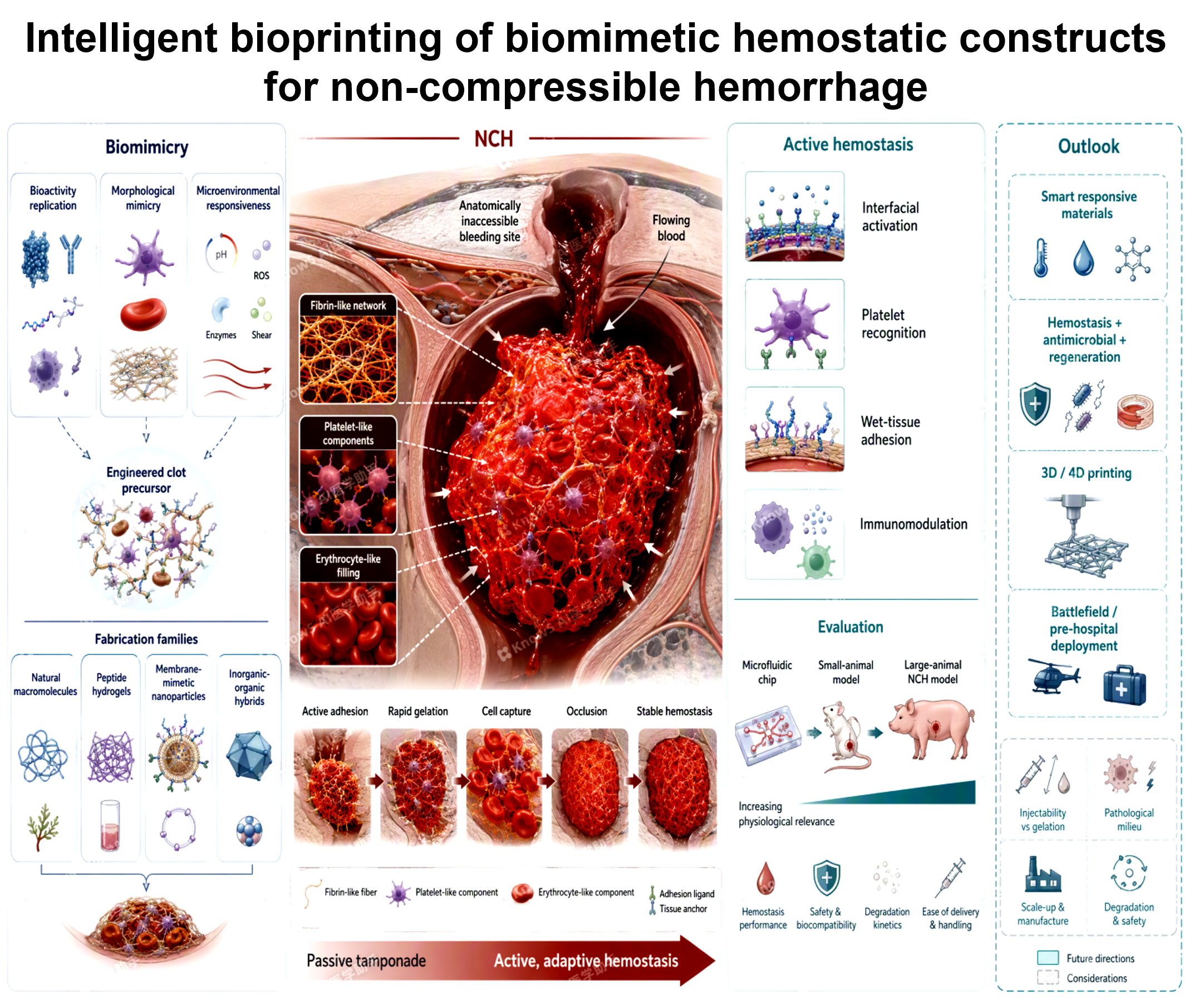
Non-compressible hemorrhage (NCH) remains a leading cause of preventable trauma mortality because conventional gauze and oxidized cellulose act as passive barriers, whereas fibrin sealants depend on patient-derived fibrinogen; neither is reliable in coagulopathic patients. Recent convergence of bioink engineering, 3D/4D bioprinting, and artificial intelligence (AI)-assisted material design enables the fabrication of biomimetic hemostatic constructs with programmable composition, multiscale architecture, and dynamic responsiveness. This review critically examines how intelligent bioprinting—integrating stimuli-responsive bioinks, multi-axis extrusion/digital light processing printing, and AI-guided bioink optimization—fundamentally differs from conventional biomaterial fabrication in recapitulating the structural mechanics of natural thrombi. We first analyze the structure–function relationships of native fibrin/platelet/red blood cell networks that should be mimicked by bioprinted constructs. We then systematically compare bioink formulations (natural biopolymers, synthetic peptides, cell-membrane-coated nano-vectors, and inorganic–organic composites) across four bioprinting-relevant dimensions: printability, post-printing bioactivity, wet-tissue adhesion strength, and burst pressure. We further evaluate cross-tier preclinical validation, including microfluidic thrombosis-on-chip, small-animal models, and lethal large-animal NCH models (porcine liver/spleen/junctional injury), with explicit differentiation from rodent wound-healing studies. Finally, we identify translational bottlenecks (rheological paradox, Good Manufacturing Practice scale-up, regulatory pathways) and articulate future directions: AI-guided bioink discovery, organ-on-chip patient-specific screening, and deployable 4D-printed hemostats. By bridging biomimetic design, programmable fabrication, and quantitative translational evaluation, intelligent bioprinting offers a manufacturable and clinically translatable route to next-generation NCH therapeutics.
- Montazerian H, Davoodi E, Baidya A, et al. Engineered Hemostatic Biomaterials for Sealing Wounds. Chem Rev. 2022; 122(15):12864-12903. doi: 10.1021/acs.chemrev.1c01015
- Tucker LJ, Hilmas K, Brown AC. Structure-based design of therapeutics to control hemostasis. Blood. 2025;146(12):1431-1439. doi: 10.1182/blood.2024025323
- Dong R, Zhang H, Guo B. Emerging hemostatic materials for non-compressible hemorrhage control. Natl Sci Rev. 2022;9(11):nwac162. doi: 10.1093/nsr/nwac162
- Hong C, Olsen BD, Hammond PT. A review of treatments for non-compressible torso hemorrhage (NCTH) and internal bleeding. Biomaterials. 2022;283:121432. doi: 10.1016/j.biomaterials.2022.121432
- Liu Z, Xu J, Wang X. Bioactive hemostatic materials: a new strategy for promoting wound healing and tissue regeneration. MedComm (2020). 2025;6(4):e70113. doi: 10.1002/mco2.70113
- Zou CY, Han C, Xing F, et al. Smart design in biopolymer-based hemostatic sponges: From hemostasis to multiple functions. Bioact Mater. 2025;45:459-478. doi: 10.1016/j.bioactmat.2024.11.034
- Wang L, Hao F, Tian S, Dong H, Nie J, Ma G. Targeting polysaccharides such as chitosan, cellulose, alginate and starch for designing hemostatic dressings. Carbohydr Polym. 2022;291:119574. doi: 10.1016/j.carbpol.2022.119574
- Guo Y, Wang M, Liu Q, Liu G, Wang S, Li J. Recent advances in the medical applications of hemostatic materials. Theranostics. 2023;13(1):161-196. doi: 10.7150/thno.79639
- Jarrassier A, Boutonnet M, Duranteau J, et al. Initial management of haemorrhagic war casualties: tactical priorities and innovative approaches in modern and future warfare. Crit Care. 2025;29(1):509. doi: 10.1186/s13054-025-05752-6
- Simpson A, Shukla A, Brown AC. Biomaterials for Hemostasis. Annu Rev Biomed Eng. 2022;24:111-135. doi: 10.1146/annurev-bioeng-012521-101942
- Zhou M, Lin X, Wang L, Yang C, Yu Y, Zhang Q. Preparation and Application of Hemostatic Hydrogels. Small. 2024;20(22):e2309485. doi: 10.1002/smll.202309485
- CRASH-2 collaborators, Roberts I, Shakur H, et al. Effects of tranexamic acid on death, vascular occlusive events, and blood transfusion in trauma patients (CRASH-2): a randomised, placebo-controlled trial. Lancet. 2010;376(9734):23-32.
- CRASH-2 collaborators. The importance of early treatment with tranexamic acid in bleeding trauma patients: an exploratory analysis of the CRASH-2 randomised controlled trial. Lancet. 2011;377(9771):1096-1101.
- Zhang Z, Lin Z, Yu C, et al. Chitosan/oxidized cellulose composite nanofiber sponges: a rapid and effective hemostasis strategy for non-compressible hemorrhage. Carbohydr Polym. 2025;361:123655. doi: 10.1016/j.carbpol.2025.123655
- Jiang T, Chen S, Xu J, et al. Superporous sponge prepared by secondary network compaction with enhanced permeability and mechanical properties for non-compressible hemostasis in pigs. Nat Commun. 2024;15(1):5460. doi: 10.1038/s41467-024-49578-2
- Zhang K, Yang H, Sun T, et al. One-step prepared janus cryogel enables the separation of blood cells and plasma for whole-process hemostasis and accelerated infected wound healing. Biomaterials. 2026;334:124309. doi: 10.1016/j.biomaterials.2026.124309
- Jiang S, Bao G, Yang Z, et al. Engineering tough blood clots for rapid haemostasis and enhanced regeneration. Nature. 2026;653(8115):723-730. doi: 10.1038/s41586-026-10412-y
- Ji W, Dou M, Ma H, et al. Natural coagulation inspired RBCs-structural inheritance microgels hybrid featured with quasi-bicontinuous structure for junctional hemostasis. Biomaterials. 2026;325:123593. doi: 10.1016/j.biomaterials.2025.123593
- Ji M, Yuan Z, Ju F, et al. Advances in hemostatic biomaterials: biomimetic strategies, nanotechnology, and smart therapeutics. Burns Trauma. 2026;14:tkag023. doi: 10.1093/burnst/tkag023
- Feng Y, Zhang Z, Yan W, et al. A Sprayable Hydrogel Based on Biomimetic Polypeptide-Modified Lipid Nanoparticles for Treating Non-Compressible Hemorrhaging. Adv Mater. 2025;37(27):e2500908. doi: 10.1002/adma.202500908
- Shuai Y, Qian Y, Zheng M, et al. Injectable platelet-mimicking silk protein-peptide conjugate microspheres for hemostasis modulation and targeted treatment of internal bleeding. J Nanobiotechnology. 2025;23(1):128. doi: 10.1186/s12951-025-03180-w
- Ye R, Zhu Z, Gu T, et al. Neutrophil extracellular traps-inspired DNA hydrogel for wound hemostatic adjuvant. Nat Commun. 2024;15(1):5557. doi: 10.1038/s41467-024-49933-3
- Li Z, Wang L, Zheng Z, et al. Directional Pore Size-Mediated Blood Hydrodynamics Govern Hemostasis in Cellulose Sponges. Small. 2025;21(38):e06109. doi: 10.1002/smll.202506109
- Pan Z, Li M, Zhang C, et al. Bubble Evolution-Guided Interconnected Hierarchical Macroporous Sponges for Non-Compressible Hemostasis in Preclinical Models. Adv Mater. 2026;38(13):e72296. doi: 10.1002/adma.72296
- Cai B, Fan Y, Yang S, Che C, Li X, Wang X. A highly compressible and expandable cellulose sponge with arch-like lamellar structures for non-compressible hemorrhage. Carbohydr Polym. 2025;353:123255. doi: 10.1016/j.carbpol.2025.123255
- Xiang D, Wang K, Wang F, et al. Coagulopathy-independent injectable catechol-functionalized chitosan shape-memory material to treat non-compressible hemorrhage. Carbohydr Polym. 2024;346:122648. doi: 10.1016/j.carbpol.2024.122648
- Cai M, Huang L, Lv S, Jiang X. Synthesis and characterization of thermosensitive 2-hydroxypropyl-trimethylammonium chitin and its antibacterial sponge for noncompressible hemostasis and tissue regeneration. Carbohydr Polym. 2024;331:121879. doi: 10.1016/j.carbpol.2024.121879
- Liu Y, Huang T, Yap NA, Lim K, Ju LA. Harnessing the power of bioprinting for the development of next-generation models of thrombosis. Bioact Mater. 2024;42:328-344. doi: 10.1016/j.bioactmat.2024.08.040
- Gu B, Jiang K, Wu T, et al. Mechanics, Fracture, and Fragmentation of Thrombi: A Computational Study Review. Acta Biomaterialia. 2026;222:28-66. doi: 10.1016/j.actbio.2026.07.044
- Weisel JW, Litvinov RI. Exploring the thrombus niche: lessons learned and potential therapeutic opportunities. Blood. 2025;146(12):1389-1399. doi: 10.1182/blood.2024025319
- Luyendyk JP, Flick MJ, Wolberg AS. Factor XIII: driving (cross-)links in hemostasis, thrombosis, and disease. Blood. 2025;146(12):1412-1421. doi: 10.1182/blood.2024025321
- Cai C, Zhang Z, Nameny A, et al. Nonlinear relationships of fibrin network structure as a function of fibrinogen and thrombin concentrations for purified fibrinogen and plasma clots. Acta Biomaterialia. 2026;219:236-248. doi: 10.1016/j.actbio.2026.06.047
- Ferraresso M, Ali-Mohamad N, Cau MF, et al. Contraction of blood clots occurs during hemostasis and hemorrhagic shock to promote closure of lacerations. Biomaterials. 2026;334:124288. doi: 10.1016/j.biomaterials.2026.124288
- Kim OV, Litvinov RI, Gagne AL, French DL, Brass LF, Weisel JW. Megakaryocyte-induced contraction of plasma clots: cellular mechanisms and structural mechanobiology. Blood. 2024;143(6):548-560. doi: 10.1182/blood.2023021545
- Ballard-Kordeliski A, Lee RH, O’Shaughnessy EC, et al. 4D intravital imaging studies identify platelets as the predominant cellular procoagulant surface in a mouse hemostasis model. Blood. 2024;144(10):1116-1126. doi: 10.1182/blood.2023022608
- Domingues MM, Carvalho FA, Santos NC. Nanomechanics of Blood Clot and Thrombus Formation. Annu Rev Biophys. 2022;51:201-221. doi: 10.1146/annurev-biophys-111821-072110
- Vilahur G, Fuster V. Interplay between platelets and coagulation: from protective haemostasis to pathological arterial thrombosis. Eur Heart J. 2025;46(5):413-423. doi: 10.1093/eurheartj/ehae776
- Zakharov A, Awan M, Cheng T, et al. Clots reveal anomalous elastic behavior of fiber networks. Sci Adv. 2024;10(2):eadh1265. doi: 10.1126/sciadv.adh1265
- Liu D, Jia Z, Liu B, Hou J, Bao R, Wang M. Molecular Creep Induced Fatigue Rupture of Fibrin Clots. Adv Sci (Weinh). 2025;12(38):e05109. doi: 10.1002/advs.202505109
- Wang Z, Lauko J, Kijas AW, et al. Snake venom-defined fibrin architecture dictates fibroblast survival and differentiation. Nat Commun. 2023;14(1):1029. doi: 10.1038/s41467-023-36437-9
- Sun Y, Kang S, Heiniger M, et al. Enzyme-Responsive Hemostatic Elastin-like Polypeptides for Fibrin Stabilization and Coagulation Restoration in Thrombocytopenia. J Am Chem Soc. 2026;148(5):5287-5298. doi: 10.1021/jacs.5c18009
- Dan R, Huang Y, Tan S, et al. Bioinspired Smart Nanogels for Rapid Blue Laser-Activated Hemostasis in Gastrointestinal Bleeding. Adv Mater. 2025;37(38):e2506955. doi: 10.1002/adma.202506955
- Wang G, Liu R, Ma H, et al. Elevator-Like Hollow Channels in Porous Scaffolds Accelerate Vascularized Bone Regeneration via NETs-Fibrin-Mediated Macrophage Recruitment. Adv Sci (Weinh). 2026;13(9):e15693. doi: 10.1002/advs.202515693
- Zhang S, He J, Zhang K, et al. Radially Aligned Microchannels in a Hemostatic Sponge: Orchestrating Directional Transport, Active Sieving, and Coagulation. Adv Healthc Mater. 2026;15(25):e71312. doi: 10.1002/adhm.71312
- Fa J, Chen Y, Pan W, et al. Polymeric anti-platelet carriers for the precision-targeting of age-related cardiovascular and cerebrovascular diseases. Mater Today Bio. 2026;37:102920. doi: 10.1016/j.mtbio.2026.102920
- Kim TY, Son K, Moon CH, et al. Quinone-mediated, tissue-adaptive double-network hydrogel for instant hemostasis and wet-tissue adhesion. Nat Commun. 2026;17(1):5526. doi: 10.1038/s41467-026-72068-6
- Han C, Zou CY, Zhang JY, et al. Bio-inspired programmable assembly of shape-memory and blood-reinforced cryogel for hemostasis and functional liver regeneration. Materials Today Bio. 2026;38:103147. doi: 10.1016/j.mtbio.2026.103147
- Wang Y, Okuro K. Mechanotransducing Hydrogel for Switching Enzyme Reactions through Modulation of Multivalent Salt-Bridge Interactions. J Am Chem Soc. 2024;146(24):16737-16742. doi: 10.1021/jacs.4c04344
- Du Z, Huang Y, Ma Q, et al. Mytilus edulis foot protein mimics for tailoring long-acting endothelium-mimicking anti-thrombotic surfaces. Bioact Mater. 2025;50:1-13. doi: 10.1016/j.bioactmat.2025.03.019
- Padilla S, Nurden AT, Prado R, Nurden P, Anitua E. Healing through the lens of immunothrombosis: Biology-inspired, evolution-tailored, and human-engineered biomimetic therapies. Biomaterials. 2021;279:121205. doi: 10.1016/j.biomaterials.2021.121205
- Wang Y, Li X, Li Z, et al. A Shape-Recovery Polycationic Fibroin for Hemostasis-Regeneration Transition by Recapitulating Natural Coagulation Networks. Adv Mater. 2025;37(45):e12265. doi: 10.1002/adma.202512265
- Li X, Zhang G, Wang X, et al. Dual-Network Protein Hydrogels Promote Rapid Hemostasis and Immune-Regulated Scarless Tissue Regeneration. Advd Sci. 2026;13(38):e75324. doi: 10.1002/advs.75324
- Zhang S, Lei X, Lv Y, Wang L, Wang LN. Recent advances of chitosan as a hemostatic material: Hemostatic mechanism, material design and prospective application. Carbohydr Polym. 2024;327:121673. doi: 10.1016/j.carbpol.2023.121673
- Liu Z, Xu Y, Su H, et al. Chitosan-based hemostatic sponges as new generation hemostatic materials for uncontrolled bleeding emergency: Modification, composition, and applications. Carbohydr Polym. 2023;311:120780. doi: 10.1016/j.carbpol.2023.120780
- Du Y, Chen X, Li L, et al. Benzeneboronic-alginate/quaternized chitosan-catechol powder with rapid self-gelation, wet adhesion, biodegradation and antibacterial activity for non-compressible hemorrhage control. Carbohydr Polym. 2023;318:121049. doi: 10.1016/j.carbpol.2023.121049
- Chen XJ, Lei ZY, Liu P, et al. An aminocaproic acid-grafted chitosan derivative with superior antibacterial and hemostatic properties for the prevention of secondary bleeding. Carbohydr Polym. 2023;316:120988. doi: 10.1016/j.carbpol.2023.120988
- Zhang Z, Ma X, Zhang Z, et al. Biomimetic recombinant collagen with multicopy dual-targeted hemostatic motifs for enhanced hemostasis in surgical trauma. Trends Biotechnol. 2026;44(7):1960-1986. doi: 10.1016/j.tibtech.2026.01.017
- Mahmoodzadeh A, Valizadeh N, Edalati M, et al. Robust adhesive nanocomposite sponge composed of citric acid and nano clays modified cellulose for rapid hemostasis of lethal non-compressible hemorrhage. Carbohydr Polym. 2024;326:121614. doi: 10.1016/j.carbpol.2023.121614
- Huang S, Li M, Xu H, et al. Ultra-fast self-gelling self-expanding self-propelling high-adhesion procoagulant hemostatic powder for non-compressible hemorrhage hemostasis in pigs. Nat Commun. 2026;17(1):2146. doi: 10.1038/s41467-026-68683-y
- Lu Q, Tang X, Huang K, et al. Lipoic acid-kaempferol hydrogel loaded with Typhaneoside for sutureless wound closure, hemostasis, and healing of diabetic infected wounds. Mater Today Bio. 2025;35:102504. doi: 10.1016/j.mtbio.2025.102504
- Lin C, Lu TW, Hsu FY, et al. An injectable in situ-forming hydrogel with self-activating genipin-chitosan (GpCS) cross-linking and an O(2)/Ca(2+) self-supplying capability for wound healing and rapid hemostasis. Carbohydr Polym. 2025;351:123051. doi: 10.1016/j.carbpol.2024.123051
- Liu H, Lv Y, Li J, et al. Modular alginate-based hydrogels embedding multilayer nanofibers: A synergistic strategy for hemostasis, antibacterial, and immunomodulatory therapy. Carbohydr Polym. 2026;379:124977. doi: 10.1016/j.carbpol.2026.124977
- Girish A, Jolly K, Alsaadi N, et al. Platelet-Inspired Intravenous Nanomedicine for Injury-Targeted Direct Delivery of Thrombin to Augment Hemostasis in Coagulopathies. ACS Nano. 2022;16(10):16292-16313. doi: 10.1021/acsnano.2c05306
- Sobreiro-Almeida R, Santos SC, Decarli MC, et al. Leveraging Blood Components for 3D Printing Applications Through Programmable Ink Engineering Approaches. Adv Sci (Weinh). 2024; 1(47):e2406569. doi: 10.1002/advs.202406569
- Huang Y, Yu X, Zhang Q, et al. Honeybee-mimicking microenvironment-responsive theranostic nanovesicles for enhanced magnetic resonance imaging and targeted thrombolytic therapy. J Control Release. 2026;391:114630. doi: 10.1016/j.jconrel.2026.114630
- Huangfu Y, Zhao Z, Liu X, et al. An Off-the-Shelf Artificial Blood Clot Hydrogel Neutralizing Multiple Proinflammatory Mediators for Pro-Regenerative Periodontitis Treatment. Adv Sci (Weinh). 2025;12(31):e04106. doi: 10.1002/advs.202504106
- Ghovvati M, Jain S, Cheng GZ, et al. Rapid closure and hemostasis of ruptured soft tissues using a modified human tropoelastin-based sealant in preclinical models. Sci Transl Med. 2025;17(798):eadr6458. doi: 10.1126/scitranslmed.adr6458
- Zhang S, Ding F, Liu Y, Ren X. Glucose-responsive biomimetic nanoreactor in bacterial cellulose hydrogel for antibacterial and hemostatic therapies. Carbohydr Polym. 2022;292:119615. doi: 10.1016/j.carbpol.2022.119615
- Wang Y, Li Y, Liu S, et al. An ultrafast self-gelling powder based on insect chitosan/gelatin/protocatechualdehyde‑gallium ions cross-linked for emergency hemostasis and MRSA-infected wound healing. Carbohydr Polym. 2026;373:124577. doi: 10.1016/j.carbpol.2025.124577
- Yang G, Huang Z, McCarthy A, et al. Super-Elastic Carbonized Mushroom Aerogel for Management of Uncontrolled Hemorrhage. Adv Sci (Weinh). 2023;10(16):e2207347. doi: 10.1002/advs.202207347
- Ponsen AC, Proust R, Soave S, et al. A new hemostatic agent composed of Zn(2+)-enriched Ca(2+) alginate activates vascular endothelial cells in vitro and promotes tissue repair in vivo. Bioact Mater. 2022;18:368-382. doi: 10.1016/j.bioactmat.2022.01.049
- Gillot C, Michaux P, Evrard J, et al. Device-Induced Thrombosis in Blood-Contacting Medical Devices: Mechanisms and Emerging Prevention Strategies. Adv Healthcare Materials. 2026;15(23):e05409. doi: 10.1002/adhm.202505409
- Nellenbach K, Mihalko E, Nandi S, et al. Ultrasoft platelet-like particles stop bleeding in rodent and porcine models of trauma. Sci Transl Med. 2024;16(742):eadi4490. doi: 10.1126/scitranslmed.adi4490
- Fang Y, Lin Y, Wang L, Chen Q, Weng Y, Liu H. Gluing blood into adhesive gel by oppositely charged polysaccharide dry powder inspired by fibrin fibers coagulation mediator. Carbohydr Polym. 2024;333:121998. doi: 10.1016/j.carbpol.2024.121998
- Chen H, Yuan X, Du M, et al. Tough Hydrogels with Robust Wet Adhesion via Entropy-Driven Hydrogen Bond Reorganization. Advanced Materials. 2026;38(31). doi: 10.1002/adma.73182
- Xue B, Gu J, Li L, et al. Hydrogel tapes for fault-tolerant strong wet adhesion. Nat Commun. 2021;12(1):7156. doi: 10.1038/s41467-021-27529-5
- Zheng Y, Shariati K, Ghovvati M, et al. Hemostatic patch with ultra-strengthened mechanical properties for efficient adhesion to wet surfaces. Biomaterials. 2023;301:122240. doi: 10.1016/j.biomaterials.2023.122240
- Zheng Y, Baidya A, Annabi N. Molecular design of an ultra-strong tissue adhesive hydrogel with tunable multifunctionality. Bioact Mater. 2023;29:214-229. doi: 10.1016/j.bioactmat.2023.06.007
- Ren J, Kong R, Wang H, et al. Robust Underwater Adhesion of Catechol-Functionalized Polymer Triggered by Water Exchange. Small Methods. 2023;7(6):e2201235. doi: 10.1002/smtd.202201235
- Kong B, Liu R, Cheng Y, et al. Structural Color Medical Patch with Surface Dual-Properties of Wet Bioadhesion and Slipperiness. Adv Sci (Weinh). 2022;9(31):e2203096. doi: 10.1002/advs.202203096
- Yu Q, Su B, Zhao W, Zhao C. Janus Self-Propelled Chitosan-Based Hydrogel Spheres for Rapid Bleeding Control. Adv Sci (Weinh). 2023;10(5):e2205989. doi: 10.1002/advs.202205989
- Chen Z, Zhao J, Wu H, et al. A triple-network carboxymethyl chitosan-based hydrogel for hemostasis of incompressible bleeding on wet wound surfaces. Carbohydr Polym. 2023;303:120434. doi: 10.1016/j.carbpol.2022.120434
- Yong J., Toh C.H. Rethinking coagulation: from enzymatic cascade and cell-based reactions to a convergent model involving innate immune activation. Blood. 2023;142(25):2133-2145. doi: 10.1182/blood.2023021166
- Su Y, Ju J, Shen C, et al. In situ 3D bioprinted GDMA/Prussian blue nanozyme hydrogel with wet adhesion promotes macrophage phenotype modulation and intestinal defect repair. Materials Today Bio. 2025;31:101636. doi: 10.1016/j.mtbio.2025.101636
- Xie H, Shi G, Wang R, et al. Bioinspired wet adhesive carboxymethyl cellulose-based hydrogel with rapid shape adaptability and antioxidant activity for diabetic wound repair. Carbohydr Polym. 2024;334:122014. doi: 10.1016/j.carbpol.2024.122014
- Zhang Y, Li D, Liu M, et al. An Oral Mucosa-Inspired Wet-Adhesion Janus Hydrogel With Asymmetric Bifunctionalities of Antifouling/Antioxidant for Treating Oral Ulcer in Diabetes. Small. 2026;22(23):e13928. doi: 10.1002/smll.202513928
- Fang R, Yu N, Chen S, Xu X, Zhang J. Hemoadhican-based self-leveling Janus patch for comprehensive prevention of postoperative adhesions. Mater Today Bio. 2025;33:102021. doi: 10.1016/j.mtbio.2025.102021
- Li J, Wu X, Wan Y, et al. Biomimetic interfacial water-regulated hybrid dual-layer hydrogel for wound healing, anti-adhesion and hemostasis post partial hepatectomy. Materials Today Bio. 2026;39:103419. doi: 10.1016/j.mtbio.2026.103419
- Qin R, Guo Y, Ren H, et al. Instant Adhesion of Amyloid-like Nanofilms with Wet Surfaces. ACS Cent Sci. 2022;8(6):705-717.
- Lee S, Yoo S, Deepankumar K, Shebanova A, Miserez A, Hwang DS. Suckerin Colloids and Hydrogels With Low Immunogenicity as Resorbable and Hemostatic Tissue Adhesives for Wound Healing. Small. 2026;22(16):e12461. doi: 10.1002/smll.202512461
- Yue S, Zhang W, Ma Q, Zhang Z, Lu J, Yang Z. Engineering anti-thrombogenic and anti-infective catheters through a stepwise metal-catechol-(amine) surface engineering strategy. Bioact Mater. 2024;42:366-378. doi: 10.1016/j.bioactmat.2024.09.009
- Li S, Han Z, Xu W, et al. Trace-stimuli-triggered controlled degradation for hydrogel adhesives. Natl Sci Rev. 2026;13(1):nwaf498. doi: 10.1093/nsr/nwaf498
- Crilly S, Lomora M. Human in vitro models of neurovasculature and the application to pre-clinical intracerebral haemorrhage research. Bioact Mater. 2026;56:294-315. doi: 10.1016/j.bioactmat.2025.10.018
- Goh T, Gao L, Singh J, et al. Platelet Adhesion and Activation in an ECMO Thrombosis-on-a-Chip Model. Adv Sci (Weinh). 2024;11(30):e2401524. doi: 10.1002/advs.202401524
- Stone TP Jr, Maragos SL, Greenwood JD, et al. Improved localization to sites of hemorrhage via peptide amphiphile nanofibers containing a factor VII-mimetic epitope. Acta Biomaterialia. 2026;221:304-317. doi: 10.1016/j.actbio.2026.07.035
- Yang Y, He G, Pan Z, et al. An Injectable Hydrogel with Ultrahigh Burst Pressure and Innate Antibacterial Activity for Emergency Hemostasis and Wound Repair. Adv Mater. 2024;36(33):e2404811. doi: 10.1002/adma.202404811
- Lei XX, Liu ML, Lu CF, et al. A self-hygroscopic, rapidly self-gelling polysaccharide-based sponge with robust wet adhesion for non-compressible hemorrhage control and infected wounds healing. Bioact Mater. 2025;46:311-330. doi: 10.1016/j.bioactmat.2024.12.016
- Liu X, Hu Y, Liang H, Feng S, Wei Y, Huang D. Aldehyde-mediated carboxymethylcellulose/gelatin-based injectable dual network hydrogel with antimicrobial and adhesion properties for rapid hemostasis and wound repair. Carbohydr Polym. 2026;376:124817. doi: 10.1016/j.carbpol.2025.124817
- Lv S, Cai M, Leng F, Jiang X. Biodegradable carboxymethyl chitin-based hemostatic sponges with high strength and shape memory for non-compressible hemorrhage. Carbohydr Polym. 2022;288:119369. doi: 10.1016/j.carbpol.2022.119369
- Haghniaz R., Kim H.J., Montazerian H., Baidya A., Tavafoghi M., Chen Y., et al. Tissue adhesive hemostatic microneedle arrays for rapid hemorrhage treatment. Bioact Mater. 2023;23:314-327. doi: 10.1016/j.bioactmat.2022.08.017
- Liu Q, Lin J, Liu X, et al. Forced hemostasis via enhanced erythrocyte adhesion: A procyanidin-based composite sponge for managing hemorrhage in coagulopathic conditions. Materials Today Bio. 2026;38:103122. doi: 10.1016/j.mtbio.2026.103122
- Chen Z, Shen J, Zuo B, et al. A self-crosslinking powder based on carboxymethyl chitosan and guar gum with free radical scavenging for rapid hemostasis and promotion of wound healing. Carbohydr Polym. 2026;388:125511. doi: 10.1016/j.carbpol.2026.125511
- Wang J, Yang Y, Xu H, Huang S, Guo B, Hu J. All-in-One: A Multifunctional Composite Biomimetic Cryogel for Coagulation Disorder Hemostasis and Infected Diabetic Wound Healing. Nanomicro Lett. 2025;17(1):171. doi: 10.1007/s40820-024-01603-1
- Hu S, Yang Z, Zhai Q, et al. An All-in-One "4A Hydrogel": through First-Aid Hemostatic, Antibacterial, Antioxidant, and Angiogenic to Promoting Infected Wound Healing. Small. 2023;19(27):e2207437. doi: 10.1002/smll.202207437
- Andrabi SM, Shahriar SMS, Al-Gahmi AM, Wilczewski BL, Carlson MA, Xie J. Injectable and rapidly expandable thrombin-decorated cryogels achieve rapid hemostasis and high survival rates in a swine model of lethal junctional hemorrhage. Bioact Mater. 2024;38:154-168. doi: 10.1016/j.bioactmat.2024.04.024
- Li Y, Xiao D, Yan W, et al. Bioinspired hierarchical porous tough adhesive to promote sealing of high-pressure bleeding. Bioact Mater. 2025;45:88-101. doi: 10.1016/j.bioactmat.2024.11.003
- Zhang X, Wang X, Yuan P, et al. A 3D-Printed Cuttlefish Bone Elastomeric Sponge Rapidly Controlling Noncompressible Hemorrhage. Small. 2024;20(19):e2307041. doi: 10.1002/smll.202307041
- Fang Y, Zhang L, Chen Y, Wu S, Weng Y, Liu H. Polysaccharides based rapid self-crosslinking and wet tissue adhesive hemostatic powders for effective hemostasis. Carbohydr Polym. 2023;312:120819. doi: 10.1016/j.carbpol.2023.120819
- Zou CY, Han C, Xiong M, et al. All-in-one extracellular matrix-based powders with instant self-assembly and multiple bioactivities integrate hemostasis and in-situ tissue functional repair. Bioact Mater. 2025;50:215-231. doi: 10.1016/j.bioactmat.2025.04.005
- Zeng X, Wei QS, Ye JC, et al. A biocompatible gelatin sponge scaffold confers robust tissue remodeling after spinal cord injury in a non-human primate model. Biomaterials. 2023;299:122161. doi: 10.1016/j.biomaterials.2023.122161
- Nepal A, Tran H, Nguyen NT, Ta HT. Emerging haemostatic sprays: From material design to clinical translation. Biomater Adv. 2026;184:214796. doi: 10.1016/j.bioadv.2026.214796
- Yang X, Si X, Pan L, Li X, Ji Z, Shi C. Double-network structure sponge with enhanced mechanical properties, procoagulant potential, and 3D printability for acute hemorrhage. Chem Eng J. 2024;487:150608. doi: 10.1016/j.cej.2024.150608
- Fang J, Wu Z, Fu H, et al. 3D printed porous okara-based sponge with hemostatic and antimicrobial effects for wound healing. ACS Sustain Chem Eng. 2024;12(30):11231-11243. doi: 10.1021/acssuschemeng.4c02407
- Zhou M, Yuan T, Shang L. 3D printing of naturally derived adhesive hemostatic sponge. Research. 2024;7:0446. doi: 10.34133/research.0446
- Wang Q, Chen K, Zhang Y, et al. Nanostructured GelMA colloidal gels as bioinks for freeform multi-mode 3D printing: better replacement for the classical GelMA polymeric inks. Bioact Mater. 2025;53:188-204. doi: 10.1016/j.bioactmat.2025.07.010
- Chen A, Wang W, Mao Z, et al. Multimaterial 3D and 4D Bioprinting of Heterogenous Constructs for Tissue Engineering. Adv Mater. 2024;36(34):e2307686. doi: 10.1002/adma.202307686
- Goodarzi Hosseinabadi H, Biswas A, Bhusal A, et al. 4D-Printable Photocrosslinkable Polyurethane-Based Inks for Tissue Scaffold and Actuator Applications. Small. 2024;20(6):e2306387. doi: 10.1002/smll.202306387
- Fang Y, Mu L, Lu Y, et al. Coagulation-Independent Hemostasis Through Architecturally Programmed Chitosan Aerogels with Dual-Crosslinked Networks. Adv Mater. 2026;38(22):e23140. doi: 10.1002/adma.202523140
- Lei XX, Zou CY, Hu JJ, et al. A Self-Assembly Pro-Coagulant Powder Capable of Rapid Gelling Transformation and Wet Adhesion for the Efficient Control of Non-Compressible Hemorrhage. Adv Sci (Weinh). 2024;11(4):e2306289. doi: 10.1002/advs.202306289
- Zhou H, Kong B, Cheng Y, et al. Ultrafast Self-Gelling, Adhesive, Anti-Bacterial Coacervate-Based Powders for Enhanced Hemostasis and Wound Healing. Small. 2025; 21(3):e2409164. doi: 10.1002/smll.202409164
- Ding Y, Liu Z, Jing X, et al. Shelf-Stable, Rapid-Gelling, and Robust Thrombin-Independent Fibrinogen-Based Hydrogels for Massive Hemorrhage Control. Adv Healthc Mater. 2026;15(32):e71483. doi: 10.1002/adhm.71483
- An S, Jeon J, Han SY, et al. Highly Absorbent Ultrafast Self-Gelling Starch Microparticles for Robust Wet-Tissue Adhesion and Instant Hemostasis. Adv Sci (Weinh). 2025;12(19):e2501857. doi: 10.1002/advs.202501857
- Liu X, Long L, Meng L, et al. One hydrophobic coating enables macro- and micro-scale blood contact activation. Biomaterials. 2025;318:123155. doi: 10.1016/j.biomaterials.2025.123155
- Zhang X, Jiang L, Li X, et al. A Bioinspired Hemostatic Powder Derived from the Skin Secretion of Andrias davidianus for Rapid Hemostasis and Intraoral Wound Healing. Small. 2022;18(3):e2101699. doi: 10.1002/smll.202101699
- Alipour N, Salmanipour S, Rezaie A, et al. Mussel-inspired modified regenerated cellulose as tissue adhesive and antibacterial gauze: A promising approach for rapid hemostasis in non-compressible hemorrhage. Carbohydr Polym. 2025;349(Pt A):122949. doi: 10.1016/j.carbpol.2024.122949
- Paunovic N, Meyer D, Krivitsky A, Studart AR, Bao Y, Leroux JC. 4D printing of biodegradable elastomers with tailorable thermal response at physiological temperature. J Control Release. 2023;361:417-426. doi: 10.1016/j.jconrel.2023.07.053
- Jiang C, Ning H, Liu W, et al. Unveiling Photo-Thermal-Electrical Performance in Robust, Self-Healing, and Anti-Freezing Cellulose-MXene Eutectogels for Advanced Hemostasis. Nano-Micro Lett. 2026;18(1):444. doi: 10.1007/s40820-026-02283-9
- Yarali E, Mirzaali MJ, Ghalayaniesfahani A, Accardo A, Diaz‐Payno PJ, Zadpoor AA. 4D Printing for Biomedical Applications. Adv Mater. 2024;36(31):e2402301. doi: 10.1002/adma.202402301
- Lee H, Kim KS, Zare I, et al. Smart nanomaterials for multimodal theranostics and tissue regeneration. Coord Chem Rev. 2025;541:216801. doi: 10.1016/j.ccr.2025.216801
- Karunakar KK, Cheriyan BV, Anandakumar R, et al. Stimuli-responsive smart materials: Bridging the gap between biotechnology and regenerative medicine. Bioprinting. 2025;48:e00415. doi: 10.1016/j.bprint.2025.e00415
- Bellarmin M, Nandhini J, Karthikeyan E, Mahalakshmi D, Karthik KK. A comprehensive review on stimuli-responsive nanomaterials: advancements in wound healing and tissue regeneration. Biomed Mater Devices. 2025;4(2):1220-1244. doi: 10.1007/s44174-025-00323-3
- Shang L, Yan Y, Li Z, Liu H, Ge S, Ma B. Hydro-Sensitive, In Situ Ultrafast Physical Self-Gelatinizing, and Red Blood Cells Strengthened Hemostatic Adhesive Powder with Antibiosis and Immunoregulation for Wound Repair. Adv Sci (Weinh). 2024;11(4):e2306528. doi: 10.1002/advs.202306528
- Haghniaz R, Gangrade A, Montazerian H, et al. An All-In-One Transient Theranostic Platform for Intelligent Management of Hemorrhage. Adv Sci (Weinh). 2023;10(24):e2301406. doi: 10.1002/advs.202301406
- Yadav AK, Verma D, Thakkar S, et al. Pioneering 3D and 4D Bioprinting Strategies for Advanced Wound Management: From Design to Healing. Small. 2025;21(41):e06259. doi: 10.1002/smll.202506259
- Lai J, Liu Y, Lu G, et al. 4D bioprinting of programmed dynamic tissues. Bioact Mater. 2024;37:348-377. doi: 10.1016/j.bioactmat.2024.03.033
- Xu HQ, Liu JC, Zhang ZY, Xu CX. A review on cell damage, viability, and functionality during 3D bioprinting. Mil Med Res. 2022;9(1):70. doi: 10.1186/s40779-022-00429-5
- Mirasadi K, Yousefi MA, Jin L, et al. 4D Printing of Magnetically Responsive Shape Memory Polymers: Toward Sustainable Solutions in Soft Robotics, Wearables, and Biomedical Devices. Adv Sci (Weinh). 2026;13(15):e13091. doi: 10.1002/advs.202513091
- Younas A, Dong Z, Hou Z, Asad M, Li M, Zhang N. A chitosan/fucoidan nanoparticle-loaded pullulan microneedle patch for differential drug release to promote wound healing. Carbohydr Polym. 2023;306:120593. doi: 10.1016/j.carbpol.2023.120593
- He W, Zhang Y, Wu W, et al. A cell motility-based selective hydrogel enables rapid generation of nerve-repairing blood clots. Bioact Mater. 2026;64:548-563. doi: 10.1016/j.bioactmat.2026.05.015
- Chung N, Yang C, Yang H, et al. Local delivery of platelet-derived factors mitigates ischemia and preserves ovarian function through angiogenic modulation: A personalized regenerative strategy for fertility preservation. Biomaterials. 2025;313:122768. doi: 10.1016/j.biomaterials.2024.122768