
Stimuli-responsive bioinks for bioprinted cancer models: Toward personalized drug screening and resistance modeling

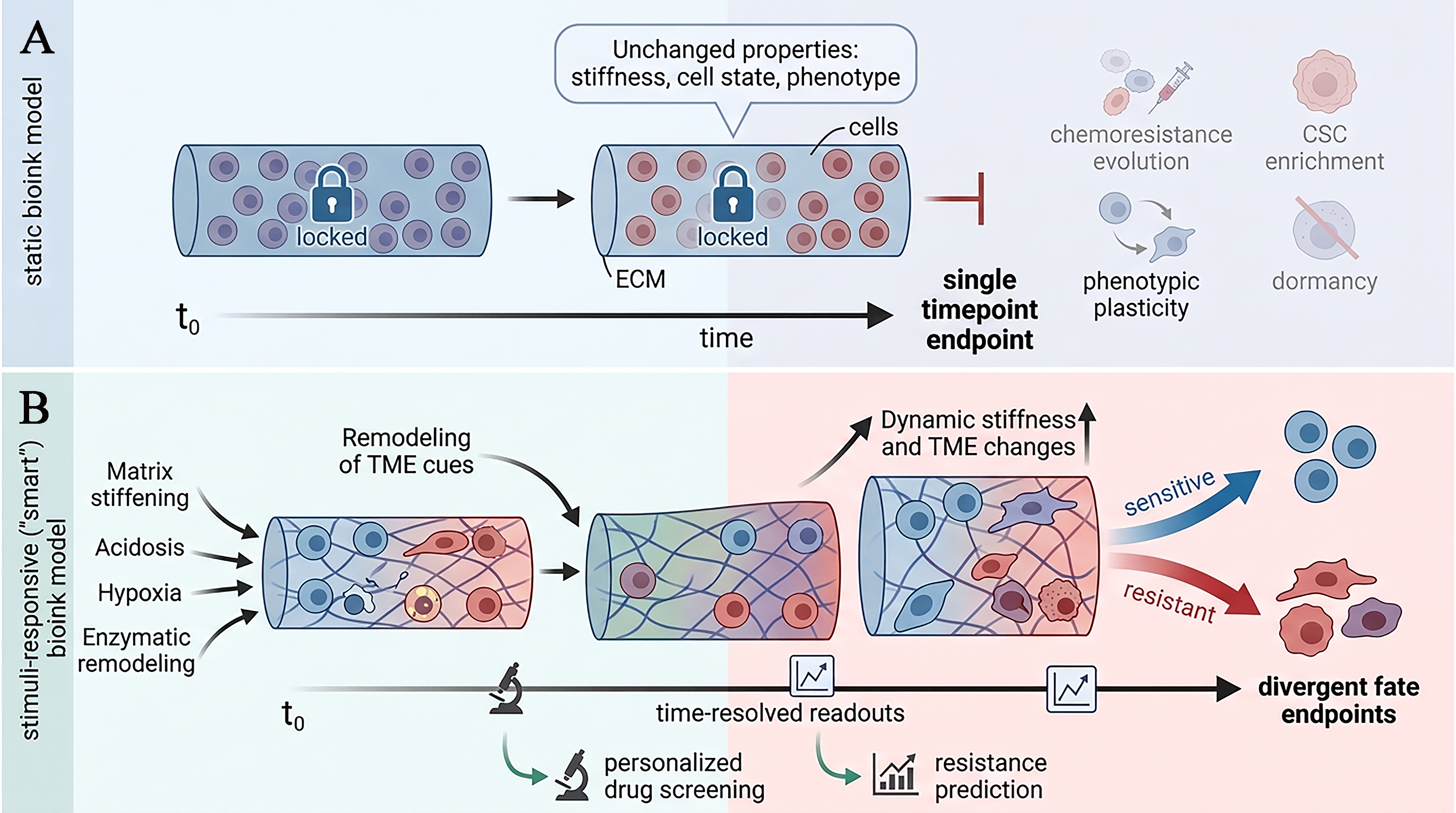
Drug resistance remains the leading cause of treatment failure in solid tumors. Conventional two-dimensional (2D) cultures and animal models cannot reproduce the dynamic tumor microenvironment (TME) cues driving resistance evolution—matrix stiffening, acidification, hypoxia, and enzymatic remodeling. Most 3D-bioprinted constructs remain static matrices and share this limitation. This review proposes the spatiotemporal dynamics of the TME as a design criterion for stimuli-responsive ("smart") bioinks, whose stiffness, degradability, drug-release kinetics, and geometry change in response to endogenous TME cues or external triggers. This review distills the TME into a quantitative design blueprint; examines the printability, cytocompatibility, and responsiveness requirements of smart inks, together with the dynamic chemistries enabling them; and summarizes strategies for reconstructing an evolving TME, using pancreatic ductal adenocarcinoma and glioblastoma as anchor case studies. The scope is restricted to cancer modeling and drug screening, excluding drug delivery and tissue regeneration. Current evidence remains proof-of-concept: printed models recapitulate resistance-associated phenotypes such as stiffness-mediated chemoresistance, cancer stem cell enrichment, dormancy, and phenotypic plasticity, whereas prospective validation of resistance models in patients has not been achieved. This review outlines the path from phenotype recapitulation to clinical prediction and analyzes prerequisites including vascularization, standardization, regulatory translation, and artificial intelligence (AI)-guided ink design.
- Sharma R, Restan Perez M, da Silva VA, et al. 3D bioprinting complex models of cancer. Biomater Sci. 2023;11(10):3414-3430. doi: 10.1039/d2bm02060b
- Datta P, Dey M, Ataie Z, Unutmaz D, Ozbolat IT. 3D bioprinting for reconstituting the cancer microenvironment. npj Precis Oncol. 2020;4(1):18. doi: 10.1038/s41698-020-0121-2
- Bahcecioglu G, Basara G, Ellis BW, Ren X, Zorlutuna P. Breast cancer models: Engineering the tumor microenvironment. Acta Biomater. 2020;106:1-21. doi: 10.1016/j.actbio.2020.02.006
- Almazrouei KM, Mishra V, Pandya H, Sambhav K, Bhavsar SN. Tumor Microenvironment and Its Role in Cancer Progression: An Integrative Review. Cureus. 2025;17(9):e92707. doi: 10.7759/cureus.92707
- Zhao Y, Li S, Zhu L, et al. Personalized drug screening using patient-derived organoid and its clinical relevance in gastric cancer. Cell Rep Med. 2024;5(7):101627. doi: 10.1016/j.xcrm.2024.101627
- Wang H-M, Zhang C-Y, Peng K-C, et al. Using patient-derived organoids to predict locally advanced or metastatic lung cancer tumor response: A real-world study. Cell Rep Med. 2023;4(2):100911. doi: 10.1016/j.xcrm.2022.100911
- Mo S, Tang P, Luo W, et al. Patient-Derived Organoids from Colorectal Cancer with Paired Liver Metastasis Reveal Tumor Heterogeneity and Predict Response to Chemotherapy. Adv Sci. 2022;9(31):2204097. doi: 10.1002/advs.202204097
- Merrill NM, Kaffenberger SD, Bao L, et al. Integrative Drug Screening and Multiomic Characterization of Patient-derived Bladder Cancer Organoids Reveal Novel Molecular Correlates of Gemcitabine Response. Eur Urol. 2024;86(5):434-444. doi: 10.1016/j.eururo.2024.05.026
- Aisenbrey EA, Murphy WL. Synthetic alternatives to Matrigel. Nat Rev Mater. 2020;5(7):539-551. doi: 10.1038/s41578-020-0199-8
- Kozlowski MT, Crook CJ, Ku HT. Towards organoid culture without Matrigel. Commun Biol. 2021;4(1):1387. doi: 10.1038/s42003-021-02910-8
- Zhao Z, Chen X, Dowbaj AM, et al. Organoids. Nat Rev Methods Primers. 2022;2(1):94. doi: 10.1038/s43586-022-00174-y
- Zhang C, Shen Y, Huang M, et al. Dynamic hydrogel mechanics in organoid engineering: From matrix design to translational paradigms. Bioact Mater. 2026;55:144-170. doi: 10.1016/j.bioactmat.2025.09.021
- Hofer M, Lutolf MP. Engineering organoids. Nat Rev Mater. 2021;6(5):402-420. doi: 10.1038/s41578-021-00279-y
- Lv J, Du X, Wang M, Su J, Wei Y, Xu C. Construction of tumor organoids and their application to cancer research and therapy. Theranostics. 2024;14(3):1101-1125. doi: 10.7150/thno.91362
- Qu J, Kalyani FS, Liu L, Cheng T, Chen L. Tumor organoids: synergistic applications, current challenges, and future prospects in cancer therapy. Cancer Commun. 2021;41(12):1331-1353. doi: 10.1002/cac2.12224
- Lin M, Tang M, Duan W, Xia S, Liu W, Wang Q. 3D Bioprinting for Tumor Metastasis Research. ACS Biomater Sci Eng. 2023;9(6):3116-3133. doi: 10.1021/acsbiomaterials.3c00239
- Matai I, Kaur G, Seyedsalehi A, McClinton A, Laurencin CT. Progress in 3D bioprinting technology for tissue/organ regenerative engineering. Biomaterials. 2020;226:119536. doi: 10.1016/j.biomaterials.2019.119536
- Yuan T, Fu X, Hu R, et al. Bioprinted, spatially defined breast tumor microenvironment models of intratumoral heterogeneity and drug resistance. Trends Biotechnol. 2024;42(11):1523-1550. doi: 10.1016/j.tibtech.2024.06.007
- Romanazzo S, Tian P, Jalandhra GK, Doshi RB, Gooding JJ, Kilian KA. A biofabricated 3D cancer-stroma tumor microenvironment model. Biofabrication. 2025;17(4):045019. doi: 10.1088/1758-5090/ae0a82
- Xu K, Huang Y, Wu M, Yin J, Wei P. 3D bioprinting of multi-cellular tumor microenvironment for prostate cancer metastasis. Biofabrication. 2023;15(3):035020. doi: 10.1088/1758-5090/acd960
- Desigaux T, Comperat L, Dusserre N, et al. 3D bioprinted breast cancer model reveals stroma-mediated modulation of extracellular matrix and radiosensitivity. Bioact Mater. 2024;42:316-327. doi: 10.1016/j.bioactmat.2024.08.037
- McCormack A, Highley CB, Leslie NR, Melchels FPW. 3D Printing in Suspension Baths: Keeping the Promises of Bioprinting Afloat. Trends Biotechnol. 2020;38(6):584-593. doi: 10.1016/j.tibtech.2019.12.020
- Lian L, Xie M, Luo Z, et al. Rapid Volumetric Bioprinting of Decellularized Extracellular Matrix Bioinks. Adv Mater. 2024;36(34):2304846. doi: 10.1002/adma.202304846
- Shi W, Mirza S, Kuss M, et al. Embedded Bioprinting of Breast Tumor Cells and Organoids Using Low-Concentration Collagen-Based Bioinks. Adv Healthc Mater. 2023;12(26):2300905. doi: 10.1002/adhm.202300905
- Agarwal T, Onesto V, Banerjee D, et al. 3D bioprinting in tissue engineering: current state-of-the-art and challenges towards system standardization and clinical translation. Biofabrication. 2025;17(4):042003. doi: 10.1088/1758-5090/ade47a
- Yigci D, Sarabi MR, Ustun M, et al. 3D bioprinted glioma models. Prog Biomed Eng. 2022;4(4):042001. doi: 10.1088/2516-1091/ac7833
- Filipczak N, Joshi U, Attia SA, et al. Hypoxia-sensitive drug delivery to tumors. J Control Release 2022;341:431-442. doi: 10.1016/j.jconrel.2021.11.034
- Guo B, Yang F, Zhang L, et al. Cuproptosis Induced by ROS Responsive Nanoparticles with Elesclomol and Copper Combined with αPD-L1 for Enhanced Cancer Immunotherapy. Adv Mater. 2023;35(22):2212267. doi: 10.1002/adma.202212267
- LeSavage BL, Zhang D, Huerta-López C, et al. Engineered matrices reveal stiffness-mediated chemoresistance in patient-derived pancreatic cancer organoids. Nat Mater. 2024;23(8):1138-1149. doi: 10.1038/s41563-024-01908-x
- Kalli M, Poskus MD, Stylianopoulos T, Zervantonakis IK. Beyond matrix stiffness: targeting force-induced cancer drug resistance. Trends Cancer. 2023;9(11):937-954. doi: 10.1016/j.trecan.2023.07.006
- Saatci O, Kaymak A, Raza U, et al. Targeting lysyl oxidase (LOX) overcomes chemotherapy resistance in triple negative breast cancer. Nat Commun. 2020;11(1):2416. doi: 10.1038/s41467-020-16199-4
- Rasti Boroojeni F, Naeimipour S, Lifwergren P, et al. Proteolytic remodeling of 3D bioprinted tumor microenvironments. Biofabrication. 2024;16(2):025002. doi: 10.1088/1758-5090/ad17d1
- Kundu M, Butti R, Panda VK, et al. Modulation of the tumor microenvironment and mechanism of immunotherapy-based drug resistance in breast cancer. Mol Cancer. 2024;23(1):92. doi: 10.1186/s12943-024-01990-4
- Chu X, Tian Y, Lv C. Decoding the spatiotemporal heterogeneity of tumor-associated macrophages. Mol Cancer. 2024;23(1):150. doi: 10.1186/s12943-024-02064-1
- Finger A-M, Hendley AM, Figueroa D, Gonzalez H, Weaver VM. Tissue mechanics in tumor heterogeneity and aggression. Trends Cancer. 2025;11(8):806-824. doi: 10.1016/j.trecan.2025.04.004
- Neumann M, di Marco G, Iudin D, et al. Stimuli-Responsive Hydrogels: The Dynamic Smart Biomaterials of Tomorrow. Macromolecules. 2023;56(21):8377-8392. doi: 10.1021/acs.macromol.3c00967
- Moorman A, Benitez EK, Cambuli F, et al. Progressive plasticity during colorectal cancer metastasis. Nature. 2025;637(8047):947-954. doi: 10.1038/s41586-024-08150-0
- Dhimolea E, de Matos Simoes R, Kansara D, et al. An Embryonic Diapause-like Adaptation with Suppressed Myc Activity Enables Tumor Treatment Persistence. Cancer Cell. 2021;39(2):240-256.e11. doi: 10.1016/j.ccell.2020.12.002
- Mao X, Xu J, Wang W, et al. Crosstalk between cancer-associated fibroblasts and immune cells in the tumor microenvironment: new findings and future perspectives. Mol Cancer. 2021;20(1):131. doi: 10.1186/s12943-021-01428-1
- Nicolas AM, Pesic M, Engel E, et al. Inflammatory fibroblasts mediate resistance to neoadjuvant therapy in rectal cancer. Cancer Cell. 2022;40(2):168-184.e13. doi: 10.1016/j.ccell.2022.01.004
- Saraswathibhatla A, Indana D, Chaudhuri O. Cell–extracellular matrix mechanotransduction in 3D. Nat Rev Mol Cell Bio. 2023;24(7):495-516. doi: 10.1038/s41580-023-00583-1
- Villares E, Gerecht S. Engineered Biomaterials and Model Systems to Study YAP/TAZ in Cancer. ACS Biomater Sci Eng. 2024;10(9):5550-5561. doi: 10.1021/acsbiomaterials.4c01170
- Laughney AM, Hu J, Campbell NR, et al. Regenerative lineages and immune-mediated pruning in lung cancer metastasis. Nat Med. 2020;26(2):259-269. doi: 10.1038/s41591-019-0750-6
- Sadra Bakhshandeh UH, Hubert M. Taïeb, Adithi R. Varadarajan, et al. Dormancy-inducing 3D engineered matrix uncovers mechanosensitive and drug-protective FHL2-p21 signaling axis. Sci Adv. 2024;10(45):eadr3997. doi: 10.1126/sciadv.adr3997
- Melino S, Seliktar D. A hydrogel reveals an elusive cancer stem cell. Cell Death Dis. 2021;12(5):415. doi: 10.1038/s41419-021-03696-7
- Lee VK, Tejero R, Silvia N, et al. 3D Brain Vascular Niche Model Captures Glioblastoma Infiltration, Dormancy, and Gene Signatures. Adv Sci. 2025;12(33):e00689. doi: 10.1002/advs.202500689
- McDonough E, Barroso M, Ginty F, Corr DT. Modeling intratumor heterogeneity in breast cancer. Biofabrication. 2024;17(1):012009. doi: 10.1088/1758-5090/ad9b50
- Vaskovich-Koubi D, Green Buzhor M, Krinsky A, et al. Patient-Derived 3D-Bioprinted Models of Pancreatic Cancer: Toward Personalized Therapy and Overcoming Tumor Microenvironment Challenges. Adv Drug Deliv Rev. 2025;225:115670. doi: 10.1016/j.addr.2025.115670
- Lai J, Liu Y, Lu G, et al. 4D bioprinting of programmed dynamic tissues. Bioact Mater. 2024;37:348-377. doi: 10.1016/j.bioactmat.2024.03.033
- Faber L, Yau A, Chen Y. Translational biomaterials of four-dimensional bioprinting for tissue regeneration. Biofabrication. 2023;16(1):012001. doi: 10.1088/1758-5090/acfdd0
- Ding H, Tan P, Fu S, et al. Preparation and application of pH-responsive drug delivery systems. J Control Release 2022;348:206-238. doi: 10.1016/j.jconrel.2022.05.056
- Cook AB, Palange A, Schlich M, et al. Matrix metalloproteinase responsive hydrogel microplates for programmed killing of invasive tumour cells. RSC Appl Polym. 2023;1(1):19-29. doi: 10.1039/d3lp00057e
- Lin F-Y, Chang C-Y, Nguyen H, Li H, Fishel ML, Lin C-C. Viscoelastic hydrogels for interrogating pancreatic cancer-stromal cell interactions. Mater Today Bio. 2023;19:100576. doi: 10.1016/j.mtbio.2023.100576
- Luo R, Xiang X, Jiao Q, Hua H, Chen Y. Photoresponsive Hydrogels for Tissue Engineering. ACS Biomater Sci Eng. 2024;10(6):3612-3630. doi: 10.1021/acsbiomaterials.4c00314
- Alavi SE, Alharthi S, Alavi SZ, Raza A, Ebrahimi Shahmabadi H. Bioresponsive drug delivery systems. Drug Discovery Today. 2024;29(1):103849. doi: 10.1016/j.drudis.2023.103849
- Hu H, Busa P, Zhao Y, Zhao C. Externally triggered drug delivery systems. Smart Mater Med. 2024;5(3):386-408. doi: 10.1016/j.smaim.2024.08.004
- de Barros NR, Gomez A, Ermis M, et al. Gelatin methacryloyl and Laponite bioink for 3D bioprinted organotypic tumor modeling. Biofabrication. 2023;15(4):045005. doi: 10.1088/1758-5090/ace0db
- Xu J, Yang S, Su Y, et al. A 3D bioprinted tumor model fabricated with gelatin/sodium alginate/decellularized extracellular matrix bioink. Int J Bioprint. 2022;9(1):630. doi: 10.18063/ijb.v9i1.630
- Sekar MP, Suresh S, Zennifer A, Sethuraman S, Sundaramurthi D. Hyaluronic Acid as Bioink and Hydrogel Scaffolds for Tissue Engineering Applications. ACS Biomater Sci Eng. 2023;9(6):3134-3159. doi: 10.1021/acsbiomaterials.3c00299
- Hauptstein J, Böck T, Bartolf-Kopp M, et al. Hyaluronic Acid-Based Bioink Composition Enabling 3D Bioprinting and Improving Quality of Deposited Cartilaginous Extracellular Matrix. Adv Healthc Mater. 2020;9(15):2000737. doi: 10.1002/adhm.202000737
- Kim HS, Lee KY. Stretchable and self-healable hyaluronate-based hydrogels for three-dimensional bioprinting. Carbohydr Polym. 2022;295:119846. doi: 10.1016/j.carbpol.2022.119846
- Zhu L, Yuhan J, Yu H, Zhang B, Huang K, Zhu L. Decellularized Extracellular Matrix for Remodeling Bioengineering Organoid's Microenvironment. Small. 2023;19(25):2207752. doi: 10.1002/smll.202207752
- De Santis MM, Alsafadi HN, Tas S, et al. Extracellular-Matrix-Reinforced Bioinks for 3D Bioprinting Human Tissue. Adv Mater. 2021;33(3):2005476. doi: 10.1002/adma.202005476
- Xiang Y, Zhao Z, Yao EJ, et al. Multifaceted cancer alleviation by cowpea mosaic virus in a bioprinted ovarian cancer peritoneal spheroid model. Biomaterials. 2024;311:122663. doi: 10.1016/j.biomaterials.2024.122663
- Xu X, Liu Y, Fu W, et al. Poly(N-isopropylacrylamide)-Based Thermoresponsive Composite Hydrogels for Biomedical Applications. Polymers. 2020;12(3):580. doi: 10.3390/polym12030580
- Ansari MJ, Rajendran RR, Mohanto S, et al. Poly(N-isopropylacrylamide)-Based Hydrogels for Biomedical Applications: A Review of the State-of-the-Art. Gels. 2022;8(7):454. doi: 10.3390/gels8070454
- Navara AM, Kim YS, Xu Y, et al. A dual-gelling poly(N-isopropylacrylamide)-based ink and thermoreversible poloxamer support bath for high-resolution bioprinting. Bioact Mater. 2022;14:302-312. doi: 10.1016/j.bioactmat.2021.11.016
- Träger A, Naeimipour S, Jury M, Selegård R, Aili D. Nanocellulose Reinforced Hyaluronan-Based Bioinks. Biomacromolecules. 2023;24(7):3086-3093. doi: 10.1021/acs.biomac.3c00168
- Kerch G. Nanocomposite Hydrogels and Extracellular Matrix—Advantages and Associated Risks. Gels. 2023;9(9):754. doi: 10.3390/gels9090754
- Li Q, Jiang Z, Ma L, et al. A versatile embedding medium for freeform bioprinting with multi-crosslinking methods. Biofabrication. 2022;14(3):035022. doi: 10.1088/1758-5090/ac7909
- Mueller E, Xu F, Hoare T. FRESH Bioprinting of Dynamic Hydrazone-Cross-Linked Synthetic Hydrogels. Biomacromolecules. 2022;23(11):4883-4895. doi: 10.1021/acs.biomac.2c01046
- Terriac L, Helesbeux J-J, Maugars Y, Guicheux J, Tibbitt MW, Delplace V. Boronate Ester Hydrogels for Biomedical Applications: Challenges and Opportunities. Chem Mater. 2024;36(14):6674-6695. doi: 10.1021/acs.chemmater.4c00507
- Hull SM, Lou J, Lindsay CD, et al. 3D bioprinting of dynamic hydrogel bioinks enabled by small molecule modulators. Sci Adv. 2023;9(13):eade7880. doi: 10.1126/sciadv.ade7880
- Cai C, Zhang X, Li Y, et al. Self-Healing Hydrogel Embodied with Macrophage-Regulation and Responsive-Gene-Silencing Properties for Synergistic Prevention of Peritendinous Adhesion. Adv Mater. 2022;34(5):2106564. doi: 10.1002/adma.202106564
- Zhu M, Zhang H, Zhou Q, et al. Dynamic GelMA/DNA Dual-Network Hydrogels Promote Woven Bone Organoid Formation and Enhance Bone Regeneration. Adv Mater. 2025;37(24):2501254. doi: 10.1002/adma.202501254
- Sharma A, Steger RF, Li JM, et al. Sp1 mechanotransduction regulates breast cancer cell invasion in engineered viscoelastic extracellular matrices. Biomaterials. 2026;327:123755. doi: 10.1016/j.biomaterials.2025.123755
- Jing S, Lian L, Hou Y, et al. Advances in volumetric bioprinting. Biofabrication. 2023;16(1):012004. doi: 10.1088/1758-5090/ad0978
- Kobayashi J, Nakayama M, Nagase K. Molecular design of dynamically thermoresponsive biomaterials. Sci Technol Adv Mater. 2025;26(1):2475736. doi: 10.1080/14686996.2025.2475736
- Moon SH, Park TY, Cha HJ, Yang YJ. Photo-/thermo-responsive bioink for improved printability in extrusion-based bioprinting. Mater Today Bio. 2024;25:100973. doi: 10.1016/j.mtbio.2024.100973
- Kim MH, Lin C-C. Norbornene-functionalized methylcellulose as a thermo- and photo-responsive bioink. Biofabrication. 2021;13(4):045023. doi: 10.1088/1758-5090/ac24dc
- Kok HP, van Rhoon GC, Herrera TD, Overgaard J, Crezee J. Biological modeling in thermoradiotherapy: present status and ongoing developments toward routine clinical use. Int J Hyperth. 2022;39(1):1126-1140. doi: 10.1080/02656736.2022.2113826
- Zhu W, Pan S, Zhang J, et al. The role of hyperthermia in the treatment of tumor. Crit Rev Oncol/Hematol. 2024;204:104541. doi: 10.1016/j.critrevonc.2024.104541
- Zhou J, Wang H, Chen H, et al. pH-responsive nanocomposite hydrogel for simultaneous prevention of postoperative adhesion and tumor recurrence. Acta Biomater. 2023;158:228-238. doi: 10.1016/j.actbio.2022.12.025
- Yi D, Wang T, Xu S, et al. Injectable ROS/pH-Responsive Hydrogel for Synergistic Chemo-Photodynamic Tumor Therapy and Enhanced Wound Healing. Adv Healthc Mater. 2026;15(1):e02349. doi: 10.1002/adhm.202502349
- Yip AM-H, Lee LC-C, Shum J, Lo KK-W. A matrix metalloproteinase-responsive iridium(iii)-based hydrogel for cancer cell-specific imaging and lysosome-targeted photodynamic therapy. Chem Commun. 2025;61(98):19461-19464. doi: 10.1039/d5cc05380c
- Sun H, Xu J, Wang Y, et al. Bone microenvironment regulative hydrogels with ROS scavenging and prolonged oxygen-generating for enhancing bone repair. Bioact Mater. 2023;24:477-496. doi: 10.1016/j.bioactmat.2022.12.021
- Zhang W, Kuss M, Yan Y, Shi W. Dynamic Alginate Hydrogel as an Antioxidative Bioink for Bioprinting. Gels. 2023;9(4):312. doi: 10.3390/gels9040312
- Liu R, Liang Q, Luo JQ, et al. Ferritin-Based Nanocomposite Hydrogel Promotes Tumor Penetration and Enhances Cancer Chemoimmunotherapy. Adv Sci. 2024;11(3):2305217. doi: 10.1002/advs.202305217
- Zhong G, Miao Y, Zhou J, et al. Near-infrared light-induced photothermal and immunotherapy system for lung cancer bone metastasis treatment with simultaneous bone repair. Bioact Mater. 2025;52:182-199. doi: 10.1016/j.bioactmat.2025.06.008
- Yeingst TJ, Arrizabalaga JH, Hayes DJ. Ultrasound-Induced Drug Release from Stimuli-Responsive Hydrogels. Gels. 2022;8(9):554. doi: 10.3390/gels8090554
- Xu D, Fu S, Zhang H, et al. Ultrasound-Responsive Aligned Piezoelectric Nanofibers Derived Hydrogel Conduits for Peripheral Nerve Regeneration. Adv Mater. 2024;36(28):2307896. doi: 10.1002/adma.202307896
- Paci C, Iberite F, Arrico L, et al. Piezoelectric nanocomposite bioink and ultrasound stimulation modulate early skeletal myogenesis. Biomater Sci. 2022;10(18):5265-5283. doi: 10.1039/d1bm01853a
- Dai F, Zhang J, Chen F, et al. A Multi-Responsive Hydrogel Combined With Mild Heat Stimulation Promotes Diabetic Wound Healing by Regulating Inflammatory and Enhancing Angiogenesis. Adv Sci. 2024;11(46):2408783. doi: 10.1002/advs.202408783
- Li S, Zheng W, Deng W, et al. Logic-Based Strategy for Spatiotemporal Release of Dual Extracellular Vesicles in Osteoarthritis Treatment. Adv Sci. 2024;11(26):2403227. doi: 10.1002/advs.202403227
- Tebon PJ, Wang B, Markowitz AL, et al. Drug screening at single-organoid resolution via bioprinting and interferometry. Nat Commun. 2023;14(1):3168. doi: 10.1038/s41467-023-38832-8
- Jeong M-H, Kim I, Park K, et al. An Automated High-Throughput Screening (HTS) Spotter for 3D Tumor Spheroid Formation. Int J Mol Sci. 2023;24(2):1006. doi: 10.3390/ijms24021006
- Wang J, Jing F, Zhao Y, You Z, Zhang A, Qin S. Piezo1: structural pharmacology and mechanotransduction mechanisms. Trends Pharmacol Sci. 2025;46(8):752-770. doi: 10.1016/j.tips.2025.06.009
- Shan Y, Pang M, Wang L, et al. Increased stiffness of extracellular matrix enhanced chemoresistance in 3D-bioprinted ovarian cancer model. Int J Bioprint. 2024;10(3):1673. doi: 10.36922/ijb.1673
- Isik S, Yucel D, Hasirci V. Modeling a hypoxia-integrated glioblastoma microenvironment to mimic tumor heterogeneity and chemoresistance. Biomater Sci. 2026;14(15):3963-3981. doi: 10.1039/d5bm01824b
- Montesdeoca CYC, Stocco TD, Marciano FR, Webster TJ, Lobo AO. 3D Bioprinting of Smart Oxygen-Releasing Cartilage Scaffolds. J Funct Biomater. 2022;13(4):252. doi: 10.3390/jfb13040252
- Lu J-J, Zhang Q-C, Yuan G-C, et al. Oxygen-controllable injectable hydrogel alleviates intervertebral disc degeneration by balancing extracellular matrix metabolism. Mater Today Bio. 2024;29:101252. doi: 10.1016/j.mtbio.2024.101252
- Ntekoumes D, Song J, Liu H, Amelung C, Guan Y, Gerecht S. Acute Three-Dimensional Hypoxia Regulates Angiogenesis. Adv Healthc Mater. 2025;14(2):2403860. doi: 10.1002/adhm.202403860
- Ayuso JM, Rehman S, Farooqui M, et al. Microfluidic Tumor-on-a-Chip Model to Study Tumor Metabolic Vulnerability. Int J Mol Sci. 2020;21(23):9075. doi: 10.3390/ijms21239075
- Abed H, Radha R, Anjum S, et al. Targeted Cancer Therapy-on-A-Chip. Adv Healthc Mater. 2024;13(29):2400833. doi: 10.1002/adhm.202400833
- Monteduro AG, Rizzato S, Caragnano G, Trapani A, Giannelli G, Maruccio G. Organs-on-chips technologies - A guide from disease models to opportunities for drug development. Biosens Bioelectron. 2023;231:115271. doi: 10.1016/j.bios.2023.115271
- Wang H, Chen Y, Wei R, et al. Synergistic Chemoimmunotherapy Augmentation via Sequential Nanocomposite Hydrogel-Mediated Reprogramming of Cancer-Associated Fibroblasts in Osteosarcoma. Adv Mater. 2024;36(15):2309591. doi: 10.1002/adma.202309591
- Bayer IS. Hyaluronic Acid and Controlled Release: A Review. Molecules. 2020;25(11):2649. doi: 10.3390/molecules25112649
- Ciolacu DE, Nicu R, Ciolacu F. Cellulose-Based Hydrogels as Sustained Drug-Delivery Systems. Materials. 2020;13(22):5270. doi: 10.3390/ma13225270
- Ju Y, Hu Y, Yang P, Xie X, Fang B. Extracellular vesicle-loaded hydrogels for tissue repair and regeneration. Mater Today Bio. 2023;18:100522. doi: 10.1016/j.mtbio.2022.100522
- Zhou H, Dong G, Gao G, et al. Hydrogel-Based Stimuli-Responsive Micromotors for Biomedicine. Cyborg and Bionic Systems. 2022;2022. doi: 10.34133/2022/9852853
- Wan Z, Zhang P, Liu Y, Lv L, Zhou Y. Four-dimensional bioprinting: Current developments and applications in bone tissue engineering. Acta Biomater. 2020;101:26-42. doi: 10.1016/j.actbio.2019.10.038
- Han S, Kim S, Chen Z, et al. 3D Bioprinted Vascularized Tumour for Drug Testing. Int J Mol Sci. 2020;21(8):2993. doi: 10.3390/ijms21082993
- Miri AK, Khalilpour A, Cecen B, Maharjan S, Shin SR, Khademhosseini A. Multiscale bioprinting of vascularized models. Biomaterials. 2019;198:204-216. doi: 10.1016/j.biomaterials.2018.08.006
- Lee G, Kim SJ, Park JK. Fabrication of a self-assembled and vascularized tumor array via bioprinting on a microfluidic chip. Lab Chip. 2023;23(18):4079-4091. doi: 10.1039/d3lc00275f
- Wang X, Li X, Ding J, et al. 3D bioprinted glioma microenvironment for glioma vascularization. J Biomed Mater Res A 2021;109(6):915-925. doi: 10.1002/jbm.a.37082
- Park W, Lee JS, Gao G, Kim BS, Cho DW. 3D bioprinted multilayered cerebrovascular conduits to study cancer extravasation mechanism related with vascular geometry. Nat Commun. 2023;14(1):7696. doi: 10.1038/s41467-023-43586-4
- Shukla AK, Shukla S, Suryawanshi SP, et al. High-Throughput 3D Bioprinted Organoids of Skin Cancer Utilized for Diagnosis and Personalized Therapy. Curr Oncol. 2025;32(12):653. doi: 10.3390/curroncol32120653
- Li J, Li N, Liu B, Li S, Zhang H. Current advances of 3D-bioprinted microfluidic models with hydrogel bioinks and their applications in drug screening. Int J Bioprint. 2024;10(3):1951. doi: 10.36922/ijb.1951
- Tong L, Cui W, Zhang B, et al. Patient-derived organoids in precision cancer medicine. Med. 2024;5(11):1351-1377. doi: 10.1016/j.medj.2024.08.010
- Li F, Li Z, Wei C, et al. Application of hydrogels for targeting cancer stem cells in cancer treatment. Biomed Pharmacother. 2024;180:117486. doi: 10.1016/j.biopha.2024.117486
- Kaps P, Zunke E, Ramtke J, et al. 3D bioprinting of the glioblastoma microenvironment for preclinical assessment of CDK4/6 inhibition. Int J Bioprint. 2026;12(2):025520537. doi: 10.36922/ijb025520537
- Sachs N, Papaspyropoulos A, Zomer-van Ommen DD, et al. Long-term expanding human airway organoids for disease modeling. EMBO J. 2019;38(4):EMBJ2018100300. doi: 10.15252/embj.2018100300
- Shi R, Radulovich N, Ng C, et al. Organoid Cultures as Preclinical Models of Non-Small Cell Lung Cancer. Clin Cancer Res. 2020;26(5):1162-1174. doi: 10.1158/1078-0432.Ccr-19-1376
- Wang Y, Zhang L, Wang LZ, et al. The application of organoids in treatment decision-making for digestive system cancers: progress and challenges. Mol Cancer. 2025;24(1):222. doi: 10.1186/s12943-025-02429-0
- Tang M, Xie Q, Gimple RC, et al. Three-dimensional bioprinted glioblastoma microenvironments model cellular dependencies and immune interactions. Cell Res. 2020;30(10):833-853. doi: 10.1038/s41422-020-0338-1
- Joseph JP, Gugulothu SB, Nandi D, Chatterjee K. Mechanical Properties Affect Primary T Cell Activation in 3D Bioprinted Hydrogels. ACS Macro Lett. 2023;12(8):1085-1093. doi: 10.1021/acsmacrolett.3c00271
- Dey M, Kim MH, Dogan M, et al. Chemotherapeutics and CAR-T Cell-Based Immunotherapeutics Screening on a 3D Bioprinted Vascularized Breast Tumor Model. Adv Funct Mater. 2022;32(52):2203966. doi: 10.1002/adfm.202203966
- Andersch L, Grunewald L, Stecklum M, et al. Investigating genetic modifications to enhance L1CAM-CAR T cell migration in solid tumors in a 3D bioprinted neuroblastoma model. Front Immunol. 2025;16:1677361. doi: 10.3389/fimmu.2025.1677361
- Jiang S, Deng T, Cheng H, et al. Macrophage-organoid co-culture model for identifying treatment strategies against macrophage-related gemcitabine resistance. J Exp Clin Cancer Res. 2023;42(1):199. doi: 10.1186/s13046-023-02756-4
- Zou Z, Lin Z, Wu C, et al. Micro-Engineered Organoid-on-a-Chip Based on Mesenchymal Stromal Cells to Predict Immunotherapy Responses of HCC Patients. Adv Sci. 2023;10(27):2302640. doi: 10.1002/advs.202302640
- Li K, Liu C, Sui X, et al. An organoid co-culture model for probing systemic anti-tumor immunity in lung cancer. Cell Stem Cell. 2025;32(8):1218-1234.e7. doi: 10.1016/j.stem.2025.05.011
- Xie Z, Chen M, Lian J, Wang H, Ma J. Glioblastoma-on-a-chip construction and therapeutic applications. Front Oncol. 2023;13:1183059. doi: 10.3389/fonc.2023.1183059
- Ustun M, Rahmani Dabbagh S, Ilci I, Bagci-Onder T, Tasoglu S. Glioma-on-a-Chip Models. Micromachines. 2021;12(5):490. doi: 10.3390/mi12050490
- Pasupuleti V, Vora L, Prasad R, Nandakumar DN, Khatri DK. Glioblastoma preclinical models: Strengths and weaknesses. Biochim Biophys Acta, Rev Cancer. 2024;1879(1):189059. doi: 10.1016/j.bbcan.2023.189059
- Heinrich MA, Heinrich L, Ankone MJK, Vergauwen B, Prakash J. Endotoxin contamination alters macrophage-cancer cell interaction and therapeutic efficacy in pre-clinical 3D in vitro models. Biomater Adv. 2023;144:213220. doi: 10.1016/j.bioadv.2022.213220
- Cattaneo CM, Dijkstra KK, Fanchi LF, et al. Tumor organoid-T-cell coculture systems. Nat Protoc. 2020;15(1):15-39. doi: 10.1038/s41596-019-0232-9
- Magré L, Verstegen MMA, Buschow S, van der Laan LJW, Peppelenbosch M, Desai J. Emerging organoid-immune co-culture models for cancer research: from oncoimmunology to personalized immunotherapies. J Immunother Cancer. 2023;11(5):e006290. doi: 10.1136/jitc-2022-006290
- Wang X, Sun Y, Zhang DY, Ming G-l, Song H. Glioblastoma modeling with 3D organoids: progress and challenges. Oxf Open Neurosci. 2023;2:kvad008. doi: 10.1093/oons/kvad008
- Oliver L, Landais Y, Gratas C, et al. Transcriptional landscape of the interaction of human Mesenchymal Stem Cells with Glioblastoma in bioprinted co-cultures. Stem Cell Res Ther. 2024;15(1):424. doi: 10.1186/s13287-024-04022-6
- Sun H, Wang Y, Sun M, et al. Developing Patient-Derived 3D-Bioprinting models of pancreatic cancer. J Adv Res. 2025;74:165-174. doi: 10.1016/j.jare.2024.09.011
- Mao S, Xie R, Shou J, Pang Y, Sun W. Bioprinting of patient-derived heterogeneous renal cell carcinoma organoids for personalized therapy. Biofabrication. 2025;17(4):045008. doi: 10.1088/1758-5090/adecc5
- Jin Y, Zhang J, Xing J, et al. Multicellular 3D bioprinted human gallbladder carcinoma forin vitromimicry of tumor microenvironment and intratumoral heterogeneity. Biofabrication. 2024;16(4):045028. doi: 10.1088/1758-5090/ad6d8c
- González-Callejo P, Vázquez-Aristizabal P, García-Astrain C, et al. 3D bioprinted breast tumor-stroma models for pre-clinical drug testing. Mater Today Bio. 2023;23:100826. doi: 10.1016/j.mtbio.2023.100826
- Yan Q, Hu W, Wang J, et al. 3D bioprinting of patient-derived cholangiocarcinoma organoids in a decellularized liver matrix-based bioink for drug testing. Int J Bioprint. 2026;12(3):026200188. doi: 10.36922/ijb026200188
- Clark CC, Yoo KM, Sivakumar H, et al. Immersion bioprinting of hyaluronan and collagen bioink-supported 3D patient-derived brain tumor organoids. Biomed Mater. 2022;18(1):015014. doi: 10.1088/1748-605X/aca05d
- Korelidou A, Domínguez-Robles J, Islam R, Donnelly RF, Coulter JA, Larrañeta E. 3D-printed implants loaded with acriflavine for glioblastoma treatment. Int J Pharm. 2024;665:124710. doi: 10.1016/j.ijpharm.2024.124710
- Liu Z, Yin J, Qiu T, et al. Reversing the immunosuppressive tumor microenvironment via "Kynurenine starvation therapy" for postsurgical triple-negative breast cancer treatment. J Control Release 2025;383:113832. doi: 10.1016/j.jconrel.2025.113832
- Tsen HT, Sun TC, Lai TK, et al. Cisplatin-activated and hemoglobin-mediated injectable hydrogel system for antitumor chemodynamic and chemotherapy. Biomed Pharmacother. 2024;175:116713. doi: 10.1016/j.biopha.2024.116713
- Li X, Xu X, Xu M, Geng Z, Ji P, Liu Y. Hydrogel systems for targeted cancer therapy. Front Bioeng Biotechnol. 2023;11:1140436. doi: 10.3389/fbioe.2023.1140436
- Wang J, Chen X, Li R, et al. Standardization and consensus in the development and application of bone organoids. Theranostics. 2025;15(2):682-706. doi: 10.7150/thno.105840
- Marsee A, Roos FJM, Verstegen MMA, et al. Building consensus on definition and nomenclature of hepatic, pancreatic, and biliary organoids. Cell Stem Cell. 2021;28(5):816-832. doi: 10.1016/j.stem.2021.04.005
- Zhou C, Liu C, Liao Z, Pang Y, Sun W. AI for biofabrication. Biofabrication. 2024;17(1):012004. doi: 10.1088/1758-5090/ad8966
- Freeman S, Calabro S, Williams R, Jin S, Ye K. Bioink Formulation and Machine Learning-Empowered Bioprinting Optimization. Front Bioeng Biotechnol. 2022;10:913579. doi: 10.3389/fbioe.2022.913579
- Liu S, Kaur N, Song D-H, Moses JC, Ozbolat IT. Self-driving bioprinting laboratories. Biofabrication. 2026;18(1):013001. doi: 10.1088/1758-5090/ae3645
- Bai L, Su J. Artificial Intelligence Virtual Organoids (AIVOs). Bioact Mater. 2026;59:45-68. doi: 10.1016/j.bioactmat.2025.12.030