

Bioprinting and artificial intelligence strategies for additively manufactured wearable biosensors

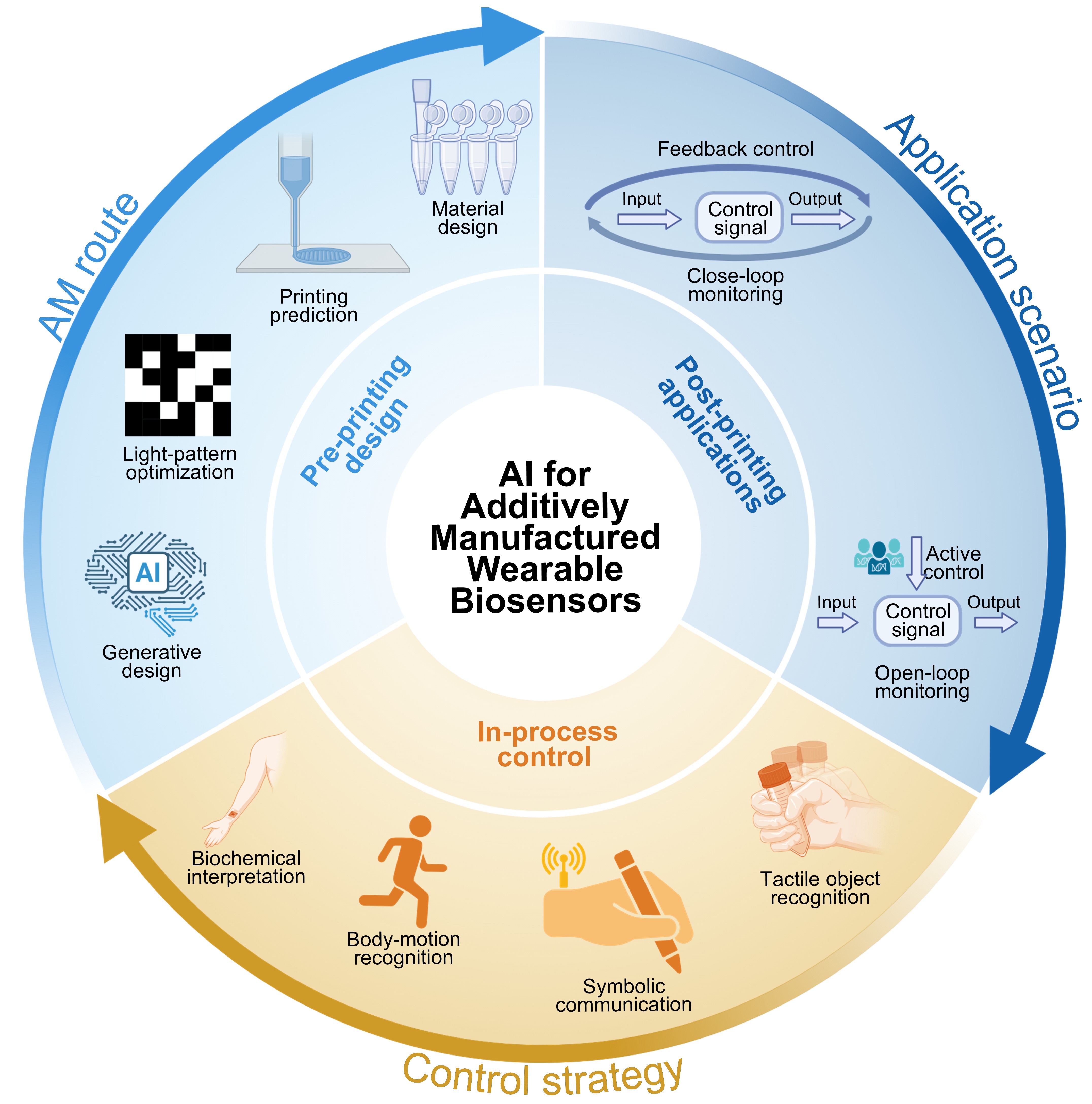
Additively manufactured wearable biosensors enable continuous, noninvasive, and real-time monitoring of physiological and biochemical signals during daily use. Recent advances in artificial intelligence (AI) provide complementary tools for identifying printable material windows, optimizing formulations and printing parameters, monitoring fabrication quality, and interpreting noisy, high-dimensional sensing data. These capabilities are particularly relevant to wearable biosensors, whose performance depends on manufacturing reproducibility and reliable signal analysis during continuous or multimodal operation. This review summarizes recent progress in the AI-assisted development of additively manufactured wearable biosensors across three stages: pre-printing design, in-process monitoring and control, and post-printing signal interpretation and application. By organizing the field around this workflow, we clarify how AI supports material selection, fabrication optimization, device evaluation, and wearable sensing, and identify the remaining challenges in developing more reliable and adaptive biosensing systems.
- Kim J, Campbell AS, de Ávila BE-F, Wang J. Wearable biosensors for healthcare monitoring. Nat Biotechnol. 2019;37(4):389-406. doi: 10.1038/s41587-019-0045-y
- Iqbal SMA, Mahgoub I, Du E, Leavitt MA, Asghar W. Advances in healthcare wearable devices. npj Flexible Electron. 2021;5(1):9. doi: 10.1038/s41528-021-00107-x
- Wicaksono I, Tucker CI, Sun T, et al. A tailored, electronic textile conformable suit for large-scale spatiotemporal physiological sensing in vivo. npj Flexible Electron. 2020;4(1):5. doi: 10.1038/s41528-020-0068-y
- Liu Y, Pharr M, Salvatore GA. Lab-on-Skin: A Review of Flexible and Stretchable Electronics for Wearable Health Monitoring. ACS Nano. 2017;11(10):9614-9635. doi: 10.1021/acsnano.7b04898
- Duan H, Peng S, He S, et al. Wearable electrochemical biosensors for advanced healthcare monitoring. Adv Sci. 2025;12(2):2411433. doi: 10.1002/advs.202411433
- Suryaprabha T, Choi C, Wu Y, Liu L, Hwang B. Smart wearable and implantable biosensors for continuous health monitoring: materials, biocompatibility, and AI integration. npj Flexible Electron. 2026;10(1):46. doi: 10.1038/s41528-026-00560-6
- Ates HC, Nguyen PQ, Gonzalez-Macia L, et al. End-to-end design of wearable sensors. Nat Rev Mater. 2022;7(11):887-907. doi: 10.1038/s41578-022-00460-x
- Mahato K, Saha T, Ding S, Sandhu SS, Chang A-Y, Wang J. Hybrid multimodal wearable sensors for comprehensive health monitoring. Nat Electron. 2024;7(9):735-750. doi: 10.1038/s41928-024-01247-4
- Fan W, He Q, Meng K, et al. Machine-knitted washable sensor array textile for precise epidermal physiological signal monitoring. Sci Adv. 2020;6(11):eaay2840. doi: 10.1126/sciadv.aay2840
- Qaiser N, Suryaprabha T, Vetrano F, Hwang B, Elatab N. Mechanics and bio-interface engineering in flexible biosensors for continuous health monitoring. npj Flexible Electron. 2026;10(1):23. doi: 10.1038/s41528-025-00524-2
- Vaghasiya JV, Mayorga-Martinez CC, Pumera M. Wearable sensors for telehealth based on emerging materials and nanoarchitectonics. npj Flexible Electron. 2023;7(1):26. doi: 10.1038/s41528-023-00261-4
- Qiu Y, Zou Z, Zou Z, et al. Deep-learning-assisted printed liquid metal sensory system for wearable applications and boxing training. npj Flexible Electron. 2023;7(1):37. doi: 10.1038/s41528-023-00272-1
- Wang P, Wang G, Sun G, et al. A flexible-integrated multimodal hydrogel-based sensing patch. Nano Micro Lett. 2025;17(1):156. doi: 10.1007/s40820-025-01656-w
- Kelly D, Sergis V, Ventura i Blanco L, Mason K, Daly AC. Autonomous control of extrusion bioprinting using convolutional neural networks. Adv Funct Mater. 2025;35(30):2424553. doi: 10.1002/adfm.202424553
- Lu W-x, Fang P, Zhu M-l, et al. Artificial intelligence–enabled gesture-language-recognition feedback system using strain-sensor-arrays-based smart glove. Adv Intell Syst. 2023;5(8):2200453. doi: 10.1002/aisy.202200453
- Chen B, Dong J, Ruelas M, et al. Artificial Intelligence-assisted high-throughput screening of printing conditions of hydrogel architectures for accelerated diabetic wound healing. Adv Funct Mater. 2022;32(38):2201843. doi: 10.1002/adfm.202201843
- Song Y, Tay RY, Li J, et al. 3D-printed epifluidic electronic skin for machine learning–powered multimodal health surveillance. Sci Adv. 2023;9(37):eadi6492. doi: 10.1126/sciadv.adi6492
- Ng WL, An J, Chua CK. Process, material, and regulatory considerations for 3D printed medical devices and tissue constructs. Engineering. 2024;36:146-166. doi: 10.1016/j.eng.2024.01.028
- Chua CK, An J, Fan S, et al. A perspective on transformative bioprinting. Int J Bioprint. 2024;11(1):1-9. doi: 10.36922/ijb.3525
- Su J, Ng WL, An J, Yeong WY, Chua CK, Sing SL. Achieving sustainability by additive manufacturing: a state-of-the-art review and perspectives. Virtual Phys Prototyping. 2024;19(1):e2438899. doi: 10.1080/17452759.2024.2438899
- Etefagh AH, Razfar MR. Bayesian optimization of 3D bioprinted polycaprolactone/magnesium oxide nanocomposite scaffold using a machine learning technique. Proc Inst Mech Eng, Part B: J Eng Manuf. 2024;238(10):1448-1462. doi: 10.1177/09544054231202219
- Mohammadrezaei D, Podina L, Silva JD, Kohandel M. Cell viability prediction and optimization in extrusion-based bioprinting via neural network-based Bayesian optimization models. Biofabrication. 2024;16(2):025016. doi: 10.1088/1758-5090/ad17cf
- Qiao Q, Zhang X, Yan Z, et al. The use of machine learning to predict the effects of cryoprotective agents on the GelMA-based bioinks used in extrusion cryobioprinting. Bio-Des Manuf. 2023;6(4):464-477. doi: 10.1007/s42242-023-00244-4
- Shi J, Song J, Song B, Lu WF. Multi-Objective Optimization Design through Machine Learning for Drop-on-Demand Bioprinting. Engineering. 2019;5(3):586-593. doi: 10.1016/j.eng.2018.12.009
- Shetty A, Fathima A, Anika B, et al. Computational optimization of 3D printed bone scaffolds using orthogonal array-driven FEA and neural network modeling. Sci Rep. 2025;15(1):30515. doi: 10.1038/s41598-025-15122-5
- Zhuo F, Zhou J, Liu Y, et al. Kirigami-Inspired 3D-Printable MXene Organohydrogels for Soft Electronics. Adv Funct Mater. 2023;33(52):2308487. doi: 10.1002/adfm.202308487
- Pak K, Yang JC, Sim JY, et al. Fabrication of multifunctional wearable interconnect E-textile platform using direct ink writing (DIW) 3D printing. npj Flexible Electron. 2025;9(1):48. doi: 10.1038/s41528-025-00414-7
- Bonatti AF, Vozzi G, Chua CK, Maria C. A Deep Learning Quality Control Loop of the Extrusion-based Bioprinting Process. Int J Bioprint. 2022;8(4):620. doi: 10.18063/ijb.v8i4.620
- Tan HW, Tran T, Chua CK. A review of printed passive electronic components through fully additive manufacturing methods. Virtual Phys Prototyping. 2016;11(4):271-288. doi: 10.1080/17452759.2016.1217586
- Gao H, An J, Chua CK, Bourell D, Kuo C-N, Tan DTH. 3D printed optics and photonics: Processes, materials and applications. Mater Today. 2023;69:107-132. doi: 10.1016/j.mattod.2023.06.019
- Shinde S, Kim KH, Pawar O, Patil OA, Lim S, Lee HE. 3D-printable alginate-MoS2-AgNW hydrogel bioink for dual-mode wearable capacitive biosensors. Int J Bioprint. 2025;11(5):301. doi: 10.36922/ijb025290295
- Tang K, Yang Z, Cheng M, et al. 3D-printed multi-stage helical continuous carbon fiber based supercapacitors with enhanced mechanical performance. J Energy Storage. 2026;148:120354. doi: 10.1016/j.est.2026.120354
- Levato R, Dudaryeva O, Garciamendez-Mijares CE, et al. Light-based vat-polymerization bioprinting. Nat Rev Methods Primers. 2023;3(1):47. doi: 10.1038/s43586-023-00231-0
- Poltue T, Montgomery SM, Sun X, et al. Machine learning-based optimization of pixel light intensities for improving polymerization accuracy in digital light processing 3D printing. Adv Mater Technol. 2025;10(20):e00902. doi: 10.1002/admt.202500902
- Ma Y, Tian Z, Wang B, et al. Enhancing the 3D printing fidelity of vat photopolymerization with machine learning-driven boundary prediction. Mater Des. 2024;241:112978. doi: 10.1016/j.matdes.2024.112978
- Guan J, You S, Xiang Y, et al. Compensating the cell-induced light scattering effect in light-based bioprinting using deep learning. Biofabrication. 2021;14(1):015011. doi: 10.1088/1758-5090/ac3b92
- Xu H, Liu Q, Casillas J, et al. Prediction of cell viability in dynamic optical projection stereolithography-based bioprinting using machine learning. J Intell Manuf. 2022;33(4):995-1005. doi: 10.1007/s10845-020-01708-5
- Nam J, Chen B, Kim M. Machine learning-driven grayscale digital light processing for mechanically robust 3D-printed gradient materials. Adv Mater. 2025;37(42):2504075. doi: 10.1002/adma.202504075
- Maleki H, Asadi P, Akbari M, Peyghami M, Salarvand V, Bedir F. Incorporation of machine learning in the design of bio-nanocomposites produced by DLP 3D printer. Results Eng. 2025;27:105756. doi: 10.1016/j.rineng.2025.105756
- Chen X, Chen C, Zeng H, et al. 3D-printed microstructured ionic hydrogel and nano-friction generator for self-powered electronic skin and deep learning character recognition. Chem Eng J. 2026;530:173579. doi: 10.1016/j.cej.2026.173579
- Lin SS-r, Gamage NM, Herath K, Withana A. MyoSpring: 3D Printing Mechanomyographic Sensors for Subtle Finger Gesture Recognition. In: Proceedings of the Sixteenth International Conference on Tangible, Embedded, and Embodied Interaction. February 13-16, 2022; Daejeon, Korea. ACM. 2022:1-13. doi:10.1145/3490149.3501321
- Xie Y, Li K, Liu J, et al. A smart lab on a wearable microneedle patch with convolutional neural network-enhanced colorimetry for early warning of syndrome of inappropriate antidiuretic hormone secretion. Aggregate. 2025;6(2):e671. doi: 10.1002/agt2.671
- Wang X, Liu J, Dong R, Gilchrist MD, Zhang N. High-precision digital light processing (DLP) printing of microstructures for microfluidics applications based on a machine learning approach. Virtual Phys Prototyping. 2024;19(1):e2318774. doi: 10.1080/17452759.2024.2318774
- Saadi OW, Khan KA. Advancements in vat photopolymerization for piezoresistive sensors: materials, mechanisms, and applications. Virtual Phys Prototyping. 2025;20(1):e2505994. doi: 10.1080/17452759.2025.2505994
- Ren Z, Yang Z, Srinivasaraghavan Govindarajan R, et al. Two-Photon Polymerization of Bioinspired Microstructure with Tunable Wettability Controlled by Dielectric Elastomer Actuator. ACS Appl Mater Interfaces. 2025;17(45):62662-62671. doi: 10.1021/acsami.5c10911
- Sun J, Yao K, An J, Jing L, Huang K, Huang D. Machine learning and 3D bioprinting. Int J Bioprint. 2023;9(4):717. doi: 10.18063/ijb.717
- Wang X, Dong W, Dong H, et al. Bioprinting of wearable sensors, brain-machine interfaces, and exoskeleton robots. Int J Bioprint. 2024;10(6):3590. doi: 10.36922/ijb.3590
- Gharraei R, Bergstrom DJ, Chen X. Extrusion bioprinting from a fluid mechanics perspective. Int J Bioprint. 2024;10(6):3973. doi: 10.36922/ijb.3973
- Seneviratne S, Hu Y, Nguyen T, et al. A Survey of Wearable Devices and Challenges. IEEE Communications Surveys & Tutorials. 2017;19(4):2573-2620. doi: 10.1109/COMST.2017.2731979
- Wang AYL, Aviña AE, Liu Y-Y, Kao H-K. Skin bioprinting for burn reconstruction: From stem cell integration to smart in situ regenerative systems. Int J Bioprint. 2025;11(6):130. doi: 10.36922/ijb025360364
- Roy A, Zenker S, Jain S, et al. A highly stretchable, conductive, and transparent bioadhesive hydrogel as a flexible sensor for enhanced real-time human health monitoring. Adv Mater. 2024;36(35):2404225. doi: 10.1002/adma.202404225
- Wang Y, Bai H, Ren Y, Yang Y, Wang J. Artificial intelligence-augmented bioprinting systems: Data-driven optimization and future applications in pharmacological research. Int J Bioprint. 2025;11(6):025350349. doi: 10.36922/ijb025350349
- Quan R, Liu F, Chinchilla SC. Integrating machine learning and finite element simulation for interpretable prediction of 3D-printed bone scaffold mechanics. Int J Bioprint. 2025;11(6):025270257. doi: 10.36922/ijb025270257
- Garg A, Sharma A, Zheng W, Li L. A review on artificial intelligence-enabled mechanical analysis of 3D printed and FEM-modelled auxetic metamaterials. Virtual Phys Prototyping. 2025;20(1):e2445712. doi: 10.1080/17452759.2024.2445712
- Yin X, Akmal J, Salmi M. Artificial intelligence-driven defect detection and localization in metal 3D printing using convolutional neural networks. Mater Sci Addit Manuf. 2025;4(3):025150022. doi: 10.36922/msam025150022
- Cui F, Yue Y, Zhang Y, Zhang Z, Zhou HS. Advancing Biosensors with Machine Learning. ACS Sens. 2020;5(11):3346-3364. doi: 10.1021/acssensors.0c01424
- Bhaiyya M, Panigrahi D, Rewatkar P, Haick H. Role of machine learning assisted biosensors in point-of-care-testing for clinical decisions. ACS Sens. 2024;9(9):4495-4519. doi: 10.1021/acssensors.4c01582
- Sidey-Gibbons JAM, Sidey-Gibbons CJ. Machine learning in medicine: a practical introduction. BMC Med Res Methodol. 2019;19(1):64. doi: 10.1186/s12874-019-0681-4
- LeCun Y, Bengio Y, Hinton G. Deep learning. Nature. 2015;521(7553):436-444. doi: 10.1038/nature14539
- Lee J, Oh SJ, An SH, Kim W-D, Kim S-H. Machine learning-based design strategy for 3D printable bioink: elastic modulus and yield stress determine printability. Biofabrication. 2020;12(3):035018. doi: 10.1088/1758-5090/ab8707
- Chen H, Liu Y, Balabani S, Hirayama R, Huang J. Machine learning in predicting printable biomaterial formulations for direct ink writing. Research. 2023;6:0197. doi: 10.34133/research.0197
- Kim T, Kim D, Kwon S-S, Sing SL, Kim N, Jung ID. Reinforcement learning-based toolpath optimisation with 3D U-Net driven rapid thermal prediction. Virtual Phys Prototyping. 2026;21(1):e2627765. doi: 10.1080/17452759.2026.2627765
- Chen Y, Han P, Vandi L-J, et al. A biocompatible thermoset polymer binder for Direct Ink Writing of porous titanium scaffolds for bone tissue engineering. Mater Sci Eng C. 2019;95:160-165. doi: 10.1016/j.msec.2018.10.033
- Hashemi A, Ezati M, Zumberg I, et al. Characterization and optimization of a biomaterial ink aided by machine learning-assisted parameter suggestion. Mater Today Commun. 2024;40:109777. doi: 10.1016/j.mtcomm.2024.109777
- da Silva VA, Yu B, Willerth SM. Early-stage material properties as predictors of neural bioink performance during extrusion 3D bioprinting. Biofabrication. 2026;18(2):025002. doi: 10.1088/1758-5090/ae46e2
- Zhu Z, Guo S-Z, Hirdler T, et al. 3D Printed Functional and Biological Materials on Moving Freeform Surfaces. Adv Mater. 2018;30(23):1707495. doi: 10.1002/adma.201707495
- Zhu Z, Park HS, McAlpine MC. 3D printed deformable sensors. Sci Adv. 2020;6(25):eaba5575. doi: 10.1126/sciadv.aba5575
- Jeong S-H, Kim J, Thibault BC, et al. Intelligent In situ Printing of Multimaterial Bioinks for First-Aid Wound Care Guided by Eye-In-Hand Robot Technology. Adv Mater Technol. 2024;9(11):2400060. doi: 10.1002/admt.202400060
- Kumar D, Liu Y, Song H, Namilae S. Explainable deep neural network for in-plain defect detection during additive manufacturing. Rapid Prototyping J. 2023;30(1):49-59. doi: 10.1108/rpj-05-2023-0157
- Kumar D, Phillips NA, Liu Y, Namilae S. Multisource data fusion for defect detection in composite additive manufacturing using explainable deep neural network. Aerosp Sci Technol. 2024;155:109729. doi: 10.1016/j.ast.2024.109729
- Fu Z, Angeline V, Sun W. Evaluation of Printing Parameters on 3D Extrusion Printing of Pluronic Hydrogels and Machine Learning Guided Parameter Recommendation. Int J Bioprint. 2021;7(4):434. doi: 10.18063/ijb.v7i4.434
- Tian S, Stevens R, McInnes BT, Lewinski NA. Machine Assisted Experimentation of Extrusion-Based Bioprinting Systems. Micromachines. 2021;12(7):780. doi: 10.3390/mi12070780
- Barši Palmić T, Podlipnik E, Slavič J. Single-process 3D-printed smart pad with CNN-based touch localization and force classification. Virtual Phys Prototyping. 2026;21(1):e2640277. doi: 10.1080/17452759.2026.2640277
- Hu B, Cheng M, Yang Z, et al. Multi-material 3D printing of self-powered sensors based on ionic thermoelectric hydrogels. Virtual Phys Prototyping. 2026;21(1):e2638660. doi: 10.1080/17452759.2026.2638660
- Yang Z, Medora E, Ren Z, Cheng M, Namilae S, Jiang Y. Coaxial direct ink writing of ZnO functionalized continuous carbon fiber-reinforced thermosetting composites. Compos Sci Technol. 2024;256:110782. doi: 10.1016/j.compscitech.2024.110782
- Li X, Liu S, Mo J, et al. A programmable bioresorbable electrochemical microneedle sensor array for perioperative monitoring of organ health. Nat Biomed Eng. 2026:1-18. doi: 10.1038/s41551-025-01609-z
- Li X, Zheng S, He M, et al. Self-calibrating multiplexed microneedle electrode array for continuous mapping of subcutaneous multi-analytes in diabetes. The Innovation. 2025;6(2):100781. doi: 10.1016/j.xinn.2024.100781
- Jin Z, Zhang Z, Shao X, Gu GX. Monitoring anomalies in 3D bioprinting with deep neural networks. ACS Biomater Sci Eng. 2023;9(7):3945-3952. doi: 10.1021/acsbiomaterials.0c01761
- Chen Y, Non J, Vozovik Z, Kim WS. AI-enhanced diagnosis of atrial arrhythmia using 3D-printed origami ECG sensors. Biosens Bioelectron. 2026;292:118069. doi: 10.1016/j.bios.2025.118069
- Bocan A, Siavash Moakhar R, del Real Mata C, et al. Machine-learning-aided advanced electrochemical biosensors. Adv Mater. 2025;37(33):2417520. doi: 10.1002/adma.202417520
- Rahmani Dabbagh S, Ozcan O, Tasoglu S. Machine learning-enabled optimization of extrusion-based 3D printing. Methods. 2022;206:27-40. doi: 10.1016/j.ymeth.2022.08.002
- Nadernezhad A, Groll J. Machine learning reveals a general understanding of printability in formulations based on rheology additives. Adv Sci. 2022;9(29):2202638. doi: 10.1002/advs.202202638
- Yi H, Guo X, Chang F, Cao H, An J, Chua CK. Ink-jetting-based conformal additive manufacturing: advantages, opportunities, and challenges. Int J Extreme Manuf. 2025;7(3):032002. doi: 10.1088/2631-7990/ada8e6
- Giordano GF, Ferreira LF, Bezerra ÍRS, et al. Machine learning toward high-performance electrochemical sensors. Anal Bioanal Chem. 2023;415(18):3683-3692. doi: 10.1007/s00216-023-04514-z
- Hinton GE, Salakhutdinov RR. Reducing the Dimensionality of Data with Neural Networks. Science. 2006;313(5786):504-507. doi: 10.1126/science.1127647
- Yu K, Yao Y, Zhang W, et al. Defects, monitoring, and AI-enabled control in soft material additive manufacturing: a review. Virtual Phys Prototyping. 2025;20(1):e2588456. doi: 10.1080/17452759.2025.2588456
- Guerrero F, Ortiz AR, Thomson P, Gomez D. Hierarchical bayesian model selection for three-dimensional-printed cementitious materials. Mater Sci Addit Manuf. 2026;5(2):025460109. doi: 10.36922/msam025460109
- Breiman L. Random Forests. Mach Learn. 2001;45(1):5-32. doi: 10.1023/A:1010933404324
- Cortes C, Vapnik V. Support-vector networks. Mach Learn. 1995;20(3):273-297. doi: 10.1007/BF00994018
- Quinlan JR. Induction of decision trees. Mach Learn. 1986;1(1):81-106. doi: 10.1007/BF00116251
- Friedman JH. Greedy function approximation: A gradient boosting machine. Ann. Stat. 2001;29(5):1189-1232,44. doi: 10.1214/aos/1013203451
- Cover T, Hart P. Nearest neighbor pattern classification. IEEE Trans Inf Theor. 1967;13(1):21-27. doi: 10.1109/tit.1967.1053964
- Rumelhart DE, Hinton GE, Williams RJ. Learning representations by back-propagating errors. Nature. 1986;323(6088):533-536. doi: 10.1038/323533a0
- Lecun Y, Bottou L, Bengio Y, Haffner P. Gradient-based learning applied to document recognition. Proc IEEE. 1998;86(11):2278-2324. doi: 10.1109/5.726791
- Vaswani A, Shazeer N, Parmar N, et al. Attention is all you need. Presented at: Proceedings of the 31st International Conference on Neural Information Processing Systems. Long Beach, CA; 2017. doi: 10.48550/arXiv.1706.03762
- Pearson K. LIII. On lines and planes of closest fit to systems of points in space. London Edinburgh Philos. Mag & J Sci. 1901;2(11):559-572. doi: 10.1080/14786440109462720
- Snoek J, Larochelle H, Adams RP. Practical Bayesian optimization of machine learning algorithms. Presented at: Proceedings of the 26th International Conference on Neural Information Processing Systems. Volume 2. Lake Tahoe, Nevada; 2012. doi: 10.48550/arXiv.1206.2944
- Creswell A, White T, Dumoulin V, Arulkumaran K, Sengupta B, Bharath AA. Generative Adversarial Networks: An Overview. IEEE Signal Process Mag. 2018;35(1):53-65. doi: 10.1109/MSP.2017.2765202
- Chen H, Huang J. Advancing sustainability in bioprinting through artificial intelligence. Int J Bioprint. 2025;11(4):025170164. doi: 10.36922/ijb025170164
- Qin L, Qian X, Xu D, et al. Personalized antimicrobial and soundproof earplugs through embedded-suspension 3D printing of polydimethylsiloxane-Ag composites for the prevention of swimmers’ otitis externa. Mater Sci Addit Manuf. 2025;5(1):025260054. doi: 10.36922/msam025260054
- Mendoza-Cerezo L, Rodríguez-Rego JM, Macías-García A, Díaz-Prado SM, Marcos-Romero AC. A quantitative calibration strategy for reproducible extrusion-based bioprinting using gelatin methacryloyl hydrogels. Int J Bioprint. 2026;12(2):025480500. doi: 10.36922/ijb025480500
- Niyagama WW, Kumar SS, Puttonen T, Partanen J. Development of a compact multi-material vat photopolymerization printing solution. Mater Sci Addit Manuf. 2026;5(2):025510122. doi: 10.36922/msam025510122
- Yang Z, Tang K, Song W, et al. Coaxial direct writing of ultra-strong supercapacitors with braided continuous carbon fiber based electrodes. Chem Eng J. 2024;499:155875. doi: 10.1016/j.cej.2024.155875
- Wu Y, Yang Z, Madiyar F, Jiang Y, Namilae S. Hydroxyapatite functionalized natural fiber-reinforced composites: Interfacial modification and additive manufacturing. Polym Compos. 2025;46(1):141-155. doi: 10.1002/pc.28974
- Gbaguidi A, Madiyar F, Kim D, Namilae S. Multifunctional inkjet printed sensors for MMOD impact detection. Smart Mater Struct. 2020;29(8):085052. doi: 10.1088/1361-665X/ab98eb
- Dinuwan Gunawardhana KRS, Simorangkir RBVB, McGuinness GB, et al. The potential of electrospinning to enable the realization of energy-autonomous wearable sensing systems. ACS Nano. 2024;18(4):2649-2684. doi: 10.1021/acsnano.3c09077
- Singh SK, Rai N, Subramanian A. Machine learning-informed predictive design and analysis of electrohydrodynamic printing systems. Adv Eng Mater. 2023;25(19):2300740. doi: 10.1002/adem.202300740
- Zhang H, Yu Y, Liu X, et al. Autonomous printing process optimisation and in-situ anomaly detection in fused deposition modelling using an integrated data-driven approach. Virtual Phys Prototyping. 2025;20(1):e2545523. doi: 10.1080/17452759.2025.2545523
- Yu B, Zhang H, Tang J, et al. Multi-view deep information fusion framework for online quality monitoring and autonomous correction in material extrusion additive manufacturing. Virtual Phys Prototyping. 2025;20(1):e2500672. doi: 10.1080/17452759.2025.2500672
- Pohanka M. Screen Printed Electrodes in Biosensors and Bioassays. A Review. Int J Electrochem Sci. 2020;15(11):11024-11035. doi: 10.20964/2020.11.19
- Metters JP, Kadara RO, Banks CE. New directions in screen printed electroanalytical sensors: an overview of recent developments. Analyst. 2011;136(6):1067-1076. doi: 10.1039/C0AN00894J
- Xu Y, Mao H, Liu C, et al. Hopping light vat photopolymerization for multiscale fabrication. Small. 2023;19(11):2205784. doi: 10.1002/smll.202205784
- Xing J-F, Zheng M-L, Duan X-M. Two-photon polymerization microfabrication of hydrogels: an advanced 3D printing technology for tissue engineering and drug delivery. Chem Soc Rev. 2015;44(15):5031-5039. doi: 10.1039/C5CS00278H
- Song J, Michas C, Chen CS, White AE, Grinstaff MW. From Simple to Architecturally Complex Hydrogel Scaffolds for Cell and Tissue Engineering Applications: Opportunities Presented by Two-Photon Polymerization. Adv Healthcare Mater. 2020;9(1):1901217. doi: 10.1002/adhm.201901217
- Lee XY, Saha SK, Sarkar S, Giera B. Automated detection of part quality during two-photon lithography via deep learning. Addit Manuf. 2020;36:101444. doi: 10.1016/j.addma.2020.101444
- Zhang X, Li Z, Wang S, et al. Technological progress and challenges of volumetric additive manufacturing technology. Virtual Phys Prototyping. 2026:e2617762. doi: 10.1080/17452759.2026.2617762
- Florczak S, Größbacher G, Ribezzi D, et al. Adaptive and context-aware volumetric printing. Nature. 2025;645(8079):108-114. doi: 10.1038/s41586-025-09436-7
- Arduengo J, Hascoët N, Chinesta F, Hascoet J-Y. Closed-Loop Control of Extrusion-Based Bioprinting Through Real-Time Computer Vision. J Mach Eng. 2025;25(2):28-42. doi: 10.36897/jme/205422
- Zhu Q, Van Vliet K, Holten-Andersen N, Miserez A. A Double-Layer Mechanochromic Hydrogel with Multidirectional Force Sensing and Encryption Capability. Adv Funct Mater. 2019;29(14):1808191. doi: 10.1002/adfm.201808191
- Farber E, Orlov A, Popovich A. Design and characterization of additively manufactured energy-absorbing mechanical metamaterials with bioinspired geometries. Mater Sci Addit Manuf. 2026;5(2):025360082. doi: 10.36922/msam025360082
- Asim S, Tabish TA, Liaqat U, Ozbolat IT, Rizwan M. Advances in gelatin bioinks to optimize bioprinted cell functions. Adv Healthcare Mater. 2023;12(17):2203148. doi: 10.1002/adhm.202203148
- Naghieh S, Chen X. Printability–A key issue in extrusion-based bioprinting. J Pharm Anal. 2021;11(5):564-579. doi: 10.1016/j.jpha.2021.02.001
- Lai J, Wang C, Wang M. 3D printing in biomedical engineering: Processes, materials, and applications. Appl Phys Rev. 2021;8(2):021322. doi: 10.1063/5.0024177
- Sarah R, Schimmelpfennig K, Rohauer R, Lewis CL, Limon SM, Habib A. Characterization and machine learning-driven property prediction of a novel hybrid hydrogel bioink considering extrusion-based 3D bioprinting. Gels. 2025;11(1):45. doi: 10.3390/gels11010045
- Deng B, Chen S, Lasaosa FL, et al. Predicting rheological properties of HAMA/GelMA hybrid hydrogels via machine learning. J Mech Behav Biomed Mater. 2025;168:107005. doi: 10.1016/j.jmbbm.2025.107005
- Rane A, Hart S, Ramesh S, Deep A. Surrogate-assisted multi-objective Bayesian optimization for improved rheological design of bioinks. Manuf Lett. 2024;41:1405-1414. doi: 10.1016/j.mfglet.2024.09.167
- Sharma M, Seiti M. Machine learning-based printability assessment and process control of aerosol jet 2D and 3D Printed PEDOT:PSS-based microstructures. Virtual Phys Prototyping. 2025;20(1):e2575397. doi: 10.1080/17452759.2025.2575397
- Toptaş M, Yılmaz M. Comparative and experimentally validated surrogate machine learning framework for predicting airflow velocity in EHD thrusters. Int J Heat Fluid Flow. 2026;119:110315. doi: 10.1016/j.ijheatfluidflow.2026.110315
- Gao W, Zhang Y, Ramanujan D, et al. The status, challenges, and future of additive manufacturing in engineering. Comput-Aided Des. 2015;69:65-89. doi: 10.1016/j.cad.2015.04.001
- Pugliese R, Badini S, Frontoni E, Regondi S. Generative artificial intelligence for advancing discovery and design in biomateriomics. Intell Comput. 2025;4:0117. doi: 10.34133/icomputing.0117
- Shen SC-y, Buehler MJ. Nature-inspired architected materials using unsupervised deep learning. Commun Eng. 2022;1(1):37. doi: 10.1038/s44172-022-00037-0
- Fang Z, Wang Z, Xiong J, Zhou X. Numerical characterization on mechanical performances of artificial cuttlebone-like structures produced via the generative adversarial network. Mater Today Commun. 2023;37:106900. doi: 10.1016/j.mtcomm.2023.106900
- Buehler MJ. Generating 3D architectured nature-inspired materials and granular media using diffusion models based on language cues. Oxford Open Mater Sci. 2022;2(1):itac010. doi: 10.1093/oxfmat/itac010
- Lew AJ, Buehler MJ. Single-shot forward and inverse hierarchical architected materials design for nonlinear mechanical properties using an Attention-Diffusion model. Mater Today. 2023;64:10-20. doi: 10.1016/j.mattod.2023.03.007
- Zhang C, Elvitigala KCML, Sakai S. Generative AI-guided in silico closed-loop optimisation of deposition morphology for 3D bioprinting applications. Virtual Phys Prototyp. 2026;21(1):e2671497. doi:10.1080/17452759.2026.2671497
- Luu RK, Buehler MJ. BioinspiredLLM: Conversational large language model for the mechanics of biological and bio-inspired materials. Adv Sci. 2024;11(10):2306724. doi: 10.1002/advs.202306724
- Buehler MJ. Cephalo: Multi-modal vision-language models for bio-inspired materials analysis and design. Adv Funct Mater. 2024;34(49):2409531. doi: 10.1002/adfm.202409531
- Ghafarollahi A, Buehler MJ. SciAgents: Automating scientific discovery through bioinspired multi-agent intelligent graph reasoning. Adv Mater. 2025;37(22):2413523. doi: 10.1002/adma.202413523
- Wang L, Jiang J, Dong Y, Ghita O, Zhu Y, Sucala VI. Machine learning enabled 3D printing parameter settings for desired mechanical properties. Virtual Phys Prototyping. 2024;19(1):e2425825. doi: 10.1080/17452759.2024.2425825
- Rezapour Sarabi M, Alseed MM, Karagoz AA, Tasoglu S. Machine Learning-Enabled Prediction of 3D-Printed Microneedle Features. Biosensors. 2022;12(7):491. doi: 10.3390/bios12070491
- Ruberu K, Senadeera M, Rana S, et al. Coupling machine learning with 3D bioprinting to fast track optimisation of extrusion printing. Appl Mater Today. 2021;22:100914. doi: 10.1016/j.apmt.2020.100914
- Bone JM, Childs CM, Menon A, et al. Hierarchical Machine Learning for High-Fidelity 3D Printed Biopolymers. ACS Biomater Sci Eng. 2020;6(12):7021-7031. doi: 10.1021/acsbiomaterials.0c00755
- Bediaga-Bañeres H, Moreno-Benítez I, Arrasate S, et al. Artificial intelligence-driven modeling for hydrogel three-dimensional printing: computational and experimental cases of study. Polymers. 2025;17(1):121. doi: 10.3390/polym17010121
- Skonta A, Bellou MG, Stamatis H. 3D-Printed PLA hollow microneedles loaded with chitosan nanoparticles for colorimetric glucose detection in sweat using machine learning. Biosensors. 2025;15(7):461. doi: 10.3390/bios15070461
- Hou Y, Gao M, Gao J, et al. 3D Printed Conformal Strain and Humidity Sensors for Human Motion Prediction and Health Monitoring via Machine Learning. Adv Sci. 2023;10(36):2304132. doi: 10.1002/advs.202304132
- Young S, Zhou H, Alici G. Gesture recognition framework for teleoperation of infrared (IR) consumer devices using a novel pFMG soft armband. Sensors. 2024;24(18):6124. doi: 10.3390/s24186124
- Zhou Z, Zhang W, Zhang Y, Yin X, Chen X-Y, He B. Facile and direct 3D printing of smart glove for gesture monitoring. Microelectron Eng. 2023;282:112102. doi: 10.1016/j.mee.2023.112102
- Zhang X, Huang B, Xu K, Ge SS, Wei X. 3D printing of self-powered piezoelectric sensors enabled gait recognition via deep learning. J Mater Chem C. 2025;13(29):14875-14885. doi: 10.1039/D5TC01211B
- Truong H, Nguyen P, Nguyen A, Bui N, Vu T. Capacitive Sensing 3D-printed Wristband for Enriched Hand Gesture Recognition. In: Proceedings of the 2017 Workshop on Wearable Systems and Applications. ACM;2017:11-15. doi: 10.1145/3089351.3089359
- Zhang P, Guo C, Huang L, Li Y, Zhang K, Zhang Y. Highly Stretchable Serpentine-Shaped Strain Sensor Based on 3-D Printing for Gestures Recognition. IEEE Trans Instrum Meas. 2024;73:1-7. doi: 10.1109/TIM.2024.3488139
- Liu S, Hu M, Li X, et al. Topology-regulated 3D printed PDMS foams with conformal polydopamine/Ag interfaces for piezoresistive sensing. Polymer. 2026;358:130171. doi: 10.1016/j.polymer.2026.130171
- Long K, Su C, Hu C, et al. Stretchable, conductive Hydrogel-Based triboelectric nanogenerator integrated with deep learning algorithm for character recognition. Chem Eng J. 2024;499:155919. doi: 10.1016/j.cej.2024.155919
- Rudin C. Stop explaining black box machine learning models for high stakes decisions and use interpretable models instead. Nat Mach Intell. 2019;1(5):206-215. doi: 10.1038/s42256-019-0048-x
- Butler KT, Davies DW, Cartwright H, Isayev O, Walsh A. Machine learning for molecular and materials science. Nature. 2018;559(7715):547-555. doi: 10.1038/s41586-018-0337-2
- Karniadakis GE, Kevrekidis IG, Lu L, Perdikaris P, Wang S, Yang L. Physics-informed machine learning. Nat Rev Phys. 2021;3(6):422-440. doi: 10.1038/s42254-021-00314-5
- Mahmoudabadbozchelou M, Karniadakis GE, Jamali S. nn-PINNs: Non-Newtonian physics-informed neural networks for complex fluid modeling. Soft Matter. 2022;18(1):172-185. doi: 10.1039/d1sm01298c
- Chen H, Yang M, Smetana B, Novák V, Matějka V, Compton RG. Discovering Electrochemistry with an Electrochemistry-Informed Neural Network (ECINN). Angew Chem Int Ed. 2024;63(13):e202315937. doi: 10.1002/anie.202315937
- Tao F, Sui F, Liu A, et al. Digital twin-driven product design framework. Int J Prod Res. 2019;57(12):3935-3953. doi: 10.1080/00207543.2018.1443229
- Tao F, Zhang H, Liu A, Nee AYC. Digital Twin in Industry: State-of-the-Art. IEEE Trans Ind Inf. 2019;15(4):2405-2415. doi: 10.1109/TII.2018.2873186
- Jamshididana S, Bischoff A, Olarra A, Holmgren B, Roach DJ. Real-time digital twin of vat-based 3D printing using in-situ ultrasonic monitoring. Virtual Phys Prototyping. 2025;20(1):e2592734. doi: 10.1080/17452759.2025.2592734
- Ng WL, Goh GL, Goh GD, Ten JSJ, Yeong WY. Progress and opportunities for machine learning in materials and processes of additive manufacturing. Adv Mater. 2024;36(34):2310006. doi: 10.1002/adma.202310006
- Topart J, Tortajada H, Fiolet T, Lombardi R, Panier S. Enabling AI-Controlled additive manufacturing with real-time multiphysics digital twins. Virtual Phys Prototyping. 2026;21(1):e2610146. doi: 10.1080/17452759.2025.2610146
- Hossain MB, Posada-Quintero HF, Chon KH. A Deep Convolutional Autoencoder for Automatic Motion Artifact Removal in Electrodermal Activity Signals: A Preliminary Study. In: Proceedings of the 2022 44th Annual International Conference of the IEEE Engineering in Medicine & Biology Society (EMBC). July 11-15, 2022; Glasgow, United Kingdom. IEEE; 2022:325-328. doi: 10.1109/embc48229.2022.9871635
- Wang C, Guo Y, Han G, Zhou Y, Nyein HYY. Calibration-free and ready-to-use wearable electroanalytical reporting system (r-WEAR) for long-term remote monitoring of electrolytes markers. Biosens Bioelectron. 2025;267:116769. doi: 10.1016/j.bios.2024.116769
- Armbrust M, Fox A, Griffith R, et al. A view of cloud computing. Commun ACM. 2010;53(4):50–58. doi: 10.1145/1721654.1721672
- Hamid SHA, Hock GC. Rapid prototyping of microstrip patch antenna design: A review and bibliometric analysis for future research directions. Mater Sci Addit Manuf. 2025;4(4):025260052. doi: 10.36922/msam025260052
- Bariya M, Nyein HYY, Javey A. Wearable sweat sensors. Nat Electron. 2018;1(3):160-171. doi: 10.1038/s41928-018-0043-y
- Li S, Feng S, Kuan A, Lu Y. Toward a Standard Data Architecture for Additive Manufacturing. JOM. 2024;76(4):1905-1912. doi: 10.1007/s11837-023-06367-4
- Tang Y, Rahmani Dehaghani M, Wang GG. Review of transfer learning in modeling additive manufacturing processes. Addit Manuf. 2023;61:103357. doi: 10.1016/j.addma.2022.103357
- Zhao S, Liu S, Jiang Y, et al. Industrial Foundation Models (IFMs) for intelligent manufacturing: A systematic review. J Manuf Syst. 2025;82:420-448. doi: 10.1016/j.jmsy.2025.06.011
- Hu X. Foundation models for physiological data, how to develop them, and what to expect of them. Physiol Meas. 2024;45(2):020301. doi: 10.1088/1361-6579/ad252f