
Silk fibroin-reinforced bioink for high-fidelity 3D printing and tissue regeneration

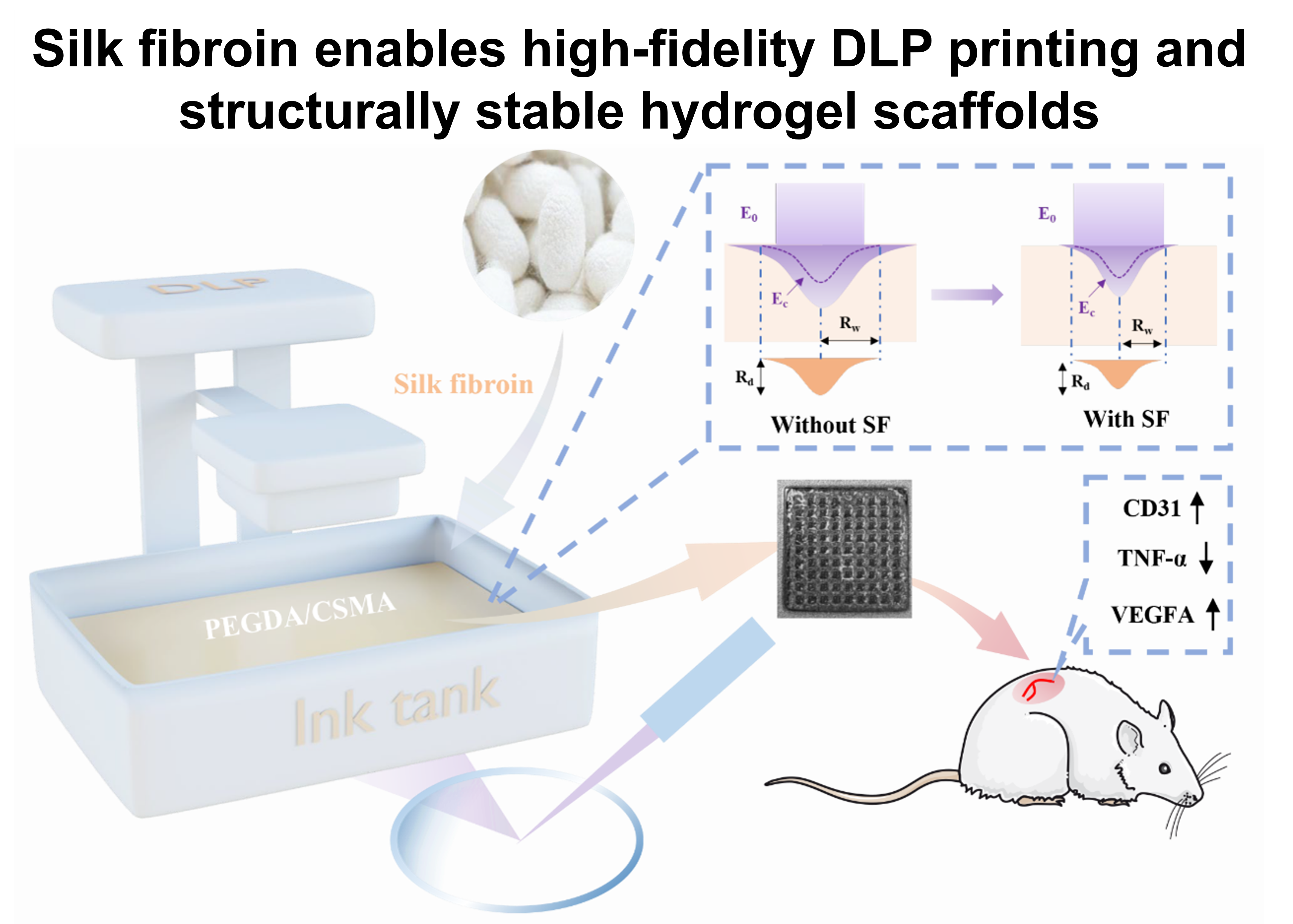
Digital light processing (DLP) three-dimensional (3D) printing is an additive manufacturing technique that fabricates objects layer by layer using digitally projected light patterns. It effectively addresses the demand for complex geometries and is widely adopted in the biological field. However, traditional macromolecular bioinks still suffer from printing inaccuracies due to light scattering and runaway free-radical reactions. In this study, we introduced silk fibroin (SF) into the conventional poly(ethylene glycol) diacrylate (PEGDA)/chitosan methacrylate (CSMA) bioink to enhance the precision of DLP 3D printing. The incorporation of SF achieved a significant improvement in mechanical property (alcohol-induced β-sheet formation increased the compressive modulus from 9.5 kPa to 208.1 kPa) and anti-swelling performance (volume swelling ratio from about 366.5% to 144.6%) of cell-free PEGDA/CSMA/SF hydrogel via alcohol treatment, meeting the enhanced mechanical requirements and addressing the commonly neglected issue of geometric deformation of 3D-printed hydrogels caused by swelling in moist environments. Ethanol treatment induced SF β-sheet structure formation and reduced PEGDA/CSMA/SF hydrogel pore size (from about 78.3 μm to 23.6 μm), thereby enhancing the hydrogel network crosslinking. The PEGDA/CSMA/SF bioink exhibited antibacterial potential, inhibiting Escherichia coli by about 41.3% and Staphylococcus aureus by about 45.8% within 12 h in vitro. The porous scaffolds were printed with a designed PEGDA/CSMA/SF bioink and effectively accelerated defect repair in rat full-thickness skin wound models (about 19.1% of the untreated control group). Histological analysis revealed that the PEGDA/CSMA/SF hydrogel scaffold promoted angiogenesis and collagen deposition, upregulated vascular endothelial growth factor A expression, and downregulated tumor necrosis factor-α expression. The straightforward approach of introducing SF into traditional bioinks represents a promising strategy for DLP 3D printing in tissue regeneration.
- Wang Q, Liu Y, Zhang S, et al. Exosome-based bioinks for 3D bioprinting applications in tissue engineering and regenerative medicine. Int J Bioprint. 2023;9(6):0114. doi: 10.36922/ijb.0114
- Yu W, Liu X, Liu Y, Chen X, Ge S, Dong Z. 3D printing of phase-separating hydrogels with tunable microachitecture for mechanoregulated bone regeneration. Adv Funct Mater. 2026;36(30). doi: 10.1002/adfm.202523349
- Andreu A, Lee H, Kang J, Yoon YJ. Self-healing materials for 3D printing. Adv Funct Mater. 2024;34(30):2315046. doi: 10.1002/adfm.202315046
- Elder B, Neupane R, Tokita E, Ghosh U, Hales S, Kong YL. Nanomaterial patterning in 3D printing. Adv Mater. 2020;32(17):1907142. doi: 10.1002/adma.201907142
- Pal S, Gavhane UA, Asha SK. Biocompatible PVAc-g-PLLA acrylate polymers for DLP 3D printing with tunable mechanical properties. ACS Appl Mater Interfaces. 2024;16(45):62594-62605. doi: 10.1021/acsami.4c11285
- Zhang N, Lu Y, Li J, et al. DLP 3D printing of hyperelastic photocurable perivascular scaffolds enabling patient-specific vascular remodeling. Acta Biomater. 2025;203:381-398. doi: 10.1016/j.actbio.2025.07.048
- Xu Z, Zhang Q, Fan C, et al. A gel microparticle-based self-thickening strategy for 3D printing high-modulus hydrogels skeleton cushioned with PNAGA hydrogel mimicking anisotropic mechanics of meniscus. Bioact Mater. 2023;26:64-76. doi: 10.1016/j.bioactmat.2023.02.020
- Yang X, Yao L, Sun X, Wang L, Xiao J. Low-temperature DLP 3D printing of low-concentration collagen methacryloyl for the fabrication of durable and bioactive personalized scaffolds. Chem Eng J. 2024;497:155650. doi: 10.1016/j.cej.2024.155650
- Yuan H, Xiao P, Sarmento B, Chen G, Cui W. Synovial lubrication factors-recruiting biomimetic polyphenolized hyaluronic acid for promoting cartilage repair. Adv Funct Mater. 2024;34(42):2406668. doi: 10.1002/adfm.202406668
- Hong H, Seo YB, Kim DY, et al. Digital light processing 3D printed silk fibroin hydrogel for cartilage tissue engineering. Biomaterials. 2020;232:119679. doi: 10.1016/j.biomaterials.2019.119679
- Ye J, Li F, Wen Z, et al. Multichannel 3D-printed bioactive scaffold combined with small interfering RNA delivery to promote neurological recovery after spinal cord injury. Research (Wash D C). 2025;8:0951. doi: 10.34133/research.0951
- Na K, Shin S, Lee H, et al. Effect of solution viscosity on retardation of cell sedimentation in DLP 3D printing of gelatin methacrylate/silk fibroin bioink. J Ind Eng Chem. 2018;61:340-347. doi: 10.1016/j.jiec.2017.12.032
- He Y, Wang F, Wang X, Zhang J, Wang D, Huang X. A photocurable hybrid chitosan/acrylamide bioink for DLP based 3D bioprinting. Mater Des. 2021;202:109588. doi: 10.1016/j.matdes.2021.109588
- Yang M, Chu L, Zhuang Y, et al. Multi-material digital light processing (DLP) bioprinting of heterogeneous hydrogel constructs with perfusable networks. Adv Funct Mater. 2024;34(32):2316456. doi: 10.1002/adfm.202316456
- Wei Q, Liu D, Chu G, et al. TGF-β1-supplemented decellularized annulus fibrosus matrix hydrogels promote annulus fibrosus repair. Bioact Mater. 2023;19:581-593. doi: 10.1016/j.bioactmat.2022.04.025
- Li X, Xing R, Xu C, et al. Immunostimulatory effect of chitosan and quaternary chitosan: a review of potential vaccine adjuvants. Carbohydr Polym. 2021;264:118050. doi: 10.1016/j.carbpol.2021.118050
- Rezaei FS, Sharifianjazi F, Esmaeilkhanian A, Salehi E. Chitosan films and scaffolds for regenerative medicine applications: a review. Carbohydr Polym. 2021;273:118631. doi: 10.1016/j.carbpol.2021.118631
- Zanon M, Cue-López R, Martínez-Campos E, et al. Bioderived dyes-mediated vat photopolymerization 3D printing of chitosan hydrogels for tissue engineering. Addit Manuf. 2023;69:103553. doi: 10.1016/j.addma.2023.103553
- Cheng F, Zhang X, Dai J, et al. Digital light processing-printed nanozyme-integrated hydrogels enable spatiotemporal immunomodulation and repair of infected wounds. Acta Biomater. 2026;214:254-270. doi: 10.1016/j.actbio.2026.03.013
- Shen Y, Tang H, Huang X, et al. DLP printing photocurable chitosan to build bio-constructs for tissue engineering. Carbohydr Polym. 2020;235:115970. doi: 10.1016/j.carbpol.2020.115970
- Miri AK, Nieto D, Iglesias L, et al. Microfluidics-enabled multimaterial maskless stereolithographic bioprinting. Adv Mater. 2018;30(27):1800242. doi: 10.1002/adma.201800242
- He N, Wang X, Shi L, et al. Photoinhibiting via simultaneous photoabsorption and free-radical reaction for high-fidelity light-based bioprinting. Nat Commun. 2023;14(1):3063. doi: 10.1038/s41467-023-38838-2
- Ma Y, Wei W, Gong L, et al. Biomacromolecule-based agent for high-precision light-based 3D hydrogel bioprinting. Cell Rep Phys Sci. 2022;3(8):100985. doi: 10.1016/j.xcrp.2022.100985
- Zhan Y, Fu W, Xing Y, Ma X, Chen C. Advances in versatile anti-swelling polymer hydrogels. Mater Sci Eng C Mater Biol Appl. 2021;127:112208. doi: 10.1016/j.msec.2021.112208
- Pan X, Li R, Li W, et al. Silk fibroin hydrogel adhesive enables sealed-tight reconstruction of meniscus tears. Nat Commun. 2024;15(1):2651. doi: 10.1038/s41467-024-47029-6
- Kundu B, Rajkhowa R, Kundu SC, Wang X. Silk fibroin biomaterials for tissue regenerations. Adv Drug Deliv Rev. 2013;65(4):457-470. doi: 10.1016/j.addr.2012.09.043
- Fei Y, Wang X, Ling Z, et al. Angiogenic apoptotic vesicle-laden silk fibroin/sodium alginate hydrogel for pulp regeneration. Mater Today Bio. 2025;33:102060. doi: 10.1016/j.mtbio.2025.102060
- Wu D, Li J, Wang C, et al. Injectable silk fibroin peptide nanofiber hydrogel composite scaffolds for cartilage regeneration. Mater Today Bio. 2024;25:100962. doi: 10.1016/j.mtbio.2024.100962
- Su D, Yao M, Liu J, Zhong Y, Chen X, Shao Z. Enhancing mechanical properties of silk fibroin hydrogel through restricting the growth of β-sheet domains. ACS Appl Mater Interfaces. 2017;9(20):17489-17498. doi: 10.1021/acsami.7b04623
- Hasturk O, Jordan KE, Choi J, Kaplan DL. Enzymatically crosslinked silk and silk-gelatin hydrogels with tunable gelation kinetics, mechanical properties and bioactivity for cell culture and encapsulation. Biomaterials. 2020;232:119720. doi: 10.1016/j.biomaterials.2019.119720
- Kaewpirom S, Teangtam W, Monthatong M, Boonsang S. Modification of silk fibroin film structure: from silkworm diet to material properties. Int J Biol Macromol. 2025;317:144855. doi: 10.1016/j.ijbiomac.2025.144855
- Li H, Ma T, Zhang J, et al. Boosting corrosion resistance and osteogenic activity of magnesium-based implants with metal ions chelated silk fibroin coating via binary solvent system. Chem Eng J. 2024;485:149905. doi: 10.1016/j.cej.2024.149905
- Rockwood DN, Preda RC, Yücel T, Wang X, Lovett ML, Kaplan DL. Materials fabrication from Bombyx mori silk fibroin. Nat Protoc. 2011;6(10):1612-1631. doi: 10.1038/nprot.2011.379
- Hu H, Zhai X, Li W, et al. A photo-triggering double cross-linked adhesive, antibacterial, and biocompatible hydrogel for wound healing. iScience. 2022;25(7):104619. doi: 10.1016/j.isci.2022.104619
- Zhang X, Yang D, Nie J. Chitosan/polyethylene glycol diacrylate films as potential wound dressing material. Int J Biol Macromol. 2008;43(5):456-462. doi: 10.1016/j.ijbiomac.2008.08.010
- Zhai X, Hu M, Song L, et al. Silk fibroin based bioinks for high-precision digital light processing 3D printing. Int J Biol Macromol. 2025;310(pt 1):143248. doi: 10.1016/j.ijbiomac.2025.143248
- Wang H, Zhang Y, Shao H, Hu X. A study on the flow stability of regenerated silk fibroin aqueous solution. Int J Biol Macromol. 2005;36(1-2):66-70. doi: 10.1016/j.ijbiomac.2005.03.011
- Yu K, Zhang X, Sun Y, et al. Printability during projection-based 3D bioprinting. Bioact Mater. 2022;11:254-267. doi: 10.1016/j.bioactmat.2021.09.021
- Zakeri S, Vippola M, Levänen E. A comprehensive review of the photopolymerization of ceramic resins used in stereolithography. Addit Manuf. 2020;35:101177. doi: 10.1016/j.addma.2020.101177
- You S, Wang P, Schimelman J, Hwang HH, Chen S. High-fidelity 3D printing using flashing photopolymerization. Addit Manuf. 2019;30:100834. doi: 10.1016/j.addma.2019.100834
- Priya S, Choudhari M, Tomar Y, et al. Exploring polysaccharide-based bio-adhesive topical film as a potential platform for wound dressing application: a review. Carbohydr Polym. 2024;327:121655. doi: 10.1016/j.carbpol.2023.121655
- Kulkarni G, Guha Ray P, Byram PK, Kaushal M, Dhara S, Das S. Tailorable hydrogel of gelatin with silk fibroin and its activation/crosslinking for enhanced proliferation of fibroblast cells. Int J Biol Macromol. 2020;164:4073-4083. doi: 10.1016/j.ijbiomac.2020.09.016
- Liang R, Shen X, Xie C, et al. Silk gel recruits specific cell populations for scarless skin regeneration. Appl Mater Today. 2021;23:101004. doi: 10.1016/j.apmt.2021.101004
- Chen Z, Cheng J, Wang M, et al. In situ forming silk fibroin hydrogel dressing accelerates acute wound healing via immunomodulation and extracellular matrix regeneration. J Control Release. 2025;387:114228. doi: 10.1016/j.jconrel.2025.114228
- Guan Q, Hou S, Wang K, et al. Micropore structure engineering of injectable granular hydrogels via controlled liquid-liquid phase separation facilitates regenerative wound healing in mice and pigs. Biomaterials. 2025;318:123192. doi: 10.1016/j.biomaterials.2025.123192
- Tetik-Elsherbiny N, Elsherbiny A, Setya A, et al. RNF20-mediated transcriptional pausing and VEGFA splicing orchestrate vessel growth. Nat Cardiovasc Res. 2024;3(10):1199-1216. doi: 10.1038/s44161-024-00546-5