

In vivo evaluation of a 3D-printed personalized temporomandibular joint condylar prosthesis with an elastic layer for hemiarthroplasty

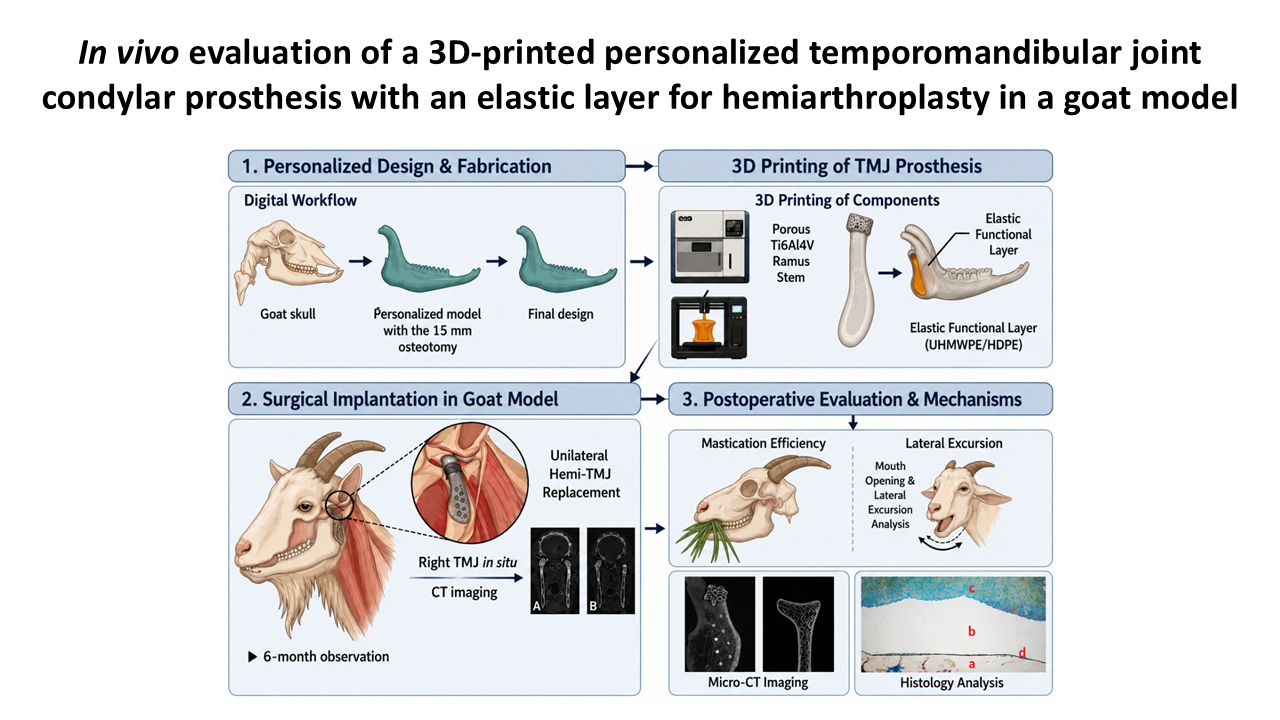
Reconstructing severe temporomandibular joint defects remains a significant challenge in oral and maxillofacial surgery. This study evaluated the in vivo performance of a novel, 3D-printed personalized temporomandibular joint (TMJ) condylar prosthesis featuring an integrated elastic functional layer (EFL) in a goat model. Conventional rigid metal and ultra-high-molecular-weight polyethylene prostheses often trigger stress shielding and contralateral joint degeneration due to a mechanical mismatch with the native articular disc. To address these limitations, unilateral hemi-TMJ reconstructions were performed on four adult male goats using a custom prosthesis combining a porous Ti6Al4V stem and a 3D-printed UHMWPE/HDPE composite elastic layer. Over a 6-month follow-up, clinical, radiographic, and histological parameters were evaluated. All animals survived without serious complications. Maximum passive mouth opening and lateral excursion ranges successfully returned to levels comparable to preoperative baselines, while masticatory efficiency stabilized after an initial postoperative decline. Hepatic and renal function metrics confirmed the material's systemic biosafety. CT and micro-CT imaging verified stable prosthetic positioning, robust osseointegration, and bone matrix ingrowth into the porous metallic scaffold. Histological analysis revealed the formation of a beneficial "synovial-like" membrane on the elastic substrate surface, which was supported by significantly elevated local expression of the regenerative cytokine TGF-β via ELISA. These findings suggest that the elastic design promotes favorable initial stability, good biocompatibility, and vital functional recovery. The observed synovial metaplasia provides a promising protective mechanism to minimize wear and prevent heterotopic ossification, offering strong preclinical evidence for elastic configurations in advanced TMJ arthroplasty.
- Yoda T, Ogi N, Yoshitake H, et al. Clinical guidelines for total temporomandibular joint replacement. Jpn Dent Sci Rev. 2020;56(1):77-83. doi: 10.1016/j.jdsr.2020.03.001
- Thor A, Bengtsson M, Dowgierd K, et al. Alloplastic total temporomandibular joint (TMJ) replacement registry: a protocol for a prospective global multicentre observational cohort study. BMJ Open. 2026;16(3):e113558. doi: 10.1136/bmjopen-2025-113558
- De Meurechy N, Braem A, Mommaerts M Y. Biomaterials in temporomandibular joint replacement: current status and future perspectives-a narrative review. Int J Oral Maxillofac Surg. 2018;47(4):518-533. doi: 10.1016/j.ijom.2017.10.001
- Cheng KJ, Liu YF, Wang JH, et al. 3D-printed porous condylar prosthesis for temporomandibular joint replacement: Design and biomechanical analysis. Technol Health Care. 2022;30(4):1017-1030. doi: 10.3233/THC-213534
- Piao C, Wu D, Luo M, Ma H. Stress shielding effects of two prosthetic groups after total hip joint simulation replacement. J Orthop Surg Res. 2014;9(1):71. doi: 10.1186/s13018-014-0071-x
- Kent JN, Misiek DJ, Akin RK, Hinds EC, Homsy CA. Temporomandibular joint condylar prosthesis: a ten-year report. J Oral Maxillofac Surg. 1983;41(4):245-254. doi: 10.1016/0278-2391(83)90267-7
- Elledge R, Mercuri LG, Attard A, Green J, Speculand B. Review of emerging temporomandibular joint total joint replacement systems. Br J Oral Maxillofac Surg. 2019;57(8):722-728. doi: 10.1016/j.bjoms.2019.08.009
- Niezen ET, van Minnen B, Bos RRM, Dijkstra PU. Temporomandibular joint prosthesis as treatment option for mandibular condyle fractures: a systematic review and meta-analysis. Int J Oral Maxillofac Surg. 2023;52(1):88-97. doi: 10.1016/j.ijom.2022.05.014
- Mehrotra D, Kumar S, Mehrotra P, et al. Patient specific total temporomandibular joint reconstruction: A review of biomaterial, designs, fabrication and outcomes. J Oral Biol Craniofac Res. 2021;11(2):334-343. doi: 10.1016/j.jobcr.2021.02.014
- Zheng JS, Liu XH, Chen XZ, et al. Customized skull base-temporomandibular joint combined prosthesis with 3D-printing fabrication for craniomaxillofacial reconstruction: a preliminary study. Int J Oral Maxillofac Surg. 2019;48(11):1440-1447. doi: 10.1016/j.ijom.2019.02.020
- Stanković S, Vlajković S, Bošković M, Radenković G, Antić V, Jevremović D. Morphological and biomechanical features of the temporomandibular joint disc: an overview of recent findings. Arch Oral Biol. 2013;58(10):1475-1482. doi: 10.1016/j.archoralbio.2013.06.014
- Jiang N, Chen H, Zhang J, et al. Decellularized-disc based allograft and xenograft prosthesis for the long-term precise reconstruction of temporomandibular joint disc. Acta Biomater. 2023;159:173-187. doi: 10.1016/j.actbio.2023.01.042
- Zhao J, Dai H, Qiao K, et al. Viscoelastic Polyurethane Discs with Host-Guest Interaction for Temporomandibular Joint Function Restoration. Adv Funct Mater. 2026;36(8):e07926. doi: 10.1002/adfm.202507926
- Xu X, Zhang J, Luo D, Guo C, Rong Q. Biomechanical comparison between the custom-made mandibular condyle prosthesis and total temporomandibular joint prosthesis in finite element analysis. Acta Bioeng Biomech. 2020;22(4): 151-160. doi: 37190/ABB-01721-2020-03
- Guo F, Huang S, Hu M, Yang C, Li D, Liu C. Biomechanical evaluation of a customized 3D-printed polyetheretherketone condylar prosthesis. Exp Ther Med. 2021;21(4):348. doi: 10.3892/etm.2021.9779
- Ackland DC, Robinson D, Redhead M, Lee PVS, Moskaljuk A, Dimitroulis G. A personalized 3D-printed prosthetic joint replacement for the human temporomandibular joint: From implant design to implantation. J Mech Behav Biomed Mater. 2017;69:404-411. doi: 10.1016/j.jmbbm.2017.01.048
- Jiang J, Jiao Z, Cheng B, Han J, Xu X, Guo C. Design, fabrication, and evaluation of a novel 3D-printed temporomandibular joint prosthesis enhanced with elastic layer. Int J Bioprinting. 2024;0(0):4899. doi: 10.36922/ijb.4899
- Baecher H, Maheta B, Lottner LM, et al. Current clinical and translational challenges in temporomandibular joint reconstruction. Front Bioeng Biotechnol. 2025;18(13):1590021. doi: 10.3389/fbioe.2025.1590021
- Angelo DF, Morouço P, Alves N, et al. Choosing sheep (Ovis aries) as animal model for temporomandibular joint research: Morphological, histological and biomechanical characterization of the joint disc. Morphologie. 2016;100(331):223-233. doi: 10.1016/j.morpho.2016.06.002
- Mommaerts MY, Deman F, Verwilghen D, De Meurechy N. Lateral pterygoid muscle enthesis reconstruction in alloplastic total temporomandibular joint replacement: an animal experiment with histological verification. J Craniomaxillofac Surg. 2025;53(5):476–483. doi: 10.1016/j.jcms.2025.01.022
- Xu X, Luo D, Guo C, Rong Q. A custom-made temporomandibular joint prosthesis for fabrication by selective laser melting: Finite element analysis. Med Eng Phys. 2017;46(1):1-11. doi: 10.1016/j.medengphy.2017.04.012
- Shokrgozar MA, Farokhi M, Rajaei F, et al. Biocompatibility evaluation of HDPE-UHMWPE reinforced β-TCP nanocomposites using highly purified human osteoblast cells. J Biomed Mater Res A. 2010;95A(4):1074-1083. doi: 1002/jbm.a.32892
- Shen P, Zhang SY, Yang C, Yun B. Biological safety evaluation of total temporomandibular joint prosthesis in sheep. China J Oral Maxillofac Surg. 2013,11(4):297-302. doi: CNKI:SUN:ZGKQ.0.2013-04-009.
- Shen P, Zhang SY, Yang C, Yun B. Stability study of total temporomandibular joint replacement on sheep. J Craniomaxillofac Surg. 2014;42(7):1265-1270. doi: 10.1016/j.jcms.2014.03.008
- Trento G, Parize H, Bohner L, Oelerich O, Jung S, Kleinheinz J. Can a unilateral total temporomandibular joint prosthesis affect the healthy contralateral temporomandibular joint? A systematic review. Int J Oral Maxillofac Surg. 2025;54(1):65-73. doi: 10.1016/j.ijom.2024.10.001.
- Olate S, Ravelo V, Huentequeo C, Parra M, Unibazo A. An Overview of Clinical Conditions and a Systematic Review of Personalized TMJ Replacement. J Pers Med. 2023;13(3):533. doi: 10.3390/jpm13030533
- Monje F, Mercuri L, Villanueva-Alcojol L, de Mera JJ. Synovial metaplasia found in tissue encapsulating a silicone spacer during 2-staged temporomandibular joint replacement for ankylosis. J Oral Maxillofac Surg. 2012;70(10):2290-2298. doi: 10.1016/j.joms.2012.06.177
- Raso DS, Greene WB, Harley RA, Maize JC. Silicone deposition in reconstruction scars of women with silicone breast implants. J Am Acad Dermatol. 1996;35(1):32-36. doi: 10.1016/S0190-9622(96)90492-2
- Ko CY, Ahn CY, Ko J, Chopra W, Shaw WW. Capsular synovial metaplasia as a common response to both textured and smooth implants. Plast Reconstr Surg. 1996;97(7):1427-1433. doi: 10.1097/00006534-199606000-00017
- Drachman D B, Sokoloff L. The role of movement in embryonic joint development. Dev Biol. 1966;14(3):401-420. doi: 10.1016/0012-1606(66)90022-4
- Linden O, Kelil T, Greenwood H, Lauw M, Strachowski L. Capsular synovial metaplasia mimicking radiographic features of implant-associated anaplastic lymphoma. Clin Imaging. 2020;59(2):144-147. doi: 10.1016/j.clinimag.2019.10.019
- Ângelo DF, Cardoso HJ, Sanz D. Synovial entrapment in alloplastic temporomandibular joint replacement. Int J Oral Maxillofac Surg. 2021;50(12):1628-1631. doi: 10.1016/j.ijom.2021.05.022
- Vargas E, Ravelo V, Rana M, Unibazo A, Olate S. Long-Term Stability in Temporomandibular Joint Replacement: A Review of Related Variables. Dent J (Basel). 2024;12(11):372. doi: 10.3390/dj12110372
- Zhong YQ, Sun Q, He DM, Zou LX, Lu C. Study on the lateral pterygoid muscle status after artificial temporomandibular joint replacement. Int J Oral Maxillofac Surg. 2021;50(11):1496-1501. doi: 10.1016/j.ijom.2021.03.008
- Su L, Kang Y, Guo C, Wang X. Analysis of Dynamic Mandibular Movement of Patients With Condylar Hyperplasia Treated With Orthognathic Surgery and Condylectomy. J Craniofac Surg. 2025;36(6):1972-1977. doi: 10.1097/SCS.0000000000011083
- Lall AB, Singhal M, Kusum T, Safi S. Evaluation of Masticatory Efficiency and Mandibular Function Following Open or Closed Reduction of Mandibular Fractures. J Maxillofac Oral Surg. 2025;24(6):1668-1675. doi: 10.1007/s12663-025-02641-x.
- Braczkowski MJ, Kufel KM, Kulińska J, et al. Pleiotropic Action of TGF-β in Physiological and Pathological Liver Conditions. Biomedicines. 2024;12(4):925. doi: 10.3390/biomedicines12040925
- de Araújo Farias V, Carrillo-Gálvez AB, Martín F, Anderson P. TGF-β and mesenchymal stromal cells in regenerative medicine, autoimmunity and cancer. Cytokine Growth Factor Rev. 2018;43:25-37. doi: 10.1016/j.cytogfr.2018.06.002
- Nakerakanti S, Trojanowska M. The Role of TGF-β Receptors in Fibrosis. Open Rheumatol J. 2012;6(1):156-162. doi: 10.2174/1874312901206010156
- De Meurechy N, Aktan MK, Boeckmans B, et al. Surface wear in a custom manufactured temporomandibular joint prosthesis. J Biomed Mater Res B Appl Biomater. 2022;110(6):1425-1438. doi: 10.1002/jbm.b.35010