
Coaxial 3D printing of hollow tubular sodium alginate/polyacrylamide double-network hydrogel scaffolds

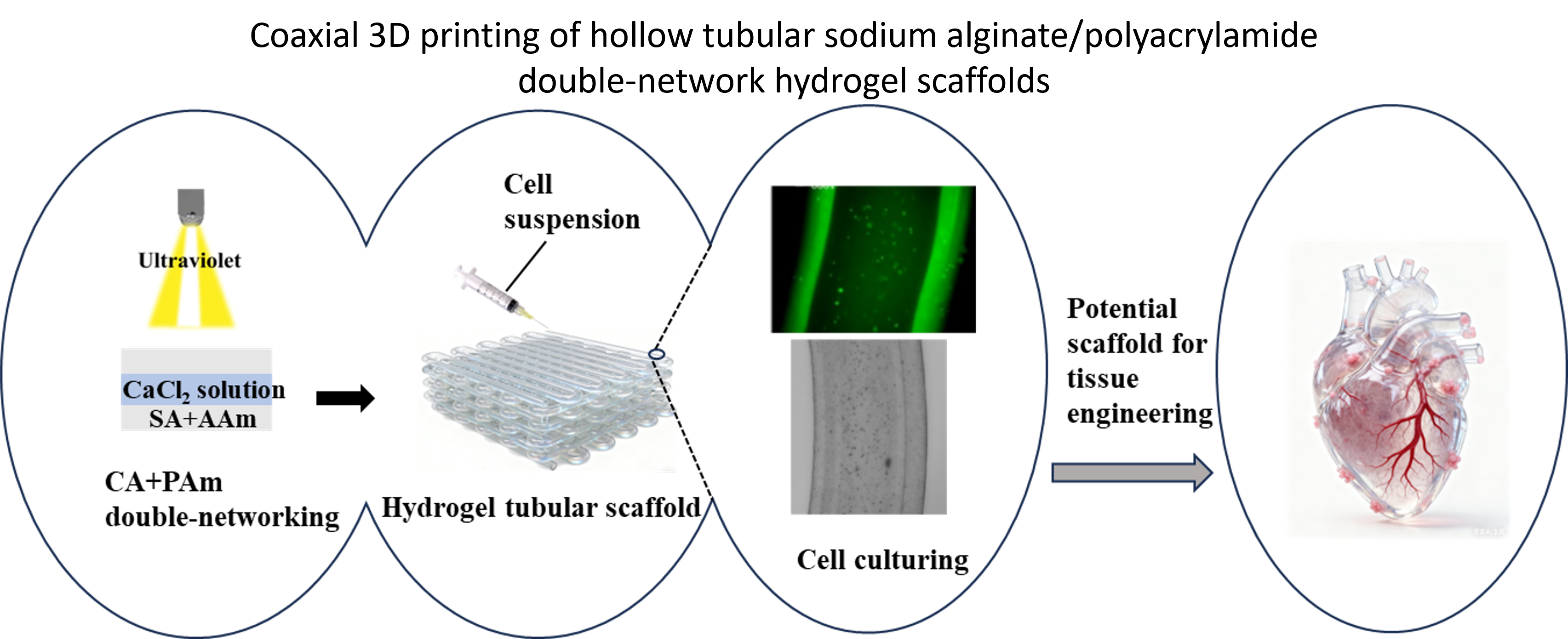
Tubular hydrogel scaffolds facilitate nutrient and oxygen transport, making them particularly suitable for culturing cells with high metabolic demands. In this study, a double-network hydrogel scaffold with a tubular structure was fabricated using coaxial extrusion-based 3D printing. The hydrogel was composed of sodium alginate and polyacrylamide, and its biocompatibility was assessed through cell culture experiments. The results show that the crosslinking sequence, material composition, and printing parameters were the main factors affecting the macrostructure, microstructure, and mechanical properties of the hydrogel. The CA-PAm hydrogel, in which alginate was ionically crosslinked before subsequent acrylamide (AAm) polymerization under UV exposure, exhibited a more compact microstructure and superior mechanical performance. By optimizing the material composition, the CA-PAm hydrogel achieved a tensile strength of 809.80 kPa and an elongation at break of 217.07%. In addition, the inner-to-outer flow-rate ratio and the platform moving speed are critical factors determining the tubular structural parameters and 3D structural stability. The hydrogel leachate assay showed 89.8% cell viability, and perfusion culture within the tubular scaffold showed an MEF survival rate of 85.4% after three days, indicating good biocompatibility of the scaffold. These results show that crosslinking-sequence reconfiguration is a practical strategy for matching hydrogel network formation with the requirements of coaxial tubular printing and provides a feasible route for fabricating mechanically robust and cytocompatible hollow hydrogel scaffolds for tissue engineering.
- Khademhosseini A, Langer R. A decade of progress in tissue engineering. Nat Protoc. 2016;11(10):1775-1781. doi: 10.1038/nprot.2016.123
- Rouwkema J, Rivron NC, van Blitterswijk CA. Vascularization in tissue engineering. Trends Biotechnol. 2008;26(8):434-441. doi: 10.1016/j.tibtech.2008.04.009
- Ntege EH, Sunami H, Shimizu Y. Advances in regenerative therapy: A review of the literature and future directions. Regen Ther. 2020;14:136-153. doi: 10.1016/j.reth.2020.01.004
- Kolesky DB, Homan KA, Skylar-Scott MA, Lewis JA. Three-dimensional bioprinting of thick vascularized tissues. Proc Natl Acad Sci USA. 2016;113(12):3179-3184. doi: 10.1073/pnas.1521342113
- Zhu W, Qu X, Zhu J, et al. Direct 3D bioprinting of prevascularized tissue constructs with complex microarchitecture. Biomaterials. 2017;124:106-115. doi: 10.1016/j.biomaterials.2017.01.042
- Priya SG, Jungvid H, Kumar A. Skin Tissue Engineering for Tissue Repair and Regeneration. Tissue Eng Part B Rev. 2008;14(1):105-118. doi: 10.1089/teb.2007.0318
- Ratcliffe A. Tissue engineering of vascular grafts. Matrix Biol. 2000;19(4):353-357. doi: 10.1016/s0945-053x(00)00080-9
- Mollica PA, Booth-Creech EN, Reid JA, et al. 3D bioprinted mammary organoids and tumoroids in human mammary derived ECM hydrogels. Acta Biomater. 2019;95:201-213. doi: 10.1016/j.actbio.2019.06.017
- Xue L, Greisler HP. Biomaterials in the development and future of vascular grafts. J Vasc Surg. 2003;37(2):472-480. doi: 10.1067/mva.2003.88
- Datta P, Ayan B, Ozbolat IT. Bioprinting for vascular and vascularized tissue biofabrication. Acta Biomater. 2017;51:1- 20. doi: 10.1016/j.actbio.2017.01.035
- Jain RK, Au P, Tam J, Duda DG, Fukumura D. Engineering vascularized tissue. Nat Biotechnol. 2005;23(7):821-823. doi: 10.1038/nbt0705-821
- Boland T, Xu T, Damon B, Cui X. Application of inkjet printing to tissue engineering. Biotechnol J. 2006;1(9):910- 917. doi: 10.1002/biot.200600081
- Boland T, Mironov V, Gutowska A, Roth EA, Markwald RR. Cell and organ printing 2: Fusion of cell aggregates in three-dimensional gels. Anat Rec. 2003;272A(2):497-502. doi: 10.1002/ar.a.10059
- Gu BK, Choi DJ, Park SJ, Kim YJ, Kim CH. 3D Bioprinting Technologies for Tissue Engineering Applications. In: Advances in Experimental Medicine and Biology. Springer Singapore; 2018:15-28. doi: 10.1007/978-981-13-0950-2_2
- Duan B, Hockaday LA, Kang KH, Butcher JT. 3D Bioprinting of heterogeneous aortic valve conduits with alginate/gelatin hydrogels. J Biomed Mater Res A. 2013;101A(5):1255-1264. doi: 10.1002/jbm.a.34420
- Albrecht DR, Underhill GH, Wassermann TB, Sah RL, Bhatia SN. Probing the role of multicellular organization in three-dimensional microenvironments. Nat Methods. 2006;3(5):369-375. doi: 10.1038/nmeth873
- Khalil S, Sun W. Bioprinting Endothelial Cells With Alginate for 3D Tissue Constructs. J Biomech Eng. 2009;131(11):111002. doi: 10.1115/1.3128729
- Attalla R, Puersten E, Jain N, Selvaganapathy PR. 3D bioprinting of heterogeneous bi- and tri-layered hollow channels within gel scaffolds using scalable multi-axial microfluidic extrusion nozzle. Biofabrication. 2018;11(1):015012. doi: 10.1088/1758-5090/aaf7c7
- Shao L, Gao Q, Xie C, Fu J, Xiang M, He Y. Directly coaxial 3D bioprinting of large-scale vascularized tissue constructs. Biofabrication. 2020;12(3):035014. doi: 10.1088/1758-5090/ab7e76
- Pei M, Peng X, Wan T, et al. Double cross-linked poly(vinyl alcohol) microcomposite hydrogels with high strength and cell compatibility. Eur Polym J. 2021;160:110786. doi: 10.1016/j.eurpolymj.2021.110786
- E S, Ning D, Wang Y, et al. Ternary Synergistic Strengthening and Toughening of Bio-Inspired TEMPO-Oxidized Cellulose Nanofibers/Borax/Polyvinyl Alcohol Composite Film with High Transparency. ACS Sustainable Chem Eng. 2020;8(41):15661-15669. doi: 10.1021/acssuschemeng.0c05292
- Zhong Y, Lin Q, Yu H, et al. Construction methods and biomedical applications of PVA-based hydrogels. Front Chem. 2024;12. doi: 10.3389/fchem.2024.1376799
- Sun JY, Zhao X, Illeperuma WRK, et al. Highly stretchable and tough hydrogels. Nature. 2012;489(7414):133-136. doi: 10.1038/nature11409
- Zhang Y, Yu Y, Chen H, Ozbolat IT. Characterization of printable cellular micro-fluidic channels for tissue engineering. Biofabrication. 2013;5(2):025004. doi: 10.1088/1758-5082/5/2/025004
- Gao Q, He Y, Fu J-z, Liu A, Ma L. Coaxial nozzle-assisted 3D bioprinting with built-in microchannels for nutrients delivery. Biomaterials. 2015;61:203-215. doi: 10.1016/j.biomaterials.2015.05.031
- Jia W, Gungor-Ozkerim PS, Zhang YS, et al. Direct 3D bioprinting of perfusable vascular constructs using a blend bioink. Biomaterials. 2016;106:58-68. doi: 10.1016/j.biomaterials.2016.07.038