

Neuromodulation with a 3D-printed, patient-specific hand orthotic in stroke: A proof-of-concept fMRI case series on clinical application

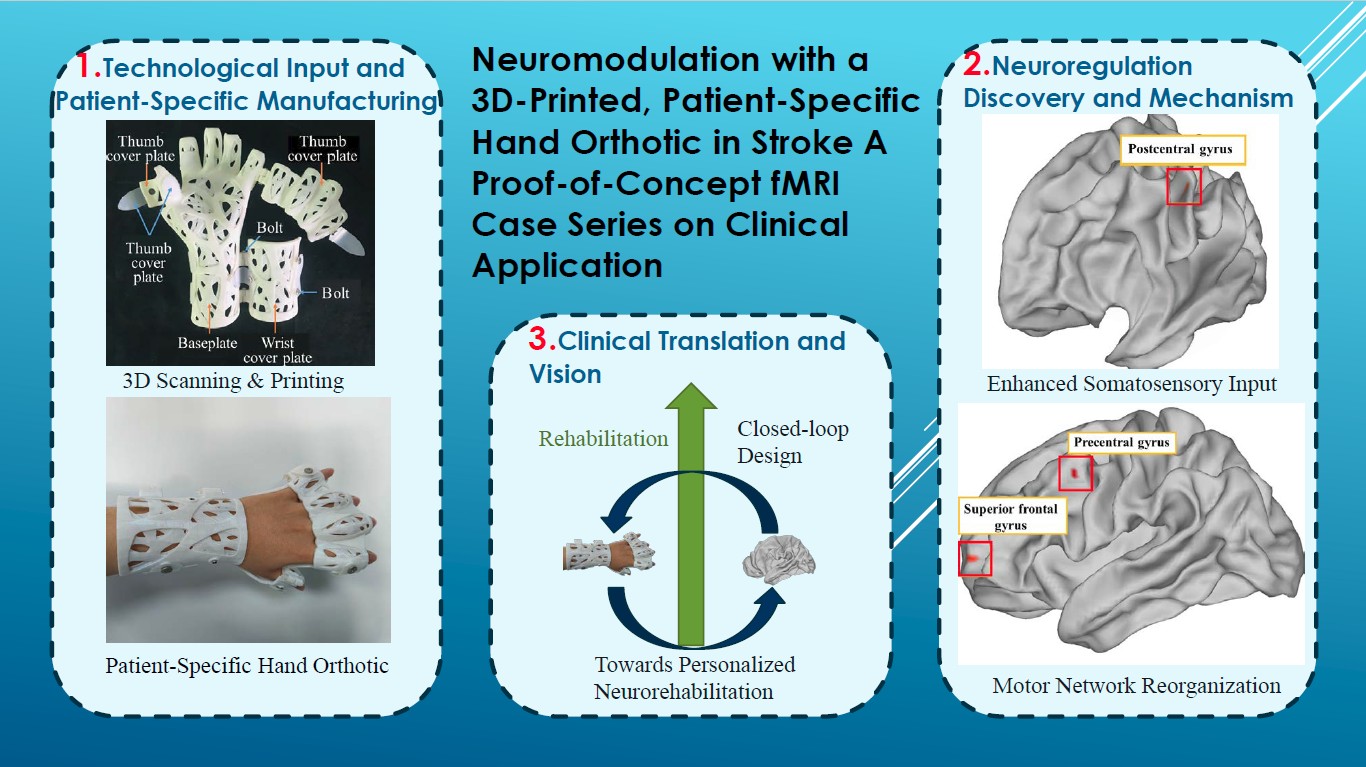
Three-dimensional (3D) printing holds great promise for creating patient-specific rehabilitative devices. While previous studies have demonstrated that behavioral interventions can induce cortical reorganization in stroke, direct evidence that a device alone—specifically, a patient-specific 3D-printed orthotic—can modulate brain function remains lacking. This proof-of-concept case series bridges this gap by integrating a complete digital workflow—from upper limb 3D scanning to stereolithography (SLA) fabrication of a custom hand orthotic—with longitudinal multimodal functional magnetic resonance imaging (fMRI) to assess cortical reorganization in chronic stroke. Four patients participated, with two index cases wearing the 3D-printed orthosis daily for four months alongside conventional rehabilitation, while two reference patients underwent conventional therapy only. Pre- and post-intervention neuroimaging revealed consistent, orthosis-associated neural changes: enhanced activity in the primary somatosensory cortex and greater functional integration within sensorimotor networks. Structural adaptations in motor regions were also observed in both index cases. Quantitatively, the index cases exhibited functional changes in nine brain regions and structural changes in six regions, substantially exceeding the minimal changes observed in the reference cases. This work provides the first direct evidence that a 3D-printed, patient-specific orthotic can drive targeted neuroplasticity independent of intensive behavioral coaching, validating its role not merely as a passive assistive device but as an active neuromodulatory tool. It establishes a translational framework for using objective neuroimaging biomarkers to guide the development and personalization of 3D-printed interventions in neurorehabilitation.
- Ledoux ED, Barth EJ. Design, modeling, and preliminary evaluation of a 3D-printed wrist–hand grasping orthosis for stroke survivors. Wearable Technol. 2024;5:e12. doi: 10.1017/wtc.2024.18
- Bose D, Gupta S, Chanda A. Scalable direct manufacturing of a functional multipurpose wrist-hand orthosis using 3D printing. Ann 3D Print Med. 2025;17:100186. doi: 10.1016/j.stlm.2025.100186
- Demeco A, Foresti R, Frizziero A, et al. The Upper Limb Orthosis in the Rehabilitation of Stroke Patients: The Role of 3D Printing. Bioengineering. 2023;10(11):1256. doi: 10.3390/bioengineering10111256
- Gorelick PB. The global burden of stroke: persistent and disabling. Lancet Neurol. 2019;18(5):417-418. doi: 10.1016/S1474-4422(19)30030-4
- The GBD 2016 Lifetime Risk of Stroke Collaborators. Global, regional, and country-specific lifetime risks of stroke, 1990 and 2016. New Engl. J. Med. 2018;379(25):2429-2437. doi: 10.1056/NEJMoa180449
- He Q, Wang W, Zhang Y, et al. Global, regional, and national burden of stroke, 1990–2021: A systematic analysis for global burden of disease 2021. Stroke. 2024;55(12):2815- 2824. doi: 10.1161/STROKEAHA.124.048033
- Cantillo-Negrete J, Carino-Escobar RI, Carrillo-Mora P, et al. Brain-Computer Interface Coupled to a Robotic Hand Orthosis for Stroke Patients’ Neurorehabilitation: A Crossover Feasibility Study. Front Hum Neurosci. 2021;15:656975. doi: 10.3389/fnhum.2021.656975
- Vaughn S, Cournan M. World Health Organization Rehabilitation 2030: Call to Action Update. Rehabil Nurs J. 2024;49(5):143-146. doi: 10.1097/RNJ.0000000000000473
- Toth L, Schiffer A, Nyitrai M, et al. Developing an anti-spastic orthosis for daily home-use of stroke patients using smart memory alloys and 3D printing technologies. Mater Des. 2020;195:109029. doi: 10.1016/j.matdes.2020.109029
- Oud TAM, Lazzari E, Gijsbers HJH, et al. Effectiveness of 3D-printed orthoses for traumatic and chronic hand conditions: A scoping review. PloS ONE. 2021;16(11):e0260271. doi: 10.1371/journal.pone.0260271
- Yang YS, Tseng CH, Fang WC, Han IW, Huang SC. Effectiveness of a New 3D-Printed Dynamic Hand–Wrist Splint on Hand Motor Function and Spasticity in Chronic Stroke Patients. J Clin Med. 2021;10(19):4549. doi: 10.3390/jcm10194549
- Wang K, Shi Y, He W, et al. The research on 3D printing fingerboard and the initial application on cerebral stroke patient’s hand spasm. BioMedical Eng. 2018;17(1):92. doi: 10.1186/s12938-018-0522-4
- Schlaug G, Cassarly C, Feld JA, et al. Safety and efficacy of transcranial direct current stimulation in addition to constraint-induced movement therapy for post-stroke motor recovery (TRANSPORT2): a phase 2, multicentre, randomised, sham-controlled triple-blind trial. Lancet Neurol. 2025;24(5):400-412. doi: 10.1016/S1474-4422(25)00044-4
- Ang BWK, Yeow CH. Design and Characterization of a 3D Printed Soft Robotic Wrist Sleeve with 2 DoF for Stroke Rehabilitation. In: Proceedings of the 2019 2nd IEEE International Conference on Soft Robotics (RoboSoft); April 14-18, Seoul, South Korea. IEEE; 2019:577-582. doi: 10.1109/ROBOSOFT.2019.8722771
- Zheng Y, Liu G, Yu L, Wang Y, Fang Y, Shen Y, et al. Effects of a 3D-printed orthosis compared to a low-temperature thermoplastic plate orthosis on wrist flexor spasticity in chronic hemiparetic stroke patients: a randomized controlled trial. Clin Rehabil. 2019;34(2):194-204. doi: 10.1177/0269215519885174
- Cui Y, Cheng S, Chen X, Xu G, Ma N, Li H, et al. Advances in the clinical application of orthotic devices for stroke and spinal cord injury since 2013. Front Neurol. 2023;14. doi: 10.3389/fneur.2023.1108320
- Levy CE, Nichols DS, Schmalbrock PM, et al. Functional MRI evidence of cortical reorganization in upper-limb stroke hemiplegia treated with constraint-induced movement therapy. Am J Phys Med Rehabil. 2001;80(1):4-12. doi: 10.1097/00002060-200101000-00003
- Lv H, Wang Z, Tong E, et al. Resting-state functional MRI: everything that nonexperts have always wanted to know. Am J Neuroradiol. 2018;39(8):1390-1399. doi: 10.3174/ajnr.A5527
- Wang X, Wang H, Xiong X, et al. Motor imagery training after stroke increases slow-5 oscillations and functional connectivity in the ipsilesional inferior parietal lobule. Neurorehabilit Neural Repair. 2020;34(4):321-332. doi: 10.1177/1545968319899919
- de Jesus Faria AST. Additive manufacturing of custom-fit orthoses for the upper limb. Master’s Thesis. Porto, Portugal: Universidade do Porto; 2017.
- Meier TB, Nycz CJ, Daudelin A, Fischer GS. The PneuHOPE Hand Exoskeleton: A Platform for Studying Brain Activation During Robot-Facilitated Hand Movement Using fMRI. IEEE Trans Med Robot Bionics. 2025;7(1):85-93. doi: 10.1109/TMRB.2024.3503998
- Tombari D, Loubinoux I, Pariente J, et al. A longitudinal fMRI study: in recovering and then in clinically stable sub-cortical stroke patients. Neuroimage. 2004;23(3):827-839. doi: 10.1016/j.neuroimage.2004.07.058
- Ward NS, Brown MM, Thompson AJ, Frackowiak RSJ. Neural correlates of motor recovery after stroke: a longitudinal fMRI study. Brain. 2003;126(11):2476-2496. doi: 10.1093/brain/awg245
- Cramer SC. Treatments to promote neural repair after stroke. J Stroke. 2018;20(1):57-70. doi: 10.5853/jos.2017.02796
- Dobkin BH, Carmichael ST. The specific requirements of neural repair trials for stroke. Neurorehabilit Neural Repair 2016;30(5):470-478. doi: 10.1177/1545968315604400
- Buma FE, Raemaekers M, Kwakkel G, Ramsey NF. Brain Function and Upper Limb Outcome in Stroke: A Cross-Sectional fMRI Study. Cappello F, ed. PLoS ONE. 2015;10(10):e0139746. doi: 10.1371/journal.pone.0139746
- Kitago T, Liang J, Huang VS, et al. Improvement after constraint-induced movement therapy: recovery of normal motor control or task-specific compensation? Neurorehabilit Neural Repair. 2013;27(2):99-109. doi: 10.1177/1545968312452631
- Manganotti P, Acler M, Formaggio E, et al. Changes in cerebral activity after decreased upper-limb hypertonus: an EMG-fMRI study. Magn Reson Imaging. 2010;28(5):646- 652. doi: 10.1016/j.mri.2009.12.023
- Schuster-Amft C, Henneke A, Hartog-Keisker B, et al. Intensive virtual reality-based training for upper limb motor function in chronic stroke: a feasibility study using a single case experimental design and fMRI. Disabil Rehabil Assist Technol. 2015;10(5):385-392. doi: 10.3109/17483107.2014.908963
30. Crofts A, Kelly ME, Gibson CL. Imaging functional recovery following ischemic stroke: clinical and preclinical fMRI studies. J Neuroimaging. 2020;30(1):5-14. doi: 10.1111/jon.12668