

Roughness-engineered 3D-printed microfluidics for continuous glucose and lactate sensing in 3D in vitro tissue models

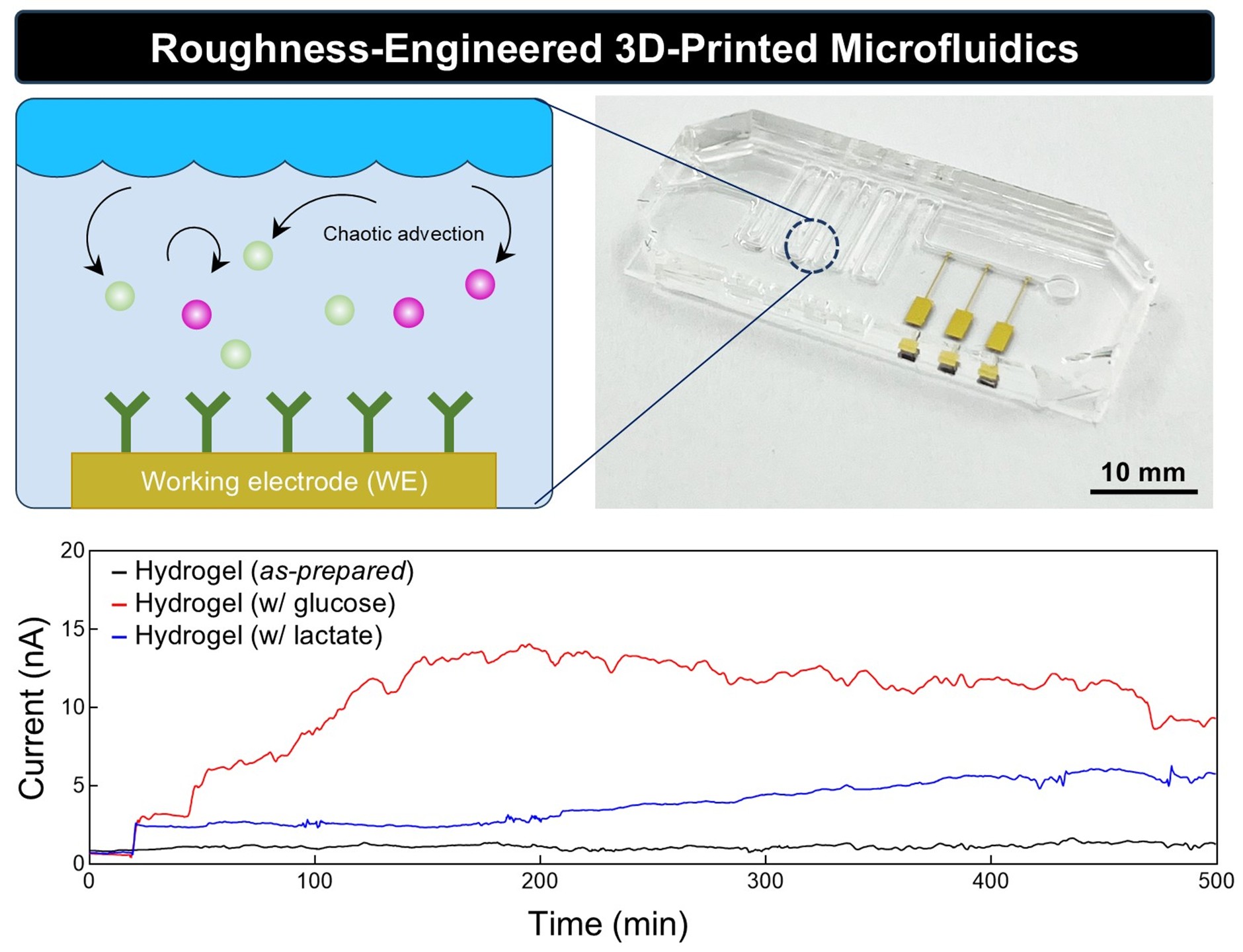
Monitoring metabolic flux in 3D tissue models is essential for validating physiological maturity and maintaining homeostatic balance. However, conventional optical based analytical techniques often fail to capture dynamic and transient metabolic shifts due to phototoxicity, signal attenuation in thick 3D constructs, and the requirement for invasive labeling, all of which hinder long-term, continuous monitoring. Standard assays such as high-performance liquid chromatography (HPLC) and enzyme-linked immunosorbent assay (ELISA) are also inherently time consuming and labor-intensive. Although electrochemical sensors offer a promising alternative, their integration into microfluidic platforms is frequently constrained by limited mass transport and the poor scalability of traditional lithography-based fabrication methods. Herein, we report an integrated, roughness-engineered microfluidic platform that addresses these limitations by strategically exploiting the “stair-stepping” artifacts inherent to fused deposition modeling (FDM) 3D printing as functional passive micromixers. By repurposing these manufacturing defects into deterministic micro-topographies, the platform induces chaotic advection,disrupting the boundary layer and enhancing solute exchange at physiologically relevant low flow rates. Numerical simulations elucidate the correlation between surface roughness and fluidic vorticity, providing a robust framework for performance optimization. Experimental validation demonstrates superior sensitivity, with a glucose response of 6.983 nA/mM and a lactate response of 5.669 nA/mM. Finally, real-time monitoring of biomimetic hydrogel phantoms over 500 min underscores the platform’s potential as a scalable and cost-effective quality control tool for 3D in vitro tissue engineering and regenerative medicine.
- Cardoso, B.D., E.M. Castanheira, S. Lanceros‐Mendez, and V.F. Cardoso. Recent advances on cell culture platforms for in vitro drug screening and cell therapies: from conventional to microfluidic strategies. Adv. Healthc. Mater. 2023;12(18):2202936. doi: 10.1002/adhm.202202936
- Ko, J., D. Park, J. Lee, et al. Microfluidic high-throughput 3D cell culture. Nat. Rev. Bioeng. 2024;2(6):453-469. doi: 10.1038/s44222-024-00163-8
- Dornhof, J., J. Kieninger, H. Muralidharan, et al. Microfluidic organ-on-chip system for multi-analyte monitoring of metabolites in 3D cell cultures. Lab Chip. 2022;22(2):225-239. doi: 10.1039/D1LC00689D
- Nashimoto, Y., R. Mukomoto, T. Imaizumi, et al. Electrochemical sensing of oxygen metabolism for a three dimensional cultured model with biomimetic vascular flow. Biosens. Bioelectron. 2023;219: 114808. doi: 10.1016/j.bios.2022.114808
- Sun, C., G. Wu, D. Wu, et al. Determining the optimal transplantation window in hepatic organoids via real-time biosensing of vascularization and metabolic maturation utilizing the integrated organoid-on-a-chip platform. Biosens. Bioelectron. 2025:118057. doi: 10.1016/j.bios.2025.118057
- Kim, Y., H. Kim, U.H. Ko, et al. Islet-like organoids derived from human pluripotent stem cells efficiently function in the glucose responsiveness in vitro and in vivo. Sci Rep. 2016;6(1):35145. doi: 10.1038/srep35145
- Kim, J., J. Kim, Y. Jin, and S.-W. Cho. In situ biosensing technologies for an organ-on-a-chip. Biofabrication. 2023;15(4):042002. doi: 10.1088/1758-5090/aceaae
- Kim, Y., E.C. Chica-Carrillo, and H.J. Lee. Microfabricated sensors for non-invasive, real-time monitoring of organoids. Micro Nano Syst. Lett. 2024;12(1):26. doi: 10.1186/s40486-024-00216-y
- Lee, J., I. Soltis, S.A. Tillery, et al. Long-term stable pH sensor array with synergistic bilayer structure for 2D real-time mapping in cell culture monitoring. Biosens Bioelectron. 2024;254:116223. doi: 10.1016/j.bios.2024.116223
- Moya, A., M. Ortega-Ribera, X. Guimera, et al. Online oxygen monitoring using integrated inkjet-printed sensors in a liver-on-a-chip system. Lab Chip. 2018;18(14):2023-2035. doi: 10.1039/c8lc00456k
- Weltin, A., S. Hammer, F. Noor, et al. Accessing 3D microtissue metabolism: Lactate and oxygen monitoring in hepatocyte spheroids. Biosens. Bioelectron. 2017;87:941-948. doi: 10.1016/j.bios.2016.07.094
- Heidenberger, J., E.I. Reihs, J. Strauss, et al. The effect of cyclic fluid perfusion on the proinflammatory tissue environment in osteoarthritis using equine joint-on-a-chip models. Lab Chip. 2025;25(9):2256-2269. doi: 10.1039/D4LC01078G
- Dupard, S.J., A.G. Garcia, and P.E. Bourgine. Customizable 3D printed perfusion bioreactor for the engineering of stem cell microenvironments. Front Bioeng Biotechnol. 2023;10:1081145. doi: 10.3389/fbioe.2022.1081145
- Ceccato, B.T., S.S. Vianna, and L.G. de la Torre. Numerical and experimental investigation of chaotic advection and diffusion mixing effects in 3D multihelical microfluidics for liposome synthesis. Chem. Eng. Sci. 2024;295:120190. doi: 10.1016/j.ces.2024.120190
- Fournie, V., B. Venzac, E. Trevisiol, et al. A microfluidics assisted photopolymerization method for high-resolution multimaterial 3D printing. Addit Manuf. 2023;72:103629. doi: 10.1016/j.addma.2023.103629
- Nielsen, A.V., M.J. Beauchamp, G.P. Nordin, and A.T. Woolley. 3D printed microfluidics. Annu Rev Anal Chem. 2020;13(1):45-65. doi: 10.1146/annurev-anchem-091619-102649
- Wang, X., J. Liu, R. Dong, M.D. Gilchrist, and N. Zhang. High-precision digital light processing (DLP) printing of microstructures for microfluidics applications based on a machine learning approach. Virtual Phys Prototyp. 2024;19(1):e2318774. doi: 10.1080/17452759.2024.2318774
- Quero, R.F., B.M. de Castro Costa, J.A.F. da Silva, and D.P. de Jesus. Using multi-material fused deposition modeling (FDM) for one-step 3D printing of microfluidic capillary electrophoresis with integrated electrodes for capacitively coupled contactless conductivity detection. Sens Actuator B-Chem. 2022;365:131959. doi: 10.1016/j.snb.2022.131959
- Su, R., F. Wang, and M.C. McAlpine. 3D printed microfluidics: advances in strategies, integration, and applications. Lab Chip. 2023;23(5):1279-1299. doi: 10.1039/D2LC01177H
- Collingwood, J., K. De Silva, and K. Arif. High-speed 3D printing for microfluidics: Opportunities and challenges. Mater Today Proc. 2023. doi: 10.1016/j.matpr.2023.05.683
- Nelson, M.D., P.A. Tresco, C.C. Yost, and B.K. Gale. Achieving biocompatibility and tailoring mechanical properties of SLA 3D printed devices for microfluidic and cell culture applications. Lab Chip. 2024;24(19):4632-4638. doi: 10.1039/D4LC00354C
- Khoo, H., W.S. Allen, N. Arroyo-Curras, and S.C. Hur. Rapid prototyping of thermoplastic microfluidic devices via SLA 3D printing. Sci Rep. 2024;14(1):17646. doi: 10.1038/s41598-024-68761-5
- Shin, H., H.J. Lee, U. Chae, et al. Neural probes with multidrug delivery capability. Lab Chip. 2015;15(18):3730-3737. doi: 10.1039/c5lc00582e