

Multimaterial vat photopolymerization: Computational optimization of slicing workflow for complex tissue geometries

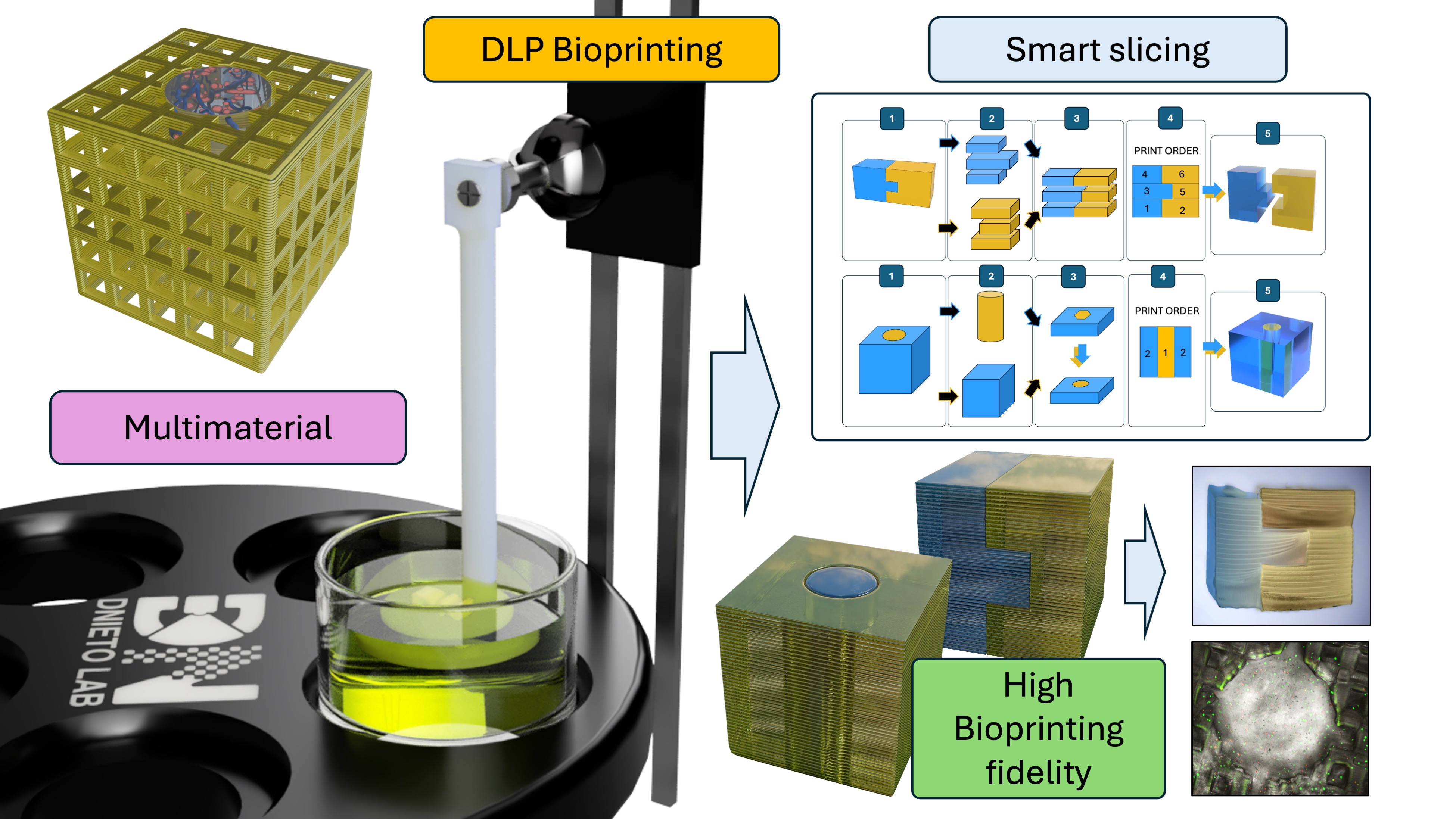
Multimaterial printing using digital light processing (DLP) has progressed from a niche laboratory method to a scalable technology capable of fabricating complex and functional tissue constructs. However, current multimaterial DLP workflows face significant limitations. Material changes typically require repeated washing and reloading steps, which increase print time, raise the risk of cross-contamination or layer misalignment, and ultimately constrain scaffold design complexity and biological relevance. To address these challenges, we present a computational pipeline that significantly improves the efficiency, precision, and usability of DLP for multimaterial bioprinting. Our system includes three key innovations: (i) a high-resolution segmentation and material-labeling method using computer graphics techniques for accurate material assignment in Standard Tessellation Language (STL) models; (ii) a computer vision-based algorithm for real-time detection and correction of material interference or contamination; and (iii) a GPU-accelerated layer sequencing method that supports rapid, precise material switching within single-layer projections. Experimental validation demonstrates improved print fidelity, reduced processing time, and higher material resolution. We further showcase the practical utility of our system by bioprinting a multimaterial tissue construct composed of a poly(ethylene glycol) diacrylate-based scaffold integrated with a gelatin methacryloyl-based cell-laden microenvironment. This work represents a significant step toward enabling scalable, high-resolution, and biologically functional scaffold fabrication for advanced tissue engineering applications.
- Deo KA, Singh KA, Peak CW, Alge DL, Gaharwar AK. Bioprinting 101: design, fabrication, and evaluation of cell-laden 3D bioprinted scaffolds. Tissue Eng Part A. 2020;26(5-6):318-338. doi: 10.1089/ten.tea.2019.0298
- Tripathi S, Mandal SS, Bauri S, Maiti P. 3D bioprinting and its innovative approach for biomedical applications. MedComm (2020). 2023;4(1):e194. doi: 10.1002/mco2.194
- Mirshafiei M, Rashedi H, Yazdian F, Rahdar A, Baino F. Advancements in tissue and organ 3D bioprinting: current techniques, applications, and future perspectives. Mater Des. 2024;240:112853. doi: 10.1016/j.matdes.2024.112853
- Leberfinger AN, Dinda S, Wu Y, et al. Bioprinting functional tissues. Acta Biomater. 2019;95:32-49. doi: 10.1016/j.actbio.2019.01.009
- Li W, Wang M, Ma H, Chapa-Villarreal FA, Lobo AO, Zhang YS. Stereolithography apparatus and digital light processing-based 3D bioprinting for tissue fabrication. iScience. 2023;26(2):106039. doi: 10.1016/j.isci.2023.106039
- Alparslan C, Bayraktar Ş. Advances in digital light processing (DLP) bioprinting: a review of biomaterials and its applications, innovations, challenges, and future perspectives. Polymers (Basel). 2025;17(9):1287. doi: 10.3390/polym17091287
- Nazir A, Gokcekaya O, Md Masum Billah K, et al. Multi-material additive manufacturing: a systematic review of design, properties, applications, challenges, and 3D printing of materials and cellular metamaterials. Mater Des. 2023;226:111661. doi: 10.1016/j.matdes.2023.111661
- Kwok TH. Comparing slicing technologies for digital light processing printing. J Comput Inf Sci Eng. 2019;19(4):044502. doi: 10.1115/1.4043672
- Yang S, Wang L, Chen Q, Xu M. In situ process monitoring and automated multi-parameter evaluation using optical coherence tomography during extrusion-based bioprinting. Addit Manuf. 2021;47:102251. doi: 10.1016/j.addma.2021.102251
- Kim H, Choi J, Wicker R. Scheduling and process planning for multiple material stereolithography. Rapid Prototyp J. 2010;16(4):232-240. doi: 10.1108/13552541011049243
- Shaukat U, Rossegger E, Schlögl S. A review of multi-material 3D printing of functional materials via vat photopolymerization. Polymers (Basel). 2022;14(12):2449. doi: 10.3390/polym14122449
- Shaukat U, Thalhamer A, Rossegger E, Schlögl S. Dual-vat photopolymerization 3D printing of vitrimers. Addit Manuf. 2024;79:103930. doi: 10.1016/j.addma.2023.103930
- Chin KCH, Ovsepyan G, Boydston AJ. Multi-color dual wavelength vat photopolymerization 3D printing via spatially controlled acidity. Nat Commun. 2024;15(1):3867. doi: 10.1038/s41467-024-48159-7
- Ghaderi I, Behravesh AH, Hedayati SK, et al. Multimaterial additive manufacturing of poly-L-lactic acid–hydroxylapatite/graphene oxide scaffold fabricated via vat photopolymerization: experimental investigation, analysis and cell study. Rapid Prototyp J. 2024;30(9): 1789-1802. doi: 10.1108/RPJ-02-2024-0085
- Preparata FP, Shamos MI. Computational Geometry. New York: Springer; 1985. doi: 10.1007/978-1-4612-1098-6
- Keeter M. DLP Slicer. https://www.mattkeeter.com/ projects/dlp
- Shreiner D, Sellers G, Kessenich JM, Licea-Kane BM. OpenGL Programming Guide: The Official Guide to Learning OpenGL, Version 4.3. Massachusetts, United States: Addison Wesley; 2013:984.
- Gonzalez RC, Woods RE. Digital Image Processing. Harlow Essex, England: Pearson Education; 2018.
- Choi YJ, Park H, Ha DH, Yun HS, Yi HG, Lee H. 3D bioprinting of in vitro models using hydrogel-based bioinks. Polymers (Basel). 2021;13(3):366. doi: 10.3390/polym13030366
- Gao J, Li M, Cheng J, et al. 3D-printed GelMA/PEGDA/ F127DA scaffolds for bone regeneration. J Funct Biomater. 2023;14(2):96. doi: 10.3390/jfb14020096
- Mancha Sánchez E, Gómez-Blanco JC, López Nieto E, et al. Hydrogels for bioprinting: a systematic review of hydrogels synthesis, bioprinting parameters, and bioprinted structures behavior. Front Bioeng Biotechnol. 2020;8:776. doi: 10.3389/fbioe.2020.00776
- Schneider CA, Rasband WS, Eliceiri KW. NIH Image to ImageJ: 25 years of image analysis. Nat Methods. 2012;9(7):671-675. doi: 10.1038/nmeth.2089
- Yang Y, Zhou Y, Lin X, Yang Q, Yang G. Printability of external and internal structures based on digital light processing 3D printing technique. Pharmaceutics. 2020;12(3):207. doi: 10.3390/pharmaceutics12030207
- Flores-Jiménez MS, Garcia-Gonzalez A, Fuentes-Aguilar RQ. Review on porous scaffolds generation process: a tissue engineering approach. ACS Appl Bio Mater. 2023; 6(1):1-23. doi: 10.1021/acsabm.2c00740
- Şener Raman T, Kuehnert M, Daikos O, et al. A study on the material properties of novel PEGDA/gelatin hybrid hydrogels polymerized by electron beam irradiation. Front Chem. 2023;10:1094981. doi: 10.3389/fchem.2022.1094981
- Metz J, Gonnerman K, Chu A, Chu TMG. Effect of crosslinking density on swelling and mechanical properties of PEGDA400/PCLTMA900 hydrogels. Biomed Sci Instrum. 2006;42:389-394.
- Bupphathong S, Quiroz C, Huang W, Chung PF, Tao HY, Lin CH. Gelatin methacrylate hydrogel for tissue engineering applications—a review on material modifications. Pharmaceuticals. 2022;15(2):171. doi: 10.3390/ph15020171
- Fowler M, Moreno Lozano A, Krause J, et al. Guiding vascular infiltration through architected GelMA/PEGDA hydrogels: an in vivo study of channel diameter, length, and complexity. Biomater Sci. 2025;13(11):2951-2960. doi: 10.1039/D5BM00193E