
Development of an in situ 3D bioprinting and laser-assisted wound care model: From leech regeneration to space medicine applications

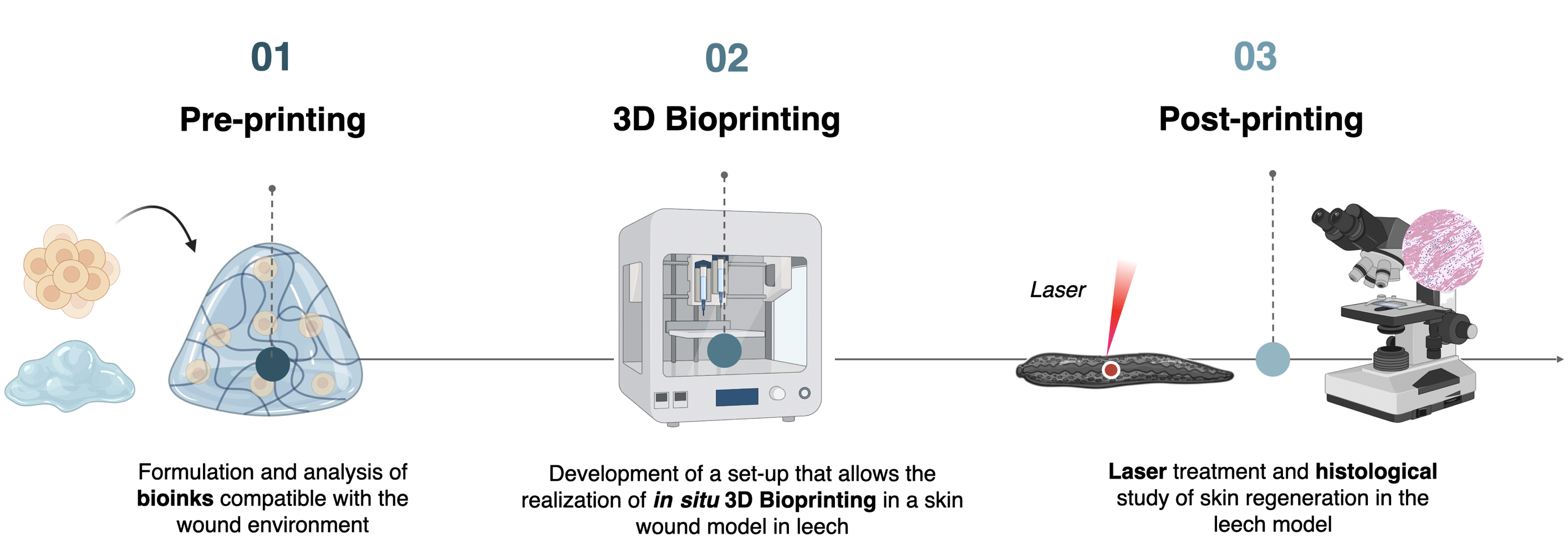
Wound healing is a complex process that ensures tissue recovery and survival, but remains challenging to manage, particularly in deep wounds and burns. Conventional treatments require specialized operators, repeated interventions, and high costs. In extreme environments, such as space, the absence of dedicated facilities and personnel further complicates wound care, highlighting the need for novel, automated, and easy-to-use therapeutic strategies. In this study, we developed and validated a protocol that combines in situ 3D bioprinting with near-infrared (NIR) laser irradiation to promote graft integration and accelerate wound repair. The approach was tested in the leech model of a skin wound with tissue loss, selected for its suitability in reproducing key aspects of tissue regeneration and for its relevance in space-oriented regenerative medicine experiments design comprised four steps: (i) identification of biomaterial inks compatible with the wound environment; (ii) application of an optimized in situ 3D bioprinting protocol; (iii) NIR laser irradiation to stimulate graft integration; and (iv) histological and immunofluorescence evaluation of healing outcomes compared to controls (bioprinting only, laser only, and untreated). Results demonstrated that the integrated protocol significantly improved wound healing, preventing fibrosis and enhancing re-epithelialization, fibroblast activation, and transdifferentiation. The combined treatment outperformed all control conditions, confirming the synergistic effect of In situ bioprinting and laser irradiation. This work introduces an advanced wound care strategy integrating biofabrication and photobiomodulation. The protocol shows high potential for clinical translation, with applications not only in conventional medical settings but also in extreme environments such as space.
- Sorg H, Sorg CGG. Skin Wound Healing: of Players, patterns, and processes. Eur Surg Res. 2023;64(2):141-157. doi: 10.1159/000528271
- Peña OA, Martin P. Cellular and molecular mechanisms of skin wound healing. Nat Rev Mol Cell Biol. 2024;25(8): 599-616. doi: 10.1038/s41580-024-00715-1
- Cialdai F, Risaliti C, Monici M. Role of fibroblasts in wound healing and tissue remodeling on Earth and in space. Front Bioeng Biotechnol. 2022;10:958381. doi: 10.3389/fbioe.2022.958381
- Darby IA, Hewitson TD. Fibroblast differentiation in wound healing and fibrosis. Int Rev Cytol. 2007;257:143-79. doi: 10.1016/S0074-7696(07)57004-X
- Martin P, Pardo-Pastor C, Jenkins RG, Rosenblatt J. Imperfect wound healing sets the stage for chronic diseases. Science. 2024;386(6726):eadp2974. doi: 10.1126/science.adp2974
- Sen CK. Human Wound and Its Burden: Updated 2022 Compendium of Estimates. Adv Wound Care (New Rochelle). 2023;12(12):657-670. doi: 10.1089/wound.2023.0150
- Avishai E, Yeghiazaryan K, Golubnitschaja O. Impaired wound healing: facts and hypotheses for multi-professional considerations in predictive, preventive and personalised medicine. EPMA J. 2017;8(1):23-33. doi: 10.1007/s13167-017-0081-y
- Hongying Z, Chunmei H, Lijuan C, et al. The current status and influencing factors of quality of life of chronic wound patients based on Wound-QoL scale: a cross-sectional study. Medicine (Baltimore). 2025;104(27):e42961. doi: 10.1097/MD.0000000000042961
- Harding K, Gray D, Timmons J, Hurd T. Evolution or revolution? Adapting to complexity in wound management. Int Wound J. 2007;4(Suppl 2):1-12. doi: 10.1111/j.1742-481X.2007.00329.x
- Radzikowska-Büchner E, Łopuszyńska I, Flieger W, Tobiasz M, Maciejewski R, Flieger J. An overview of recent developments in the management of burn injuries. Int J Mol Sci. 2023;24(22):16357. doi: 10.3390/ijms242216357
- Kirkpatrick AW, Ball CG, Campbell M, Williams DR, Parazynski SE, Mattox KL, Broderick TJ. Severe traumatic injury during long duration spaceflight: Light years beyond ATLS. J Trauma Manag Outcomes. 2009;3:4. doi: 10.1186/1752-2897-3-4
- Balukoff NC, Houk G, Gonzalez T, et al. Out of this World: wound healing on earth and in space. J Invest Dermatol. 2025;145(8):1879-1895. doi:10.1016/j.jid.2024.12.024
- Pantalone D. Surgery in the next space missions. Life. 2023;13(7):1477. doi: 10.3390/life13071477
- Cubo-Mateo N, Gelinsky M. Wound and skin healing in space: the 3D Bioprinting Perspective. Front Bioeng Biotechnol. 2021;9:720217. doi: 10.3389/fbioe.2021.720217
- Klarmann GJ, Rogers AJ, Gilchrist KH, Ho VB. 3D bioprinting meniscus tissue onboard the International Space Station. Life Sci Space Res (Amst). 2024;43:82-91. doi: 10.1016/j.lssr.2024.09.004
- Tettamanti G, Grimaldi A, Congiu T, Perletti G, Raspanti M, Valvassori R, de Eguileor M. Collagen reorganization in leech wound healing. Biol Cell. 2005;97(7):557-68. doi: 10.1042/BC20040085
- Grimaldi A, Banfi S, Bianchi C, et al. The leech: a novel invertebrate model for studying muscle regeneration and diseases. Curr Pharm Des. 2010;16(8):968-77. doi: 10.2174/138161210790883417
- Cialdai F, Colciago A, Pantalone D, et al. Effect of unloading condition on the healing process and effectiveness of platelet rich plasma as a countermeasure: study on In vivo and In vitro wound healing models. Int J Mol Sci. 2020;21(2):407. doi: 10.3390/ijms21020407
- Baranzini N, Pulze L, Tettamanti G, Acquati F, Grimaldi A. HvRNASET2 regulate connective tissue and collagen I remodeling during wound healing process. Front Physiol. 2021;12:632506. doi: 10.3389/fphys.2021.632506
- Lotz RG, Baum P, Bowman GH, Klein KD, von Lohr R, Schrotter L. Test of a life support system with Hirudo medicinalis in a sounding rocket. Life Sci. Space Res. 1972;10:133–143.
- Ronzoni FL, Aliberti F, Scocozza F, et al. Myoblast 3D bioprinting to burst in vitro skeletal muscle differentiation. J Tissue Eng Regen Med. 202216(5):484–495. doi: 10.1002/term.3293
- Delgrosso E, Scocozza F, Cansolino L, et al. 3D bioprinted osteosarcoma model for experimental boron neutron capture therapy (BNCT) applications: Preliminary assessment. J Biomed Mater Res B Appl Biomater. 2023;111(8): 1571-1580. doi: 10.1002/jbm.b.35255
- Loi G, Scocozza F, Aliberti F, et al. 3D Co-Printing and Substrate Geometry Influence the Differentiation of C2C12 Skeletal Myoblasts. Gels. 2023; 9(7):595. doi: 10.3390/gels9070595
- Loi G, Scocozza F, Benedetti L, et al. Design, development, and benchmarking of a bioreactor integrated with 3D bioprinting: application to skeletal muscle regeneration. Bioprinting. 2024;42:e00352. doi: 10.1016/j.bprint.2024.e00352
- Fantini V, Bordoni M, Scocozza F, et al. Bioink composition and printing parameters for 3D modeling neural tissue. Cells. 2019;8(8):830. doi: 10.3390/cells8080830
- Cavallo A, Al Kayal T, Mero A, et al. Fibrinogen-Based Bioink for application in skin equivalent 3D Bioprinting. J Funct Biomater. 2023;14(9):459. doi: 10.3390/jfb14090459
- Monici M, Basile V, Cialdai F, Romano G, Fusi F, Conti A. Irradiation by pulsed Nd: YAG laser induces the production of extracellular matrix molecules by cells of the connective tissues: a tool for tissue repair. Biophotonics: Photonic solutions for better health care. Edited by Popp Jürgen, Drexler Wolfgang, Tuchin Valery V, Matthews Dennis L. Proceedings of the SPIE. 2008;6991:10.
- Monici M, Cialdai F, Romano G, Fusi F, Egli M, Pezzatini S. An in vitro study on tissue repair: impact of unloading on cells involved in the remodelling phase. Microgravity Sci Technol. 2011;23:391–401. doi:10.1007/s12217-011-9259-4
- Genah S, Cialdai F, Ciccone V, Sereni E, Morbidelli L, Monici M. Effect of NIR laser therapy by MLS-MIS source on fibroblast activation by inflammatory cytokines in relation to wound healing. Biomedicines. 2021;9(3):307. doi: 10.3390/biomedicines9030307
- Barrientos S, Stojadinovic O, Golinko MS, Brem H, Tomic- Canic M. Growth factors and cytokines in wound healing. Wound Repair Regen. 2008;16(5):585-601. doi: 10.1111/j.1524-475X.2008.00410.x
- Moretti L, Stalfort J, Barker TH, Abebayehu D. The interplay of fibroblasts, the extracellular matrix, and inflammation in scar formation. J Biol Chem. 2022;298(2):101530. doi: 10.1016/j.jbc.2021.101530
- Younesi FS, Miller AE, Barker TH, Rossi FMV, Hinz B. Fibroblast and myofibroblast activation in normal tissue repair and fibrosis. Nat Rev Mol Cell Biol. 2024;25(8):617-638. doi: 10.1038/s41580-024-00716-0
- Gardeazabal L, Izeta A. Elastin and collagen fibres in cutaneous wound healing. Exp Dermatol. 2024;33(3):e15052. doi: 10.1111/exd.15052
- Ito S, Nagata K. Roles of the endoplasmic reticulum-resident, collagen-specific molecular chaperone Hsp47 in vertebrate cells and human disease. J Biol Chem. 2019;294(6):2133-2141. doi: 10.1074/jbc.TM118.002812
- McAndrews KM, Miyake T, Ehsanipour EA, et al. Dermal αSMA+ myofibroblasts orchestrate skin wound repair via β1 integrin and independent of type I collagen production. EMBO J. 2022;41(7):e109470. doi: 10.15252/embj.2021109470
- Singh S, Choudhury D, Yu F, Mironov V, Naing MW. In situ bioprinting – Bioprinting from benchside to bedside? Acta Biomaterialia. 2020;101(2020):14–25 doi: 10.1016/j.actbio. 2019.08.045
- Hu C, Wang C, Bian S, et al. In situ bioprinting: Tailored printing strategies for regenerative medicine. Int J Bioprint. 2024;10(5):3366. doi: 10.36922/ijb.3366
- Ashammakhi N, Ahadian S, Pountos I, et al. In situ three-dimensional printing for reparative and regenerative therapy. Biomed Microdevices. 2019;21(2):42. doi: 10.1007/s10544-019-0372-2
- Wang MY, He JK, Liu YX, et al. The trend towards in vivo bioprinting. Int J Bioprinting. 2015;1(1): 15–26. doi: 10.18063/IJB.2015.01.001
- Chaudhry MS, Czekanski A. In-situ bioprinting of skin - a review. Bioprinting. 2023;e00271:1-15. doi: 10.1016/j.bprint.2023.e00271
- Wallace HA, Basehore BM, Zito PM. Wound healing phases. In: StatPearls [Internet]. Treasure Island (FL): StatPearls Publishing; 2025.
- Zhu W, Nie X, Tao Q, Yao H, Wang DA. Interactions at engineered graft-tissue interfaces: a review. APL Bioeng. 2020;4(3):031502. doi: 10.1063/5.0014519
- Kuffler DP. Photobiomodulation in promoting wound healing: a review. Regen Med. 2016;11(1):107-22. doi: 10.2217/rme.15.82
- Mosca RC, Ong AA, Albasha O, Bass K, Arany P. Photobiomodulation therapy for wound care: a potent, noninvasive, photoceutical approach. Adv Skin wound care. 2019;32(4):157-167. doi: 10.1097/01.ASW.0000553600.97572.d2