A visible light-crosslinkable decellularized kidney matrix bioink for 3D bioprinting of organoids and drug testing

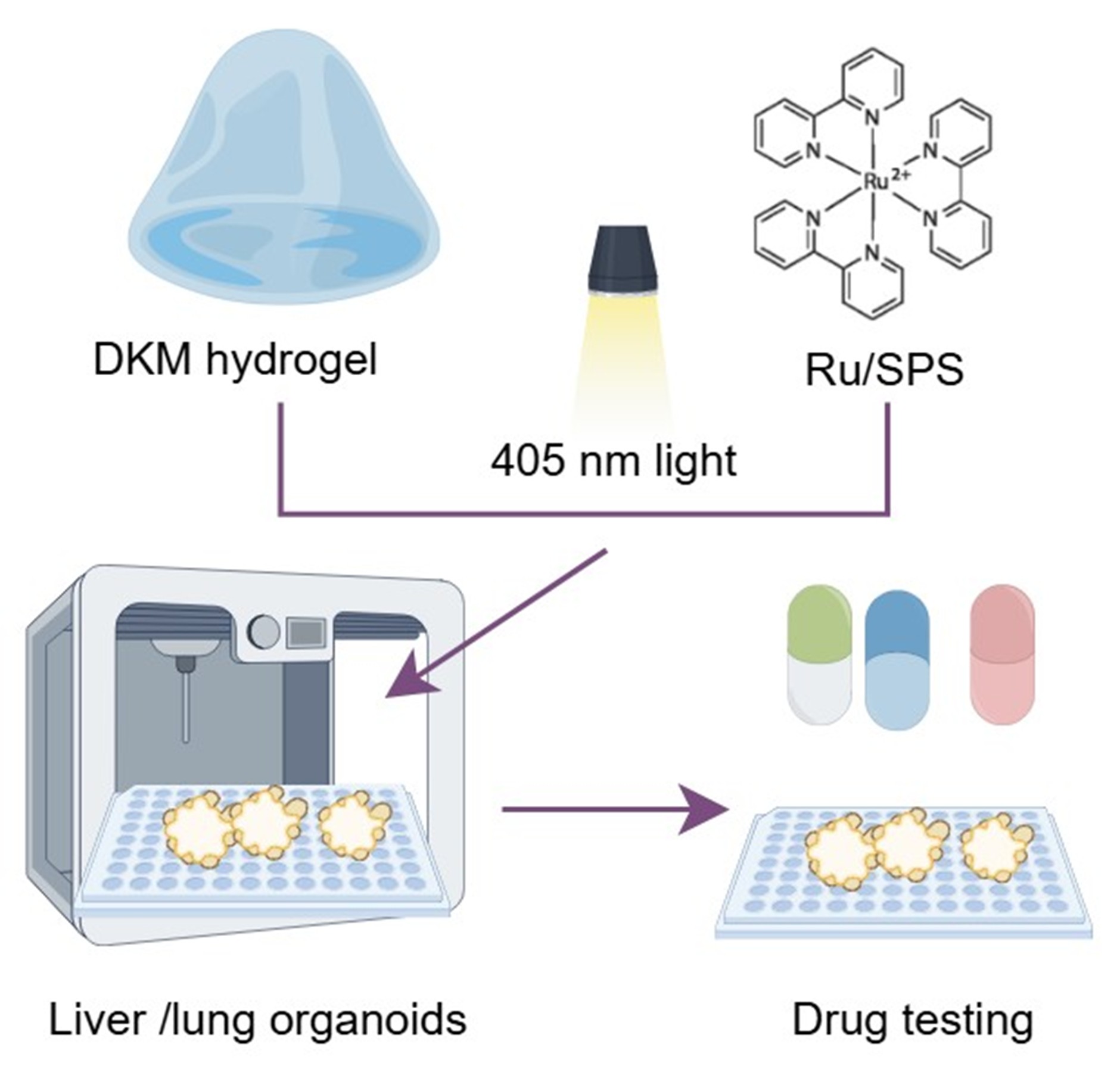
Decellularized kidney extracellular matrix (DKM) is an acellular scaffold rich in structural proteins and glycosaminoglycans that can promote tissue regeneration and support organoid culture. Porcine-derived DKM contains abundant extracellular matrix (ECM) components, such as collagen, laminin, and fibronectin, and offers native biochemical cues. However, conventional decellularized ECM hydrogels often exhibit weak mechanical properties, poor printability, and slow gelation, limiting their use in high-throughput applications. Here, we report a visible-light-mediated crosslinking strategy for rapid gelation of DKM based on a tris(2,2’-bipyridyl) ruthenium (II) chloride hexahydrate/sodium persulfate (Ru/SPS) photoinitiator system. Illumination at 405 nm (30 mW/cm2) in the presence of Ru/SPS achieves gelation in about 40 s, yielding a composite DKM–Ru/SPS bioink with tunable modulus by adjusting DKM, Ru, and SPS concentrations. High-fidelity 3D constructs were produced by extrusion bioprinting using a representative formulation (15 mg/mL DKM, 0.25 mM Ru, 2.5 mM SPS). As proof of concept, organoids encapsulated in the DKM–Ru/SPS bioink exhibited viability, proliferation, and lineage marker expression during culture. This work demonstrates a rapid, cell-compatible photocrosslinking approach for DKM–Ru/SPS that integrates organoid culture with 3D bioprinting and drug testing, supporting its potential use as a standardized bioink in tissue engineering and functional screening.