
Fabrication of biomimetic corneas featuring epithelial, stromal, and endothelial layers via bioprinting

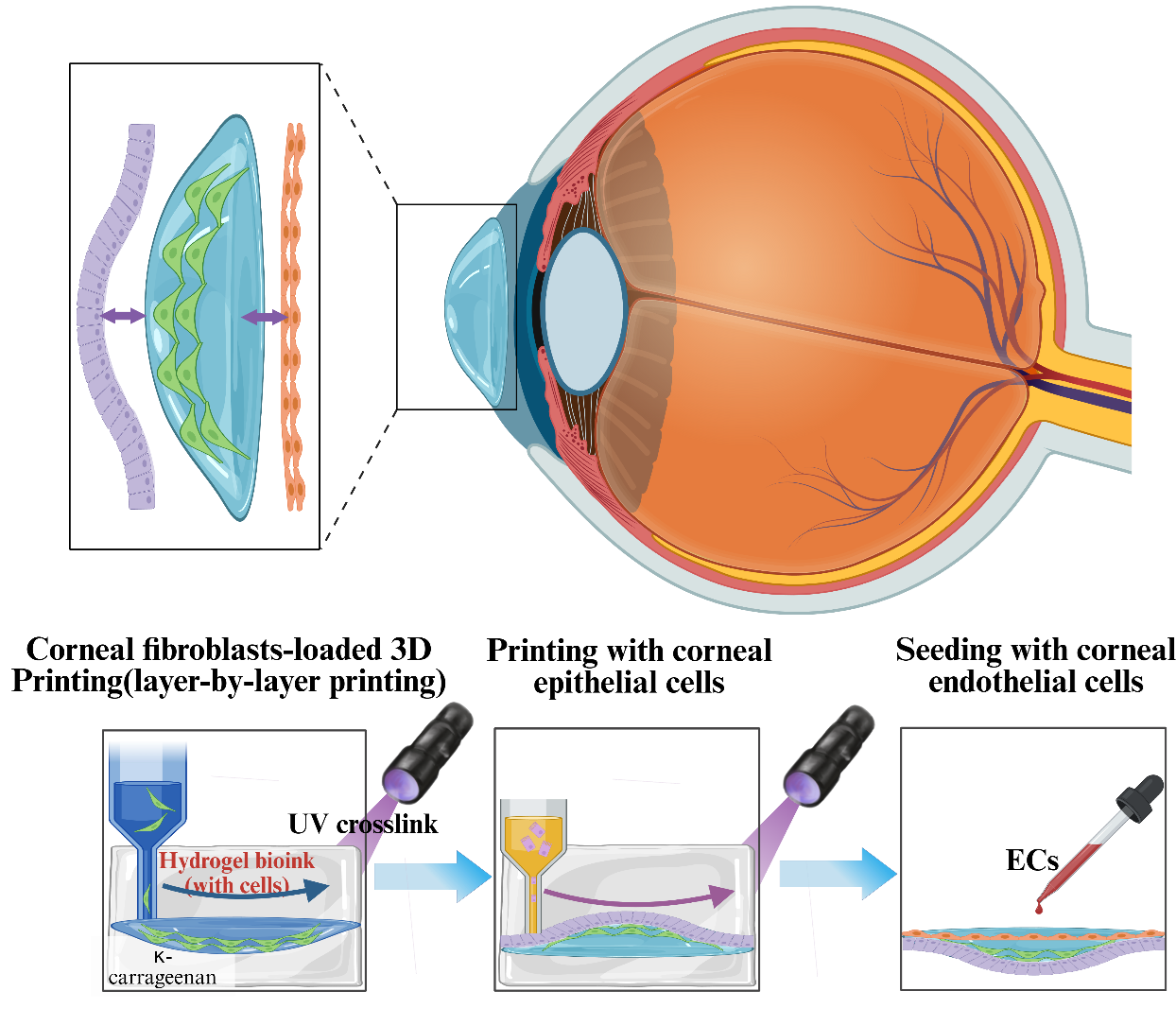
The bioengineering of full-thickness corneal substitutes presents significant challenges, primarily due to the complex stratified structure of the cornea, which consists of the epithelium, stroma, and endothelium, as well as its critical functional requirements, including optical transparency, mechanical stability, and biocompatibility. Herein, we present an integrated fabrication strategy that combines embedded hydrogel bioprinting with subsequent two-dimensional endothelial cell seeding to create biomimetic corneal structures using a gelatin methacryloyl (GelMA)/hyaluronic acid methacryloyl (HAMA) composite hydrogel. The engineered scaffold successfully recapitulates the native cornea’s trilaminar architecture (epithelium, stroma, and endothelium) and exhibits 30–80% optical transparency across the visible spectrum. The hybrid hydrogel exhibits optimal wettability (a contact angle of approximately 50° and minimal swelling of less than 10%) and controlled degradation kinetics, effectively addressing the limitations of single-component hydrogels. The scaffold maintains structural integrity during suturing and supports robust cellular proliferation and migration. Gene expression analysis revealed the phenotypic orientation of seeded cells toward key corneal lineages, with upregulation of epithelial (Klf4 and Pax6), stromal (Col1a1 and Col4a4), and endothelial (Zeb1 and Foxc1) markers. Overall, the bioprinted GelMA/HAMA biomimetic cornea presents a promising proof of concept for a trilayered tissue-engineered corneal construct.
- Meek KM, Knupp C, Lewis PN, Morgan SR, Hayes S. Structural control of corneal transparency, refractive power and dynamics. Eye. 2025;39(4):644-650. doi: 10.1038/s41433-024-02969-7.
- Brown L, Leck AK, Gichangi M, Burton MJ, Denning DW. The global incidence and diagnosis of fungal keratitis. Lancet Infect Dis. 2021:21(3):e49-e57. doi: 10.1016/s1473-3099(20)30448-5.
- Gain P, Jullienne R, He Z, et al. Global survey of corneal transplantation and eye banking. JAMA Ophthalmol. 2016:134(2):167-173. doi: 10.1001/jamaophthalmol.2015.4776.
- Deogaonkar K, Roy A. Donor related corneal graft infection: a review of literature and preventive strategies. Semin Ophthalmol. 2023:38(3):219-225. doi: 10.1080/08820538.2022.2095873.
- Weiss JS, Rapuano CJ, Seitz B, et al. IC3D classification of corneal dystrophies-Edition 3. Cornea. 2024:43(4): 466-527. doi: 10.1097/ico.0000000000003420.
- Rafat M, Jabbarvand M, Sharma N, et al. Bioengineered corneal tissue for minimally invasive vision restoration in advanced keratoconus in two clinical cohorts. Nat Biotechnol. 2023;41(1):70-81. doi: 10.1038/s41587-022-01408-w.
- Li Y, Wang Z. Biomaterials for corneal regeneration. Adv Sci. 2025;12(6):e2408021. doi: 10.1002/advs.202408021.
- Maher C, Chen Z, Zhou Y, et al. Innervation in corneal bioengineering. Acta Biomater. 2024;189:73-87. doi: 10.1016/j.actbio.2024.10.009.
- Camburu G, Zemba M, Tătaru CP, Purcărea VL. The measurement of central corneal thickness. Rom J Ophthalmol. 2023;67(2):168-174. doi: 10.22336/rjo.2023.29.
- Vijayaraghavan R, Loganathan S, Valapa RB. 3D bioprinted photo crosslinkable GelMA/methylcellulose hydrogel mimicking native corneal model with enhanced in vitro cytocompatibility and sustained keratocyte phenotype for stromal regeneration. Int J Biol Macromol. 2024;264(Pt 1):130472. doi: 10.1016/j.ijbiomac.2024.130472.
- Cai Y, Tan Y, Cao J, et al. Dual-crosslinked betaine-based amphiphilic hydrogel as a promising vitreous substitute: anti-adhesion, anti-fouling, and anti-cell proliferation. Adv Sci. 2025;12(36):e13455. doi: 10.1002/advs.202413455.
- Kim JJ, Bae M, Kim J, et al. Development of a 3D cell-printed RVO model by advancing a retina-on-a-chip with hybrid retinal dECM bioink and an integrated 3D bioprinting system. Adv Compos Hybrid Mater 2025; 8(5):364. doi: 10.1007/s42114-025-01455-2.
- Chand R, Janarthanan G, Elkhoury K, Vijayavenkataraman S. Digital light processing 3D bioprinting of biomimetic corneal stroma equivalent using gelatin methacryloyl and oxidized carboxymethylcellulose interpenetrating network hydrogel. Biofabrication. 2025;17(2). doi: 10.1088/1758-5090/adab27.
- Xu Y, Liu J, Song W, et al. Biomimetic convex implant for xorneal regeneration through 3D printing. Adv Sci. 2023;10(11):e2205878. doi: 10.1002/advs.202205878.
- Goodarzi Hosseinabadi H, Dogan E, Miri AK, Ionov L. Digital Light processing bioprinting advances for microtissue models. ACS Biomater Sci Eng. 2022;8(4):1381-1395. doi: 10.1021/acsbiomaterials.1c01509.
- Chen A, Wang W, Mao Z, et al. Multimaterial 3D and 4D bioprinting of heterogenous constructs for tissue engineering. Adv Mater. 2024;36(34):e2307686. doi: 10.1002/adma.202307686.
- Grönroos P, Mörö A, Puistola P, et al. Bioprinting of human pluripotent stem cell derived corneal endothelial cells with hydrazone crosslinked hyaluronic acid bioink. Stem Cell Res Ther. 2024;15(1):81. doi: 10.1186/s13287-024-03672-w.
- Ouyang L, Yao R, Mao S, et al. Three-dimensional bioprinting of embryonic stem cells directs highly uniform embryoid body formation. Biofabrication. 2015; 7(4):044101. doi: 10.1088/1758-5090/7/4/044101.
- Shi B, Zhu T, Luo Y, et al. Three-dimensional bioprinted cell-adaptive hydrogel with anisotropic micropores for enhancing skin wound healing. Int J Biol Macromol. 2024;280(Pt 4):136106. doi: 10.1016/j.ijbiomac.2024.136106.
- Guo K, Li G, Yu Q, et al. Injectable hyaluronate-based hydrogel with a dynamic/covalent dual-crosslinked architecture for bone tissue engineering: enhancing osteogenesis and immune regulation. Int J Biol Macromol. 2024;282(Pt 5):137249. doi: 10.1016/j.ijbiomac.2024.137249.
- Asim S, Tuftee C, Qureshi AT, et al. Multi-functional gelatin-dithiolane hydrogels for tissue engineering. Adv Funct Mater. 2025;35(3):2407522. doi: 10.1002/adfm.202407522.
- Puistola P, Miettinen S, Skottman H, Mörö A. Novel strategy for multi-material 3D bioprinting of human stem cell based corneal stroma with heterogenous design. Mater Today Bio. 2024;24:100924. doi: 10.1016/j.mtbio.2023.100924.
- Ahn M, Park GT, Shukla AK, et al. 3D Bioprinting-assisted engineering of stem cell-laden hybrid biopatches with distinct geometric patterns considering the mechanical characteristics of regular and irregular connective tissues. Adv Healthc Mater. 2025;14(25):e2502763. doi: 10.1002/adhm.202502763.
- Xu R, Zhang H, Luo Y, et al. Magnetically bioprinted anisotropic hydrogels promote BMSC osteogenic differentiation for bone defect repair. Mater. Today Bio. 2025;32:101885. doi: 10.1016/j.mtbio.2025.101885.
- Sang S, Yan Y, Shen Z, et al. Photo-crosslinked hydrogels for tissue engineering of corneal epithelium. Exp Eye Res. 2022;218:109027. doi: 10.1016/j.exer.2022.109027.
- Zhang H, Luo Y, Hu Z, et al. Cation-crosslinkedκ- carrageenan sub-microgel medium for high-quality embedded bioprinting. Biofabrication. 2024;16(2). doi: 10.1088/1758-5090/ad1cf3.
- Zhang H, Luo Y, Li G, et al. Micelle-facilitated gelation kinetics and viscoelasticity of dynamic hyaluronan hydrogels for bioprinting of mimetic constructs and tissue repair. Composites, Part B: Eng. 2025;294:112151. doi: 10.1016/j.compositesb.2025.112151.
- Larrañeta E, Henry M, Irwin NJ, et al. Synthesis and characterization of hyaluronic acid hydrogels crosslinked using a solvent-free process for potential biomedical applications. Carbohydr Polym. 2018;181:1194-1205. doi: 10.1016/j.carbpol.2017.12.015.
- Velasco-Rodriguez B, Diaz-Vidal T, Rosales-Rivera LC, et al. Hybrid methacrylated gelatin and hyaluronic acid hydrogel scaffolds. preparation and systematic characterization for prospective tissue engineering applications. Int J Mol Sci. 2021;22(13). doi: 10.3390/ijms22136758.
- Zhou M, Yue K, Zhao J, et al. Optimizing GBM organoid construction with hydrogel-based models: GelMA-HAMA scaffold supports GBM organoids with clonal growth for drug screening. Cell Transplant. 2025;34:9636897251347537. doi: 10.1177/09636897251347537.