

Effect of seed distribution characteristics on mechanical properties, degradation behavior, and osteogenic differentiation of additively manufactured Voronoi-based biomimetic scaffolds

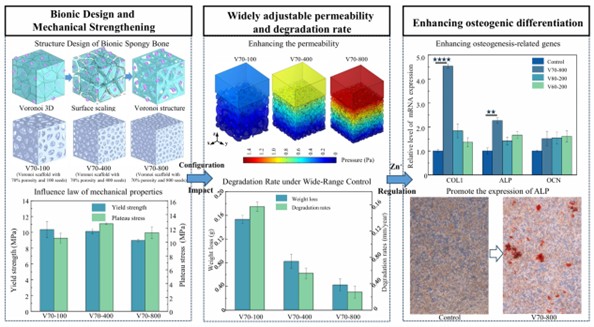
The application of bionic porous structures based on Voronoi diagrams in bone defect repair has been extensively studied, with seed distribution characteristics recognized as key parameters affecting the performance of Voronoi scaffolds. In this study, a controllable parametric design method for Voronoi scaffolds was employed to experimentally and numerically investigate the effects of seed count and porosity on the mechanical properties, degradation behavior, mass transfer efficiency, and cell activity of laser powder bed fusion–printed degradable zinc-based Voronoi bone scaffolds. The results revealed the influence mechanisms of seed distribution characteristics on the mechanical properties and deformation modes of Voronoi scaffolds, achieving a 26.9% enhancement in failure stress. Moreover, by adjusting seed distribution, the degradation rate was precisely regulated within the range of 0.027–0.157 mm/year, enabling a 5.8-fold control over the release of zinc ion. Additionally, the effect of seed density on the osteogenic performance and gene expression of mouse pre-osteoblast cells were examined, demonstrating that higher seed densities predominantly upregulated COL1 and ALP expression to promote osteogenic differentiation. Increasing the seed count density elevated COL1 expression to 4.5 times that of the control group. These findings provide a theoretical basis for the clinical application and performance optimization of degradable zinc-based Voronoi bionic bone scaffolds.
- Ling C, Li Q, Zhang Z, et al. Influence of heat treatment on microstructure, mechanical and corrosion behavior of WE43 alloy fabricated by laser-beam powder bed fusion. Int J Extreme Manuf. 2023;6(1):015001. doi: 10.1088/2631-7990/acfad5
- Wu X, Liu J, Yang Y, et al. Laser powder bed fusion of biodegradable magnesium alloys: process, microstructure and properties. Int J Extreme Manuf. 2024;7(2):022007. doi: 10.1088/2631-7990/ad967e
- Tan C, Zou J, Li S, et al. Additive manufacturing of bio-inspired multi-scale hierarchically strengthened lattice structures. Int J Mach Tools Manuf. 2021;167:103764. doi: 10.1016/j.ijmachtools.2021.103764
- Wei S, Ma J, Xu L, et al. Biodegradable materials for bone defect repair. Mil Med Res. 2020;7(1):54. doi: 10.1186/s40779-020-00280-6
- Yang Y, Jiang R, Han C, et al. Frontiers in laser additive manufacturing technology. Addit Manuf Front. 2024;3(4):200160. doi: 10.1016/j.amf.2024.200160
- Lu Y, Chen G, Long Z, et al. Novel 3D-printed prosthetic composite for reconstruction of massive bone defects in lower extremities after malignant tumor resection. J Bone Oncol. 2019;16:100220. doi: 10.1016/j.jbo.2019.100220
- Ran Q, Yang W, Hu Y, et al. Osteogenesis of 3D printed porous Ti6Al4V implants with different pore sizes. J Mech Behav Biomed Mater. 2018;84:1-11. doi: 10.1016/j.jmbbm.2018.04.010
- Zhang W, Wang L, Feng Z, et al. Research progress on selective laser melting (SLM) of magnesium alloys: a review. Optik. 2020;207:163842. doi: 10.1016/j.ijleo.2019.163842
- Yang M, Yang L, Peng S, et al. Laser additive manufacturing of zinc: formation quality, texture, and cell behavior. Bio-Des Manuf. 2023;6(2):103-120. doi: 10.1007/s42242-022-00216-0
- Bandyopadhyay A, Mitra I, Avila JD, et al. Porous metal implants: processing, properties, and challenges. Int J Extreme Manuf. 2023;5(3):032014. doi: 10.1088/2631-7990/acdd35
- Gao Z, Ren P, Wang H, et al. Additive manufacture of ultrasoft bioinspired metamaterials. Int J Mach Tools Manuf. 2024;195:104101. doi: 10.1016/j.ijmachtools.2023.104101
- Jin J, Wu S, Yang L, et al. Ni–Ti multicell interlacing Gyroid lattice structures with ultra-high hyperelastic response fabricated by laser powder bed fusion. Int J Mach Tools Manuf. 2024;195:104099. doi: 10.1016/j.ijmachtools.2023.104099
- Gibson L. The mechanical behaviour of cancellous bone. J Biomech. 1985;18(5):317-328. doi: 10.1016/0021-9290(85)90287-8
- Yang Y, Ling C, Li Y, et al. Microstructure development and biodegradation behavior of additively manufactured Mg-Zn-Gd alloy with LPSO structure. J Mater Sci Technol. 2023;144:1-14. doi: 10.1016/j.jmst.2022.09.059
- Gatto ML, Cerqueni G, Groppo R, et al. Improved biomechanical behavior of 316L graded scaffolds for bone tissue regeneration produced by laser powder bed fusion. J Mech Behav Biomed Mater. 2023;144:105989. doi: 10.1016/j.jmbbm.2023.105989
- Tyagi SA, Manjaiah M. Additive manufacturing of titanium-based lattice structures for medical applications–a review. Bioprinting. 2023;30:e00267. doi: 10.1016/j.bprint.2023.e00267
- Wang D, Liu L, Tang J, et al. Recent advances on additive manufacturing of heterogeneous/gradient metallic materials via laser powder bed fusion. Int J Extreme Manuf. 2025;7(6):062007. doi: 10.1088/2631-7990/adf69e
- Ma S, Tang Q, Han X, et al. Manufacturability, mechanical properties, mass-transport properties and biocompatibility of triply periodic minimal surface (TPMS) porous scaffolds fabricated by selective laser melting. Mater Des. 2020;195:109034. doi: 10.1016/j.matdes.2020.109034
- Zhang L, Wang B, Song B, et al. 3D printed biomimetic metamaterials with graded porosity and tapering topology for improved cell seeding and bone regeneration. Bioact Mater. 2023;25:677-688. doi: 10.1016/j.bioactmat.2022.07.009
- Fortune S. A sweepline algorithm for Voronoi diagrams. Proc Second Annu Symp Comput Geom. 1986:313-322. doi: 10.1145/10515.10549
- Du Q, Faber V, Gunzburger M. Centroidal Voronoi tessellations: applications and algorithms. SIAM Rev. 1999;41(4):637-676. doi: 10.1137/S0036144599352836
- Fantini M, Curto M. Interactive design and manufacturing of a Voronoi-based biomimetic bone scaffold for morphological characterization. Int J Interact Des Manuf. 2018;12:585-596. doi: 10.1007/s12008-017-0416-x
- Dong Z, Du H, Xu S, et al. Achieving near-isotropic strength and ductility in laser additively manufactured zinc via columnar-to-equiaxed grain transition under thermoelectric magnetic effect. J Mater Sci Technol. 2025;258:107-120. doi: 10.1016/j.jmst.2025.09.023
- Li D, Xie H, Gao C, et al. Harmonic heterostructured pure Ti fabricated by laser powder bed fusion for excellent wear resistance via strength-plasticity synergy. Opto-Electron Adv. 2025;8(9):250043-1-250043-21. doi: 10.29026/oea.2025.250043
- Zhao H, Han Y, Pan C, et al. Design and mechanical properties verification of gradient Voronoi scaffold for bone tissue engineering. Micromachines. 2021;12(6):664. doi: 10.3390/mi12060664
- Gómez S, Vlad M D, López J, et al. Design and properties of 3D scaffolds for bone tissue engineering. Acta Biomater. 2016;42:341-350. doi: 10.1016/j.actbio.2016.06.032
- Herath B, Suresh S, Downing D, et al. Mechanical and geometrical study of 3D printed Voronoi scaffold design for large bone defects. Mater Des. 2021;212:110224. doi: 10.1021/acsbiomaterials.1c01482
- Zou S, Gong H, Gao J. Additively Manufactured Multilevel Voronoi-Lattice Scaffolds with Bonelike Mechanical Properties [J]. ACS Biomater Sci Eng. 2022;8(7): 3022-3037 doi: 10.1007/s12008-017-0416-x
- Guaglione F, Caprio L, Previtali B, et al. Single point exposure LPBF for the production of biodegradable Zn-alloy lattice structures. Addit Manuf. 2021;48:102426. doi: 10.1016/j.addma.2021.102426
- Xu S, Xue Y, Hu X, et al. Relation between materials, process, structure and property of metallic porous bone scaffolds fabricated by laser powder bed fusion (LPBF): a review. Opt Laser Technol. 2025;191:113377. doi: 10.1016/j.optlastec.2025.113377
- Wang H, Shu Z, Chen P, et al. Laser powder bed fusion printed poly-ether-ether-ketone/bioactive glass composite scaffolds with dual-scale pores for enhanced osseointegration and bone ingrowth. Acta Biomater. 2024;189:605-620. doi: 10.1016/j.actbio.2024.09.055
- Yang J, Jin X, Gao H, et al. Additive manufacturing of trabecular tantalum scaffolds by laser powder bed fusion: mechanical property evaluation and porous structure characterization. Mater Character. 2020;170:110694. doi: 10.1016/j.matchar.2020.110694
- Zhou X, Feng Y, Zhang J, et al. Recent advances in additive manufacturing technology for bone tissue engineering scaffolds. Int J Adv Manuf Technol. 2020;108(11):3591-606. doi: 10.1007/s00170-020-05444-1
- Deering J, Dowling KI, Dicecco LA, et al. Selective Voronoi tessellation as a method to design anisotropic and biomimetic implants. J Mech Behav Biomed Mater. 2021;116:104361. doi: 10.1016/j.jmbbm.2021.104361
- Duan Y, Du B, Zhao X, et al. The cell regularity effects on the compressive responses of additively manufactured Voronoi foams. Int J Mech Sci. 2019;164:105151. doi: 10.1016/j.ijmecsci.2019.105151
- Jiao C, Xie D, He Z, et al. Additive manufacturing of Bio-inspired ceramic bone Scaffolds: structural design, mechanical properties and biocompatibility. Mater Des. 2022;217:110610. doi: 10.1016/j.matdes.2022.110610
- Sotomayor OE, Tippur HV. Role of cell regularity and relative density on elastoplastic compression response of 3-D open-cell foam core sandwich structure generated using Voronoi diagrams. Acta Mater. 2014;78:301-313. doi: 10.1016/j.actamat.2014.06.051
- Tang L, Shi X, Zhang L, et al. Effects of statistics of cell’s size and shape irregularity on mechanical properties of 2D and 3D Voronoi foams. Acta Mech. 2014;225(4):1361-1372. doi: 10.1007/s00707-013-1054-4
- Hou C, Sinico M, Vrancken B, et al. Investigation of the laser powder bed fusion manufacturing process and quasi-static behaviour of Ti6Al4V Voronoi structures. J Mater Process Technol. 2024;328:118410. doi: 10.1016/j.jmatprotec.2024.118410
- Wu T, Yu S, Chen D, et al. Bionic design, materials and performance of bone tissue scaffolds. Materials. 2017;10(10):1187. doi: 10.3390/ma10101187
- Edelsbrunner H, Seidel R. Voronoi diagrams and arrangements. Proc First Annu Symp Comput Geom. 1985:251-262. doi: 10.1145/323233.323266
- Canny J, Donald B. Simplified Voronoi diagrams. Proc Third Annu Symp Comput Geom, F. 1987:153-161. doi: 10.1145/41958.41974
- Erwig M. The graph Voronoi diagram with applications. Netw: Int J. 2000;36(3):156-163. doi: 10.1002/1097-0037(200010)36:3<156::AID-NET2>3.0.CO;2-L
- Goharian A, Daneshjoo K, Mahdavinejad M, et al. Voronoi geometry for building facade to manage direct sunbeams. J Sustain Archit Civil Eng. 2022;31(2):109-124. doi: 10.5755/j01.sace.31.2.30800
- Lazar EA, Lu J, Rycroft CH. Voronoi cell analysis: the shapes of particle systems. Am J Phys. 2022;90(6):469-480. doi: 10.1119/5.0087591
- Sugihara K. Approximation of generalized Voronoi diagrams by ordinary Voronoi diagrams. CVGIP: Graph Models Image Process. 1993;55(6):522-531. doi: 10.1006/cgip.1993.1039
- Han C, Wang Y, Wang Z, et al. Enhancing mechanical properties of additively manufactured Voronoi-based architected metamaterials via a lattice-inspired design strategy. Int J Mach Tools Manuf. 2024;202:104199. doi: 10.1016/j.ijmachtools.2024.104199
- Soro N, Attar H, Wu X, et al. Investigation of the structure and mechanical properties of additively manufactured Ti- 6Al-4V biomedical scaffolds designed with a Schwartz primitive unit-cell. Mater Sci Eng: A. 2019;745:195-202. doi: 10.1016/j.msea.2018.12.104
- Xiao L, Xu X, Feng G, et al. Compressive performance and energy absorption of additively manufactured metallic hybrid lattice structures. Int J Mech Sci. 2022;219:107093. doi: 10.1016/j.ijmecsci.2022.107093
- Zhong H, Das R, Gu J, et al. Low-density, high-strength metal mechanical metamaterials beyond the Gibson-Ashby model. Mater Today. 2023;68:96-107. doi: 10.1016/j.mattod.2023.07.018
- Fantini M, Curto M, De Crescenzio F. A method to design biomimetic scaffolds for bone tissue engineering based on Voronoi lattices. Virt Phys Prototyp. 2016;11(2):77-90. doi: 10.1080/17452759.2016.1172301
- Dong Z, Han C, Zhao Y, et al. Role of heterogenous microstructure and deformation behavior in achieving superior strength-ductility synergy in zinc fabricated via laser powder bed fusion. Int J Extreme Manuf. 2024;6(4):045003. doi: 10.1088/2631-7990/ad3929
- Dong Z, Han C, Liu G, et al. Revealing anisotropic mechanisms in mechanical and degradation properties of zinc fabricated by laser powder bed fusion additive manufacturing. J Mater Sci Technol. 2025;214:87-104. doi: 10.1016/j.jmst.2024.06.045
- Syahrom A, Abdul KMR, Abdullah J, et al. Permeability studies of artificial and natural cancellous bone structures. Med Eng Phys. 2013;35(6):792-799. doi: 10.1016/j.medengphy.2012.08.011
- Yang Y, Lu C, Shen L, et al. In-situ deposition of apatite layer to protect Mg-based composite fabricated via laser additive manufacturing. J Magnesium Alloys. 2023;11(2):629-640. doi: 10.1016/j.jma.2021.04.009
- Wang C, Hu Y, Zhong C, et al. Microstructural evolution and mechanical properties of pure Zn fabricated by selective laser melting. Mater Sci Eng: A. 2022;846:143276. doi: 10.1016/j.msea.2022.143276
- Gu D, Zhang H, Dai D, et al. Laser additive manufacturing of nano-TiC reinforced Ni-based nanocomposites with tailored microstructure and performance. Composites, Part B. 2019;163:585-597. doi: 10.1016/j.compositesb.2018.12.146
- Maconachie T, Leary M, Lozanovski B, et al. SLM lattice structures: properties, performance, applications and challenges. Mater Des. 2019;183:108137. doi: 10.1016/j.matdes.2019.108137
- Gu XN, Zheng YF. A review on magnesium alloys as biodegradable materials. Front Mater Sci China. 2010;4(2):111-115. doi: 10.1007/s11706-010-0024-1
- Grimm MJ, Williams JL. Measurements of permeability in human calcaneal trabecular bone. J Biomech. 1997;30(7):743-745. doi: 10.1016/S0021-9290(97)00016-X
- Zhang L, Wang B, Song B, et al. 3D printed biomimetic metamaterials with graded porosity and tapering topology for improved cell seeding and bone regeneration. Bioact Mater. 2023;25:677-688. doi: 10.1016/j.bioactmat.2022.07.009
- Liu L, Meng Y, Volinsky AA, et al. Influences of albumin on in vitro corrosion of pure Zn in artificial plasma. Corros Sci. 2019;153:341-356. doi: 10.1016/j.corsci.2019.04.003
- Thomas S, Cole IS, Sridhar M, et al. Revisiting zinc passivation in alkaline solutions. Electrochim Acta. 2013;97:192-201. doi: 10.1016/j.electacta.2013.03.008
- Mouanga M, Berçot P, Rauch JY. Comparison of corrosion behaviour of zinc in NaCl and in NaOH solutions. Part I: corrosion layer characterization. Corros Sci. 2010;52(12):3984-3992. doi: 10.1016/j.corsci.2010.08.003
- Qin Y, Liu A, Guo H, et al. Additive manufacturing of Zn-Mg alloy porous scaffolds with enhanced osseointegration: in vitro and in vivo studies. Acta Biomater. 2022;145:403-415. doi: 10.1016/j.actbio.2022.03.055