

Optimal structural characteristics of bone tissue engineering scaffolds from bionics and PSO-BP-NSGA III integrated algorithm

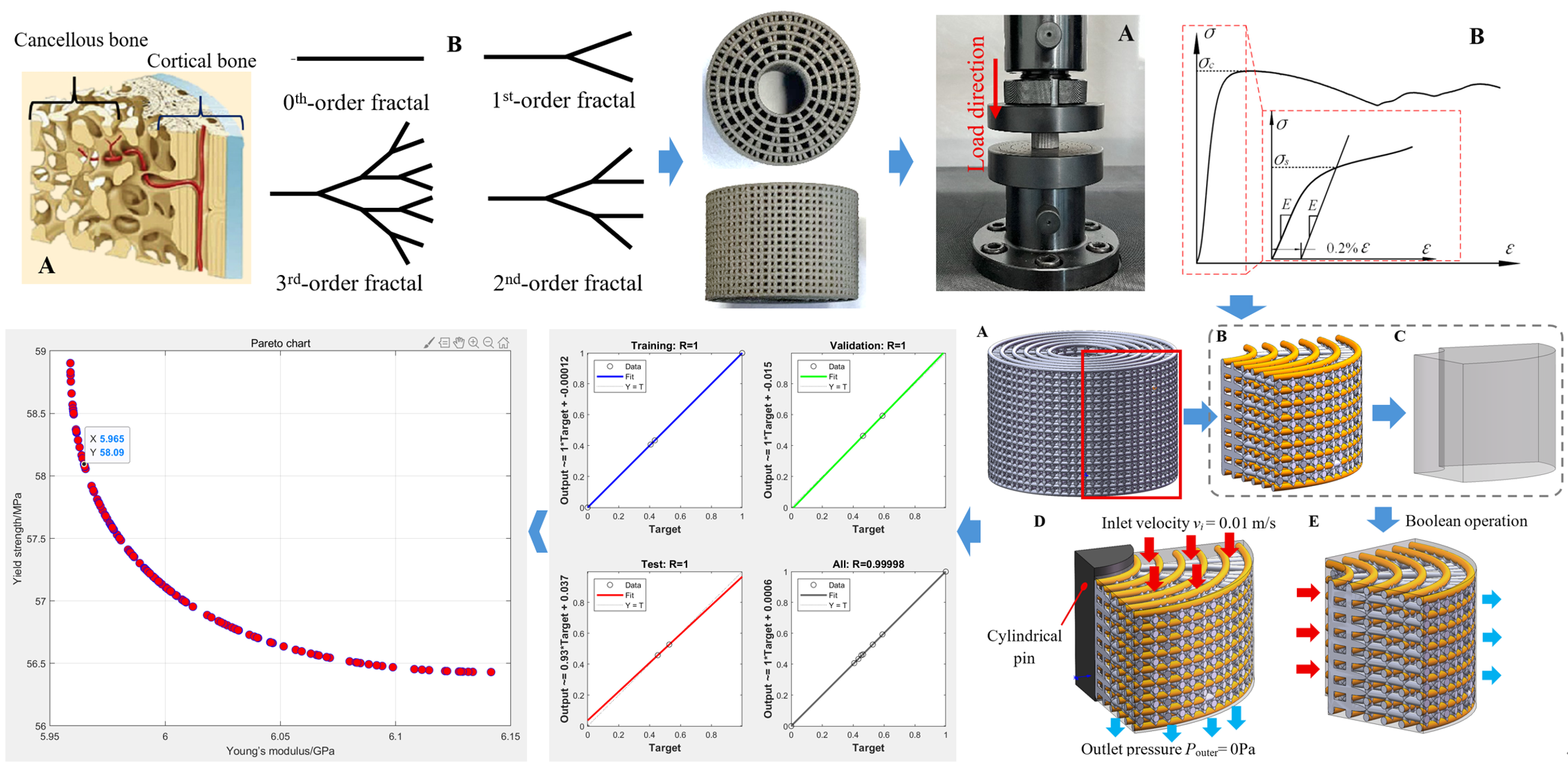
The repair of large segmental bone defects has always been a significant challenge in clinical practice, with stress shielding being one of the key issues. Here, tree-like fractal biomimetic scaffolds were created based on the morphological similarity between natural trees and bone trabeculae. To optimize the balance between high yield strength and low elastic modulus of the scaffold, an integrated particle swarm optimization-backpropagation-non-dominated sorting genetic algorithm III (PSO-BP-NSGA III) was employed. The scaffolds were fabricated using selective laser melting three-dimensional printing with Ti6Al4V, and their mechanical performance was experimentally evaluated and compared with the algorithm’s predictions. The tree-like fractal scaffold exhibited a radial gradient in porosity, similar to that of natural bone. The second-order fractal scaffold achieved an effective synergy between yield strength and Young’s modulus, demonstrating high yield strength and low Young’s modulus. Additionally, it showed a favorable fluid flow gradient and permeability, with a comprehensive permeability of 3.13 × 10⁻⁸ m2. The relative errors between the test and predicted values of yield strength and Young’s modulus were 0.83% and 7.93% respectively, indicating that the PSO-BP-NSGA III integrated algorithm has good predictive ability. These findings establish a validated bionic design framework that integrates advanced optimization algorithms to guide the development of bone tissue engineering scaffolds.
- Luo L, Zheng W, Li J, et al. 3D-printed titanium trabecular scaffolds with sustained release of hypoxia-induced exosomes for dual-mimetic bone regeneration. Adv Sci. 2025;12(23):2500599. doi: 10.1002/advs.202500599
- Qin Y, Jing Z, Zou D, et al. A metamaterial scaffold beyond modulus limits: enhanced osteogenesis and angiogenesis of critical bone defects. Nat Commun. 2025;16:2180. doi: 10.1038/s41467-025-57609-9
- Jin Y, Li J, Fan H, Du J, He Y. Biomechanics and mechanobiology of additively manufactured porous load-bearing bone implants. Small. 2025;21(20):2409955. doi: 10.1002/smll.202409955
- Ahmed H, Shakshak M, Trompeter A. A review of the Masquelet technique in the treatment of lower limb critical-size bone defects. Ann R Coll Surg Engl. 2025;107(6): 383-389. doi: 10.1308/rcsann.2023.0022
- Naghavi SA, Tamaddon M, Garcia-Souto P, et al. A novel hybrid design and modelling of a customised graded Ti- 6Al-4V porous hip implant to reduce stress-shielding: An experimental and numerical analysis. Front Bioeng Biotechnol. 2023;11:1092361. doi: 10.3389/fbioe.2023.1092361
- Li Z, Chen Z, Chen X, Zhao R. Design and evaluation of TPMS-inspired 3D-printed scaffolds for bone tissue engineering: enabling tailored mechanical and mass transport properties. Compos Struct. 2024;327:117638. doi: 10.1016/j.compstruct.2023.117638
- D’Andrea L, Gabrieli R, Milano L, et al. Elastic and failure characterization of hydroxyapatite TPMS scaffolds using a combined approach of ultrasound, compression tests and micro-CT based numerical models. Acta Mater. 2025;287:120776. doi: 10.1016/j.actamat.2025.120776
- Liu H, Chen H, Sun B, et al. Enhancing angiogenesis and osseointegration through a double gyroid Ti6Al4V scaffold with triply periodic minimal surface. Bio-Des Manuf. 2025;8(1):36-54. doi: 10.1631/bdm.2400114
- Men Y, Tang S, Chen W, Liu F, Zhang C. Design and performance study of bone trabecular scaffolds based on triply periodic minimal surface method. J Biomed Eng. 2024;41(3):584-594. doi: 10.7507/1001-5515.202310005
- Deng T, Li M, Gong S, et al. Voronoi as the optimal approach for strut-based bone scaffold design. Int J Mech Sci. 2025;295:110124. doi: 10.1016/j.ijmecsci.2025.110124
- Wu C, Wan B, Xu Y, et al. Dynamic optimisation for graded tissue scaffolds using machine learning techniques. Comput Methods Appl Mech Eng. 2024;425:116911. doi: 10.1016/j.cma.2024.116911
- Ibrahimi S, D’Andrea L, Gastaldi D, Rivolta MW, Vena P. Machine learning approaches for the design of biomechanically compatible bone tissue engineering scaffolds. Comput Methods Appl Mech Eng. 2024; 423:116842. doi: 10.1016/j.cma.2024.116842
- Liu W, Zhang Y, Lyu Y, Bosiakov S, Liu Y. Inverse design of anisotropic bone scaffold based on machine learning and regenerative genetic algorithm. Front Bioeng Biotechnol. 2023;11:1241151. doi: 10.3389/fbioe.2023.1241151
- Boccaccio A, Uva AE, Fiorentino M, Mori G, Monno G. Geometry design optimization of functionally graded scaffolds for bone tissue engineering: a mechanobiological approach. PLoS One. 2016;11(1):e0146935. doi: 10.1371/journal.pone.0146935
- Wu C, Wan B, Entezari A, Fang J, Xu Y, Li Q. Machine learning-based design for additive manufacturing in biomedical engineering. Int J Mech Sci. 2024;266:108828. doi: 10.1016/j.ijmecsci.2023.108828
- Zhang J, Zhao J, Rong Q, Yu W, Li X, Misra RD. Machine learning guided prediction of mechanical properties of TPMS structures based on finite element simulation for biomedical titanium. Mater Technol. 2022;37(1):1-8. doi: 10.1080/10667857.2021.1999558
- Liu G, Zhang X, Chen X, et al. Additive manufacturing of structural materials. Mater Sci Eng R Rep. 2021;145: 100596. doi: 10.1016/j.mser.2020.100596
- Bie H, Chen H, Shan L, et al. 3D printing and performance study of porous artificial bone based on HA-ZrO2-PVA composites. Materials (Basel). 2023;16(3):1107. doi: 10.3390/ma16031107
- Xu Q, Wang S, Bai Y, et al. Porous Ti3SiC2 ceramics with improved osteogenic functions via biomineralization as load-bearing bone implants. J Mater Sci Technol. 2024;195:248-259. doi: 10.1016/j.jmst.2024.01.025
- Guo W, Li P, Wei Y, et al. Long ionic substitution through bredigite doping for microstructure and performance adjustment in DLP 3D-printed TPMS porous HA bone scaffolds. Virtual Phys Prototyp. 2024;19(1):e2423840. doi: 10.1080/17452759.2024.2423840
- Li S, Yang H, Qu X, et al. Multiscale architecture design of 3D printed biodegradable Zn-based porous scaffolds for immunomodulatory osteogenesis. Nat Commun. 2024;15:3131. doi: 10.1038/s41467-024-47189-5
- Min S, Wang C, Liu B, Lu D, Jin ZM. The biological properties of 3D-printed degradable magnesium alloy WE43 porous scaffolds via the oxidative heat strategy. Int J Bioprint. 2023;9(3):686. doi: 10.18063/ijb.686
- Erica L, Giulia R, Stefania P, Silvia B, Alessandro F, Paolo C. Mechanical interaction between additive-manufactured metal lattice structures and bone in compression: implications for stress shielding of orthopaedic implants. J Mech Behav Biomed Mater. 2021;121:104608. doi: 10.1016/j.jmbbm.2021.104608
- Foroughi AH, Razavi MJ. Multi-objective shape optimization of bone scaffolds: enhancement of mechanical properties and permeability. Acta Biomater. 2022;146:317-340. doi: 10.1016/j.actbio.2022.04.051
- Li K, Liao R, Zheng Q, et al. Design exploration of staggered hybrid minimal surface magnesium alloy bone scaffolds. Int J Mech Sci. 2024;284:1109566. doi: 10.1016/j.ijmecsci.2024.109566
- Wang Y, Qin X, Lv N, et al. Microstructure optimization for design of porous tantalum scaffolds based on mechanical properties and permeability. Materials (Basel). 2023;16:7568. doi: 10.3390/ma16247568
- Paul R, Rana M, Gupta A, Banerjee T, Karmakar SK, Chowdhury AR. Design of biomimetic porous scaffolds for bone tissue engineering. Transp Porous Media. 2024;151:1453-1473. doi: 10.1007/s11242-024-02082-z
- Liu Y, Cao Q, Yong S, et al. Optimal structural characteristics of osteoinductivity in bioceramics derived from a novel high-throughput screening plus machine learning approach. Biomaterials. 2025;321:123348. doi: 10.1016/j.biomaterials.2025.123348
- Sorrentino A, Bianchi G, Radi E, Castagnetti D. Towards new strut-based auxetic meta-biomaterials for trabecular bone scaffolds. Int J Eng Sci. 2025;215:104316. doi: 10.1016/j.ijengsci.2025.104316
- Xu Y, Zhang S, Ding W, et al. Additively-manufactured gradient porous bio-scaffolds: permeability, cytocompatibility and mechanical properties. Compos Struct. 2024;336:118021. doi: 10.1016/j.compstruct.2024.118021
- Ma H, Men Y, Tang S, Hao P, Zhang C. Simulation analysis of strength and permeability of crystalline porous scaffolds. Med Biomech. 2024;39(2):222-228. doi: 10.16156/j.1004-7220.2024.02.005
- Xu B, Lee K, Li W, et al. A comparative study on cylindrical and spherical models in fabrication of bone tissue engineering scaffolds: finite element simulation and experiments. Mater Des. 2021;211:110150. doi: 10.1016/j.matdes.2021.110150
- Santos J, Pires T, Gouveia BP, et al. On the permeability of TPMS scaffolds. J Mech Behav Biomed Mater. 2023;142:105848. doi: 10.1016/j.jmbbm.2020.103932
- Mamuti M, Chao L, Tian Z. Analysis of mechanical characteristics and permeability of TPMS and Voronoi porous structure for bone scaffold. Comput Methods Biomech Biomed Engin. 2025;28(14):2111-2124. doi: 10.1080/10255842.2024.2358378
- Zhang X, Fang G, Leeflang S, Zadpoor AA, Zhou J. Topological design, permeability and mechanical behavior of additively manufactured functionally graded porous metallic biomaterials. Acta Biomater. 2019;84:437-452. doi: 10.1016/j.actbio.2018.12.013
- Lv Y, Wang B, Liu G, et al. Design of bone-like continuous gradient porous scaffold based on triply periodic minimal surfaces. J Mater Res Technol. 2022;21:3650-3665. doi: 10.1016/j.jmrt.2022.10.160
- Maconachie T, Leary M, Lozanovski B, et al. SLM lattice structures: properties, performance, applications and challenges. Mater Des. 2019;183:108137. doi: 10.1016/j.matdes.2019.108137
- Liu Y, Li A, Du B, He X. Design and properties research of radial gradient controllable biomimetic bone scaffold based on tree-liked fractal structure. Chem Eng J. 2024;499:156168. doi: 10.1016/j.cej.2024.156168
- Chmielewska A, Dean D. The role of stiffness-matching in avoiding stress shielding-induced bone loss and stress concentration-induced skeletal reconstruction device failure. Acta Biomater. 2024;173:51-65. doi: 10.1016/j.actbio.2023.11.011
- Li Z, Qian G, Shen Z, et al. Effects of operating parameters for low-grade heat driven thermo-electrochemical cells based on orthogonal experiments. Appl Therm Eng. 2024;243:122664. doi: 10.1016/j.applthermaleng.2024.122664
- Tang L, Lai C, Tan L. Heat dissipation performance analysis and structure optimization of cooling channels for motors and controllers. J Chongqing Univ Technol (Nat Sci). 2023;37(2):104-112. doi: 10.3969/j.issn.1674-8425(z).2023.02.012
- Chen S, Xu P, Liu Y. Design and multi-objective optimization of hairpin motor cooling system based on orthogonal design method and composite algorithm. Appl Therm Eng. 2025;259:124971. doi: 10.1016/j.applthermaleng.2024.124971
- Zhang H, Hui JM. A back propagation neural network-based method for intelligent decision-making. Complexity. 2021;2021(1):610797. doi: 10.1155/2021/6610797
- Biswas MAR, Robinson MD, Fumo N. Prediction of residential building energy consumption: a neural network approach. Energy. 2016;117:84-92. doi: 10.1016/j.energy.2016.10.066
- Zhu C, Zhu J, Liu Y. Comparison of GA-BP and PSO-BP neural network models with initial BP model for rainfall-induced landslides risk assessment in regional scale: a case study in Sichuan, China. Nat Hazards. 2020;100(1):173-204. doi: 10.1007/s11069-019-03806-x
- Papasani A, Devarakonda N. A novel feature selection algorithm using decomposition-based multi-objective guided honey badger algorithm (MO-GHBA) and NSGA-III. Kuwait J Sci. 2023;50(2):53-64. doi: 10.1016/j.kjs.2023.02.009
- Qin Y, Wang Q, Shi C, Liu B, Ma S, Zhang M. Structural design and performance study of primitive triply periodic minimal surfaces Ti6Al4V biomimetic scaffold. Sci Rep. 2022;12(1):12759. doi: 10.1038/s41598-022-17066-6
- Koju N, Niraula S, Fotovvati B. Additively manufactured porous Ti6Al4V for bone implants: a review. Metals (Basel). 2022;12(4):687. doi: 10.3390/met12040687
- International Organization for Standardization. ISO 13314: Compression Test for Porous and Cellular Metals. Geneva: ISO; 2011.
- Zhu J, Zou S, Mu Y, Wang J, Jin Y. Additively manufactured scaffolds with optimized thickness based on triply periodic minimal surface. Materials (Basel). 2022;15:7084. doi: 10.3390/ma15207084
- Qu H, Han Z, Chen Z, et al. Fractal design boosts extrusion-based 3D printing of bone-mimicking radial-gradient scaffolds. Research (Wash D C). 2021;2021:9892689. doi: 10.34133/2021/9892689