
Converging Pvt1 signaling and 3D bioprinting technology for next-generation biodegradable tracheal replacement constructs

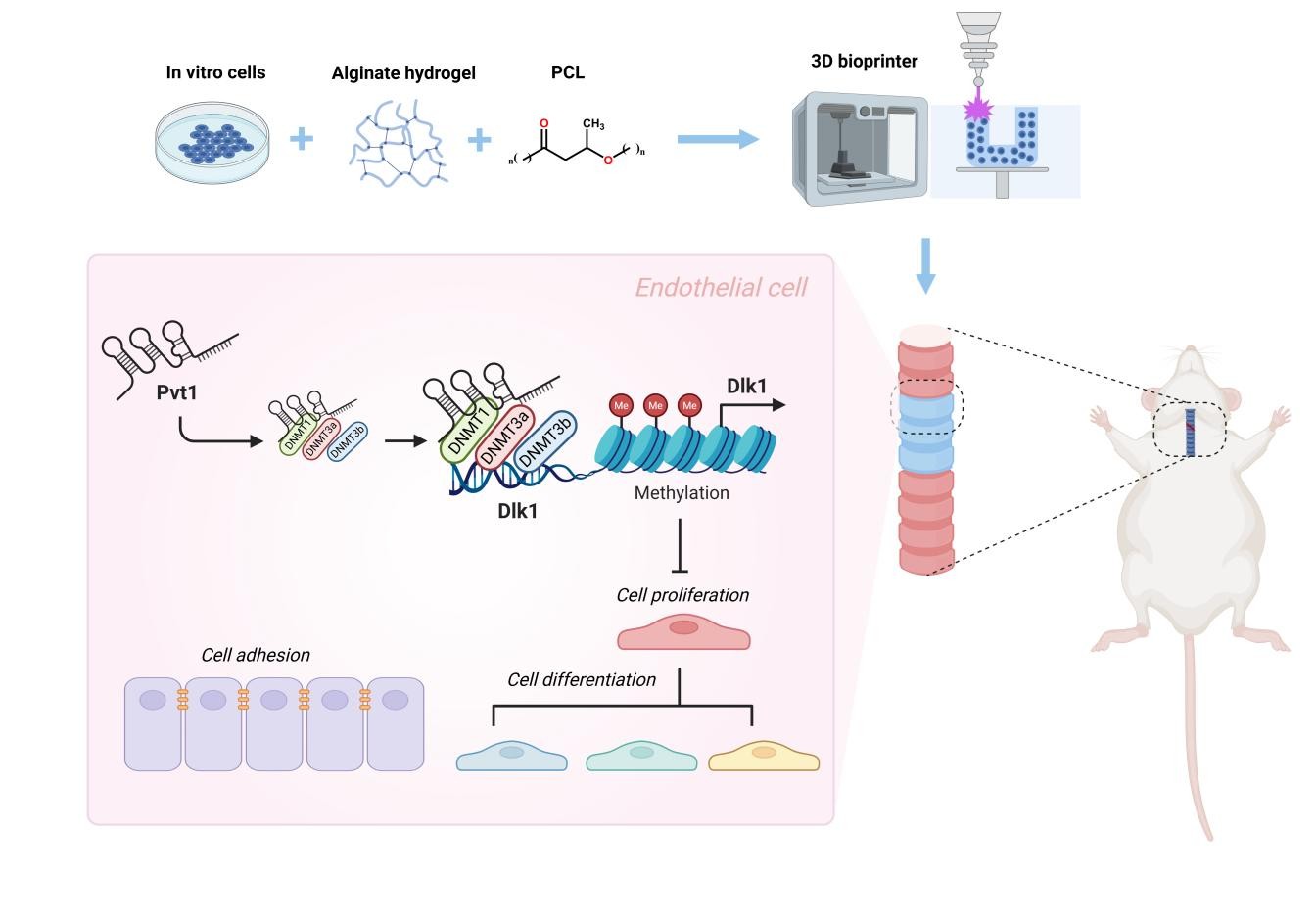
Tracheal reconstruction remains a major clinical challenge due to persistent limitations in graft vascularization, epithelialization, and long-term mechanical compatibility. Conventional synthetic scaffolds and autologous grafts often fail to achieve durable integration, underscoring the need for innovative biofabrication strategies. In the present study, we elucidate the mechanoregulatory role of the long non-coding (lnc) RNA Pvt1 in controlling endothelial cell proliferation and focal adhesion dynamics during tracheal regeneration. Patient-specific tracheal stents were fabricated using extrusion-based three-dimensional bioprinting with hierarchically optimized architectures that combined polycaprolactone (PCL) copolymers with endothelial progenitor cell (EPC)-recruiting motifs. Computational fluid dynamics-guided nozzle path planning and in situ piezoelectric characterization enabled sub- 200 μm resolution in replicating native tracheal microtopography while maintaining 94% EPC viability after printing. Pvt1-enriched bioinks significantly enhanced vascularization, yielding a 2.3-fold increase in neovascularization compared with controls in rat tracheal defect models, alongside a 38% reduction in fibrotic markers. The constructs exhibited a dual-stage biodegradation profile (30% mass loss at eight weeks), providing mechanical compatibility with tissue ingrowth patterns as confirmed by micro-computed tomography-based strain mapping. Collectively, these findings demonstrate the convergence of lncRNA biology and precision bioprinting, delivering an off-the-shelf solution for complex tracheal reconstruction that addresses current barriers in graft epithelialization and immunomodulatory response. The study advances the translational potential of bioengineered airway substitutes through molecularly informed design principles.
- Aydin S, Oz G, Dumanli A, Dongel I, Camas HE. Management of life-threatening tracheal emergencies. Ann Ital Chir. 2022;93:626-632.
- Wang H. Chronic adenoiditis. J Int Med Res. 2020;48(11):300060520971458. doi: 10.1177/0300060520971458
- Filip C, Socolov DG, Albu E, Filip C, Serban R, Popa RF. Serological parameters and vascular investigation for a better assessment in DVT during pregnancy—a systematic review. Medicina (Kaunas). 2021;57(2):160. doi: 10.3390/medicina57020160
- Sawamoto K, Alvarez Gonzalez J, Piechnik M, et al. Mucopolysaccharidosis IVA: diagnosis, treatment, and management. Int J Mol Sci. 2020;21(4):1517. doi: 10.3390/ijms21041517
- Cetrano E, Trezzi M, Secinaro A, et al. Bronchial mismatch as a predictor of respiratory failure after congenital tracheal stenosis repair. Ann Thorac Surg. 2018;105(4):1264-1271. doi: 10.1016/j.athoracsur.2017.10.046
- Ren J, Xu Y, Zhiyi G, et al. Reconstruction of the trachea and carina: surgical reconstruction, autologous tissue transplantation, allograft transplantation, and bioengineering. Thorac Cancer. 2022;13(3):284-295. doi: 10.1111/1759-7714.14315
- Richardson CM, Hart CK, Johnson KE, Gerber ME. Slide tracheoplasty. Otolaryngol Clin North Am. 2022;55(6):1253-1270. doi: 10.1016/j.otc.2022.07.014
- Zhang S, Xiao G, Peng R, Zhang P, Hong J. Clinical consequences of herpes simplex virus DNA in donor corneas: different prognosis and management of endothelial keratoplasty and deep anterior lamellar keratoplasty. J Clin Virol. 2020;129:104508. doi: 10.1016/j.jcv.2020.104508
- Broersen LHA, Andela CD, Dekkers OM, Pereira AM, Biermasz NR. Improvement but no normalization of quality of life and cognitive functioning after treatment for Cushing’s syndrome. J Clin Endocrinol Metab. 2019;104(10):4501-4512. doi: 10.1210/jc.2019-01054
- Wei G, Wang Y, Yang G, Wang Y, Ju R. Recent progress in nanomedicine for enhanced cancer chemotherapy. Theranostics. 2021;11(13):6370-6392. doi: 10.7150/thno.57828
- Shai SE, Lai YL, Hung YW, et al. De novo cartilage growth after implantation of a 3-D-printed tracheal graft in a porcine model. Am J Transl Res. 2020;12(7):3728-3740.
- Raguram A, Banskota S, Liu DR. Therapeutic in vivo delivery of gene editing agents. Cell. 2022;185(15):2806-2827. doi: 10.1016/j.cell.2022.03.045
- Perez RE, Santiago JC, Lopez MC, et al. Behavior of calcium, phosphorus, and parathormone before transplantation and in months 1, 3, 6, 9, and 12 after transplantation. Transplant Proc. 2020;52(4):1152-1156. doi: 10.1016/j.transproceed.2020.01.065
- Bertolin J, Sanchez V, Ribera A, et al. Treatment of skeletal and non-skeletal alterations of mucopolysaccharidosis type IVA by AAV-mediated gene therapy. Nat Commun. 2021;12(1):4944. doi: 10.1038/s41467-021-25697-y
- Chang NW, Dai HJ, Shih YY, et al. Biomarker identification of hepatocellular carcinoma using a methodical literature mining strategy. Database (Oxford). 2017;2017:bax082. doi: 10.1093/database/bax082
- Wu J, Lee B, Saha P, Kumta PN. A feasibility study of biodegradable magnesium–aluminum–zinc–calcium– manganese (AZXM) alloys for tracheal stent application. J Biomater Appl. 2019;33(8):1080-1093. doi: 10.1177/0885328218824775
- Luffy SA, Wu J, Kumta PN, Gilbert TW. Evaluation of magnesium alloys for use as an intraluminal tracheal for pediatric applications in a rat tracheal bypass model. J Biomed Mater Res B Appl Biomater. 2019;107(6):1844-1853. doi: 10.1002/jbm.b.34277
- Wu DT, Munguia-Lopez JG, Cho YW, et al. Polymeric scaffolds for dental, oral, and craniofacial regenerative medicine. Molecules. 2021;26(22):7043. doi: 10.3390/molecules26227043
- Gao C, Lu C, Jian Z, et al. 3D bioprinting for fabricating artificial skin tissue. Colloids Surf B Biointerfaces. 2021;208:112041. doi: 10.1016/j.colsurfb.2021.112041
- Stramiello JA, Mohammadzadeh A, Ryan J, Brigger MT. The role of bioresorbable intraluminal airway stents in pediatric tracheobronchial obstruction: a systematic review. Int J Pediatr Otorhinolaryngol. 2020;139:110405. doi: 10.1016/j.ijporl.2020.110405
- Feuerbach T, Kock S, Thommes M. Slicing parameter optimization for 3D printing of biodegradable drug-eluting tracheal stents. Pharm Dev Technol. 2020;25(6):650-658. doi: 10.1080/10837450.2020.1727921
- Yao W, Li S, Liu R, et al. Long non-coding RNA PVT1: a promising chemotherapy and radiotherapy sensitizer. Front Oncol. 2022;12:959208. doi: 10.3389/fonc.2022.959208
- Dvorak P, Leupen S, Soucek P. Functionally significant features in the 5ʹ untranslated region of the ABCA1 gene and their comparison in vertebrates. Cells. 2019; 8(6):623. doi: 10.3390/cells8060623
- Shi Y, Yang F, Wei S, Xu G. Identification of key genes affecting results of hyperthermia in osteosarcoma based on integrative ChIP-seq/TargetScan analysis. Med Sci Monit. 2017;23:2042-2048. doi: 10.12659/msm.901191
- Zhou C, Yi C, Yi Y, et al. LncRNA PVT1 promotes gemcitabine resistance of pancreatic cancer via activating Wnt/β-catenin and autophagy pathway through modulating the miR-619-5p/Pygo2 and miR-619-5p/ATG14 axes. Mol Cancer. 2020;19(1):118. doi: 10.1186/s12943-020-01237-y
- Chen S, Shen X. Long noncoding RNAs: functions and mechanisms in colon cancer. Mol Cancer. 2020;19(1):167. doi: 10.1186/s12943-020-01287-2
- Zhang M, Zhang L, Fu L, et al. Positive feedback regulation of lncRNA PVT1 and HIF2α contributes to clear cell renal cell carcinoma tumorigenesis and metastasis. Oncogene. 2021;40(37):5639-5650. doi: 10.1038/s41388-021-01971-7
- Shang R, Lal N, Lee CS, et al. Cardiac-specific VEGFB overexpression reduces lipoprotein lipase activity and improves insulin action in rat heart. Am J Physiol Endocrinol Metab. 2021;321(6):E753-E765. doi: 10.1152/ajpendo.00219.2021
- Ma L, Zhang Q, Hao J, Wang J, Wang C. LncRNA PVT1 exacerbates the inflammation and cell-barrier injury during asthma by regulating miR-149. J Biochem Mol Toxicol. 2020;34(11):e22563. doi: 10.1002/jbt.22563
- Lu X, Yu Y, Yin F, et al. Knockdown of PVT1 inhibits IL-1β- induced injury in chondrocytes by regulating miR-27b-3p/ TRAF3 axis. Int Immunopharmacol. 2020;79:106052. doi: 10.1016/j.intimp.2019.106052
- Gao B, Jing H, Gao M, et al. Long-segmental tracheal reconstruction in rabbits with pedicled tissue-engineered trachea based on a 3D-printed scaffold. Acta Biomater. 2019;97:177-186. doi: 10.1016/j.actbio.2019.07.043
- Gao M, Zhang H, Dong W, et al. Tissue-engineered trachea from a 3D-printed scaffold enhances whole-segment tracheal repair. Sci Rep. 2017;7(1):5246. doi: 10.1038/s41598-017-05518-3
- Park HS, Lee JS, Jung H, et al. An omentum-cultured 3D-printed artificial trachea: in vivo bioreactor. Artif Cells Nanomed Biotechnol. 2018;46(suppl 3):1131-1140. doi: 10.1080/21691401.2018.1533844
- Ahn CB, Son KH, Yu YS, Kim TH, Lee JI, Lee JW. Development of a flexible 3D printed scaffold with a cell-adhesive surface for artificial trachea. Biomed Mater. 2019;14(5):055001. doi: 10.1088/1748-605X/ab2a6c
- Bae SW, Lee KW, Park JH, et al. 3D bioprinted artificial trachea with epithelial cells and chondrogenic-differentiated bone marrow-derived mesenchymal stem cells. Int J Mol Sci. 2018;19(6):1624. doi: 10.3390/ijms19061624
- Park JH, Yoon JK, Lee JB, et al. Experimental tracheal replacement using 3-dimensional bioprinted artificial trachea with autologous epithelial cells and chondrocytes. Sci Rep. 2019;9(1):2103. doi: 10.1038/s41598-019-38565-z
- Taniguchi D, Matsumoto K, Tsuchiya T, et al. Scaffold-free trachea regeneration by tissue engineering with bio-3D printing. Interact Cardiovasc Thorac Surg. 2018;26(5):745-752. doi: 10.1093/icvts/ivx444
- Jensen EC. Quantitative analysis of histological staining and fluorescence using ImageJ. Anat Rec (Hoboken). 2013;296(3):378-381. doi: 10.1002/ar.22641
- Kaye R, Goldstein T, Grande DA, Zeltsman D, Smith LP. A 3-dimensional bioprinted tracheal segment implant pilot study: rabbit tracheal resection with graft implantation. Int J Pediatr Otorhinolaryngol. 2019;117: 175-178. doi: 10.1016/j.ijporl.2018.11.010
- Lee KY, Mooney DJ. Alginate: properties and biomedical applications. Prog Polym Sci. 2012;37(1):106-126. doi: 10.1016/j.progpolymsci.2011.06.003
- Liu M, Liu Z, Chen Y, et al. Dendritic epidermal T cells secreting exosomes promote the proliferation of epidermal stem cells to enhance wound re-epithelialization. Stem Cell Res Ther. 2022;13(1):438. doi: 10.1186/s13287-022-02783-6
- Zheng J, Hu L, Cheng J, et al. lncRNA PVT1 promotes the angiogenesis of vascular endothelial cell by targeting miR-26b to activate CTGF/ANGPT2. Int J Mol Med. 2018;41(3):1742-1752. doi: 10.3892/ijmm.2018.3595
- Schober A, Nazari-Jahantigh M, Wei Y, et al. MicroRNA- 126-5p promotes endothelial proliferation and limits atherosclerosis by suppressing Dlk1. Nat Med. 2014;20(4):368-376. doi: 10.1038/nm.3487
- Shirodkar AV, St Bernard R, Gavryushova A, et al. A mechanistic role for DNA methylation in endothelial cell-enriched gene expression: relationship with DNA replication timing. Blood. 2013;121(17): 3531-3540. doi: 10.1182/blood-2013-01-479170
- Herman AB, Tsitsipatis D, Gorospe M. Integrated lncRNA function upon genomic and epigenomic regulation. Mol Cell. 2022;82(12):2252-2266. doi: 10.1016/j.molcel.2022.05.027
- Welter S, Essaleh W. Management of tracheobronchial injuries. J Thorac Dis. 2020;12(10):6143-6151. doi: 10.21037/jtd-2019-as-05
- Frauenfelder C, Maughan E, Kenth J, et al. Tracheal resection for critical airway obstruction in Morquio A syndrome. Case Rep Pediatr. 2023;2023:7976780. doi: 10.1155/2023/7976780
- Leivaditis V, Skevis K, Mulita F, et al. Advancements in the management of postoperative air leak following thoracic surgery: from traditional practices to innovative therapies. Medicina (Kaunas). 2024;60(5):802. doi: 10.3390/medicina60050802
- Genden EM, Laitman BM. Human tracheal transplantation. Transplantation. 2023;107(8):1698-1705. doi: 10.1097/TP.0000000000004509
- Delaere P, Meulemans J, Vranckx J, Vos R, Poorten VV. Tracheal transplantation. Thorac Surg Clin. 2025;35(1):131-141. doi: 10.1016/j.thorsurg.2024.07.002
- Samat AA, Hamid ZAA, Yahaya BH. Tissue engineering for tracheal replacement: strategies and challenges. Adv Exp Med Biol. 2022;137:137-163. doi: 10.1007/5584_2022_707
- Tracy T, Wu L, Liu X, Cheng S, Li X. 3D printing: Innovative solutions for patients and pharmaceutical industry. Int J Pharm. 2023;631:122480. doi: 10.1016/j.ijpharm.2022.122480
- Uchida DT, Bruschi ML. 3D printing as a technological strategy for the personalized treatment of wound healing. AAPS PharmSciTech. 2023;24(1):25. doi: 10.1208/s12249-023-02503-0
- Serrano DR, Kara A, Yuste I, et al. 3D printing technologies in personalized medicine, nanomedicines, and biopharmaceuticals. Pharmaceutics. 2023;15(2):313. doi: 10.3390/pharmaceutics15020313
- Wang P, Sun Y, Shi X, Shen H, Ning H, Liu H. 3D printing of tissue engineering scaffolds: a focus on vascular regeneration. Bio-Des Manuf. 2021;4(2):344-378. doi: 10.1007/s42242-020-00109-0
- Guerra AJ, Cano P, Rabionet M, Puig T, Ciurana J. 3D-printed PCL/PLA composite stents: towards a new solution to cardiovascular problems. Materials (Basel). 2018;11(9):1679. doi: 10.3390/ma11091679
- Townsend JM, Hukill ME, Fung KM, et al. Biodegradable electrospun patch containing cell adhesion or antimicrobial compounds for trachea repair in vivo. Biomed Mater. 2020;15(2):025003. doi: 10.1088/1748-605X/ab5e1b
- Genden EM, Miles BA, Harkin TJ, et al. Single-stage long-segment tracheal transplantation. Am J Transplant. 2021;21(10):3421-3427. doi: 10.1111/ajt.16752
- Park JH, Ahn M, Park SH, et al. 3D bioprinting of a trachea-mimetic cellular construct of a clinically relevant size. Biomaterials. 2021;279:121246. doi: 10.1016/j.biomaterials.2021.121246
- Wahbeh JM, Lama J, Park S, Ebramzadeh E, Hollister SJ, Sangiorgio SN. Degradation and fatigue behavior of 3D-printed bioresorbable tracheal splints. J Biomed Mater Res B Appl Biomater. 2024;112(12):e35501. doi: 10.1002/jbm.b.35501
- Ji K, Zhang Q, Song W, et al. LncRNA PVT1 promotes cell proliferation, invasion, and migration and inhibits cell apoptosis by phosphorylating YAP. Can J Gastroenterol Hepatol. 2022;2022:5332129. doi: 10.1155/2022/5332129
- Li X, Ren H. Long noncoding RNA PVT1 promotes tumor cell proliferation, invasion, migration and inhibits apoptosis in oral squamous cell carcinoma by regulating miR-150-5p/ GLUT-1. Oncol Rep. 2020;44(3):1101-1112. doi: 10.3892/or.2020.7706
- Cui M, Chang Y, Fang QG, et al. Non-coding RNA Pvt1 promotes cancer stem cell–like traits in nasopharyngeal cancer via inhibiting miR-1207. Pathol Oncol Res. 2019;25(4):1411-1422. doi: 10.1007/s12253-018-0453-1
- Du J, Zheng L, Gao P, et al. A small-molecule cocktail promotes mammalian cardiomyocyte proliferation and heart regeneration. Cell Stem Cell. 2022;29(4):545-558.e13. doi: 10.1016/j.stem.2022.03.009