
Antibacterial photocurable resin loaded with cetylpyridinium chloride for vat photopolymerization 3D printing in dental applications

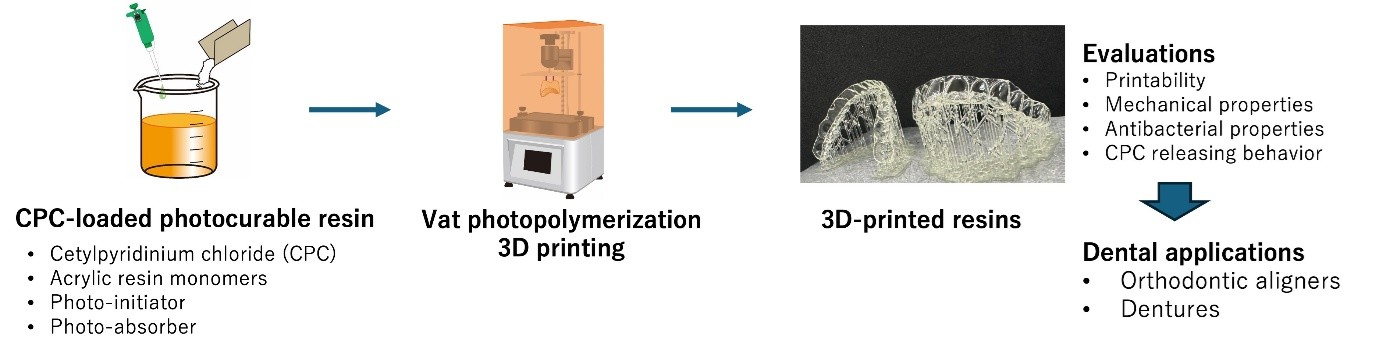
Bacterial adhesion and biofilm formation are critical issues for 3D-printed dental resin. This study aims to develop a novel cetylpyridinium chloride (CPC)-based antibacterial photocurable resin for vat photopolymerization (VPP) 3D printing and evaluate its printability, mechanical properties, antibacterial activities, and CPC-release behavior for potential use in dental prostheses and orthodontic devices. Photocurable resins containing 0–3 wt.% CPC were formulated from methacrylate and acrylate monomers. Printability of the photocurable resins was assessed by measuring viscosity, cure depth, over-curing, and the degree of conversion. The photocurable resins were printed using a VPP 3D printer, and the resulting specimens were evaluated for mechanical properties using three-point bending and Vickers hardness tests. Antibacterial activity against Streptococcus mutans was examined by bacterial viability and plaque-formation assays. CPC-release behavior was analyzed by UV–visible spectroscopy. CPC incorporation up to 3% slightly increased resin viscosity, cure depth, and over-curing while maintaining adequate printability. The degree of conversion was not significantly affected by CPC content. The 1% CPC-loaded printed resin exhibited mechanical properties comparable to the CPC-free control, whereas 3% CPC markedly reduced them. The 1% CPC-loaded resin showed strong antibacterial activity, achieving an antibacterial activity value of 5.6 (>99.99% bacterial reduction), and demonstrated sustained plaque inhibition. Sustained CPC release from the printed resins was confirmed throughout the 14-day evaluation period. These results demonstrate that 1% CPC-loading provides an optimal balance among printability, mechanical properties, and antibacterial performance. The developed material shows potential for application in 3D-printed dental polymer-based prostheses and orthodontic devices.
- Caussin E, Moussally C, Le Goff S, et al. Vat photopolymerization 3D printing in dentistry: a comprehensive review of actual popular technologies. Materials. 2024;17(4):950. doi: 10.3390/ma17040950
- Andjela L, Abdurahmanovich VM, Vladimirovna SN, Mikhailovna GI, Yurievich DD, Alekseevna MY. A review on vat photopolymerization 3D-printing processes for dental application. Dent Mater. 2022;38(11):e284-e296. doi: 10.1016/j.dental.2022.09.005
- Jungbauer R, Sabbagh H, Janjic Rankovic M, Becker K. 3D printed orthodontic aligners—a scoping review. Appl Sci. 2024;14(22):10084. doi: 10.3390/app142210084
- Turanoglu OF, Talay Cevlik E, Vural C. Investigation of adhesion status of Candida species to the surface of resin materials produced at different angles with additive manufacturing. BMC Oral Health. 2024;24(1):738. doi: 10.1186/s12903-024-04505-1
- Ozer NE, Sahin Z, Yikici C, Duyan S, Kilicarslan MA. Bacterial adhesion to composite resins produced by additive and subtractive manufacturing. Odontology. 2024;112(2):460-471. doi: 10.1007/s10266-023-00862-5
- Tseng CF, Sung CC, Yang YT, et al. Impacts of surface characteristics on biological responses and biofilm formation of 3D-printed denture base resins: an in vitro study. J Dent Sci. 2025;20(3):1716-1722. doi: 10.1016/j.jds.2025.03.027
- Ghezzi B, Artesani L, Giovati L, et al. Biological behavior of human gingival fibroblasts and formation of microbial biofilm on 3D-printed dental resin restorations. Dent Mater. 2025;41(10):1266-1276. doi: 10.1016/j.dental.2025.07.012
- Meirowitz A, Rahmanov A, Shlomo E, Zelikman H, Dolev E, Sterer N. Effect of denture base fabrication technique on Candida albicans adhesion in vitro. Materials. 2021;14(1):221. doi: 10.3390/ma14010221
- Zalega M, Bociong K. Antibacterial agents used in modifications of dental resin composites: a systematic review. Appl Sci. 2024;14(9):3710. doi: 10.3390/app14093710
- Melo MAS, Garcia IM, Alluhaidan T, et al. The next frontier in antibacterial dental resins: a 20-year journey of innovation and expectations. Dent Mater. 2025;41(9):1045-1057. doi: 10.1016/j.dental.2025.06.013
- Salgado H, Gomes A, Duarte AS, et al. Antimicrobial activity of a 3D-printed polymethylmethacrylate dental resin enhanced with graphene. Biomedicines. 2022;10(10):2607. doi: 10.3390/biomedicines10102607
- Mangal U, Min YJ, Seo JY, et al. Changes in tribological and antibacterial properties of poly(methyl methacrylate)- based 3D-printed intra-oral appliances by incorporating nanodiamonds. J Mech Behav Biomed Mater. 2020;110:103992. doi: 10.1016/j.jmbbm.2020.103992
- Jin G, Ravichandran V, Shim MS, Kim JE. Incorporating an artificially synthesized fluoride complex into urethane-acrylate-based 3D printing resin: effects on mechanical properties, cytotoxicity, antimicrobial actions, and its long-term fluoride-releasing properties. J Dent. 2024;150:105363. doi: 10.1016/j.jdent.2024.105363
- Khattar A, Alghafli JA, Muheef MA, et al. Antibiofilm activity of 3D-printed nanocomposite resin: impact of ZrO2 nanoparticles. Nanomaterials. 2023;13(3):591. doi: 10.3390/nano13030591
- Mao X, Auer DL, Buchalla W, et al. Cetylpyridinium chloride: mechanism of action, antimicrobial efficacy in biofilms, and potential risks of resistance. Antimicrob Agents Chemother. 2020;64(8):166-191. doi: 10.1128/AAC.00576-20
- Nezu T, Nagano-Takebe F, Endo K. Designing an antibacterial acrylic resin using the cosolvent method— effect of ethanol on the optical and mechanical properties of a cold-cure acrylic resin. Dent Mater J. 2017;36(5):662-668. doi: 10.4012/dmj.2016-222
- Namba N, Yoshida Y, Nagaoka N, et al. Antibacterial effect of bactericide immobilized in resin matrix. Dent Mater. 2009;25(4):424-30. doi: 10.1016/j.dental.2008.08.012
- Kitagawa H, Takeda K, Kitagawa R, et al. Development of sustained antimicrobial-release systems using poly(2-hydroxyethyl methacrylate)/trimethylolpropane trimethacrylate hydrogels. Acta Biomater. 2014; 10(10):4285-95. doi: 10.1016/j.actbio.2014.06.016
- Matsuo K, Yoshihara K, Nagaoka N, et al. Rechargeable anti-microbial adhesive formulation containing cetylpyridinium chloride montmorillonite. Acta Biomater. 2019;100:388-397. doi: 10.1016/j.actbio.2019.09.045
- Kitagawa H, Kitagawa R, Tsuboi R, et al. Development of endodontic sealers containing antimicrobial-loaded polymer particles with long-term antibacterial effects. Dent Mater. 2021;37(8):1248-1259. doi: 10.1016/j.dental.2021.04.008
- Otsubo S, Nakanishi K, Fukukawa K, et al. Development of autopolymerizing resin material with antimicrobial properties using montmorillonite and nanoporous silica. Pharmaceutics. 2023;15(2):544. doi: 10.3390/pharmaceutics15020544
- Yoshihara K, Nagaoka N, Makita Y, Yoshida Y, Van Meerbeek B. Long-term antibacterial efficacy of cetylpyridinium chloride-montmorillonite containing PMMA resin cement. Nanomaterials. 2023;13(9):1495. doi: 10.3390/nano13091495
- Khan S, Amin F, Amin R, Kumar N. Exploring the effect of cetylpyridinium chloride addition on the antibacterial activity and surface hardness of resin-based dental composites. Polymers. 2024;16(5):588. doi: 10.3390/polym16050588
- Okazaki Y, Nakamori K, Yao C, et al. Antibacterial dental adhesive containing cetylpyridinium chloride montmorillonite. Materials. 2024;17(17):4368. doi: 10.3390/ma17174368
- Yoshihara K, Kameyama T, Nagaoka N, et al. Development of an antimicrobial coating film for denture lining materials. Pharmaceutics. 2025;17(7):902. doi: 10.3390/pharmaceutics17070902
- Yamamoto Y, Yoshihara K, Nagaoka N, Van Meerbeek B, Yoshida Y. Novel composite cement containing the anti-microbial compound CPC-montmorillonite. Dent Mater. 2022;38(1):33-43. doi: 10.1016/j.dental.2021.10.009
- Perea-Lowery L, Gibreel M, Garoushi S, Vallittu P, Lassila L. Evaluation of flexible three-dimensionally printed occlusal splint materials: an in vitro study. Dent Mater. 2023;39(10):957-963. doi: 10.1016/j.dental.2023.08.178
- Simunovic L, Brenko L, Maric AJ, Mestrovic S, Haramina T. Rheology of dental photopolymers for SLA/DLP/MSLA 3D printing. Polymers. 2025;17(19):2706. doi: 10.3390/polym17192706
- ISO Standard 22196; Measurement of Antibacterial Activity on Plastics and Other Non-porous Surfaces. Geneva, Switzerland: International Standards Organization; 2011.
- Pratap B, Gupta RK, Bhardwaj B, Nag M. Resin based restorative dental materials: characteristics and future perspectives. Jpn Dent Sci Rev. 2019;55(1):126-138. doi: 10.1016/j.jdsr.2019.09.004
- Taormina G, Sciancalepore C, Messori M, Bondioli F. 3D printing processes for photocurable polymeric materials: technologies, materials, and future trends. J Appl Biomater Funct Mater. 2018;16(3):151-160. doi: 10.1177/2280800018764770
- Bennett J. Measuring UV Curing parameters of commercial photopolymers used in additive manufacturing. Addit Manuf. 2017;18:203-212. doi: 10.1016/j.addma.2017.10.009
- Kolb C, Lindemann N, Wolter H, Sextl G. 3D‐printing of highly translucent ORMOCER®‐based resin using light absorber for high dimensional accuracy. J Appl Polym Sci. 2020;138(3):e49691. doi: 10.1002/app.49691
- Khan K, Hussain MI, Tareen AK, Asghar A, Hamza M, Chen Z. Advances in vat photopolymerization 3D printing: multifunctional materials, process innovations, and emerging applications. Mater Sci Eng R Rep. 2026;167:101120. doi: 10.1016/j.mser.2025.101120
- Hofstetter C, Orman S, Baudis S, Stampfl J. Combining cure depth and cure degree, a new way to fully characterize novel photopolymers. Addit Manuf. 2018;24:166-172. doi: 10.1016/j.addma.2018.09.025
- Zakeri S, Vippola M, Levänen E. A comprehensive review of the photopolymerization of ceramic resins used in stereolithography. Addit Manuf. 2020;35:101177. doi: 10.1016/j.addma.2020.101177
- ChemBK. Cetylpyridinium Chloride. https://www.chembk. com/en/chem/Cetylpyridinium%20chloride. Accessed September 20, 2025.
- ISO 20795-1; Dentistry—Base Polymers Part 1: Denture Base Polymers. Geneva, Switzerland: International Standards Organization; 2013.
- ISO 20795-2; Dentistry—Base Polymers Part 2: Orthodontic Base Polymers. Geneva, Switzerland: International Standards Organization; 2013.
- Sakagami H, Tomomura M. Dental application of natural products. Medicines. 2018;5(1):21. doi: 10.3390/medicines5010021
- Mosaddad SA, Tahmasebi E, Yazdanian A, et al. Oral microbial biofilms: an update. Eur J Clin Microbiol Infect Dis. 2019;38(11):2005-2019. doi: 10.1007/s10096-019-03641-9