
3D-printed nano-hydroxyapatite/polylactic acid scaffold with simvastatin-loaded hydroxyethyl methacrylate/sulfobetaine methacrylate hydrogel for accelerated bone repair

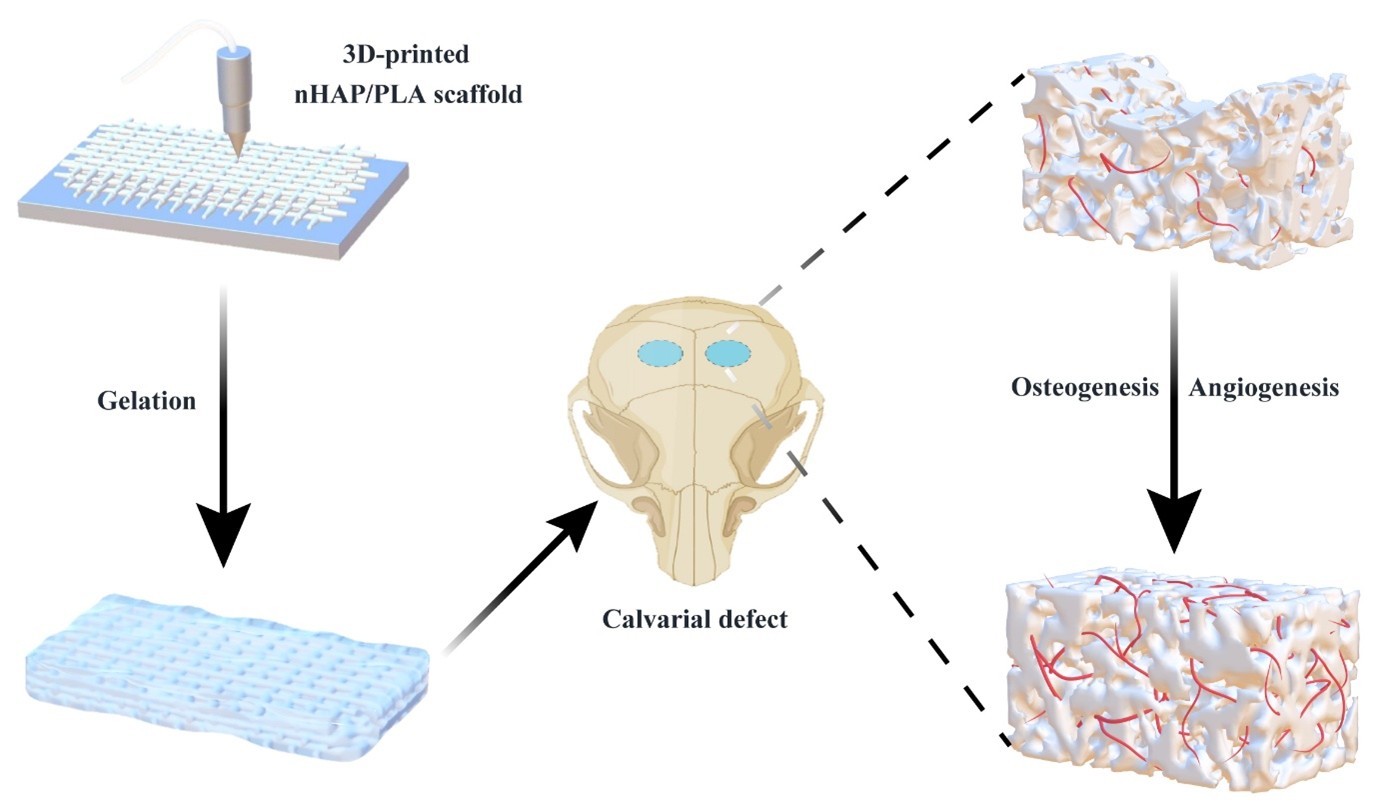
Bone defects resulting from trauma, infection, or tumor resection often exceed the self-healing capacity of bone tissue, requiring bioactive and mechanically robust repair materials. In this study, a composite scaffold was developed via in situ polymerization of a hydroxyethyl methacrylate/sulfobetaine methacrylate (HMSM) hydrogel with a three-dimensional-printed nano-hydroxyapatite/polylactic acid (NP) gradient scaffold to achieve controlled simvastatin (SIM) delivery and enhanced osteogenesis. The HMSM hydrogel served as a hydrophilic and biocompatible matrix, while the NP scaffold provided mechanical strength and structural support. SIM was incorporated into the hydrogel–scaffold composite (SIM@HMSM/NP) to establish a sustained drug-release system. The composite exhibited a smooth microstructure, uniform pore distribution, and a gradient architecture mimicking native bone. Mechanical testing demonstrated improved compressive strength compared with individual components, and in vitro studies revealed stable SIM release over 24 days with a degradation profile compatible with bone regeneration. The SIM@HMSM/ NP demonstrated excellent cytocompatibility, promoting the proliferation and osteogenic differentiation of bone marrow mesenchymal stem cells, and significantly enhanced bone formation in a rat calvarial defect model. These findings suggest that the SIM@HMSM/NP scaffold provides a promising strategy for sustained drug delivery and accelerated bone regeneration in critical-sized bone defects.
- Xu JL, Bao G, Jia B, et al. An adaptive biodegradable zinc alloy with bidirectional regulation of bone homeostasis for treating fractures and aged bone defects. Bioact Mater. 2024;38:207-224. doi: 10.1016/j.bioactmat.2024.04.027
- Kim J, Park S, Park JY, et al. Dual-phase blocks for regeneration of critical-sized bone defects. Nano Today. 2024;54:102120. doi: 10.1016/j.nantod.2023.102120
- Lee J, Byun H, Madhurakkat Perikamana SK, Lee S, Shin H. Current advances in immunomodulatory biomaterials for bone regeneration. Adv Healthc Mater. 2019;8(4):e1801106. doi: 10.1002/adhm.201801106
- Yuan B, Cheng Q, Zhao R, et al. Comparison of osteointegration property between PEKK and PEEK: effects of surface structure and chemistry. Biomaterials. 2018;170:116-126. doi: 10.1016/j.biomaterials.2018.04.014
- Wang JC, Dou ZL, Xia L, Huang N. Metal-organic complex coating for enhanced corrosion control and biocompatibility on biodegradable magnesium alloy for orthopaedic implants. J Mat Chem B. 2024;12(23):5661-5677. doi: 10.1039/d4tb00347k
- Hama R, Ulziibayar A, Reinhardt JW, Watanabe T, Kelly J, Shinoka T. Recent developments in biopolymer-based hydrogels for tissue engineering applications. Biomolecules. 2023;13(2):280. doi: 10.3390/biom13020280
- Cao H, Duan L, Zhang Y, Cao J, Zhang K. Current hydrogel advances in physicochemical and biological response-driven biomedical application diversity. Signal Transduct Target Ther. 2021;6(1):426. doi: 10.1038/s41392-021-00830-x
- Huang QT, Zou YJ, Arno MC, et al. Hydrogel scaffolds for differentiation of adipose-derived stem cells. Chem Soc Rev. 2017;46(20):6255-6275. doi: 10.1039/c6cs00052e
- Gu GH, Cui ZC, Du XF, et al. Recent advances in biomacromolecule-reinforced 2D material (2DM) hydrogels: from interactions, synthesis, and functionalization to biomedical applications. Adv Funct Mater. 2024;34(48):8367. doi: 10.1002/adfm.202408367
- Tzoumani I, Iatridi Z, Fidelli A, Krassa P, Kallitsis J, Bokias G. Room-temperature self-healable blends of waterborne polyurethanes with 2-hydroxyethyl methacrylate-based polymers. Int J Mol Sci. 2023;24(3):2575. doi: 10.3390/ijms24032575
- He X, He S, Xiang G, et al. Precise lubrication and protection of cartilage damage by targeting hydrogel microsphere. Adv Mater. 2024;36(40):2405943. doi: 10.1002/adma.202405943
- Rodzen K, O’Donnell E, Hasson F, et al. Advanced 3D printing of polyetherketoneketone hydroxyapatite composites via fused filament fabrication with increased interlayer connection. Materials (Basel). 2024;17(13):3161. doi: 10.3390/ma17133161
- Derby B. Printing and prototyping of tissues and scaffolds. Science. 2012;338(6109):92-926. doi: 10.1126/science.1226340
- Shafiee A, Atala A. Printing technologies for medical applications. Trends Mol Med. 2016;22(3):254-265. doi: 10.1016/j.molmed.2016.01.003
- Li JY, Li KK, Du YK, et al. Dual-nozzle 3D printed nano-hydroxyapatite scaffold loaded with vancomycin sustained-release microspheres for enhancing bone regeneration. Int J Nanomedicine. 2023;18:307-322. doi: 10.2147/IJN.S394366
- Rajabi M, McConnell M, Cabral J, Ali MA. Chitosan hydrogels in 3D printing for biomedical applications. Carbohydr Polym. 2021;260:117768. doi: 10.1016/j.carbpol.2021.117768
- Vijayavenkataraman S, Yan WC, Lu WF, Wang CH, Fuh JYH. 3D bioprinting of tissues and organs for regenerative medicine. Adv Drug Deliv Rev. 2018;132:296-332. doi: 10.1016/j.addr.2018.07.004
- Mandrycky C, Wang ZJ, Kim K, Kim DH. 3D bioprinting for engineering complex tissues. Biotechnol Adv. 2016; 34(4):422-434. doi: 10.1016/j.biotechadv.2015.12.011
- Anada T, Pan CC, Stahl AM, et al. Vascularized bone-mimetic hydrogel constructs by 3D bioprinting to promote osteogenesis and angiogenesis. Int J Mol Sci. 2019;20(5):1096. doi: 10.3390/ijms20051096
- Duarte JA, de Barros ALB, Leite EA. The potential use of simvastatin for cancer treatment: a review. Biomed Pharmacother. 2021;141:111858. doi: 10.1016/j.biopha.2021.111858
- Yao X, Xie R, Cao Y, et al. Simvastatin induced ferroptosis for triple-negative breast cancer therapy. J Nanobiotechnol. 2021;19(1):311. doi: 10.1186/s12951-021-01058-1
- Sun TT, Huang J, Zhang W, et al. Simvastatin-hydroxyapatite coatings prevent biofilm formation and improve bone formation in implant-associated infections. Bioact Mater. 2023;21:44-56. doi: 10.1016/j.bioactmat.2022.07.028
- Chiu KY, Huang JY, Su YH, Ou SF, Chen KK, Wang YH. A 3D-printed bioactive glass scaffold coated with sustained-release PLGA/simvastatin stimulates calvarial bone repair. Mater Des. 2024;241:112898. doi: 10.1016/j.matdes.2024.112898
- Dai BY, Li X, Xu JK, et al. Synergistic effects of magnesium ions and simvastatin on attenuation of high-fat diet-induced bone loss. Bioact Mater. 2021;6(8):2511-2522. doi: 10.1016/j.bioactmat.2021.01.027
- Chiu KY, Huang JY, Su YH, Ou SF, Chen KK, Wang YH. A 3D-printed bioactive glass scaffold coated with sustained-release PLGA/simvastatin stimulates calvarial bone repair. Mater Des. 2024;241:112898. doi: 10.1016/j.matdes.2024.112898
- Zhen J, Wan T, Sun G, Chen X, Zhang S. A ROS-responsive microsphere capsule encapsulated with NADPH oxidase 4 inhibitor ameliorates macrophage inflammation and ferroptosis. Heliyon. 2024;10(1):e23589. doi: 10.1016/j.heliyon.2023.e23589
- Liu XF, Gaihre B, Park S, et al. 3D-printed scaffolds with 2D hetero-nanostructures and immunomodulatory cytokines provide pro-healing microenvironment for enhanced bone regeneration. Bioact Mater. 2023;27:216-230. doi: 10.1016/j.bioactmat.2023.03.021
- Gu GH, Xu YY, He P, et al. Bioinspired composite hydrogels with osteogenic, angiogenic, and antioxidant properties for enhanced bone repair. Small Struct. 2025;6(4):2400462. doi: 10.1002/sstr.202400462
- Çetin D, Kahraman AS, Gümüsderelioglu M. Novel scaffolds based on poly(2-hydroxyethyl methacrylate) superporous hydrogels for bone tissue engineering. J Biomater Sci Polym Ed. 2011;22(9):1157-1178. doi: 10.1163/092050610x501704
- Moura D, Pereira AT, Ferreira HP, et al. Poly(2-hydroxyethyl methacrylate) hydrogels containing graphene-based materials for blood-contacting applications: from soft inert to strong degradable material. Acta Biomater. 2023;164:253-268. doi: 10.1016/j.actbio.2023.04.031
- Kim S, Shin BH, Yang C, et al. Development of poly(HEMA-Am) Polymer hydrogel filler for soft tissue reconstruction by facile polymerization. Polymers. 2018;10(7):772. doi: 10.3390/polym10070772
- Gao F, Xu ZY, Liang QF, et al. Direct 3D printing of high strength biohybrid gradient hydrogel scaffolds for efficient repair of osteochondral defect. Adv Funct Mater. 2018;28(13):1706644. doi: 10.1002/adfm.201706644
- Wang LL, Chen X, Wang XY, et al. Bio-inspired mineralized collagen scaffolds with precisely controlled gradients for the treatment of severe osteoarthritis in a male rabbit model. Int J Biol Macromol. 2025;300:139843. doi: 10.1016/j.ijbiomac.2025.139843
- Pathmanapan S, Periyathambi P, Anandasadagopan SK. Fibrin hydrogel incorporated with graphene oxide functionalized nanocomposite scaffolds for bone repair — in vitro and in vivo study. Nanomed. 2020;29:102251. doi: 10.1016/j.nano.2020.102251
- Xue X, Hu Y, Deng YH, Su JC. Recent advances in design of functional biocompatible hydrogels for bone tissue engineering. Adv Funct Mater. 2021;31(19):2009432. doi: 10.1002/adfm.202009432
- Zhou D, Yan X, Xiao L, Wang JL, Wei JC. Gold capped mesoporous bioactive glass guides bone regeneration via BMSCs recruitment and drug adaptive release. Chem Eng J. 2024;487:150546. doi: 10.1016/j.cej.2024.150546
- Jang HJ, Yoon JK. The role of vasculature and angiogenic strategies in bone regeneration. Biomimetics. 2024;9(2):75. doi: 10.3390/biomimetics9020075
- Schott NG, Friend NE, Stegemann JP. Coupling osteogenesis and vasculogenesis in engineered orthopedic tissues. Tissue Eng Part B Rev. 2021;27(3):199-214. doi: 10.1089/ten.teb.2020.0132
- Yu WL, Sun TW, Qi C, et al. Enhanced osteogenesis and angiogenesis by mesoporous hydroxyapatite microspheresderived simvastatin sustained release system for superior bone regeneration. Sci Rep. 2017;7:44129. doi: 10.1038/srep44129
- Saberi A, Kouhjani M, Mohammadi M, Hosta-Rigau L. Novel scaffold platforms for simultaneous induction osteogenesis and angiogenesis in bone tissue engineering: a cutting-edge approach. J Nanobiotechnol. 2023;21(1):351. doi: 10.1186/s12951-023-02115-7
- Pan Q, Zong Z, Li H, et al. Hydrogel design and applications for periodontitis therapy: a review. Int J Biol Macromol. 2025;284:137893. doi: 10.1016/j.ijbiomac.2024.137893