

Evaluating multimodal foundation models for engineering drawing assessment and spatial reasoning

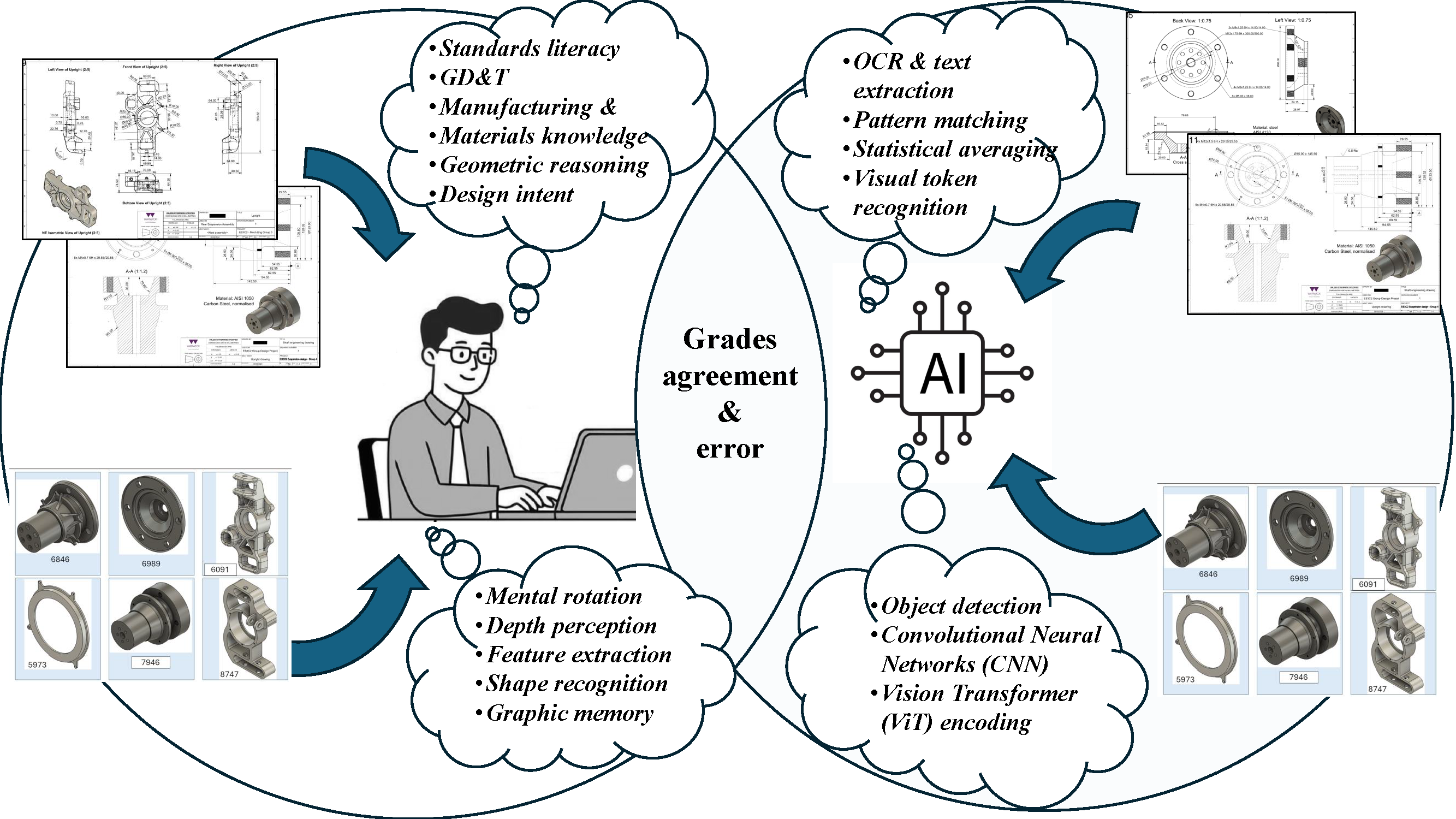
This work investigates two different aspects of contemporary multimodal vision language models (VLMs) regarding their analysis and understanding of engineering technical drawings: (i) their capacity to grade drawings based on their text, image and graphic analysis, and (ii) their engineering spatial reasoning capabilities. Using a collection of one hundred authentic engineering drawing assessments and a novel drawing-to-isometric correspondence task, we examined how two widespread commercially available VLM models, namely Gemini (Google DeepMind) and Copilot (Microsoft), perform across multiple repeats of the same task. Both experiments were benchmarked to human experts who fulfilled the same task as a baseline comparison. Results from the drawing assessment and marking experiment showed a notable capacity of both VLMs to grade submissions, both within 10% error relative to human marking results. The intra-marking consistency and the ranking ability varied across models, with Copilot displaying higher reliability levels closer to human level. The isometric-matching task, however, demonstrated that current VLMs struggle with highly visual abstraction tasks, as their model-matching capacity was well below human marker’s performance. We conclude that, although VLMs exhibit high performance in analytical tasks involving optical recognition, text and data mining, they appear to still lack sufficient abstraction capacity consistent with human mental processes such as mental rotation, graphic memory retention and shape matching. A cross-analysis further revealed that spatial reasoning performance and grading accuracy are moderately associated for Gemini, but independent for Copilot, suggesting fundamentally different underlying processing strategies between the two models.
- Xu Y, Zhang C, Xu Z, et al. Tolerance Information Extraction for Mechanical Engineering Drawings – A Digital Image Processing and Deep Learning-based Model. CIRP J Manuf Sci Technol. 2024;50:55-64. doi: 10.1016/J.CIRPJ.2024.01.013
- Otey J, Company P, Contero M, Camba JD. Revisiting the design intent concept in the context of mechanical CAD education. Comput Aided Des Appl. 2018;15(1):47-60. doi: 10.1080/16864360.2017.1353733
- Kadam K, Mishra S, Deep A, Iyer S. Enhancing engineering drawing skills via fostering mental rotation processes. Eur J Eng Educ. 2021;46(5):796-812. doi: 10.1080/03043797.2021.1920891
- Xie W, Niu J, Xue CJ, Guan N. Grade Like a Human: Rethinking Automated Assessment with Large Language Models. In: Proceedings of the International Conference on Research in Adaptive and Convergent Systems. New York, NY, USA: ACM; 2025:1-8. doi: 10.1145/3769002.3769962
- Edwards KM, Tehranchi F, Miller S, Ahmed F. AI Judges in Design: Toward Expert-Equivalent Design Evaluations With Vision-Language Models and In-Context Learning. J Mech Des. 2026;148(7). doi: 10.1115/1.4071835
- NexCAD Ltd. NexCAD - AI Drawing Checker. Accessed August 3, 2026. https://nexcad.ai/
- 3YOURMIND. AI-Powered Technical Drawing Analysis by 3YOURMIND. Accessed August 3, 2026. https://www.3yourmind.com/ai-powered-technical-drawing-analysis
- Dessia Technologies. Dessia. Accessed August 3, 2026. https://www.dessia.io/case-studies/automated-2d-drawing-check-for-design-completeness
- CoLab Software. AI Engineering Drawing Checker | CoLab. Accessed August 3, 2026. https://www.colabsoftware.com/product/ai-drawing-reviews?utm_source=google&utm_medium=paidsearch&utm_campaign=PM-GOOG-SRC-AO-ai-engineering-low-ctr-organic-keywords&utm_term=ai+for+engineering+design&utm_content=ai-for-engineering-design
- Zhang J, Huang J, Jin S, Lu S. Vision-Language Models for Vision Tasks: A Survey. IEEE Trans Pattern Anal Mach Intell. 2024;46(8):5625-5644. doi: 10.1109/TPAMI.2024.3369699
- Chen S, Zhu T, Zhou R, et al. Why Is Spatial Reasoning Hard for VLMs? An Attention Mechanism Perspective on Focus Areas. In: Proceedings of the 42nd International Conference on Machine Learning. Vancouver, Canada; 2025;267:9910-9932. Accessed July 17, 2026. https://proceedings.mlr.press/v267/chen25cr.html
- Zhang Z, Hu F, Lee J, et al. Do Vision-Language Models Represent Space and How? Evaluating Spatial Frame of Reference Under Ambiguities. In: 13th International Conference on Learning Representations, ICLR 2025. Singapore; 2025:14036-14062. Accessed August 12, 2026. https://arxiv.org/pdf/2410.17385
- How to Use AI for Manufacturing Drawing Reviews: A Step-by-Step Guide. Accessed August 3, 2026. https://www.colabsoftware.com/post/ai-for-manufacturing-drawing-checks-a-guide-for-engineering-teams
- Merzdorf HE, Jaison D, Weaver MB, Linsey J, Hammond T, Douglas KA. Work In Progress: An Object Assembly Test of Sketching in Undergraduate Engineering. Proceedings - Frontiers in Education Conference, FIE. Uppsala, Sweden; 2022;1-5. doi: 10.1109/FIE56618.2022.9962634
- Raju G, Sorby S. The Role of Spatial Skills and Sketching in Engineering Design Problem Solving. In: 2024 ASEE Annual Conference & Exposition Proceedings. Portland, Oregon. 2024. doi: 10.18260/1-2--48133
- Ernst JV, Lane D, Clark AC. Pictorial Visual Rotation Ability of Engineering Design Graphics Students. Eng Des Graph J. 2015;79(1):1-13. doi: 10.18260/edgj.v79i1.510
- Han W, Xiang S, Liu C, Wang R, Feng C. SPARE3D: A Dataset for SPAtial REasoning on Three-View Line Drawings. In: 2020 IEEE/CVF Conference on Computer Vision and Pattern Recognition (CVPR). Seattle, WA, USA; 2020:14678-14687. doi: 10.1109/CVPR42600.2020.01470
- Kunz L, Klostermeier M, Thanabalan K, Legler T, Ruskowski M, Autor K. TechMB: Exploring the Potential of Vision Language Models for Interpreting Technical Drawings. In: DS 140: Proceedings of the 36th Symposium Design for X (DFX2025). Hamburg, Germany: 2025:179-188. doi: 10.35199/DFX2025.19
- Wu S, Khasahmadi AH, Katz M, et al. CadVLM: Bridging Language and Vision in the Generation of Parametric CAD Sketches. In: Lecture Notes in Computer Science. Switzerland: Springer Nature; 2024:368-384. doi: 10.1007/978-3-031-72897-6_21
- Monjoree U, Yan W. AI’s Spatial Intelligence: Evaluating AI’s Understanding of Spatial Transformations in PSVT:R and Augmented Reality. arXiv. Preprint posted online 2024. doi: 10.48550/arXiv.2411.06269
- Picard C, Edwards KM, Doris AC, et al. From concept to manufacturing: evaluating vision-language models for engineering design. Artif Intell Rev. 2025;58(9). doi: 10.1007/S10462-025-11290-Y
- Khan MT, Chen L, Ng YH, Feng W, Tan NYJ, Moon SK. Fine-Tuning Vision-Language Model for Automated Engineering Drawing Information Extraction. arXiv. Preprint posted online 2024. doi: 10.48550/ARXIV.2411.03707
- Zhou J, Camba JD, Company P, Contero M. Drawing-Checker: A Vision RAG Framework for Automated Comparison of Engineering Drawings. Procedia CIRP. 2026;142:127-132. doi: 10.1016/j.procir.2026.05.235
- Doris AC, Grandi D, Tomich R, et al. DesignQA: A Multimodal Benchmark for Evaluating Large Language Models’ Understanding of Engineering Documentation. J Comput Inf Sci Eng. 2025;25(2):021009. doi: 10.1115/1.4067333
- University of Bristol. ES3C2-15 Advanced Mechanical Engineering Design - Module Catalogue. Accessed August 3, 2026. https://courses.warwick.ac.uk/modules/2021/ES3C2-15
- Munguia J. 2D Engineering drawing collection + Isometric representations. Zenodo. Preprint posted online August 2026. doi: 10.5281/zenodo.21905698
- Bartlett KA, Dorribo Camba J. The role of a graphical interpretation factor in the assessment of Spatial Visualization: A critical analysis. Spat Cogn Comput. 2021;23(1):1-30. doi: 10.1080/13875868.2021.2019260
- Bartlett KA. Engineering Design and Spatial Skills: A Systematic Literature Review. J Mech Des. 2026;148(4):040901. doi: 10.1115/1.4070965
- Hertanti A, Retnawati H, Wutsqa DU. The role of spatial experience in mental rotation. J Phys Conf Ser. 2019;1320(1):012043. doi: 10.1088/1742-6596/1320/1/012043
- Gan Z, Li L, Li C, Wang L, Liu Z, Gao J. Vision-Language Pre-training: Basics, Recent Advances, and Future Trends. Found Trends Comput Graph Vis. 2022;14(3-4):163-352. doi: 10.1561/0600000105
- Munguia J. Leveraging AI for 2D technical drawing analysis, feedback and assessment in higher education. Int J Mech Eng Educ. 2026. doi: 10.1177/03064190251414394