

AI for chips: A systematic review of artificial intelligence in the semiconductor lifecycle

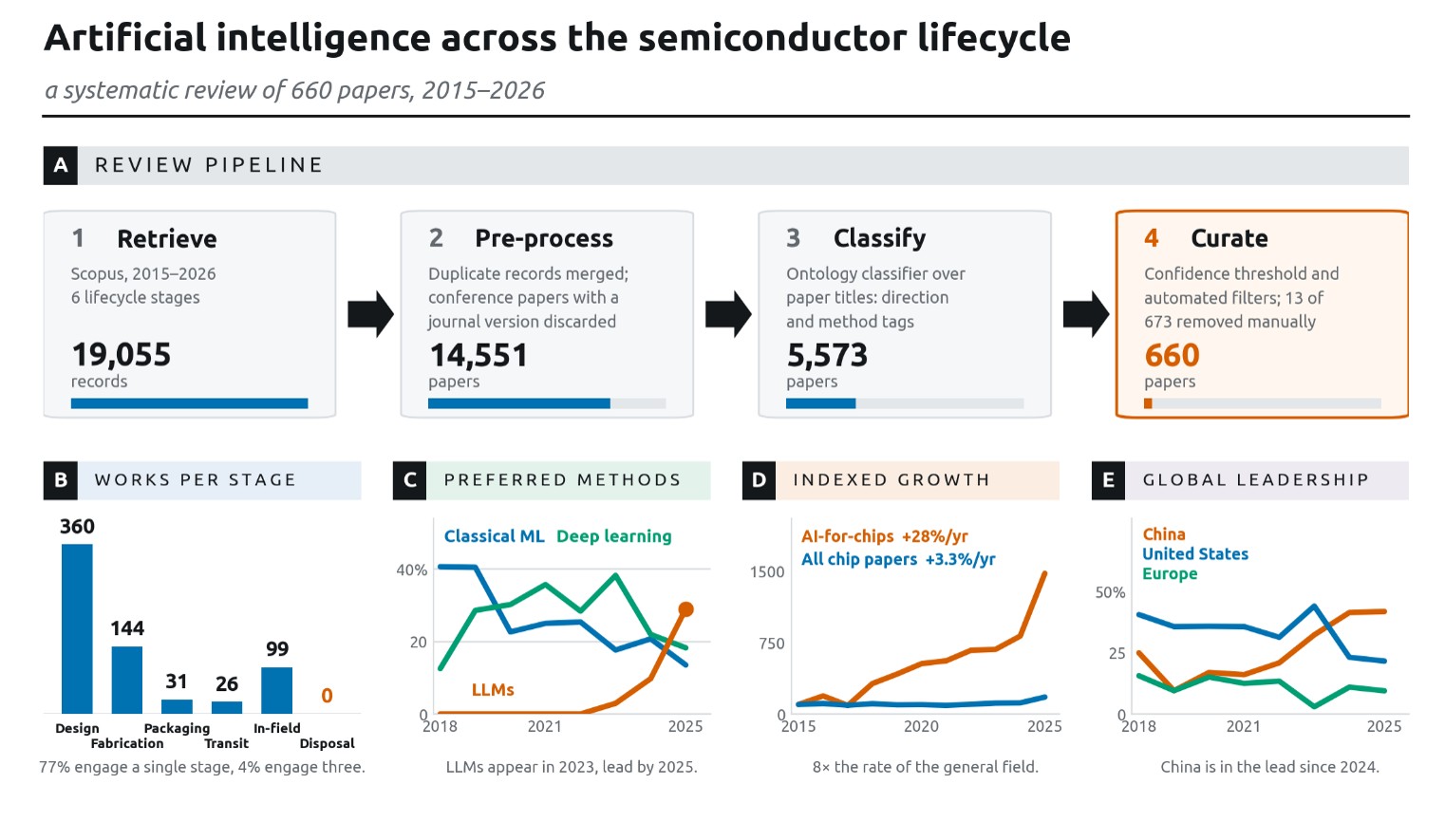
Artificial intelligence (AI) methods such as machine learning, deep learning, and large language models are increasingly used to design systems, including integrated circuits. This work provides a thorough understanding of AI adoption across the full semiconductor engineering life cycle by collecting and analyzing a corpus of peer-reviewed articles from a curated list of journals and conference proceedings. The results of this systematic review indicate active work on AI use before tapeout and depict a thinly connected lifecycle, where methods focus on specific stages and barely cross neighboring-stage boundaries. Additionally, we analyzed the geographical and industrial landscape of the global AI-for-Chips conversation and found a notable rise of China as a leader in AI research for semiconductor development, amid a general decline in contributions from other countries, with only a few exceptions. This study represents the first work bridging AI, end-to-end semiconductor engineering, and national contributions. The work benefits designers, practitioners, engineers, entrepreneurs, decision-makers, and policymakers by highlighting opportunities and challenges in using AI for chips to improve productivity and sustainability in the era of silicon dominance.
- Verner A, Kim H, Jeong I, et al. Optical overlay measurement accuracy improvement with machine learning. Proc Metrology, Inspection, and Process Control for Microlithography XXXIV. 2020;11325:113251Z. doi: 10.1117/12.2551850
- May GS, Spanos CJ. Fundamentals of Semiconductor Manufacturing and Process Control. Wiley-IEEE Press; 2006. doi: 10.1002/0471790281
- Neshati R. A Statistical Model to Analyze the Complexity of Semiconductor Manufacturing. Proc 2013 Portland Int Conf Manag Eng Technol (PICMET). 2013:2757-2764. https://ieeexplore.ieee.org/document/6641614
- Wu Q, Li Y, Zhao Y. The evolution of photolithography technology, process standards, and future outlook. Proc IEEE 15th Int Conf Solid-State Integr Circuit Technol (ICSICT). 2020:1-5. doi: 10.1109/ICSICT49897.2020.9278164
- Huang G, Hu J, He Y, et al. Machine Learning for Electronic Design Automation: A Survey. ACM Trans Des Autom Electron Syst. 2021;26(5):40. doi: 10.1145/3451179
- Sánchez D, Servadei L, Kiprit GN, Wille R, Ecker W. A Comprehensive Survey on Electronic Design Automation and Graph Neural Networks: Theory and Applications. ACM Trans Des Autom Electron Syst. 2023;28(2):15. doi: 10.1145/3543853
- Pan J, Zhou G, Chang CC, Jacobson I, Hu J, Chen Y. A Survey of Research in Large Language Models for Electronic Design Automation. ACM Trans Des Autom Electron Syst. 2025;30(3):34. doi: 10.1145/3715324
- Ngo AT, Dey B, Halder S, De Gendt S, Wang C. Machine Learning-Based Edge Placement Error Analysis and Optimization: A Systematic Review. IEEE Trans Semicond Manuf. 2023;36(1):1-13. doi: 10.1109/TSM.2022.3217326
- Shalan M, Edwards T. Building OpenLANE: A 130nm OpenROAD-based Tapeout-Proven Flow. Proc 39th Int Conf Comput Aided Des (ICCAD ’20). 2020:110. doi: 10.1145/3400302.3415735
- Ajayi T, Chhabria VA, Fogaça M, et al. Toward an Open-Source Digital Flow: First Learnings from the OpenROAD Project. Proc 56th ACM/IEEE Design Automation Conf (DAC ’19). 2019:76. doi: 10.1145/3316781.3326334
- Scheible J, Lienig J. Automation of Analog IC Layout: Challenges and Solutions. Proc 2015 ACM Int Symp Phys Des (ISPD ‘15). 2015:33-40. doi: 10.1145/2717764.2717781
- Page MJ, McKenzie JE, Bossuyt PM, et al. The PRISMA 2020 statement: an updated guideline for reporting systematic reviews. BMJ. 2021;372:n71. doi: 10.1136/bmj.n71
- MacFarlane A, Russell-Rose T, Shokraneh F. Search strategy formulation for systematic reviews: Issues, challenges and opportunities. Intell Syst Appl. 2022;15:200091. doi: 10.1016/j.iswa.2022.200091
- Choi S, Shim S, Shin Y. Neural Network Classifier-Based OPC with Imbalanced Training Data. IEEE Trans Comput Aided Des Integr Circuits Syst. 2019;38(5):938-948. doi: 10.1109/TCAD.2018.2824255
- Wang D, Xu K, Guo J, Ghiasi S. DSP-Efficient Hardware Acceleration of Convolutional Neural Network Inference on FPGAs. IEEE Trans Comput Aided Des Integr Circuits Syst. 2020;39(12):4867-4880. doi: 10.1109/TCAD.2020.2968023
- Swartout B, Patil R, Knight K, Russ T. Toward distributed use of large-scale ontologies. In: Proc 10th Workshop on Knowledge Acquisition for Knowledge-Based Systems. 1996. https://ksi.cpsc.ucalgary.ca/KAW/KAW96/swartout/Banff_96_final_2.html
- Ramkumar AS, Poorna B. Ontology based semantic search: An introduction and a survey of current approaches. Proc Int Conf Intell Comput Appl (ICICA). 2014:372-376. doi: 10.1109/ICICA.2014.82
- Mönch L, Stehli M. An ontology for production control of semiconductor manufacturing processes. In: Schillo M, Klusch M, Müller J, Tianfield H, eds. Multiagent System Technologies. MATES 2003. Lecture Notes in Computer Science, vol 2831. 2003:156-167. doi: 10.1007/978-3-540-39869-1_14
- Ehm H, Ramzy N, Moder P, Summerer C, Fetz S, Neau C. Digital Reference – A Semantic Web for Semiconductor Manufacturing and Supply Chains Containing Semiconductors. Proc 2019 Winter Simulation Conf (WSC). 2019:2409-2418. doi: 10.1109/WSC40007.2019.9004831
- Otte JN, Kiritsis D, Ali MM, et al. An ontological approach to representing the product life cycle. Appl Ontol. 2019;14(2):179-197. doi: 10.3233/AO-190210
- Wawrzik FW, Grimm CG, Neumann PN. Ontology Module Suite for Electronics and Systems Engineering. IEEE DataPort; 2023. doi: 10.21227/88nn-eb43
- Google LLC. Google Patents. https://patents.google.com/
- Gajski DD, Kuhn RH. Guest editors’ introduction: New VLSI tools. Computer. 1983;16(12):11-14. doi: 10.1109/MC.1983.1654264
- Li Y, Wang Y, Li Y, Zhou R, Lin Z. An Artificial Neural Network Assisted Optimization System for Analog Design Space Exploration. IEEE Trans Comput Aided Des Integr Circuits Syst. 2020;39(10):2640-2653. doi: 10.1109/TCAD.2019.2961322
- Budak AF, Gandara M, Shi W, Pan DZ, Sun N, Liu B. An Efficient Analog Circuit Sizing Method Based on Machine Learning Assisted Global Optimization. IEEE Trans Comput Aided Des Integr Circuits Syst. 2022;41(5):1209-1221. doi: 10.1109/TCAD.2021.3081405
- Zhang S, Yang F, Yan C, Zhou D, Zeng X. An Efficient Batch-Constrained Bayesian Optimization Approach for Analog Circuit Synthesis via Multiobjective Acquisition Ensemble. IEEE Trans Comput Aided Des Integr Circuits Syst. 2022;41(1):1-14. doi: 10.1109/TCAD.2021.3054811
- Settaluri K, Liu Z, Khurana R, Mirhaj A, Jain R, Nikolic B. Automated Design of Analog Circuits Using Reinforcement Learning. IEEE Trans Comput Aided Des Integr Circuits Syst. 2022;41(9):2794-2807. doi: 10.1109/TCAD.2021.3120547
- Ahmadzadeh M, Lappas J, Wehn N, Gielen G. AnaCraft: Duel-Play Probabilistic-Model-Based Reinforcement Learning for Sample-Efficient PVT-Robust Analog Circuit Sizing Optimization. IEEE Trans Comput Aided Des Integr Circuits Syst. 2026;45(2):901-914. doi: 10.1109/TCAD.2025.3582175
- Thakur S, Ahmad B, Pearce H, et al. VeriGen: A Large Language Model for Verilog Code Generation. ACM Trans Des Autom Electron Syst. 2024;29(3):46. doi: 10.1145/3643681
- Wu H, He Z, Zhang X, et al. ChatEDA: A Large Language Model Powered Autonomous Agent for EDA. IEEE Trans Comput Aided Des Integr Circuits Syst. 2024;43(10):3184-3197. doi: 10.1109/TCAD.2024.3383347
- Liu B, Zhang H, Gao X, et al. LayoutCopilot: An LLM-Powered Multiagent Collaborative Framework for Interactive Analog Layout Design. IEEE Trans Comput Aided Des Integr Circuits Syst. 2025;44(8):3126-3139. doi: 10.1109/TCAD.2025.3529805
- Shen J, Chen Z, Zhuang J, et al. Atelier: An Automated Analog Circuit Design Framework via Multiple Large Language Model-Based Agents. IEEE Trans Comput Aided Des Integr Circuits Syst. 2026;45(1):31-44. doi: 10.1109/TCAD.2025.3573228
- Lin Y, Jiang Z, Gu J, et al. DREAMPlace: Deep Learning Toolkit-Enabled GPU Acceleration for Modern VLSI Placement. IEEE Trans Comput Aided Des Integr Circuits Syst. 2021;40(4):748-761. doi: 10.1109/TCAD.2020.3003843
- Xu Q, Geng H, Chen S, et al. GoodFloorplan: Graph Convolutional Network and Reinforcement Learning-Based Floorplanning. IEEE Trans Comput Aided Des Integr Circuits Syst. 2022;41(10):3492-3502. doi: 10.1109/TCAD.2021.3131550
- Wu N, Xie Y, Hao C. IronMan-Pro: Multiobjective Design Space Exploration in HLS via Reinforcement Learning and Graph Neural Network-Based Modeling. IEEE Trans Comput Aided Des Integr Circuits Syst. 2023;42(3):900-913. doi: 10.1109/TCAD.2022.3185540
- Cheng C, Ho CT, Lee D, Lin B, Park D. Complementary-FET (CFET) Standard Cell Synthesis Framework for Design and System Technology Co-Optimization Using SMT. IEEE Trans Very Large Scale Integr VLSI Syst. 2021;29(6):1178-1191. doi: 10.1109/TVLSI.2021.3065639
- Zhou R, Poechmueller P, Wang Y. An Analog Circuit Design and Optimization System With Rule-Guided Genetic Algorithm. IEEE Trans Comput Aided Des Integr Circuits Syst. 2022;41(12):5182-5192. doi: 10.1109/TCAD.2022.3166637
- Dong X, Chen Y, Chen J, et al. Worst-case Power Integrity Prediction Using Convolutional Neural Network. ACM Trans Des Autom Electron Syst. 2023;28(4):54. doi: 10.1145/3564932
- Wei J, Wang H, Zhao T, Jiang YL, Wan J. A New Compact MOSFET Model Based on Artificial Neural Network With Unique Data Preprocessing and Sampling Techniques. IEEE Trans Comput Aided Des Integr Circuits Syst. 2023;42(4):1250-1254. doi: 10.1109/TCAD.2022.3193330
- Zhang J, Liu C, Cheng L, Li X, Li H. Understanding and Mitigating Errors of LLM-Generated RTL Code. IEEE Trans Comput Aided Des Integr Circuits Syst. 2026;45(10):4876-4889. doi: 10.1109/TCAD.2026.3661446
- Yang H, Li S, Deng Z, Ma Y, Yu B, Young EFY. GAN-OPC: Mask Optimization with Lithography-Guided Generative Adversarial Nets. IEEE Trans Comput Aided Des Integr Circuits Syst. 2020;39(10):2822-2834. doi: 10.1109/TCAD.2019.2939329
- Jiang B, Liu L, Ma Y, Yu B, Young EFY. Neural-ILT 2.0: Migrating ILT to Domain-Specific and Multitask-Enabled Neural Network. IEEE Trans Comput Aided Des Integr Circuits Syst. 2022;41(8):2671-2684. doi: 10.1109/TCAD.2021.3109556
- Chen G, Yu Z, Liu H, Ma Y, Yu B. DevelSet: Deep Neural Level Set for Instant Mask Optimization. IEEE Trans Comput Aided Des Integr Circuits Syst. 2023;42(12):5020-5033. doi: 10.1109/TCAD.2023.3286262
- Zhu B, Fei S, Yu BX. INN-ILT: Inverse Lithography Technique via Invertible Neural Network. IEEE Trans Comput Aided Des Integr Circuits Syst. 2026;45(9):4163-4176. doi: 10.1109/TCAD.2025.3650094
- Chiu M, Chen TM. Applying Data Augmentation and Mask R-CNN-Based Instance Segmentation Method for Mixed-Type Wafer Maps Defect Patterns Classification. IEEE Trans Semicond Manuf. 2021;34(4):455-463. doi: 10.1109/TSM.2021.3118922
- Jang SJ, Kim JS, Kim T, Lee HJ, Ko S. A wafer map yield prediction based on machine learning for productivity enhancement. IEEE Trans Semicond Manuf. 2019;32(4):400-407. doi: 10.1109/TSM.2019.2945482
- Ciccazzo A, Pillo GD, Latorre V. A SVM surrogate model-based method for parametric yield optimization. IEEE Trans Comput Aided Des Integr Circuits Syst. 2016;35(7):1224-1228. doi: 10.1109/TCAD.2015.2501307
- Seo J, Hwang HS, Park SY, et al. Deriving optimal atomic layer deposition process conditions using machine learning. J Ind Inf Integr. 2025;47:100879. doi: 10.1016/j.jii.2025.100879
- Cheng KCC, Chen LLY, Li J, et al. Machine Learning-Based Detection Method for Wafer Test Induced Defects. IEEE Trans Semicond Manuf. 2021;34(2):161-167. doi: 10.1109/TSM.2021.3065405
- Huang L, Song T, Jiang T. Linear regression combined KNN algorithm to identify latent defects for imbalance data of ICs. Microelectron J. 2023;131:105641. doi: 10.1016/j.mejo.2022.105641
- Kao SX, Chien C. Deep Learning-Based Positioning Error Fault Diagnosis of Wire Bonding Equipment and an Empirical Study for IC Packaging. IEEE Trans Semicond Manuf. 2023;36(4):619-628. doi: 10.1109/TSM.2023.3243775
- Vaisband I, Friedman EG. Energy efficient adaptive clustering of on-chip power delivery systems. Integration. 2015;48(1):1-9. doi: 10.1016/j.vlsi.2014.06.003
- Chatterjee S, Roy SK, Giri C, Rahaman H. Frequency-scaled thermal-aware test scheduling for 3D ICs using machine learning based temperature estimation. Microelectron J. 2022;128:105535. doi: 10.1016/j.mejo.2022.105535
- Dewan MI, Lin SED, Kim DH. Construction of All Multilayer Monolithic RSMTs and Its Application to Monolithic 3D IC Routing. ACM Trans Des Autom Electron Syst. 2024;29(1):17. doi: 10.1145/3626958
- Vanna-Iampikul P, Lu Y, Shim DE, Lim SK. GNN-based Multi-bit Flip-flop Clustering and Post-clustering Design Optimization for Energy-efficient 3D ICs. ACM Trans Des Autom Electron Syst. 2023;28(5):76. doi: 10.1145/3588570
- Wu JS, Pan CA, Liu YY. ILP-based Substrate Routing with Mismatched Via Dimension Consideration for Wire-bonding FBGA Package Design. ACM Trans Des Autom Electron Syst. 2023;28(5):77. doi: 10.1145/3579843
- Chen X, Ju Y, Ogrenci S, Gu J. A Physics-Informed Neural Network Surrogate for Runtime PDN and Dynamic Droop Prediction in 2.5-D Chiplet Integration. IEEE Trans Very Large Scale Integr VLSI Syst. 2026;34(4):1075–1086. doi: 10.1109/TVLSI.2025.3650633
- Russell SJ, Norvig P. Artificial Intelligence: A Modern Approach. 4th ed. Pearson; 2020. http://lib.ysu.am/disciplines_bk/efdd4d1d4c2087fe1cbe03d9ced67f34.pdf
- Yan H, Wang Y, Gao P, et al. A Lightweight Heterogeneous Graph Embedding Framework for Hotspot Detection. IEEE Trans Comput Aided Des Integr Circuits Syst. 2025;44(9):3479-3489. doi: 10.1109/TCAD.2025.3543436
- Yasaei R, Faezi S, Faruque MAA. Golden Reference-Free Hardware Trojan Localization Using Graph Convolutional Network. IEEE Trans Very Large Scale Integr VLSI Syst. 2022;30(10):1401-1411. doi: 10.1109/TVLSI.2022.3191683
- Yasaei R, Chen L, Yu SY, Faruque MAA. Hardware Trojan Detection Using Graph Neural Networks. IEEE Trans Comput Aided Des Integr Circuits Syst. 2025;44(1):25-38. doi: 10.1109/TCAD.2022.3178355
- Popryho Y, Pal D, Partin-Vaisband I. NetVGE: Netwise Hardware Trojan Detection at RTL Using Variable Dependency and Knowledge Graph Embedding. IEEE Trans Comput Aided Des Integr Circuits Syst. 2025;44(12):4667-4678. doi: 10.1109/TCAD.2025.3569492
- Utyamishev D, Partin-Vaisband I. Netwise Detection of Hardware Trojans Using Scalable Convolution of Graph Embedding Clouds. IEEE Trans Comput Aided Des Integr Circuits Syst. 2024;43(10):3116-3128. doi: 10.1109/TCAD.2024.3383348
- Chen L, Dong C, Wu Q, et al. GNN4HT: A Two-Stage GNN-Based Approach for Hardware Trojan Multifunctional Classification. IEEE Trans Comput Aided Des Integr Circuits Syst. 2025;44(1):172-185. doi: 10.1109/TCAD.2024.3428469
- Stern A, Botero UJ, Rahman F, Forte D, Tehranipoor M. EMFORCED: EM-Based Fingerprinting Framework for Remarked and Cloned Counterfeit IC Detection Using Machine Learning Classification. IEEE Trans Very Large Scale Integr VLSI Syst. 2020;28(2):363-375. doi: 10.1109/TVLSI.2019.2949733
- Narwariya AS, Kalanadhabhatta S, Acharyya A. Leveraging IO Pad Protection Diodes for Recycled IC Detection and Age Estimation Using Polynomial Regression. IEEE Trans Very Large Scale Integr VLSI Syst. 2025;33(11):3166-3175. doi: 10.1109/TVLSI.2025.3590317
- Mao M, Wang W, Lu C, Jia F, Long X. Machine learning for board-level drop response of BGA packaging structure. Microelectron Reliab. 2022;134:114553. doi: 10.1016/j.microrel.2022.114553
- Ghimire A, Alkurdi M, Mohanty SP, Amsaad F. AI-enabled image processing approach for efficient clustering and identification of hardware Trojans. Integration. 2026;107:102628. doi: 10.1016/j.vlsi.2025.102628
- de Jong SDM, Ghezeljehmeidan AG, van Driel WD. Solder joint reliability predictions using physics-informed machine learning. Microelectron Reliab. 2025;172:115797. doi: 10.1016/j.microrel.2025.115797
- Wu Z, Chai Z, Liu B, Liu M. Neural network approach to NBTI/HCD coupled failure analysis of MOS ICs. Microelectron Reliab. 2026;177:115996. doi: 10.1016/j.microrel.2025.115996
- Rahmani K, Ray S, Mishra P. Postsilicon Trace Signal Selection Using Machine Learning Techniques. IEEE Trans Very Large Scale Integr VLSI Syst. 2017;25(2):570-580. doi: 10.1109/TVLSI.2016.2593902
- Bathla S, Vasudevan V. A Framework for Reliability Analysis of Combinational Circuits Using Approximate Bayesian Inference. IEEE Trans Very Large Scale Integr VLSI Syst. 2023;31(4):543-554. doi: 10.1109/TVLSI.2023.3237885
- Elnaggar R, Chakrabarty K, Tahoori MB. Hardware Trojan Detection Using Changepoint-Based Anomaly Detection Techniques. IEEE Trans Very Large Scale Integr VLSI Syst. 2019;27(12):2706-2719. doi: 10.1109/TVLSI.2019.2925807
- Pittino F, Diversi R, Benini L, Bartolini A. Robust Identification of Thermal Models for In-Production High-Performance-Computing Clusters with Machine Learning-Based Data Selection. IEEE Trans Comput Aided Des Integr Circuits Syst. 2020;39(10):2042-2054. doi: 10.1109/TCAD.2019.2950378
- Hou T, Zhen P, Ji Z, Chen H. A Deep Learning Framework for Solving Stress-based Partial Differential Equations in Electromigration Analysis. ACM Trans Des Autom Electron Syst. 2023;28(4):57. doi: 10.1145/3567424
- Benmahdjoub MA, Mohammed M, Trabelsi M, et al. Hybrid junction temperature prediction of IGBTs combining detailed electro-thermal modelling and deep learning regression. Microelectron J. 2026;172:107133. doi: 10.1016/j.mejo.2026.107133
- Hamzat AK, Murad MdS, Subeshan B, Asmatulu R, Asmatulu E. Rare earth element recycling: a review on sustainable solutions and impacts on semiconductor and chip industries. J Mater Cycles Waste Manag. 2025;27(5):3009-3032. doi: 10.1007/s10163-025-02276-7
- European Parliament and Council of the European Union. Regulation (EU) 2024/1781 of 13 June 2024 establishing a framework for the setting of ecodesign requirements for sustainable products and repealing Directive 2009/125/EC (ESPR). Published online June 2024. Accessed April 23, 2026. http://data.europa.eu/eli/reg/2024/1781/oj
- Lu Q, Zhu D, Li M. Research on Remaining Useful Life Prediction of Bearing with Digital Twin and TSMixer. Appl Sci. 2026;16(13):6762. doi: 10.3390/app16136762
- European Parliament and Council of the European Union. Regulation (EU) 2023/1781 of 13 September 2023 establishing a framework of measures for strengthening Europe’s semiconductor ecosystem and amending Regulation (EU) 2021/694 (Chips Act). Published online September 2023. Accessed April 22, 2026. http://data.europa.eu/eli/reg/2023/1781/oj
- Noyce RN. Microelectronics. Sci Am. 1977;237(3):62-69. doi: 10.1038/scientificamerican0977-62
- Moore GE. Cramming more components onto integrated circuits. Proc IEEE. 1998;86(1):82-85. doi: 10.1109/JPROC.1998.658762
- Khan HN, Hounshell DA, Fuchs ERH. Science and research policy at the end of Moore’s law. Nat Electron. 2018;1(1):14-21. doi: 10.1038/s41928-017-0005-9