

Physics-guided machine learning for ultrasonic crack-depth quantification in laboratory rail specimens using laser ultrasonics

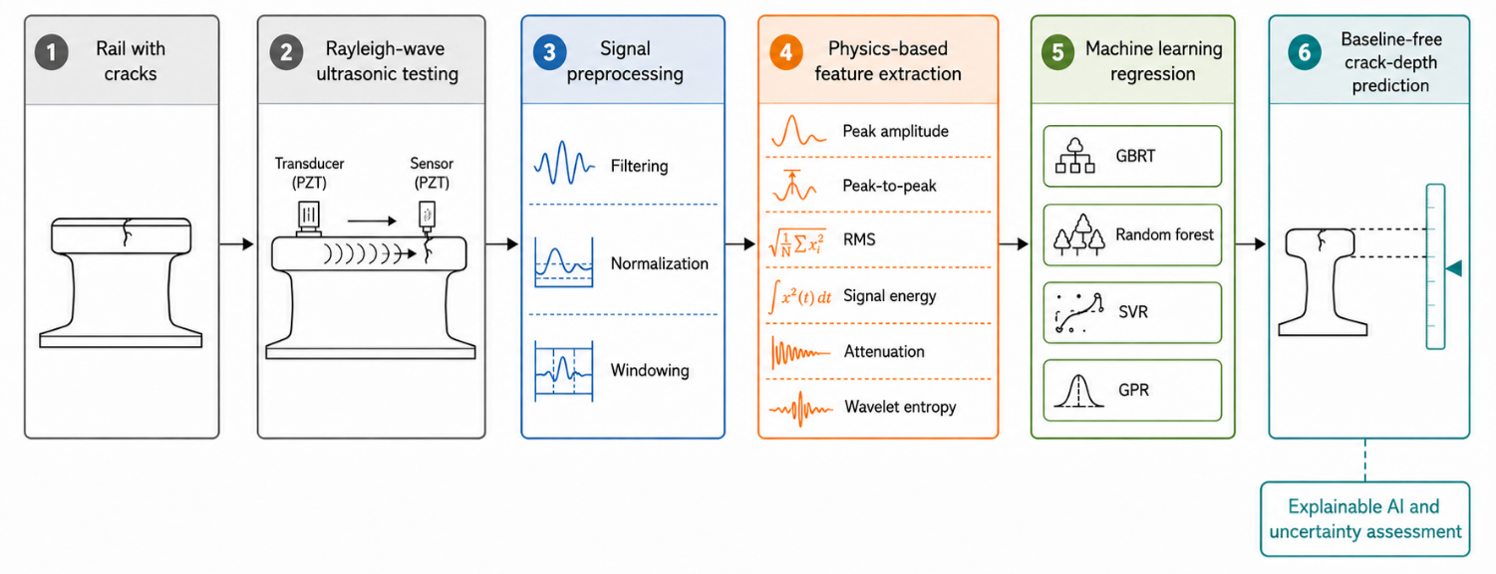
Accurate quantification of crack depth is essential for ensuring the structural integrity and operational safety of railway infrastructure. Conventional ultrasonic inspection techniques primarily focus on defect detection and often require baseline measurements or expert interpretation, limiting their suitability for autonomous structural health monitoring. This study proposes a physics-guided machine learning (ML) framework for baseline-free ultrasonic crack-depth quantification in rail-track structures using ultrasonic guided-wave and data-driven regression models. Rayleigh-wave ultrasonic signals were acquired from 13 rail specimens, comprising three healthy specimens and ten specimens with crack depths ranging from 2 to 20 mm. Each specimen was tested 25 times, resulting in a database of 325 ultrasonic measurements. After signal preprocessing, nine physics-guided damage-sensitive features, including amplitude, energy, attenuation, arrival time, and wavelet-based descriptors, were extracted to characterize crack-induced changes in wave propagation. Four regression algorithms, namely Gradient Boosted Regression Trees (GBRT-LSBoost), Random Forest (RF), Support Vector Regression (SVR), and Gaussian Process Regression (GPR), were evaluated using independent test data and specimen-wise, grouped cross-validation. Model interpretability and robustness were further assessed through feature importance, permutation importance, feature ablation, correlation analysis, and uncertainty quantification. The results show that amplitude and attenuation-based features are the most influential predictors of crack depth, whereas time-of-flight and several wavelet features contribute marginally. Among the four nonlinear ML models, Random Forest achieved the best independent-test performance (R² = 0.961, RMSE = 1.610 mm), closely followed by GBRT-LSBoost (R² = 0.960, RMSE = 1.623 mm) which could be suitable for field deployment under complex and dynamic conditions. Notably, a peak-amplitude-only linear regression baseline achieved lower error (R² = 0.995, RMSE = 0.563 mm), demonstrating the strong approximately linear relationship between transmitted Rayleigh-wave amplitude and prescribed crack depth under the controlled laboratory conditions. The results demonstrate the feasibility of the proposed feature-level physics-guided regression framework under controlled laboratory conditions, while further validation using a larger number of independent specimens and naturally occurring service cracks is required before field deployment.
- Papaelias MP, Roberts C, Davis CL. A review on non-destructive evaluation of rails: state-of-the-art and future development. Proc Inst Mech Eng F J Rail Rapid Transit. 2008;222(4):367-384. doi: 10.1243/09544097JRRT209
- Wilcox P, Pavlakovic B, Evans M, et al. Long range inspection of rail using guided waves. AIP Conf Proc. 2003;657:236-243. doi: 10.1063/1.1570142
- Loveday PW, Long CS, Ramatlo DA. Ultrasonic guided wave monitoring of an operational rail track. Struct Health Monit. 2020;19(6):1666-1684. doi: 10.1177/1475921719893887
- Scruby CB, Drain LE. Laser Ultrasonics: Techniques and Applications. New York: Routledge; 2019. doi: 10.1201/9780203749098
- Rose JL. Ultrasonic Guided Waves in Solid Media. Cambridge: Cambridge University Press; 2014. doi: 10.1017/CBO9781107273610
- Loveday PW. Guided wave inspection and monitoring of railway track. J Nondestruct Eval. 2012;31(4):303-309. doi: 10.1007/s10921-012-0145-9
- Yang Y, Wang P, Song TL, Jiang Y, Zhou WT, Xu WL. Evaluation of the transverse crack depth of rail bottoms based on the ultrasonic guided waves of piezoelectric sensor arrays. Sensors. 2022;22(18):7023. doi: 10.3390/s22187023
- Lian Y, Du F, Xie L, et al. Simulation and experimental research of V-crack testing of rail surfaces based on laser ultrasound. Photonics. 2024;11(10):920. doi: 10.3390/photonics11100920
- Hayashi T, Song WJ, Rose JL. Guided wave dispersion curves for a bar with an arbitrary cross-section, a rod and rail example. Ultrasonics. 2003;41(3):175-183. doi: 10.1016/S0041-624X(03)00097-0
- Setshedi II, Wilke DN, Loveday PW. Feature detection in guided wave ultrasound measurements using simulated spectrograms and generative machine learning. NDT E Int. 2024;143:103036. doi: 10.1016/j.ndteint.2024.103036
- Xu X, Wen Z, Ni Y, Shao B, Ma X, Pan Z. Study on monitoring broken rails of heavy haul railway based on ultrasonic guided wave. Sci Rep. 2024;14:8667. doi: 10.1038/s41598-024-59328-5
- Boris I, Barashok K, Choi Y, Choi Y, Aslam M, Lee J. Machine learning techniques in ultrasonics-based defect detection and material characterization: a comprehensive review. Adv Mech Eng. 2025;17(6). doi: 10.1177/16878132251347390
- Yang Z, Yang H, Tian T, et al. A review on guided-ultrasonic-wave-based structural health monitoring: from fundamental theory to machine learning techniques. Ultrasonics. 2023;133:107014. doi: 10.1016/j.ultras.2023.107014
- Latête T, Gauthier B, Bélanger P. Towards using convolutional neural network to locate, identify and size defects in phased array ultrasonic testing. Ultrasonics. 2021;115:106436. doi: 10.1016/j.ultras.2021.106436
- Tang R, Zhang S, Wu W, Zhang S, Han Z. Explainable deep learning based ultrasonic guided wave pipe crack identification method. Measurement. 2023;206:112277. doi: 10.1016/j.measurement.2022.112277
- Shen Y, Wu J, Chen J, Zhang W, Yang X, Ma H. Quantitative detection of pipeline cracks based on ultrasonic guided waves and convolutional neural network. Sensors. 2024;24(4):1204. doi: 10.3390/s24041204
- Mehtaj N, Banerjee S. Scientific machine learning for guided wave and surface acoustic wave (SAW) propagation: PgNN, PeNN, PINN, and neural operator. Sensors. 2025;25(5):1401. doi: 10.3390/s25051401
- Casartelli A, Lomazzi L, Pinello L, Junges R, Giglio M, Cadini F. Physics-informed machine learning for ultrasonic guided wave full-field reconstruction and damage diagnosis. In: Proceedings of the 15th International Workshop on Structural Health Monitoring. Lancaster: Destech Publications, Inc.; 2025. doi: 10.12783/shm2025/37479
- Barshok K, Choi JI, Lee J. Deep learning-based approach for automatic defect detection in complex structures using PAUT data. Sensors. 2025;25(19):6128. doi: 10.3390/s25196128
- Xiao J, Cui F. Machine learning enhanced characterization of surface defects using ultrasonic Rayleigh waves. NDT E Int. 2023;140:102969. doi: 10.1016/j.ndteint.2023.102969
- Na Y, He Y, Deng B, et al. Advances of machine learning in phased array ultrasonic non-destructive testing: a review. AI. 2025;6(6):124. doi: 10.3390/ai6060124
- Vasilache MM, Tayong RB, Velisavljevic V. Comprehensive review on the use of machine learning techniques applied to the ultrasound data for the characterisation of porosity across carbon fibre reinforced polymer layers. Appl Compos Mater. 2025;32(4):1315-1339. doi: 10.1007/s10443-025-10342-4
- Bai J, Wu D, Shelley T, et al. A comprehensive survey on machine learning driven material defect detection. ACM Comput Surv. 2025;57(11):1-36. doi: 10.1145/3730576
- Tunukovic V, McKnight S, Pierce SG, et al. Application of machine learning techniques for defect detection, localisation, and sizing in ultrasonic testing of carbon fibre reinforced polymers. In: BINDT Aerospace Event 2023. Glasgow, UK; 2023. Accessed September 3, 2026. https://pureportal.strath.ac.uk/en/publications/application-of-machine-learning-techniques-for-defect-detection-l/
- Wang Y, Miao B, Zhang Y, Huang Z, Xu S. Review on rail damage detection technologies for high-speed trains. Appl Sci. 2025;15(14):7725. doi: 10.3390/app15147725
- Wu Y, Zhu X. Rail defect detection using ultrasonic A-scan data and deep autoencoder. Transp Res Rec. 2023;2677(7):62-73. doi: 10.1177/03611981221150923
- Islam MA, Olm G. Deep learning techniques to detect rail indications from ultrasonic data for automated rail monitoring and maintenance. Ultrasonics. 2024;140:107314. doi: 10.1016/j.ultras.2024.107314
- Zhang Y, Dang DZ, Wang YW, Ni YQ. Damage identification for railway tracks using ultrasound guided wave and hybrid probabilistic deep learning. Constr Build Mater. 2024;418:135466. doi: 10.1016/j.conbuildmat.2024.135466
- Lu XL, Gao B, Woo WL, Xiao X, Zhan D, Huang C. Hybrid physics machine learning for ultrasonic field guided 3D generation and reconstruction of rail defects. NDT E Int. 2024;146:103174. doi: 10.1016/j.ndteint.2024.103174
- Lv C, Wang P, Sun H. Deep-learning-based ultrasonic guided wave detection of turnout switch rail cracks. Sens Mater. 2026;38(2):857-870. doi: 10.18494/SAM5934
- Shukla K, Di Leoni PC, Blackshire J, Sparkman D, Karniadakis GE. Physics-informed neural network for ultrasound nondestructive quantification of surface breaking cracks. J Nondestruct Eval. 2020;39(3):61. doi: 10.1007/s10921-020-00705-1
- Shukla K, Jagtap AD, Blackshire JL, Sparkman D, Karniadakis GE. A physics-informed neural network for quantifying the microstructural properties of polycrystalline nickel using ultrasound data: a promising approach for solving inverse problems. IEEE Signal Process Mag. 2022;39(1):68-77. doi: 10.1109/MSP.2021.3118904
- Pérez E, Ardıç CE, Çakıroğlu O, et al. Integrating AI in NDE: techniques, trends, and further directions. NDT E Int. 2025;156:103442. doi: 10.1016/j.ndteint.2025.103442
- Yang L, Liu P, Yi K, et al. Defect-parameterized physics-informed neural network for forward and inverse modeling of laser ultrasonic wavefield. Ultrasonics. 2026;161:107952. doi: 10.1016/j.ultras.2026.107952
- Casartelli A, Lomazzi L, Giglio M, Cadini F. Physics-informed neural network for baseline-free damage diagnosis using ultrasonic guided waves. e-J Nondestruct Test. 2026;31(8). doi: 10.58286/34001
- Guo Z, Li Z, Zeng K, Lu X, Ye J, Wang Z. Asymmetric hierarchical acoustic absorber at exceptional point: a loss-induced eigenvalues degeneracy system. Phys Rev B. 2024;109(10):104113. doi: 10.1103/PhysRevB.109.104113
- Guo Z, Du L, Yang Z, et al. Switchable bidirectional sound absorption via exceptional point modulation in acoustic metastructures with interleaved resonator coupling. Adv Sci. 2025;12(44):e08951. doi: 10.1002/advs.202508951
- Guo Z, Lei Z, Zeng K, et al. Non-integer-dimensional architected materials enabling synergistic acoustic, mechanical, and fluid coupling. Mater Horiz. 2026;13(2):748-762. doi: 10.1039/D5MH01768H
- Li Z, Wang X, Wang Z, et al. Emerging acousto-mechanical metamaterials: from physics-guided design to coupling-driven performance. Mater Today. 2025;89:151-171. doi: 10.1016/j.mattod.2025.06.029
- Singh SD, Singh MD, Singh AK, Kumar S. AI-enhanced and other load modelling in modern power systems: a comprehensive review of advances, challenges, and future directions. Rev Int Metod Numer Calc Dis Ing. 2025;41(4):19. doi: 10.23967/j.rimni.2025.10.71136
- Wang Z, Zheng C, Wang L, Gu J, Jing L, Lai X. Optimal design of composite grid/skin structures based on deep learning and Double-Double layup strategy. Aerosp Sci Technol. 2024;147:109030. doi: 10.1016/j.ast.2024.109030
- Peng J, Ye R, Lan S, Xiao T, Xu C, Song Y. Detection of small rod-end joint bearings via deep feature fusion and confidence propagation clustering. Rev Int Metod Numer Calc Dis Ing. 2024;40(3):6. doi: 10.23967/j.rimni.2024.10.56511
- Masurkar F, Cui F. A fully optical laser based system for damage detection and localization in rail tracks using ultrasonic Rayleigh waves: a numerical and experimental study. In: Proceedings of the 9th International Conference of the Asian Society for Precision Engineering and Nanotechnology (ASPEN 2022). Singapore: Research Publishing; 2022:717-722. doi: 10.3850/978-981-18-6021-8_OR-15-0042.html
- Khalil A, Masurkar F, Abdul-Ameer A. Estimating the reliability of the inspection system employed for detecting defects in rail track using ultrasonic guided waves. In: Al Marri K, Mir FA, David SA, Al-Emran M, eds. BUiD Doctoral Research Conference 2023: Multidisciplinary Studies. Vol 473. Cham: Springer; 2024:190-202. doi: 10.1007/978-3-031-56121-4_19
- Masurkar F, Ng KM, Tse PW, Yelve NP. Interrogating the health condition of rails using the narrowband Rayleigh waves emitted by an innovative design of non-contact laser transduction system. Struct Health Monit. 2021;20(5):2678-2693. doi: 10.1177/1475921720967600
- Masurkar F, Rostami J, Tse PW. Design of an innovative and self-adaptive-smart algorithm to investigate the structural integrity of a rail track using Rayleigh waves emitted and sensed by a fully non-contact laser transduction system. Appl Acoust. 2020;166:107354. doi: 10.1016/j.apacoust.2020.107354
- Ng KM, Masurkar F, Tse PW, Yelve NP. Design of a new optical system to generate narrowband guided waves with an application for evaluating the health status of rail material. Opt Lett. 2019;44(23):5695-5698. doi: 10.1364/OL.44.005695